
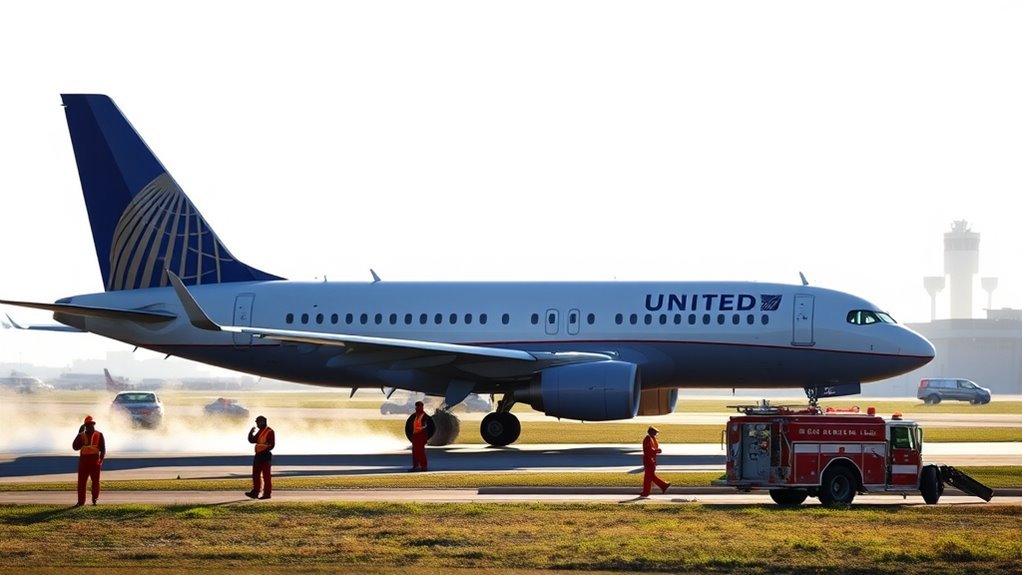
Last Updated on September 11, 2026 by Tyler Morgan
United Airlines can reasonably be considered a safe major U.S. carrier based on its current regulatory status, required safety-management program, and participation in international operational auditing. However, no airline is incident-free, and United has faced recent investigations and oversight concerns that deserve clear context. The best answer comes from FAA findings, NTSB investigations, audit standards, and confirmed records rather than headlines or unsupported airline rankings.
Quick Answer
Yes. Based on current public evidence, United Airlines can reasonably be considered a safe major U.S. carrier. The FAA’s 2024 review found no significant safety issues, and United operates under FAA and IOSA-based oversight. Still, recent incidents and a 2026 oversight audit show why safety should be judged through current investigations, not slogans.
Key Takeaways
- The FAA completed an enhanced review of United in October 2024 and said it found no significant safety issues.
- United maintains an FAA-approved Safety Management System and, as an IATA member, must remain registered under the IOSA audit program.
- A May 2026 accident involving United Flight 169 remains under NTSB investigation, so no final cause should be assumed.
- A February 2026 DOT OIG report identified weaknesses in the FAA’s resources and processes for overseeing United’s maintenance practices.
- Raw incident totals cannot fairly rank United against Delta, American, or another large carrier without consistent definitions and exposure data.
How Safe Is United Airlines?
United is subject to the same extensive federal operating, maintenance, training, and certification requirements that apply to other large U.S. airlines operating under Part 121. The FAA also maintains certificate-management offices responsible for overseeing United’s flight operations, aircrew training, maintenance program, and repair-station activities.
In October 2024, the FAA completed a Certificate Holder Evaluation Program review of United. The agency said the review did not identify any significant safety issues and ended the enhanced approval process that had affected United’s ability to add aircraft and services.
That result is meaningful, but it is not a promise that no future accident, maintenance problem, diversion, or regulatory issue will occur. Airline safety depends on layers of protection, including aircraft maintenance, crew training, dispatch decisions, air traffic control, airport conditions, manufacturer instructions, employee reporting, and the ability to learn from events.
The most supportable conclusion is that United operates within the highly regulated U.S. airline system and has substantial safety controls, but its performance should still be evaluated through current evidence and completed investigations.
Note: A diversion, precautionary landing, mechanical return, or emergency declaration does not automatically prove an airline is unsafe. These actions may show that a crew identified a potential problem and used established procedures to reduce risk.
What Affects United’s Safety Rating?
There is no single official FAA score that ranks United from safest to least safe. Government agencies certify, inspect, investigate, and enforce regulations, while private websites may create their own safety scores. Those private ratings can provide a summary, but their methods, time periods, and treatment of incidents may differ.
A more reliable assessment considers several separate forms of evidence:
- FAA certification and surveillance: Inspectors oversee flight operations, training, maintenance, regulatory compliance, and corrective actions.
- Safety Management System: FAA rules require large scheduled airlines to use a formal process for identifying hazards, assessing risk, checking whether controls work, and improving procedures.
- IOSA registration: United is an IATA member, and IATA requires its members to maintain registration under the IATA Operational Safety Audit program.
- NTSB investigations: The NTSB investigates qualifying U.S. accidents and serious incidents, determines probable cause when an investigation is complete, and may issue safety recommendations.
- Enforcement history: Proposed or completed FAA enforcement actions can reveal compliance concerns, although a proposal should not be described as a final finding.
- Operational exposure: A carrier operating thousands of daily flights has more opportunities for reportable events than a small airline, so raw totals need a meaningful denominator.
IOSA is an internationally recognized audit of an airline’s operational management and control systems. It is useful evidence of structured processes, but it is not a guarantee against accidents. Likewise, passing an FAA review means the regulator did not identify significant issues within that review’s scope; it does not eliminate all future risk.
How United Compares With Other U.S. Airlines
United, Delta, and American all operate large networks under the U.S. Part 121 regulatory system. It is not responsible to claim that one has a better current “incident rate” without defining the events counted, the time period, the number of departures or flight hours, and whether regional partners are included.
News reports can also create a distorted comparison. A large airline may generate more incident headlines because it operates more aircraft and flights. At the same time, size should not be used to dismiss a pattern that regulators or investigators consider important. Each event should be judged by its severity, cause, corrective action, and exposure-adjusted data.
| Evidence | Useful for Comparison? | Limitation |
|---|---|---|
| Final accident rate per departure or flight hour | Yes | Must use the same definitions, period, and operating scope. |
| Completed FAA or NTSB findings | Yes | A finding may concern one event or a limited review rather than the airline’s entire operation. |
| Raw incident count | Usually no | Larger carriers operate more flights, and “incident” may include events of very different severity. |
| Social-media reports or passenger reviews | No | They may describe real experiences but do not provide a controlled safety comparison. |
| Private safety score | Sometimes | The result depends on the publisher’s methodology and should not be confused with an FAA ranking. |
The available evidence supports describing United as a major carrier with established regulatory and safety-management controls. It does not support declaring United categorically safer or less safe than Delta or American from raw public incident counts alone.
Recent Safety Reviews and Improvements at United Airlines
United reports that its FAA-approved Safety Management System uses hazard identification, risk assessment, safety assurance, training, employee reporting, data analysis, and corrective-action tracking. The airline also reports voluntary, non-punitive safety-reporting programs for flight, dispatch, ground, inflight, and technical operations.
Those programs are important, but a balanced review must also include recent scrutiny and unresolved investigations:
- FAA review completed in October 2024: The FAA said its Certificate Holder Evaluation Program review did not identify significant safety issues and concluded the enhanced approval process applied to United.
- DOT OIG audit issued in February 2026: The Department of Transportation Office of Inspector General found that FAA staffing shortages, workforce-planning problems, virtual inspection practices, and limits on access to airline safety data hindered effective oversight of United’s maintenance practices. The report made six recommendations to the FAA.
- Flight 169 accident in May 2026: According to the NTSB’s preliminary information, a United Boeing 767 struck a light pole beside the New Jersey Turnpike while approaching Newark. The aircraft landed, and all passengers and crew deplaned without injury. A truck driver sustained a minor injury, and the aircraft had substantial damage. The investigation remains open.
- Proposed FAA civil penalty in July 2026: The FAA proposed a $255,000 penalty, alleging that United allowed a flight attendant to perform safety-sensitive duties without completing required return-to-duty steps. United was allowed to respond, so the proposal was not a final determination when announced.
- Continued training and reporting: United says it uses recurrent technical training, simulated scenarios, voluntary employee reports, root-cause review, and data analysis to identify emerging hazards and improve procedures.
Warning: Do not treat preliminary NTSB information, an open investigation, or a proposed FAA penalty as a final cause or completed legal finding. Conclusions may change as investigators gather records, inspect equipment, interview personnel, and analyze operational data.
The 2024 FAA review and the 2026 DOT OIG report are not contradictory because they examined different questions. The FAA review evaluated United through a certificate-holder review and reported no significant safety issues. The OIG audit evaluated whether the FAA had enough resources, planning, inspection capability, and data access to oversee United’s maintenance practices effectively.
What United Passengers Should Know
You do not need to become an aviation investigator before booking a flight. However, you should understand what information is meaningful and what practical actions remain under your control.
| Factor | What It Shows | What It Does Not Prove |
|---|---|---|
| FAA oversight | The airline must meet federal operating, training, and maintenance requirements. | That no compliance problem or accident can occur. |
| IOSA registration | Operational management and control systems are audited against an international standard. | That every flight or aircraft is risk-free. |
| Emergency landing or return | The crew responded to a condition that required caution or further inspection. | That a crash was narrowly avoided or that the airline is generally unsafe. |
| Delay or cancellation | Weather, maintenance, crew availability, air traffic, or another operational limit affected the schedule. | A direct measure of accident risk. |
| Aircraft age | How long the aircraft has been in service. | Its maintenance condition or safety by itself. |
Check the Operating Carrier
A ticket sold by United may include a flight marketed as United Express but operated by a regional airline. The operating carrier appears during booking and on your itinerary. When researching a specific flight, check the operating airline rather than relying only on the United flight number or brand.
Use Completed Findings, Not Viral Posts
Look for final NTSB reports, FAA statements, airworthiness directives, and completed enforcement actions. A video or passenger account may identify a real event, but it rarely provides the maintenance history, cockpit data, weather information, crew decisions, or engineering analysis needed to determine cause.
Keep Your Seat Belt Fastened
One of the most useful steps you can take is to remain belted whenever you are seated. The FAA advises passengers to keep their seat belts fastened because unexpected turbulence can occur even when the sky appears clear. Listen to crew instructions, review the safety card, and keep loose belongings secured.
Pro Tip: When a safety headline concerns your planned route, search the FAA or NTSB website using the flight number and event date. Check whether the information is preliminary, whether injuries occurred, and whether investigators have issued a final cause.
Frequently Asked Questions
Is United Airlines safe to fly in 2026?
Based on current public regulatory evidence, United can reasonably be considered safe to fly. The FAA’s completed 2024 review reported no significant safety issues, and United operates with an FAA-approved Safety Management System and IOSA registration requirements. Recent investigations and oversight concerns should still be followed until final findings are available.
Is United safer than Delta or American Airlines?
There is no simple official FAA ranking that establishes United as safer or less safe than Delta or American. A valid comparison would need consistent accident definitions, operating scope, departures or flight hours, regional-carrier treatment, and a defined time period. Raw incident totals or headlines do not provide that comparison.
Do recent United incidents mean the airline is unsafe?
Not automatically. The seriousness, frequency, cause, exposure level, and corrective action all matter. Some events are precautionary responses, while others qualify as accidents or serious incidents. Open investigations should not be assigned a cause before the NTSB or another responsible authority completes its work.
Is a United Express flight operated by United Airlines?
Not always. United Express is a brand used for regional flights that may be operated by a partner airline. Your booking confirmation identifies the operating carrier. Use that carrier’s name when checking its aircraft, operating record, or regulatory information.
Does an older United aircraft mean it is less safe?
Aircraft age alone does not determine safety. Maintenance status, required inspections, component limits, modifications, airworthiness directives, operating history, and regulatory compliance are more meaningful. An older aircraft can remain in service when it continues to meet applicable airworthiness and maintenance requirements.
Other Common United Travel Questions
Does United offer Wi-Fi on most flights?
United offers inflight connectivity on much of its fleet, but availability and performance can depend on the aircraft, route, equipment status, and region. Check the amenities shown for your flight before departure, and remember that connectivity can be unavailable even on an equipped aircraft.
Can I track my checked baggage online?
Yes. United’s online bag tracker lets you search using an eligible recent trip, confirmation information, or bag-tag details. Tracking updates show scan information but may not represent the bag’s exact physical location at every moment.
What is United’s baggage fee policy?
Checked-bag charges depend on the route, cabin, fare, ticketing date, MileagePlus status, credit-card benefits, bag weight, and other factors. Use United’s checked-bag fee calculator for your itinerary instead of relying on a fixed general price.
Does United have a frequent-flyer program?
Yes. United’s MileagePlus program allows eligible members to earn and redeem miles and qualify for Premier benefits. Earning rules, award pricing, partner eligibility, and status requirements can change, so review the current MileagePlus terms before making a booking decision based on expected rewards.
How early should I arrive for an international United flight?
Arriving about three hours before an international departure is a useful general target, especially when checking bags or traveling during a busy period. Exact check-in, bag-drop, document-check, and boarding deadlines vary by airport and destination, so confirm the requirements for your departure airport before traveling.
Conclusion
United Airlines can reasonably be viewed as safe by current major-airline standards, but the strongest answer is more measured than a simple rating. The FAA’s completed 2024 review found no significant safety issues, while United maintains required safety-management controls and IOSA registration. At the same time, the 2026 NTSB investigation, DOT OIG oversight findings, and proposed FAA enforcement action deserve transparent coverage.
For your travel decision, focus on completed regulator findings, the operating carrier shown on your ticket, and reliable safety instructions. Do not treat every diversion as proof of danger, but do not dismiss serious events before investigators complete their work. Keep your seat belt fastened while seated, follow crew directions, and use official sources when a new headline raises concern.
Sources
- Federal Aviation Administration: General Statements — FAA’s October 2024 United Airlines review result and conclusion of enhanced oversight.
- National Transportation Safety Board: United Flight 169 Investigation — preliminary information about the May 3, 2026 Newark accident and investigation status.
- DOT Office of Inspector General Report AV2026014 — February 2026 findings about FAA resources and processes for overseeing United’s maintenance practices.
- FAA Proposed Civil Penalty Against United Airlines — July 2026 allegation concerning drug-and-alcohol return-to-duty requirements.
- IATA Operational Safety Audit Program — IOSA purpose, registration requirements, and risk-based auditing framework.
- United Airlines Safety Management System — company-reported safety-management, employee-reporting, training, and risk-control processes.
