
Last Updated on September 10, 2026 by Daniel Globe
Parkinson’s disease (PD) is a progressive neurological condition that affects movement and can also cause changes in mood, sleep, thinking, blood pressure, and other body functions. Common movement symptoms include slowness of movement, stiffness, tremor, and problems with walking or balance. Because symptoms vary widely from one person to another, the safest type of exercise also varies.
Quick Answer
Neither hiking nor bicycling is automatically safer for everyone with Parkinson’s. For someone with significant fall risk or freezing of gait, stationary or recumbent cycling often has a lower balance demand than walking. Hiking may suit someone with stable gait on easy trails, while outdoor two-wheel cycling requires sufficient balance, judgment, reaction time, and bike control.
Exercise is an important part of Parkinson’s management. Current Parkinson’s Foundation and American College of Sports Medicine exercise recommendations encourage a mix of aerobic activity, strength training, stretching, and balance, agility, and multitasking exercises. The goal is not simply to pick the “best” activity but to choose forms of exercise that are effective, enjoyable, and safe for the person’s current abilities.
The risk of Parkinson’s increases with age, although young-onset Parkinson’s can occur before age 50. More than 10 million people worldwide are estimated to live with the disease, according to the Parkinson’s Foundation. There is no single exercise plan that works for all of them.
Key Takeaways
- Regular exercise can improve fitness, mobility, strength, balance, and several motor and non-motor symptoms of Parkinson’s disease.
- Evidence is strong for aerobic exercise and walking programs, but research on ordinary outdoor hiking specifically is limited.
- Stationary or recumbent cycling can be a useful aerobic choice when walking creates substantial fall or freezing-of-gait concerns.
- Outdoor bicycling is different from stationary cycling because it adds steering, mounting, traffic, obstacle, reaction-time, and crash risks.
- People with recurrent falls, freezing, dizziness, fainting, or major balance changes should obtain individualized advice from a Parkinson-trained physical therapist or medical professional before exercising independently.
Medical safety: This article provides general education, not an individual exercise prescription. Parkinson’s symptoms, medications, heart conditions, blood-pressure problems, cognition, vision, and fall history can change what is safe. Do not change medication timing or dosage for exercise without guidance from the clinician who manages your treatment.
Disclosure: As an Amazon Associate I earn from qualifying purchases. Some links on this page are affiliate links, at no extra cost to you.
Benefits of Exercise for Parkinson’s Patients
Exercise is supported as part of Parkinson’s care because it can improve physical fitness and functional ability. The American Physical Therapy Association clinical practice guideline for Parkinson disease gives strong recommendations for aerobic exercise, resistance training, balance training, gait training, and community-based exercise.
Aerobic activities such as brisk walking, stationary cycling, swimming, dancing, or other continuous rhythmic movement can improve cardiovascular fitness. Resistance exercise can improve strength and power, while specific balance and gait training can target mobility problems that aerobic activity alone may not fully address.
Exercise may also help some non-motor symptoms, including mood and overall quality of life. However, response varies, and exercise should be viewed as part of treatment rather than a replacement for medication, rehabilitation, or other medical care.
Note: Exercise has many proven functional benefits in Parkinson’s disease, but it should not be described as a proven cure or as definitively slowing the underlying disease. Research into possible disease-modifying effects continues.
Current Exercise Recommendations for Parkinson’s Disease
The Parkinson’s Foundation and American College of Sports Medicine updated their Parkinson’s exercise recommendations in 2026. They advise working toward about 150 minutes of moderate-to-vigorous exercise each week while including several types of training rather than relying on one activity alone.
- Aerobic activity: about 3 days per week for at least 30 minutes per session at moderate-to-vigorous effort.
- Strength training: 2 to 3 non-consecutive days per week, generally for at least 30 minutes per session.
- Stretching: 2 to 3 days per week, with daily practice often useful.
- Balance, agility, and multitasking: 2 to 3 days per week, with appropriate daily integration when safe.
The 2026 Parkinson’s exercise recommendations call for 150 minutes of moderate-to-vigorous exercise per week while combining aerobic, strength, flexibility, and balance-focused activity.
The recommendations also advise exercising during effective medication or “on” periods when applicable and modifying the program as physical or cognitive function changes. A physical therapist who understands Parkinson’s can assess walking, freezing, balance, transfers, endurance, and the need for supervision.
Safety Considerations for Parkinson’s Patients
Safety depends more on the individual’s symptoms than on the name of the activity. Parkinson’s can affect balance, posture, turning, reaction time, attention, and the ability to begin or continue walking. Falls may become more common as the condition progresses.
Before choosing hiking or bicycling, consider recent falls, near-falls, freezing of gait, dizziness, medication fluctuations, fatigue, vision, cognition, and whether the person can safely recover from a stumble or sudden stop.
Freezing of Gait and Fall Risk
Freezing of gait can make the feet feel temporarily stuck to the floor, particularly when starting, turning, moving through narrow spaces, or approaching obstacles. An uneven trail can increase the consequences of a freezing episode because roots, rocks, slopes, and drop-offs leave less room for recovery.
The APTA Parkinson disease guideline notes that cycling can be a safer aerobic mode than treadmill walking for some people who have a high fall risk or freezing of gait. In practice, that advantage is clearest with a stationary, recumbent, or otherwise well-supported cycle. It should not be interpreted to mean that riding a two-wheel bicycle outdoors is automatically safer.
Dizziness and Orthostatic Hypotension
Parkinson’s can affect the autonomic nervous system and contribute to orthostatic hypotension, a drop in blood pressure after standing. Symptoms may include lightheadedness, weakness, blurred vision, fainting, or falls. Parkinson’s medications and other medications can sometimes contribute.
Someone who becomes dizzy when standing, mounting a bicycle, climbing a hill, or exercising in hot weather should discuss the problem with a healthcare professional. Staying appropriately hydrated and changing positions slowly can help some people, although individual fluid and salt advice may differ for people with heart, kidney, or blood-pressure conditions.
Warning: Recurrent falls, fainting, new or worsening dizziness, severe freezing, or an inability to mount, dismount, stop, or turn safely are reasons to pause independent hiking or outdoor bicycling and obtain professional assessment.
Hiking as an Exercise Option for Parkinson’s Patients
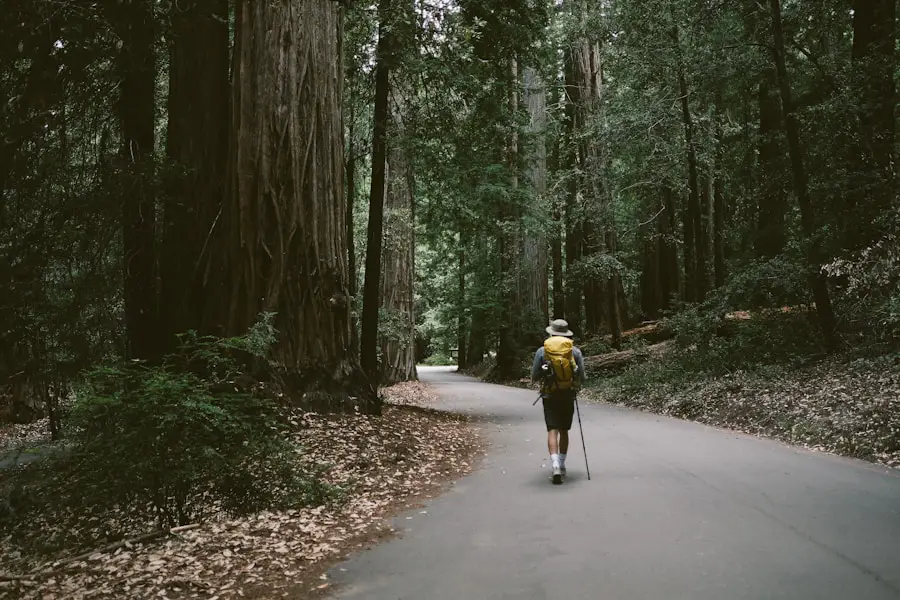
Hiking is essentially outdoor walking over terrain that may range from smooth and flat to steep, rocky, or highly uneven. Walking is well studied in Parkinson’s disease, and a 2026 systematic review and meta-analysis of voluntary walking interventions supports walking as a useful exercise approach. However, research specifically showing that recreational hiking provides unique Parkinson’s benefits is limited.
That distinction is important. A paved nature trail and a rocky mountain trail place very different demands on balance, attention, leg strength, and reaction time.
| Evidence | Good evidence supports walking and gait-focused exercise. Direct evidence for ordinary outdoor hiking in Parkinson’s is much more limited. |
| Aerobic Benefit | Brisk trail walking can contribute to aerobic exercise when the pace and duration are appropriate. |
| Balance Demand | Uneven ground increases balance and foot-placement demands. That can make hiking inappropriate when fall risk is high. |
| Social and Outdoor Value | A pleasant trail, partner, or walking group may make regular exercise more enjoyable and easier to maintain. |
| Best Fit | People with reasonably stable walking, manageable symptoms, adequate endurance, and access to a trail matched to their ability. |
When Hiking May Be a Reasonable Choice
Hiking may work well for someone who walks independently or safely with an appropriate aid, has no recent pattern of unexplained falls, can manage turns and surface changes, and understands personal limits.
Start with a short, familiar, well-maintained route. Flat or gently rolling trails with firm surfaces are easier to manage than steep descents, loose gravel, wet rocks, roots, narrow ledges, or trails far from assistance.
When Hiking Requires Extra Caution
A person with frequent freezing, repeated falls, severe postural instability, unpredictable “off” periods, significant dizziness, or cognitive problems that interfere with route-finding or hazard awareness may need a safer walking environment or another form of aerobic exercise.
Pro Tip: Trail difficulty should be based on the hardest part of the route, not the average. A mostly flat trail with one steep, rocky descent may still be unsuitable for someone whose balance worsens downhill.
Bicycling as an Exercise Option for Parkinson’s Patients
Cycling is specifically included among the aerobic activities recommended for people with Parkinson’s. A systematic review and meta-analysis of bicycling in Parkinson’s disease found beneficial effects across several Parkinson-related outcomes, although programs varied in cycling style, intensity, and study design.
Cycling can raise heart rate and train the legs without the repeated impact of walking. The seated position of a stationary or recumbent bike also reduces some of the balance demands involved in walking over uneven ground.
That does not make every bicycle equally safe.
Stationary and Recumbent Cycling
A stationary cycle removes traffic, road hazards, steering, and the need to remain upright while moving through space. A recumbent exercise bike provides additional back support and a lower seating position, which can make mounting and balance easier for some people.
These options may be especially useful when someone needs aerobic training but walking produces substantial freezing or fall concerns. They can also make supervision easier.
Adaptive Tricycles
Three-wheel cycles offer greater lateral stability than a conventional two-wheel bicycle, but they still require safe transfers, steering, braking, visual attention, and the ability to respond to obstacles. A stable cycle does not remove every outdoor risk.
Outdoor Two-Wheel Bicycling
Outdoor bicycling demands balance, steering, braking, turning, mounting, dismounting, visual scanning, judgment, and rapid reactions. Traffic, pedestrians, potholes, curbs, wet surfaces, and unexpected stops add further challenges.
A person who cycles well in a clinic or on a stationary bike should not assume that outdoor two-wheel riding is equally safe. When there is uncertainty, a physical therapist or other qualified rehabilitation professional can help assess the movement demands involved.
Comparison of Hiking and Bicycling for Parkinson’s Patients
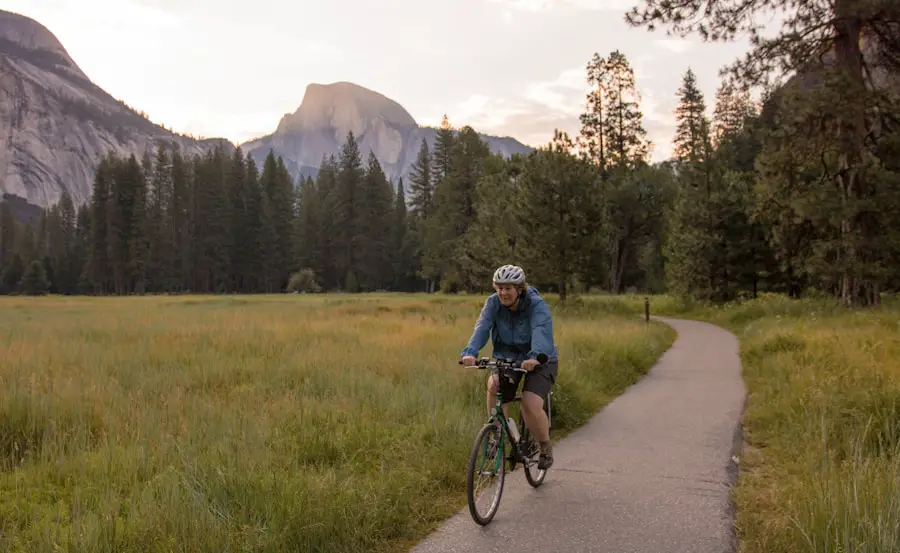
The safer choice depends on the form of cycling, the type of trail, and the person’s symptoms. Comparing a rocky hike with a stationary bike strongly favors the bike for fall protection. Comparing an easy paved walk with outdoor road cycling may produce the opposite answer for a person who no longer has safe bicycle control.
| Factor | Hiking | Cycling |
| Fall risk | Can rise sharply on roots, rocks, slopes, loose surfaces, or narrow trails. | Low on a properly used stationary/recumbent bike; potentially substantial on an outdoor two-wheel bike. |
| Freezing of gait | May interrupt walking, particularly near obstacles, turns, or narrow spaces. | Stationary cycling may avoid some walking-related freezing problems. |
| Balance demand | Moderate to high depending on terrain. | Low on stationary/recumbent equipment; high enough to be a concern on a conventional outdoor bicycle. |
| Reaction-time demand | Usually lower on an easy, quiet trail but increases with technical terrain. | High outdoors because stopping distances and travel speed are greater. |
| Aerobic training | Good when walking pace is high enough and terrain is manageable. | Good and easy to regulate on stationary equipment. |
| Best suited for | People with stable gait who enjoy walking outdoors and can safely manage the selected trail. | Stationary/recumbent cycling can suit a wide range of abilities; outdoor cycling requires additional balance and bike-handling skills. |
For a person with substantial fall risk or freezing of gait, stationary or recumbent cycling is often the more practical aerobic choice. For someone with stable walking but declining bicycle control, an easy hike or level nature walk may be safer than outdoor cycling.
Tips for Safe Hiking and Bicycling for Parkinson’s Patients
Before Either Activity
- Discuss major changes in activity with a healthcare professional when Parkinson’s symptoms, cardiovascular conditions, recurrent falls, dizziness, or other medical issues could affect safety.
- Consider a baseline assessment with a physical therapist experienced in Parkinson’s disease.
- When medications produce distinct “on” and “off” periods, plan exercise for a reliably mobile period when possible, without independently changing medication doses.
- Start below the maximum distance or intensity you think you can manage.
- Warm up gradually and allow time for a cool-down.
- Carry appropriate identification, communication, medication, water, and emergency information when exercising away from home.
- Avoid pushing through dizziness, near-fainting, unusual confusion, or sudden deterioration in movement.
Safe Hiking Checklist
- Begin on a short, familiar, well-maintained route.
- Check elevation, trail surface, weather, and turnaround points before leaving.
- Choose footwear with secure fit and dependable traction.
- Use a mobility aid or trekking poles only when they are appropriate for the individual’s balance and have been practiced safely.
- Hike with a capable companion when falls, freezing, fatigue, or navigation could be concerns.
- Avoid rushing across roots, rocks, stream crossings, steep grades, and loose surfaces.
- Take breaks before fatigue noticeably changes posture or foot clearance.
Safe Cycling Checklist
- Start with a stationary or recumbent bike when balance is uncertain.
- Make sure the seat allows safe mounting, dismounting, and pedaling without excessive reaching.
- For outdoor riding, wear a properly fitted bicycle helmet.
- Choose protected, low-traffic routes with predictable surfaces.
- Avoid outdoor two-wheel riding when stopping, steering, looking over the shoulder, or getting a foot down quickly is unreliable.
- Consider a tricycle or other adaptive cycle when professionally recommended, while remembering that outdoor hazards still remain.
- Do not ride outdoors alone when symptoms could make a fall, freezing episode, or sudden “off” period difficult to manage.
Use Effort, Not Just Heart Rate
Parkinson’s and some medications can affect the normal heart-rate response to exercise. The 2026 Parkinson’s recommendations specifically identify blunted heart-rate response as a possible consideration during aerobic exercise. A clinician may therefore use perceived exertion, the talk test, heart rate, or a combination of measures when setting an appropriate intensity.
A simple practical rule is that moderate exercise should feel purposeful and noticeably harder than rest while still allowing some conversation. Individual targets may need to be different for someone with heart disease, autonomic dysfunction, or significant deconditioning.
Progress Gradually
Someone beginning with a 10- or 15-minute walk or stationary ride does not need to reach the full weekly target immediately. Duration, frequency, resistance, speed, and terrain can be increased one step at a time as tolerance improves.
Pro Tip: Consistency is more useful than choosing an activity that is so difficult or risky that it cannot be repeated. A safe stationary ride completed regularly may provide more value than an ambitious trail outing that leads to exhaustion or a fall.
Know When to Stop
Stop the activity and move to a safe position if you develop marked dizziness, feel faint, become unusually unsteady, experience a sudden loss of coordination, or cannot safely continue the movement. Chest pain, fainting, severe breathing difficulty, or new sudden neurological symptoms require prompt medical evaluation; suspected stroke symptoms are an emergency.
Conclusion and Recommendations
Both hiking and bicycling can contribute to an active life with Parkinson’s disease, but neither activity is universally safer. The specific version of the activity matters.
For someone with freezing of gait or a high risk of falling while walking, a stationary or recumbent bicycle may provide aerobic exercise with less balance demand. For someone who walks steadily but cannot reliably balance, steer, brake, or dismount from a bicycle, a short, level hike or nature walk may be the safer outdoor choice.
Outdoor two-wheel cycling should not be treated as equivalent to stationary cycling, and rugged hiking should not be treated as equivalent to ordinary walking. Trail conditions, previous falls, cognition, dizziness, medication response, endurance, and the availability of a companion all matter.
The safest approach is to match the exercise to current abilities, progress gradually, and reassess the plan as Parkinson’s changes. A Parkinson-trained physical therapist can help identify the right combination of aerobic activity, strength, balance, gait, and flexibility training.
For Parkinson’s patients who have already determined that hiking is an appropriate activity, practical trail gear can also make an outing more enjoyable. This article on compact binoculars for hiking covers one optional piece of recreational hiking equipment; it should not be used as medical or fall-prevention guidance.
Love travel? Join Our Facebook Community
Frequently Asked Questions
What are the benefits of hiking for Parkinson’s patients?
Hiking can provide aerobic activity, walking practice, outdoor recreation, and social engagement when the terrain is appropriate. However, most Parkinson-specific evidence relates to walking and gait exercise rather than recreational hiking itself. Uneven trails may also increase fall risk.
What are the benefits of bicycling for Parkinson’s patients?
Cycling can improve aerobic fitness and leg conditioning, and research supports cycling as a useful exercise option for many people with Parkinson’s disease. Stationary cycling can provide these benefits without the traffic and many of the balance demands of outdoor riding.
Is hiking safe for Parkinson’s patients?
It can be for people whose gait and balance are suitable for the chosen trail. Start with firm, predictable terrain and consider a companion. Frequent falls, severe freezing, marked postural instability, or dizziness require additional caution and professional assessment.
Is bicycling safe for Parkinson’s patients?
Stationary or recumbent cycling can be a relatively stable form of aerobic exercise. Outdoor bicycling requires additional balance, steering, braking, reaction time, and awareness, so its safety must be judged separately.
Which activity is safer for Parkinson’s patients, hiking or bicycling?
There is no universal winner. For a person with high fall risk or freezing of gait, stationary or recumbent cycling often reduces balance demands compared with walking. A person who walks steadily but cannot safely control a bicycle may be better suited to a short, easy hike. Outdoor two-wheel cycling should not be assumed to have the same safety advantages as stationary cycling.
Is a stationary bike good for Parkinson’s disease?
Yes, stationary cycling is one of several recommended forms of aerobic exercise and can be especially useful when outdoor walking or cycling creates balance concerns. The resistance, duration, and intensity should still be matched to the individual’s health and ability.
Can someone with freezing of gait ride a bicycle?
Some people with freezing of gait can pedal effectively, and clinical guidance notes that cycling may be a safer aerobic mode than walking for some people with freezing or high fall risk. A stationary or supported cycle is different from outdoor riding, which still requires safe mounting, balance, steering, braking, and reactions.
Should Parkinson’s patients exercise alone?
It depends on fall risk, cognition, freezing, dizziness, and the activity. The 2026 Parkinson’s exercise recommendations advise having someone present when independent exercise is not safe. Remote trails and outdoor cycling also make the consequences of a problem greater than exercising in a controlled setting.
Sources
- Parkinson’s Foundation — Parkinson’s Exercise Recommendations — current 2026 exercise frequency, intensity, safety, and training-domain guidance.
- American Physical Therapy Association — Physical Therapist Management of Parkinson Disease Clinical Practice Guideline — evidence for aerobic, strength, balance, gait, and community exercise and considerations for fall risk and freezing.
- Parkinson’s Foundation — Fall Prevention in Parkinson’s — fall-risk factors and prevention guidance.
- Parkinson’s Foundation — Low Blood Pressure and PD — orthostatic hypotension, dizziness, hydration, and fall-risk considerations.
- Tiihonen et al., NPJ Parkinson’s Disease — Bicycling Systematic Review and Meta-analysis — research on cycling interventions in Parkinson’s disease.
- Kloster et al., Archives of Physical Medicine and Rehabilitation — Walking Systematic Review and Meta-analysis — current evidence for voluntary walking interventions in Parkinson’s disease.

