
Last Updated on July 29, 2026 by Daniel Globe
Italy’s historic landscape includes far more than classic turreted castles. This guide covers 20 memorable fortresses, ruins, fortified walls, royal residences, museums, and restored castle hotels across Sardinia, Sicily, Tuscany, the Aosta Valley, South Tyrol, and other regions. Use it to compare the architecture, collections, scenery, and visitor experience before building your itinerary.
Quick Answer
Some of the best castles in Italy include Fénis Castle for medieval architecture, Castel Sant’Angelo for Roman and papal history, Sirmione’s Scaliger Castle for lake views, Churburg for armor, Rocchetta Mattei for unusual design, and Donnafugata for gardens. Booking and access rules vary widely.
Key Takeaways
- For a classic medieval atmosphere, prioritize Fénis Castle, Doria Castle, Churburg, Prösels Castle, and Sirmione’s Scaliger Castle.
- For major museum collections, choose Castel Sant’Angelo, Capodimonte, Fort Bard, or the Archaeological Museum inside Baia Castle.
- Rocchetta Mattei requires a reserved guided visit, while Prösels Castle and several private properties also have controlled access.
- Reschio and Castello di Tornano are hospitality properties, so many experiences are intended for staying guests rather than casual day visitors.
- Always confirm current hours, admission, photography rules, and accessibility on the official website before traveling.
Note: This list uses “castle” in a broad travel sense. It includes medieval castles, later forts, city walls, royal palaces, noble residences, ruins, and historic hotels. Each entry identifies the type of site you can expect.
Disclosure: As an Amazon Associate I earn from qualifying purchases. Some links on this page are affiliate links, at no extra cost to you.
Compare the Best Castles and Fortified Sites in Italy
| Site | Region | Best For | Visitor Note |
|---|---|---|---|
| Alghero Walls | Sardinia | Sunset walks and coastal views | Urban fortifications rather than one castle |
| Baia Castle | Campania | Roman archaeology and gulf views | Contains a major archaeological museum |
| Aymerich Castle | Sardinia | Ruins, woodland, and a quiet walk | Ruined castle inside Aymerich Park |
| Doria Castle | Sardinia | Sea views and traditional weaving | Steep old-town approach |
| Sanluri Castle | Sardinia | Military and Risorgimento collections | Privately owned historic residence and museum |
| Ginosa Castle | Puglia | Norman history and ravine views | Confirm interior access locally |
| Fénis Castle | Aosta Valley | Frescoes and medieval architecture | Interior visited on a controlled route |
| Fort Bard | Aosta Valley | Alpine museums and exhibitions | Large 19th-century fortified complex |
| Capodimonte | Campania | Fine art, porcelain, and parkland | Royal palace and museum, not a fortress |
| Castel Sant’Angelo | Lazio | Roman, papal, and military history | Popular Rome attraction; advance planning helps |
| Brolio Castle | Tuscany | Chianti scenery and wine history | Access may focus on grounds, gardens, and tastings |
| Rocca di Dozza | Emilia-Romagna | Families, murals, and fantasy art | Museum in a compact hill town |
| Scaliger Castle | Lombardy | Lake Garda views and fortifications | Numerous stairs and busy peak periods |
| Sigmundskron Castle | South Tyrol | Mountain culture and outdoor exhibits | Seasonal Messner Mountain Museum |
| Castello di Tornano | Tuscany | Historic overnight stay | Hotel and wine relais |
| Prösels Castle | South Tyrol | Renaissance rooms and guided history | Guided and seasonal access |
| Churburg Castle | South Tyrol | Historic armor and Renaissance interiors | Private castle with scheduled tours |
| Rocchetta Mattei | Emilia-Romagna | Eclectic Moorish-inspired design | Reservation and guided visit required |
| Castello di Reschio | Umbria | Luxury lodging and estate activities | Primarily for hotel and estate guests |
| Donnafugata Castle | Sicily | Gardens, interiors, and a labyrinth | Late-19th-century noble residence |
Plan Your Italian Castle Visits
Opening arrangements differ sharply across this list. Some public walls can be explored freely, while private castles admit visitors only during scheduled tours. Museums may close one day each week, and Alpine properties can operate on seasonal schedules. Check the official visitor page again shortly before departure, even when you booked months earlier.
- Allow enough time: A compact castle may take 45–90 minutes, while Fort Bard, Capodimonte, or Castel Sant’Angelo can fill several hours.
- Expect steps: Towers, ramparts, cobbled lanes, and steep hill towns are common. Wear stable shoes.
- Reserve guided-only sites: Rocchetta Mattei, Prösels Castle, Churburg, and some private properties may have limited tour times.
- Check family restrictions: Hotel activities, cooking lessons, horse riding, and workshops may have minimum ages or require separate booking.
- Ask before photographing: Flash, tripods, drones, and photography of private rooms or fragile collections may be prohibited.
Warning: Do not rely on a single general admission estimate. Some walks are free, standard museum tickets may exceed €15, guided tours can cost more, and hotel properties may not offer ordinary sightseeing admission.
Pro Tip: Group nearby sites into regional trips. Alghero, Castelsardo, Laconi, and Sanluri work within a Sardinian itinerary, while Fénis and Fort Bard pair naturally in the Aosta Valley.
Discover the Charm of Alghero’s Medieval Walls
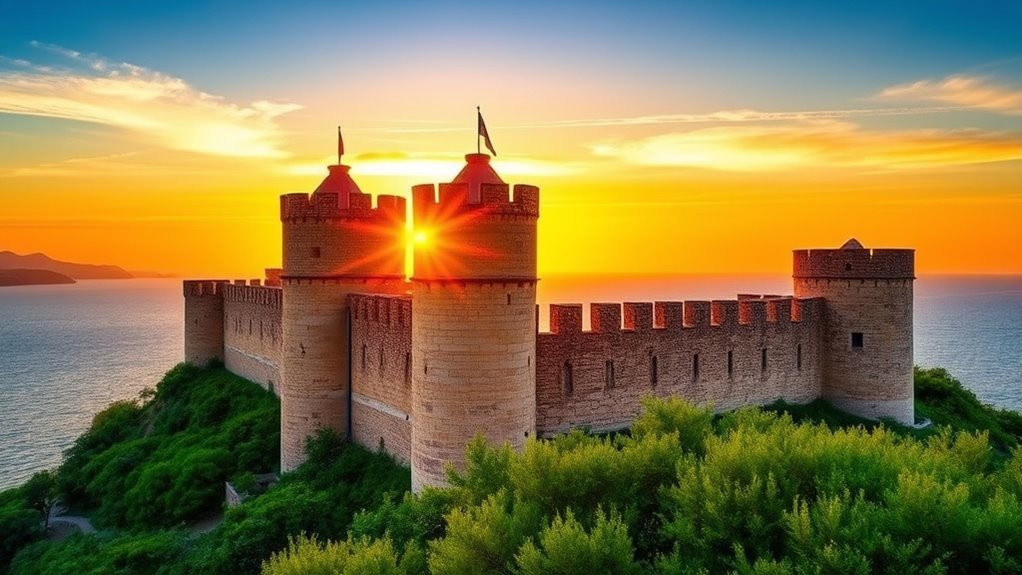
Alghero’s walls are not one intact castle or a single 11th-century building. They form a layered system of medieval and later Catalan-Aragonese fortifications around the historic center. Towers, bastions, sea-facing walls, and old gateways show how the port’s defenses evolved as its rulers and military needs changed.
Today, the waterfront bastions provide one of the easiest historic walks on this list. You can follow the promenade above the sea, examine surviving towers and cannon positions, and look toward Capo Caccia. The experience is especially appealing near sunset, when the old stone takes on a warmer color.
Learn more from the official Sardinia tourism guide to Alghero’s walls and bastions.
Step Back in Time at the Aragonese Castle of Baia
The Aragonese Castle of Baia rises above the Gulf of Pozzuoli near Bacoli. Construction began in the late 15th century, and the fortress was enlarged and altered during later periods. Its position made it useful for monitoring the coast and protecting the approaches to the Bay of Naples.
The castle now houses the Museo Archeologico dei Campi Flegrei. Its collections come from archaeological sites across the Phlegraean Fields, including ancient Baiae, Miseno, Pozzuoli, and submerged coastal areas affected by bradyseism.
Rich Historical Significance
The site is valuable because it combines a later military fortress with material from one of ancient Rome’s most important coastal regions. Rather than treating the castle as the remains of one Roman villa, view it as a gateway to the wider archaeology of the Phlegraean Fields.
| Historical Phase | Main Role | What Visitors See Today |
|---|---|---|
| Late 15th century | Aragonese coastal fortress | Defensive position above the gulf |
| Later Spanish period | Expanded military complex | Altered walls, courtyards, and fortifications |
| Modern era | Military and institutional uses | Evidence of several later adaptations |
| Present day | Archaeological museum | Sculpture, architectural remains, pottery, and regional finds |
Stunning Gulf Views
The elevated terraces and outer areas provide broad views across the volcanic coastline. Depending on visibility, you can see the gulf, nearby communities, and parts of the Campi Flegrei landscape.
- Coastal panoramas: The castle’s strategic height explains why the position was militarily useful.
- Volcanic landscape: The surrounding terrain reflects the unusual geology of the Phlegraean Fields.
- Ancient coastline: The museum explains how land movement changed the relationship between Roman sites and the sea.
- Photography: Exterior viewpoints are rewarding, but follow posted rules inside museum galleries.
Museo Archeologico Highlights
The museum displays objects recovered from settlements, sanctuaries, villas, ports, and underwater sites throughout the region. Major displays include sculpture and architectural material from the Sacellum of the Augustales at Miseno and the submerged nymphaeum at Punta Epitaffio.
Allow enough time for both the collections and the building. Visitors who rush directly to the viewpoints miss the reason the castle is one of the most important archaeological museums near Naples.
Explore the Ruins of Aymerich Castle in Laconi
The ruins known as Aymerich Castle stand within Aymerich Park in Laconi, Sardinia. The surviving remains belong to a medieval fortified site associated with the frontier between the historic realms of Arborea and Cagliari. The name Aymerich comes from the family that later held the estate.
Aymerich is best experienced as a combined nature-and-history walk rather than as a furnished castle tour.
- Medieval ruins: Surviving walls, openings, and structural fragments reveal several phases of occupation.
- Historic setting: The remains occupy high ground inside a large wooded park.
- Botanical interest: Aymerich Park contains mature and unusual trees, paths, water features, and dense greenery.
- Quiet atmosphere: The site feels less commercial than Italy’s major ticketed castles.
Wear shoes suitable for park paths and potentially damp ground. For regional background, see the official Sardinia tourism page for Aymerich Park.
Uncover the History of Doria Castle in Castelsardo
Doria Castle crowns the old town of Castelsardo on Sardinia’s northern coast. The fortress is closely tied to the Genoese Doria family and to the settlement once known as Castelgenovese. Its elevated position helped control maritime movement and provided a strong defensive outlook.
Architectural Significance
The castle’s appeal comes from the relationship between its defensive architecture and the tightly packed hill town below it.
- Fortified position: Thick masonry and limited approaches reflect the need to defend the promontory.
- Coastal views: Terraces overlook the Gulf of Asinara and the town’s layered rooftops.
- Traditional crafts: The castle houses the Museum of Mediterranean Weaving, commonly known as MIM.
- Changing rulers: Genoese, Aragonese, and later Sardinian political shifts shaped the settlement and its name.
Strategic Location
The promontory allowed defenders to watch the sea and protect the fortified community. That position now creates one of Sardinia’s most dramatic castle approaches, but it also means steep streets and steps.
The museum focuses on basketry and weaving traditions from Castelsardo and the wider Mediterranean. This makes the castle more than a military monument: it also preserves knowledge of materials, techniques, and domestic craft.
Tour the Preserved Eleonora d’Arborea Castle in Sanluri
The castle in Sanluri is commonly called the Eleonora d’Arborea Castle, although direct evidence that Eleonora lived there is lacking. Its early history is debated. Some accounts propose a 12th-century origin, while municipal records emphasize a documented Aragonese construction or rebuilding campaign ordered in 1355.
Sanluri is unusual because the fortified residence remains exceptionally well preserved and contains several distinct historical collections.
- Border history: The castle occupied a strategic area contested during conflicts between Arborea and the Crown of Aragon.
- Battle of Sanluri: The decisive 1409 battle was fought near the fortified settlement, not as a staged confrontation inside the castle rooms.
- Museum collections: Displays cover the Risorgimento, the First World War, military history, wax works, and period furnishings.
- Residential interiors: Furnished rooms help visitors understand the building’s later domestic life.
Because the site is privately owned and museum access can follow set arrangements, confirm visiting information before making a special trip. The Municipality of Sanluri provides historical and access information.
Discover Norman Architecture at Ginosa Castle
Ginosa Castle occupies a commanding position above the ravine settlements of Ginosa in Puglia. It is generally described as an 11th-century Norman castle, although later owners altered its defensive appearance and adapted parts of the complex for residential use.
The approach includes an arched stone bridge associated with the former drawbridge entrance. From the castle area, you can appreciate the relationship between the fortress, the old town, and Ginosa’s rock-cut landscape.
Interior access and restoration conditions may change, so do not assume that every room is open. Even when access is limited, the exterior and surrounding historic center help explain the castle’s strategic setting. The national tourism portal includes Ginosa’s castle in its guide to Ginosa, Laterza, and Mottola.
Visit Fénis Castle in the Aosta Valley
Fénis Castle is one of the Aosta Valley’s most recognizable medieval residences. The site appears in medieval records before the extensive building campaigns that gave it much of its present form during the 14th and early 15th centuries.
Although the towers and double walls look highly defensive, Fénis also served as a prestigious residence for the Challant family. Its courtyard paintings, chapel, domestic spaces, and decorative program reveal as much about status and courtly life as they do about defense.
Architectural Marvels
- Pentagonal plan: The main structure follows an irregular pentagonal layout rather than consisting of one pentagonal keep.
- Double walls: Battlemented outer walls and towers create the castle’s distinctive silhouette.
- Painted courtyard: Frescoes, wooden galleries, and the image of Saint George and the dragon are major highlights.
- Furnished rooms: The route passes spaces linked to storage, cooking, weapons, worship, and noble life.
Consult the official Aosta Valley Heritage page for Fénis Castle before visiting.
Family-Friendly Activities
The towers, courtyard, frescoes, and Saint George imagery make Fénis engaging for school-age children. However, it remains a protected historic property rather than an open playground.
Prepare children for a structured museum visit and keep them close on stairs and narrow passages. For a picnic or active play, use an appropriate public green space outside the monument rather than assuming food and games are permitted within the castle grounds.
Get to Know the History of Fort Bard
Fort Bard is a large fortified complex controlling a narrow passage through the Aosta Valley. Earlier defenses occupied the site, but the present monumental fortress was built in the 1830s after Napoleon ordered the previous stronghold destroyed following the campaign of 1800.
- Strategic position: The rock outcrop overlooks a historic route through the valley.
- 19th-century engineering: Casemates, terraces, walls, and separate defensive levels form an extensive military complex.
- Museums: The fort contains the Museum of the Alps and other exhibition spaces devoted to fortifications, borders, photography, art, and regional culture.
- Modern access: Panoramic lifts assist visitors in reaching the upper levels, although individual galleries and routes should still be checked for accessibility.
Fort Bard can occupy half a day when several museums or temporary exhibitions are open. Review current tickets and exhibitions on the official Fort Bard website.
Explore the Art Collections at Capodimonte
The Museo e Real Bosco di Capodimonte occupies a former Bourbon royal palace above Naples. It is not a medieval castle, but its architecture, royal history, extensive park, and major collections make it a valuable addition to a tour of Italy’s historic residences.
Masterpieces of Renaissance and Baroque Art
The museum’s strengths include the Farnese Collection, works connected with Bourbon patronage, Neapolitan painting, and major European artists. Visitors can encounter paintings by Titian, Raphael, Parmigianino, the Carracci, Caravaggio, and leading Neapolitan masters, although gallery arrangements can change during loans and renovations.
- Farnese Collection: Paintings, sculpture, and decorative works assembled by one of Italy’s most influential families.
- Neapolitan art: Galleries trace artistic development in Naples across several centuries.
- Royal apartments: Decorative interiors help explain the palace’s courtly role.
- Real Bosco: The surrounding park provides space for a longer visit beyond the galleries.
Capodimonte Porcelain Collections
The porcelain galleries document production associated with the Royal Factory of Capodimonte and later royal workshops. Instead of focusing on unsupported creation dates for individual categories, look at how materials, modeling, decoration, and courtly taste developed.
| Collection Type | What to Notice |
|---|---|
| Tableware | Painted decoration, courtly dining, and changing fashions |
| Figurines | Expressive modeling, costume, and scenes of daily life |
| Vases and vessels | Complex forms, painted surfaces, and gilded details |
| Decorative rooms | Porcelain used as part of a complete interior design |
| Royal commissions | The connection between craftsmanship, status, and diplomacy |
Decorative Arts and Tapestries
Furniture, textiles, tapestries, arms, porcelain, and other decorative objects place the paintings within the wider setting of court life. These displays are especially useful for visitors who want to understand how elite residences functioned rather than viewing each artwork in isolation.
Check current galleries, closures, and tickets on the official Capodimonte museum website.
Discover the Ancient Castel Sant’Angelo
Castel Sant’Angelo began as the mausoleum of Emperor Hadrian and his family in the second century AD. It was later incorporated into Rome’s defenses and developed into a fortress, prison, papal refuge, residence, and military installation.
The building’s circular Roman core remains central to its appearance, while medieval and Renaissance additions reveal centuries of adaptation. Visitors pass through ramps, courtyards, defensive spaces, papal rooms, chapels, and terraces.
The nearby Ponte Sant’Angelo crosses the Tiber and frames one of Rome’s best-known views. The castle is close to Vatican City, but the bridge connects it to central Rome rather than serving as a direct bridge into the Vatican.
Current tickets, opening notices, and accessibility information are available from the official National Museum of Castel Sant’Angelo.
Capture Tuscan Views From Castello di Brolio
Castello di Brolio stands among the vineyards of Chianti Classico near Gaiole in Chianti. Its history is documented from 1141, and the property has long been associated with the Ricasoli family. Warfare, rebuilding, and 19th-century redesign created the mix of medieval, Romanesque, and Gothic Revival elements visible today.
Vineyards and Landscapes
- Chianti panoramas: Elevated viewpoints overlook vineyards, woods, and rolling hills.
- Layered architecture: Fortified walls surround later residential and religious structures.
- Gardens and paths: Visitor routes emphasize the relationship between the estate and its landscape.
- Wine heritage: Tours and tastings connect the Ricasoli family with the development of Chianti wine.
Explore Its Historical Significance
Brolio’s importance extends beyond military architecture. Bettino Ricasoli was a leading political figure during Italian unification and played an influential role in the estate’s winemaking history.
| Architectural Character | Medieval defenses combined with later historicist additions |
| Historic Association | The Ricasoli family and Italian political history |
| Landscape | Gardens, vineyards, woods, and Chianti views |
| Visit Style | Grounds visits, guided experiences, and optional wine tastings |
Review current tour formats on the official Brolio visitor website. Do not assume that every private room is included with a standard grounds ticket.
Visit La Rocca di Dozza With Kids
La Rocca di Dozza combines medieval defenses, Renaissance alterations, furnished rooms, art, and family-friendly fantasy elements. A fortified structure existed here by around the 13th century, while later rebuilding transformed it into a more comfortable residence.
- Painted village: Dozza’s streets are known for large murals created through its long-running painted-wall art tradition.
- Museum rooms: Historic kitchens, bedrooms, halls, defensive areas, and temporary exhibitions provide variety.
- Fyrstan the dragon: The fantasy installation inside the fortress connects with Dozza’s FantastikA festival.
- Tower views: Upper areas provide views across the village and surrounding countryside, subject to access conditions.
The historic kitchen and furnished rooms help children imagine daily life beyond knights and battles. After the museum, families can explore the murals around the village or use a suitable public park for active play.
Check tickets and opening hours through the Fondazione Dozza.
Visit the Scenic Scaliger Castle on Lake Garda
The Scaliger Castle of Sirmione guards the entrance to Sirmione’s historic center on Lake Garda. The principal surviving structure dates mainly to the second half of the 14th century and is associated with the Della Scala rulers of Verona.
The castle is notable for its water-filled defenses and fortified dock, which still encloses part of the lake. Visitors can cross the entrance bridge, explore defensive spaces, and climb upper areas for views of Sirmione and Lake Garda.
A small display introduces the castle and regional history, but the architecture and setting are the main attractions. Combine the visit with Sirmione’s old streets, waterfront, or the Grottoes of Catullus rather than expecting a large furnished palace museum.
Stairs are a central part of the experience. Check current conditions and tickets on the official Lombardy Museums page.
Learn About Mountains at Sigmundskron Castle
Sigmundskron Castle, also called Castel Firmiano, stands on a porphyry outcrop near Bolzano. Today it houses MMM Firmian, the central location in Reinhold Messner’s Messner Mountain Museum network.
The museum examines the relationship between people and mountains through art, religion, geology, climbing history, tourism, and cultural traditions.
At MMM Firmian, the historic walls, open-air paths, towers, installations, and mountain views form part of the exhibition itself.
- Cultural exhibits: Displays consider mountains as sacred places, obstacles, resources, and destinations.
- Walking route: The visit follows indoor and outdoor paths through the castle complex.
- Art and objects: Installations, sculpture, equipment, and historic material appear throughout the site.
- Panoramic setting: Open sections reveal views over Bolzano and the surrounding ranges.
The museum operates seasonally and may close on a regular weekday. Confirm dates through the official MMM Firmian website.
Spend a Night at Castello di Tornano
Castello di Tornano is a restored historic property and wine relais near Gaiole in Chianti. It offers rooms, suites, and apartments within the castle and surrounding village buildings.
Guest spaces preserve stone walls, vaulted ceilings, period-style furnishings, and views of the Tuscan countryside while providing modern hotel comforts. The property also offers dining, wine experiences, gardens, and an outdoor pool associated with the historic moat area.
Tornano was connected with the Firidolfi Ricasoli family and with the agricultural life of Chianti. Its present form reflects both medieval origins and extensive later restoration.
This is primarily an accommodation experience, not a public museum with continuous walk-in access. Review rooms, dining, and activities on the official Castello di Tornano website.
Dive Into History at Prösels Castle
Prösels Castle, also known as Presule Castle, stands below the Schlern massif near Fiè allo Sciliar. A castle is documented here in the 13th century, while major 16th-century changes gave the complex much of its Renaissance character.
- Hall of Knights: This ceremonial space helps convey the status of the castle’s former occupants.
- Regional witch-trial history: Tours discuss the 16th-century trials associated with the area and the castle’s historical setting.
- Rooms and collections: The visit may include the chapel, courtyards, fireplaces, weapons, and furnished interiors.
- Mountain setting: The Schlern and surrounding countryside create a dramatic backdrop.
Prösels Castle generally admits visitors through scheduled guided tours and follows seasonal arrangements. Consult the official South Tyrol visitor listing before traveling.
See Historic Armor at Churburg Castle
Churburg Castle, or Castel Coira, rises above Schluderns in South Tyrol. It is one of the region’s best-preserved privately owned castles and is especially famous for its dynastic armory.
The collection should not be described simply as the world’s largest collection of all medieval weapons. More accurately, it is one of the world’s most important preserved dynastic armories, containing armor and weapons connected with the castle’s noble families and their retainers.
Guided tours also introduce visitors to the Renaissance arcaded courtyard, frescoes, chapel, family rooms, and other historic interiors. Because the castle remains private, access is controlled and photography rules may be strict.
Medieval games and knight-themed events are sometimes held in the wider Schluderns area, but they are separate events with their own dates and tickets. Confirm tours through the official Churburg Castle website.
Experience the Architecture of Rocchetta Mattei
Rocchetta Mattei stands in the Apennines of Emilia-Romagna near Riola. Count Cesare Mattei began developing the complex in the 19th century, combining medieval references with Moorish-inspired, Gothic, Romanesque, and other eclectic elements.
Colorful tiles, striped arches, unexpected staircases, courtyards, towers, and richly decorated rooms create an atmosphere unlike that of a conventional medieval fortress.
- Eclectic architecture: The design borrows from several periods and traditions rather than reproducing one historical style.
- Guided interpretation: A guide explains Cesare Mattei, the building phases, and the function of unusual rooms.
- Apennine setting: Terraces and exterior areas reveal the surrounding hills.
- Detailed interiors: Decorative surfaces and carefully framed views reward close attention.
Warning: Rocchetta Mattei requires a guided visit and advance reservation. Do not arrive expecting unrestricted walk-in entry.
Reserve through the official Rocchetta Mattei tour page.
Enjoy Estate Activities at Castello di Reschio
Castello di Reschio is a restored luxury hotel on a large Umbrian estate near the Tuscan border. It blends a historic castle setting with contemporary hospitality, dining, wellness, equestrian facilities, and outdoor experiences.
Available activities can include horse riding, walking, cycling, rowing, cooking lessons, craft experiences, and nature-based outings. Some can be adapted for families, but minimum ages, supervision, availability, and extra charges vary.
The estate’s restaurants and guest facilities make it suitable for a longer stay rather than a quick sightseeing stop. Families should discuss room arrangements, childcare, activity requirements, and dining needs directly with the property.
Explore current options on the official Reschio activities page.
Stroll Through the Gardens of Donnafugata Castle
Donnafugata Castle lies about 15 kilometers from Ragusa in Sicily. Despite its name and castle-like appearance, it is primarily a sumptuous noble residence shaped during the 19th century rather than a surviving medieval fortress.
The building combines ornate reception rooms, period furnishings, decorative details, towers, and a Gothic-Venetian-style loggia. The surrounding park extends the visit well beyond the interior.
- Stone labyrinth: The park’s maze is one of the estate’s best-known features.
- Period interiors: Furnished rooms illustrate aristocratic life and changing decorative tastes.
- Park features: Paths lead through mature vegetation, architectural curiosities, and artificial structures.
- Costume collection: The wider museum complex includes MuDeCo, the Museum of Costume.
Allow time for both the house and grounds, and bring sun protection in warm weather. Check current access through the official Donnafugata Castle website.
Frequently Asked Questions
What is the best time to visit Italy’s castles?
Spring and early fall usually provide comfortable temperatures and lighter crowds. Summer offers longer days but can bring heat and congestion, especially in Rome, Tuscany, Sicily, Sardinia, and Lake Garda. Alpine castles may have seasonal schedules, so confirm opening dates before planning an off-season visit.
Are guided tours available at these castles?
Yes, but the format varies. Rocchetta Mattei requires a guided visit, while Prösels Castle, Churburg, and other private properties use scheduled tours. Large public museums may offer optional guided tours, audio guides, or independent routes. Reserve early when a tour is the only way to enter.
Can I take photos inside Italian castles?
Photography policies are set by each property. Handheld, non-flash photography may be allowed in some museums, while private rooms, temporary exhibitions, armories, or fragile interiors may prohibit it. Tripods, drones, flash, and commercial filming usually require separate permission.
Are Italy’s castles wheelchair accessible?
Accessibility differs greatly. Fort Bard has panoramic lifts, and some museums provide adapted routes, but medieval towers, narrow stairs, cobbles, steep villages, and protected interiors can limit access. Read the official accessibility page or contact the property for details about the exact route you want to visit.
What are the entrance fees for these castles?
There is no reliable universal range. Public wall walks may be free, standard museum admission can exceed €15, and special guided tours may cost €20 or more. Hotels and private estates use different pricing structures. Check the official ticket page for the date of your visit.
Which Italian castles are best for children?
Fénis Castle, Rocca di Dozza, Sirmione’s Scaliger Castle, Fort Bard, and Donnafugata are strong choices for many families. The best option depends on the child’s age, interest in museums, comfort with stairs, and ability to follow rules inside protected spaces.
How many castles should I visit in one trip?
Two or three major sites are usually enough for a regional trip unless castles are your main interest. Group them geographically: Fénis and Fort Bard in the Aosta Valley, Churburg and Prösels in South Tyrol, or Alghero, Castelsardo, Laconi, and Sanluri during a longer Sardinian route.
Conclusion
Italy’s castles and fortified residences reveal many layers of the country’s history. Alghero’s walls and Doria Castle explain Sardinia’s maritime defenses, Fénis and Churburg preserve medieval and Renaissance life, Castel Sant’Angelo links imperial Rome with papal power, and Rocchetta Mattei shows how later architects reimagined the idea of a castle.
Choose destinations for their specific strengths rather than trying to visit as many as possible. A carefully planned regional route will give you more time to examine the architecture, understand the collections, enjoy the surrounding landscape, and explore the historic towns that grew around these remarkable sites.
Sources
- SardegnaTurismo: Walls and Bastions of Alghero — official background on Alghero’s fortifications.
- Aosta Valley Heritage: Fénis Castle — castle history, architecture, and visitor information.
- Fort Bard — official museums, exhibitions, tickets, and practical information.
- National Museum of Castel Sant’Angelo — official history and visitor information.
- Lombardy Museums: Scaliger Castle of Sirmione — official dating, architecture, and museum details.
- Donnafugata Castle — official information about the residence, museum complex, park, and visits.
