

Last Updated on September 11, 2026 by Daniel Globe
An inline water filter for car washing can make rinse water cleaner, protect hoses and pressure-washer equipment from sediment, and—in the right setup—reduce the mineral residue that becomes water spots. The important part is choosing the correct filtration technology. A sediment cartridge, softening resin, and true deionization system do very different jobs, so the best choice depends on your water quality and the finish you expect.
Quick Answer
For basic car washing, an inline sediment/resin filter can reduce debris and may reduce hard-water spotting. If you want the lowest possible mineral residue for a final rinse, choose a mixed-bed deionization (DI) system. Test your water first, match the media to the problem, and use a hose protector to reduce kinking and strain.
Key Takeaways
- Sediment filtration traps particles such as sand and rust but does not by itself remove dissolved hardness minerals.
- Softening resin reduces calcium and magnesium hardness but is different from full deionization.
- Mixed-bed DI resin removes both positively and negatively charged ions and is the better option when a very low-mineral final rinse is the goal.
- USGS classifies water above 180 mg/L as CaCO3—about 10.5 grains per gallon—as very hard.
- AQUA CREST’s current car-wash filter uses a 5-micron aperture, fits a standard 3/4-inch hose thread, and is marketed for spot reduction rather than as a full DI system.
- Filter life depends heavily on incoming water quality, water volume, and the media used; there is no reliable universal replacement interval for every inline filter.
Disclosure: As an Amazon Associate I earn from qualifying purchases. Some links on this page are affiliate links, at no extra cost to you.
What Does an Inline Water Filter Do for Car Washing?
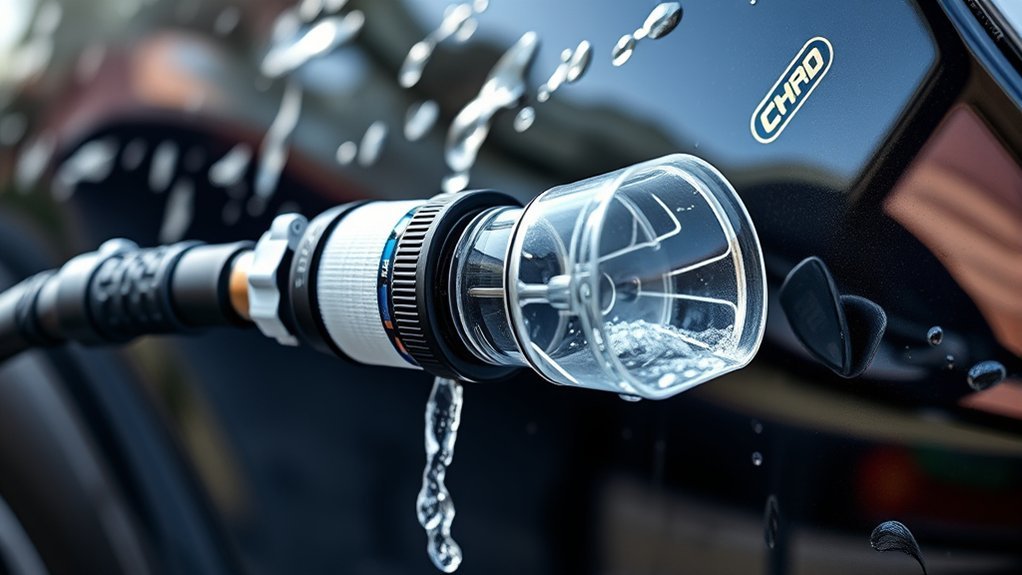
An inline water filter treats water as it moves from your faucet or hose toward a spray nozzle or pressure washer. What it removes depends on the media inside the cartridge.
A sediment stage can catch suspended particles such as dirt, sand, and rust. Activated-carbon media can reduce substances such as chlorine, taste, and odor when a product is designed and tested for those purposes. Ion-exchange media can change or remove particular dissolved ions. A true deionization system goes further by using cation and anion exchange media to remove ionized minerals and salts.
The distinction matters because the white deposits you see after water dries are usually associated with dissolved solids, not with visible sediment. A 5-micron screen may be useful for particles, but its micron rating alone does not mean it removes dissolved calcium or magnesium.
The U.S. Environmental Protection Agency describes deionization as a process that exchanges cations and anions in water for hydrogen and hydroxide ions. That is fundamentally different from simply screening particles out of the flow.
Note: “Filtered,” “softened,” and “deionized” are not interchangeable terms. A filter can make water better for one purpose without making it mineral-free.
Will It Reduce Water Spots?
It can, but the result depends on what the filter actually removes. Water spots appear when droplets evaporate and leave dissolved material behind. Hardness is especially important because calcium and magnesium are major hardness minerals, but other dissolved ions can also contribute to residue.
The U.S. Geological Survey defines water hardness mainly by dissolved calcium and magnesium. Hard water also reduces soap efficiency and contributes to scale formation.
A sediment-only filter may make the water visibly cleaner without solving mineral spotting. A conventional softening resin can reduce calcium and magnesium hardness, which may improve washing and reduce some hardness-related deposits, but softened water still contains dissolved ions. A mixed-bed DI system removes a much broader range of ions and is the stronger choice when you want a very low-residue final rinse.
Pro Tip: If your main goal is a low-mineral final rinse, use ordinary water for the wash and most of the rinse, then switch to DI water for the final rinse. This reduces the amount of expensive DI resin you consume.
Sediment, Resin, or DI: Which Filter Type Is Best?
The best filter type depends on the problem you are trying to solve. Sediment filtration protects equipment from particles. Softening resin addresses hardness. DI resin removes a much broader range of dissolved ions. Many useful systems combine more than one stage.
Sediment Filter Basics
A sediment filter is the simplest option. It catches suspended particles such as sand, rust, and dirt before those particles reach your nozzle, pressure washer, or paint.
Sediment filtration is useful when your water contains visible grit or when you want a protective prefilter for downstream equipment. However, dissolved calcium and magnesium ions are far smaller than suspended sediment and remain dissolved in the water. That means a sediment cartridge alone should not be expected to provide a truly spot-free rinse.
- Best for: Sand, dirt, rust, and other suspended debris.
- Main benefit: Protects downstream equipment and reduces particulate contamination.
- Limitation: Does not demineralize water.
- Maintenance: Replace or clean the element when restriction increases or according to the manufacturer’s instructions.
Resin Softening Power
Ion-exchange softening resin is designed primarily to address hardness. According to the Water Quality Association, conventional residential softeners typically exchange calcium and magnesium ions for sodium or potassium ions.
This improves several washing characteristics. Soap can work more efficiently, scale is reduced, and calcium/magnesium-related deposits may be less severe. However, the water is not necessarily low in total dissolved solids because the hardness ions have been exchanged rather than all dissolved ions being removed.
- Softening reduces calcium and magnesium hardness.
- It can improve soap performance in hard water.
- It may reduce some hardness-related spotting and scale.
- It does not provide the same demineralization as mixed-bed DI.
DI For Spot-Free
Deionization is the better choice when the goal is to remove ionized minerals instead of merely changing the type of ions present. Mixed-bed DI resin contains both cation- and anion-exchange media, allowing it to remove positively and negatively charged ions.
The Water Quality Association defines deionization as removal of ionized minerals and salts through cation and anion exchange. EPA likewise describes the process as exchanging cations and anions for hydrogen and hydroxide ions.
For car washing, that makes DI especially useful as a final-rinse treatment. Because fewer dissolved ions remain in the rinse water, less mineral residue is available to remain on the surface after evaporation.
| Filter Type | What It Targets | Best Use | Spot Reduction |
|---|---|---|---|
| Sediment | Suspended particles | Protecting equipment from grit | Limited if dissolved minerals are the cause |
| Carbon / composite | Depends on media; often chlorine, odor, some impurities | General outdoor-water improvement | Product-dependent |
| Softening resin | Calcium and magnesium hardness | Hard-water washing | Better than sediment alone, but not full demineralization |
| Mixed-bed DI | Cations and anions | Low-residue final rinse | Best of these options for minimizing dissolved mineral residue |
How to Choose the Right Inline Filter for Your Water
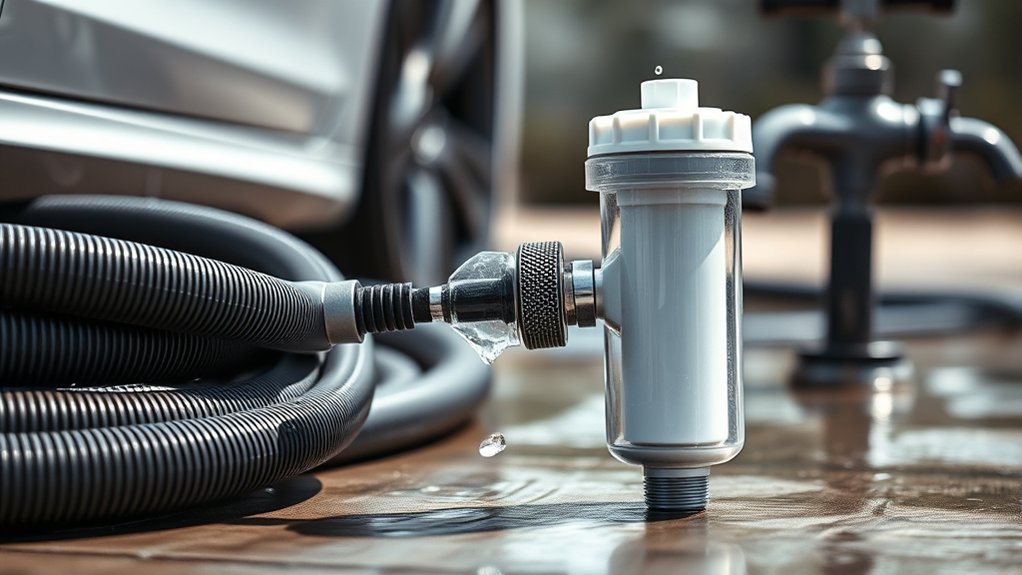
Start with your water instead of the filter box. Test hardness if scale and calcium/magnesium deposits are your concern. If you are considering DI, a TDS meter is also useful for comparing untreated water with the DI system’s output.
Then choose the least complicated system that solves the actual problem. Sediment-heavy well water may need a prefilter. Moderately hard water may benefit from softening media. Very mineral-heavy water—or any setup where minimizing final-rinse residue is the priority—may justify DI.
Water Hardness Levels
USGS expresses hardness as milligrams per liter of calcium carbonate equivalent. One grain per gallon is approximately 17.12 mg/L.
| USGS Classification | mg/L as CaCO3 | Approx. Grains/Gallon | Car-Wash Consideration |
|---|---|---|---|
| Soft | 0–60 | 0–3.5 | A basic filter and careful drying may be sufficient. |
| Moderately hard | 61–120 | About 3.6–7.0 | Spotting becomes more likely as mineral loading rises. |
| Hard | 121–180 | About 7.1–10.5 | Consider hardness treatment or DI for the final rinse. |
| Very hard | Above 180 | Above about 10.5 | DI resin may exhaust quickly; pre-treatment can improve economics. |
Hardness and TDS are related but are not the same measurement. Hardness focuses mainly on calcium and magnesium, while TDS represents a broader measure of dissolved material. A water supply can therefore have reduced hardness while still containing other dissolved ions.
Filter Media Types
Choose filter media by what you want to remove rather than by marketing phrases such as “clean water” or “spot-free.”
| Media | Best For | Main Limitation |
|---|---|---|
| Sediment | Sand, rust, dirt and suspended solids | Does not remove dissolved hardness by particle size alone |
| Activated carbon / GAC | Chlorine, odor and specific contaminants depending on design | Not a substitute for DI when mineral removal is required |
| Softening resin | Calcium and magnesium hardness | Leaves other dissolved ions in the water |
| Mixed-bed DI resin | Broad removal of ionized minerals and salts | Resin capacity can be consumed quickly by high-TDS feed water |
Hose Thread Compatibility
Many outdoor inline filters, including the current AQUA CREST car-wash model, use a standard 3/4-inch garden-hose connection. Confirm the connection type before purchasing because pressure-washer plumbing on the downstream side can use different fittings.
- Confirm the filter’s inlet and outlet match your hose setup.
- Check the manufacturer’s maximum pressure and flow requirements.
- Follow any marked flow-direction arrow on the housing.
- Use intact washers or O-rings so connections seal without excessive tightening.
- Add an anti-kink hose protector if the filter hangs directly from a faucet or other stressed connection.
Warning: Do not assume a garden-hose filter is safe for drinking water. Outdoor car-wash filters should only be used for potable-water treatment if the manufacturer specifically identifies that use and provides the appropriate performance information or certification.
Best Inline Water Filters for Car Washing in 2026
There is no single “best” inline water filter for every car because the right choice depends on the incoming water and your goal.
| Goal | Best Type | Why |
|---|---|---|
| Protect equipment from grit | Sediment prefilter | Captures suspended particles before they reach downstream equipment. |
| Low-cost outdoor spot reduction | Composite inline cartridge such as AQUA CREST | Compact, hose-compatible and marketed specifically for outdoor washing and water-spot reduction. |
| Minimize dissolved mineral residue | Mixed-bed DI | Removes both cations and anions rather than relying on particulate filtration alone. |
| High-volume use with mineral-heavy water | Pre-treatment followed by DI | Reducing the mineral load before DI can help preserve expensive DI capacity. |
AQUA CREST Inline Water Filter: What the Current Specs Actually Say
The AQUA CREST Car Washing Inline Water Filter with Flexible Hose Protector is a compact outdoor filter designed for car washing, window washing, yard cleaning, and use with pressure washers.
As of the August 2026 update, AQUA CREST’s manufacturer page lists:
- A 5-micron filter aperture.
- A standard 3/4-inch hose-thread connection.
- Compatibility with pressure washers.
- A resin-based composite filtration system.
- An anti-kink flexible hose protector.
- A manufacturer-stated working life of about one month, depending on local water quality.
The manufacturer’s page says the filter reduces water spots caused by air-dried minerals. That makes it a reasonable compact option for people who want an inexpensive inline outdoor filter. However, it should not automatically be treated as equivalent to a dedicated mixed-bed DI system when the goal is maximum dissolved-ion removal.
At the time of this August 2026 review, the hose-protector version was listed by the manufacturer at $21.99 and shown as sold out. Price and availability can change.
Why a Hose Protector Helps
A hose protector does not filter the water. Its purpose is mechanical: it reduces sharp bending, twisting, and strain near a faucet, filter, or hose connection.
- It can reduce kinking close to the filter connection.
- It can reduce twisting stress on threaded fittings.
- It can help maintain smoother flow when a short section of hose would otherwise bend sharply.
- It can make it easier to move around the vehicle without placing as much leverage on the filter housing.
AQUA CREST specifically describes its flexible protector as an anti-kink device that helps prevent twisting at the water-pipe joint and supports smoother flow. It should not be confused with a sediment stage or other filtration media.
How to Install an Inline Filter on a Hose
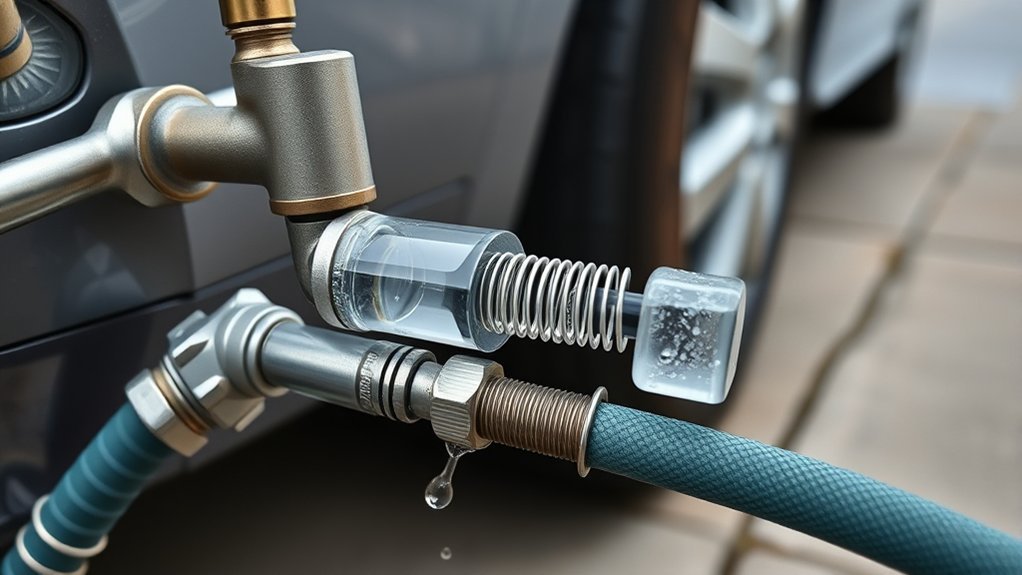
At a Glance
| Time Required | About 5–10 minutes for a basic hose-mounted filter |
| Difficulty | Easy |
| Tools Needed | Usually none; hose washers and a TDS meter are useful depending on the system |
| Cost | Basic inline cartridges can cost around $20–$40; dedicated DI systems generally cost more |
Installation is straightforward when the filter uses normal garden-hose fittings, but always follow the instructions supplied with your specific cartridge or DI system.
| Step | Action |
|---|---|
| 1 | Shut off the water. Relieve pressure before disconnecting the hose. |
| 2 | Check the filter direction. If the housing has an inlet/outlet arrow, install it in the direction of water flow. |
| 3 | Inspect the washers. Make sure sealing washers or O-rings are clean and seated correctly. |
| 4 | Attach the filter. Thread it on by hand until snug. Avoid overtightening plastic fittings. |
| 5 | Add the hose protector. Position it where the connection would otherwise bend or twist sharply. |
| 6 | Connect downstream equipment. Attach your garden hose, spray nozzle, or compatible pressure-washer supply hose. |
| 7 | Turn the water on slowly. Check every connection for leakage. |
| 8 | Flush if required. Follow the manufacturer’s flushing instructions before directing filtered water onto the vehicle. |
Installing the filter before downstream equipment allows it to treat incoming water first. If you use both sediment filtration and DI, the particulate filter normally belongs upstream so it can protect later stages.
Pro Tip: After installation, compare untreated and treated water. With a DI system, a handheld TDS meter provides an easy way to see when the resin is no longer producing low-mineral water.
How Long Inline Water Filters Last and What They Cost
There is no universal lifespan for an inline water filter. Service life depends on cartridge size, media capacity, incoming sediment, hardness or TDS, flow rate, water volume, and the manufacturer’s design.
For the AQUA CREST car-washing inline filter discussed above, the manufacturer currently states that the high-capacity filter can continuously work for about one month, depending on local water quality. That is more appropriate guidance for this model than the previously stated three-month or 3,000-gallon rule.
DI systems work differently. Their resin becomes exhausted as it captures ions. The same quantity of resin can therefore last much longer with low-mineral feed water than with mineral-heavy water.
Signs It May Be Time to Replace or Service the Filter
- Water flow is noticeably restricted.
- Visible sediment has accumulated in a serviceable prefilter.
- Water spotting becomes worse again after previously improving.
- A DI system’s output TDS starts rising beyond your normal target.
- The manufacturer-specified service interval has been reached.
- The cartridge has been stored or used outside the manufacturer’s recommended conditions.
A basic inline cartridge can be relatively inexpensive. In August 2026, AQUA CREST listed its hose-protector car-wash model at $21.99 and another car-wash variant at $39.99. Larger refillable or multi-stage DI systems are a different category and generally require a higher initial investment as well as replacement or regenerated resin over time.
What to Do If You Still Get Water Spots
A new filter does not automatically guarantee a spot-free finish. If spots remain, work through the likely causes instead of replacing parts at random.
- Retest your water. If hardness or TDS remains high after filtration, the installed media may not be designed for dissolved-mineral removal.
- Check the filter direction. Some cartridges depend on correct flow orientation.
- Check for bypass. Loose fittings or incorrect plumbing can let untreated water enter downstream.
- Check cartridge life. Softening or DI resin may be exhausted.
- Reduce flow if required. Stay within the manufacturer’s rated operating conditions.
- Wash out of direct sun when practical. Slower evaporation gives you more time to rinse and dry before ordinary tap-water minerals deposit.
- Dry the car when using non-DI water. A clean drying towel or automotive blower can remove droplets before their dissolved minerals are left behind.
- Consider DI for the final rinse. If the existing filter mainly handles sediment or chlorine, adding a proper deionization stage addresses a different problem.
Frequently Asked Questions
Do Inline Shower Filters Actually Work?
They can reduce specific substances when the filter contains suitable media and has verified performance for those substances. However, shower filters and outdoor car-wash filters are different products. A shower filter’s performance should be evaluated from its own specifications or certification rather than assumed from the word “inline.”
What Is the Best Water Filter for Giardia?
This is a drinking-water safety question, not a car-washing question. The CDC recommends filters certified to NSF 53 or 58 for cyst reduction/removal, an absolute pore size of 1 micron or smaller, or suitable microfiltration, ultrafiltration, nanofiltration, or reverse-osmosis systems for parasites such as Giardia. Do not rely on a 5-micron outdoor car-wash filter for this purpose.
Are Inline Water Filters Any Good?
Yes, when the filter matches the problem. Sediment filters are good for grit, carbon/composite filters can address specific chemicals or odors depending on their media, softening resin addresses hardness, and mixed-bed DI is better when your priority is removing dissolved ions for a low-residue final rinse.
How Often Should You Change an Inline Water Filter?
Follow the manufacturer’s service guidance rather than a universal schedule. Incoming water quality and usage can change cartridge life significantly. AQUA CREST currently states about one month for its car-wash inline filter, depending on local water quality. DI resin should be monitored by output quality, commonly with a TDS meter.
Will a 5-Micron Filter Remove Hard-Water Minerals?
Not simply because it is rated at 5 microns. A micron rating describes particle size. Dissolved calcium, magnesium, and other ions require suitable chemical treatment such as ion exchange, reverse osmosis, or deionization rather than ordinary particle screening alone.
Do I Need a DI Filter for a Spot-Free Car Wash?
Not everyone needs DI. If your water is soft and you dry the vehicle immediately, a basic filter may be enough. If your water contains a high dissolved-mineral load and you want to minimize residue from the final rinse, mixed-bed DI provides more complete ion removal than sediment or ordinary softening alone.
Can I Use an Inline Filter With a Pressure Washer?
Many can be used on the water-supply side of a pressure washer, but check the filter’s specifications and your pressure washer’s required inlet flow. AQUA CREST specifically states that its current car-wash inline filter is compatible with pressure washers.
Should I Test Hardness or TDS Before Buying a Filter?
Testing both can be useful. Hardness tells you mainly about calcium and magnesium, while TDS gives a broader indication of dissolved material. Hardness testing helps with softener decisions; a TDS meter is especially useful when monitoring DI performance.
Sources
- U.S. Geological Survey — Hardness of Water — hardness definition and official hardness classifications.
- U.S. EPA WaterSense at Work — Water Purification — deionization process and ion-exchange principles.
- Water Quality Association — Glossary of Terms — definitions of water softening and deionization.
- AQUA CREST — Car Washing Inline Water Filter With Flexible Hose Protector — current manufacturer specifications, compatibility, price and service-life guidance.
- CDC — About Choosing Home Water Filters — potable-water filtration and Giardia/cyst guidance.
Conclusion
An inline water filter can be a useful car-washing upgrade, but the right filter depends on what is actually in your water. Sediment cartridges protect against grit. Softening resin reduces calcium and magnesium hardness. Mixed-bed DI removes a much broader range of dissolved ions and is the stronger option when minimizing final-rinse mineral residue is the priority.
Test your water before buying, confirm hose and pressure compatibility, and judge filter life by the manufacturer’s instructions and actual output quality instead of relying on a universal replacement schedule. A hose protector is also worthwhile when the filter places strain on the connection because it can reduce kinking and twisting. With those pieces matched correctly, you can get cleaner rinses, fewer mineral deposits, and a more reliable car-wash setup.

