

Last Updated on July 25, 2026 by Daniel Globe
Visiting Kew Gardens is easiest when you plan your entrance, transport, tickets, and must-see stops before you arrive. The 320-acre UNESCO World Heritage site contains more than 50,000 living plants, historic glasshouses, family attractions, galleries, restaurants, and extensive tree collections, so even a half-day visit benefits from a simple route.
Quick Answer
Visit Kew Gardens by booking online for the best-value admission, checking opening times and closures, and using public transport where possible. Kew Gardens station is about 500m from Victoria Gate. Allow at least half a day for the main highlights, or a full day if you want family areas, galleries, longer walks, and a relaxed meal.
Key Takeaways
- Book standard admission online for the best current ticket value, although daytime tickets are also sold at the gates.
- Kew Gardens station is about 500m from Victoria Gate and is served by the District line and Mildmay line.
- Parking is limited and located at Brentford Gate/Ferry Lane rather than Victoria Gate.
- Check Kew’s live opening times and planned closures before travelling because glasshouses and other attractions can close for maintenance.
- Comfortable shoes, weather-appropriate clothing, a refillable water bottle, and a simple route make the large site much easier to enjoy.
Disclosure: As an Amazon Associate I earn from qualifying purchases. Some links on this page are affiliate links, at no extra cost to you.
Best Times to Visit Kew Gardens

Kew Gardens is worth visiting throughout the year, but the best season depends on what you want to see. Spring brings blossom, bulbs, magnolias, and flowering rhododendrons. Kew’s Rhododendron Dell is typically at its best in April and May.
Early summer brings lush growth, roses, long daylight hours, and plenty of space for picnics. Summer is also a good time to explore Kew’s Arboretum and extensive outdoor collections, although school holidays and sunny weekends can be busier.
Autumn is excellent for tree colour, making the Arboretum especially rewarding. Winter is quieter and offers a different landscape, while the separately ticketed Christmas at Kew light trail provides an evening experience on selected dates. For 2026, the event runs on selected dates from November 13, 2026 to January 3, 2027.
For a quieter daytime visit, arriving near opening time on a weekday is usually the safest strategy. Families who want the Children’s Garden may also find the beginning or later part of the day calmer than the busiest midday period during school holidays.
Pro Tip: Do not plan around one seasonal flower or attraction alone. Kew’s displays change throughout the year, so check current horticultural highlights and planned closures shortly before your visit.
Opening Times and How Long to Spend at Kew Gardens
Kew’s opening hours change with the season. From May 1 through August 31, 2026, the Gardens are currently scheduled to open from 10am to 7pm Monday to Friday and from 10am to 8pm on weekends and Bank Holidays. Last entry is one hour before the Gardens close.
Individual glasshouses, restaurants, galleries, and family attractions can close earlier than the grounds. Always check the official Kew Gardens opening-times page for your specific date.
For a first visit, three to four hours is a sensible minimum if you mainly want the Palm House, Princess of Wales Conservatory, Temperate House, and a short outdoor walk. A full day gives you time for the Arboretum, family areas, galleries, food stops, and less hurried exploration.
Kew covers 320 acres, so a successful first visit is less about seeing everything and more about choosing a few priority areas and leaving time to wander.
Getting to Kew Gardens: Transportation Options
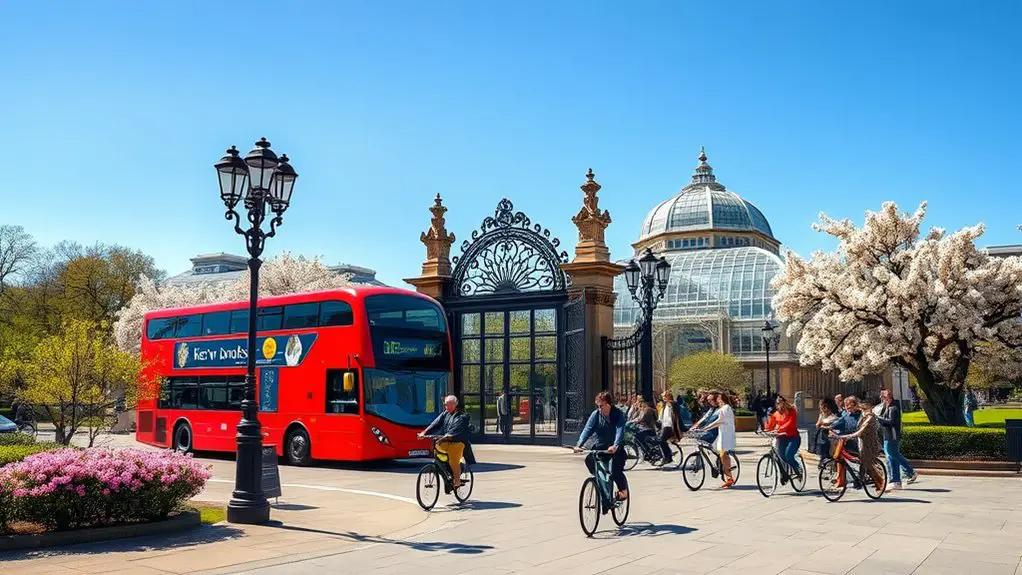
Kew Gardens has four main public entrances: Victoria Gate, Elizabeth Gate, Brentford Gate, and Lion Gate. Choosing the right entrance can save a substantial walk across the perimeter.
- Victoria Gate (TW9 3JR): closest to Kew Gardens station.
- Elizabeth Gate (TW9 3AE): convenient for Kew Bridge station, coach drop-off, and river services.
- Brentford Gate (TW9 3AF): entrance for the Kew Gardens car park.
- Lion Gate (TW9 2DF): the closest Kew entrance when approaching on foot from Richmond.
Tube and Train Stations Nearby
Kew Gardens station is the simplest public-transport choice for many visitors coming from central or west London. It is in Zone 3 and is served by the District line’s Richmond branch and the Mildmay line.
| Station | Useful Entrance | What to Know |
|---|---|---|
| Kew Gardens District line / Mildmay line |
Victoria Gate | About 500m from the gate. Platform accessibility differs by direction, so check TfL if step-free travel is essential. |
| Richmond District line / Mildmay line / National Rail |
Lion Gate | Richmond has lift and level access. Kew lists about a 15-minute walk to Lion Gate, or you can use bus 65. |
| Kew Bridge National Rail |
Elizabeth Gate | About 800m from Elizabeth Gate. Kew notes that the station does not have level access. |
Accessibility Warning: Kew Gardens station is not equally step-free in both directions. TfL advises that transferring between the platforms step-free can require a street-level route; another option is travelling to Richmond and returning on an eastbound service. Check the current TfL station information before travelling.
Bus Routes Serving Kew
Several London bus routes serve the area around Kew:
- Route 65 stops close to Elizabeth Gate, Victoria Gate, and Lion Gate and connects with Ealing Broadway and Richmond stations.
- Route 110 stops near Kew Gardens station and Elizabeth Gate and also serves Richmond.
- Routes 237 and 267 stop at Kew Bridge station, from where you can continue toward Elizabeth Gate.
London buses accept pay-as-you-go payment using a contactless card or device or an Oyster card. Use the same payment method throughout your journey so TfL can apply the correct fare and caps.
Parking Facilities Available
Kew Gardens does have visitor parking, but spaces are limited and cannot be relied on during busy periods. The main Kew Gardens car park is at Brentford Gate/Ferry Lane, TW9 3AF, not Victoria Gate.
As of July 25, 2026, Kew lists parking at £10 per day. Spaces are first come, first served. Payment is available at a card-only meter or through Kew’s stated mobile-payment option.
- Main car park: Brentford Gate/Ferry Lane, TW9 3AF.
- Peak overflow: Kew may open the Herbarium car park on selected busy weekends when the main car park fills.
- Blue Badge parking: Blue Badge holders can park free in the Kew car park. Kew currently lists 11 accessible spaces there, with additional accessible parking/drop-off arrangements near Elizabeth Gate.
Kew Gardens is outside London’s Congestion Charge zone but inside the Ultra Low Emission Zone (ULEZ). Check your vehicle before driving.
Note: Parking restrictions apply on residential streets around Kew, and parking on Kew Road is currently prohibited. Public transport is usually easier on busy weekends.
Cycling and River Boat Options
Bicycle racks are available at all four gates. Bikes, scooters, skateboards, and similar vehicles are not normally allowed inside the Gardens, so secure them at the entrance.
Another seasonal option is travelling by river. Kew lists Thames River Boats services from Westminster Pier to Kew Pier; Elizabeth Gate is the most convenient entrance from the pier. Sailing times depend on tides and weather.
For the latest gate, bus, rail, boat, and parking information, use Kew’s official Getting Here guide.
Ticketing and Entry Information
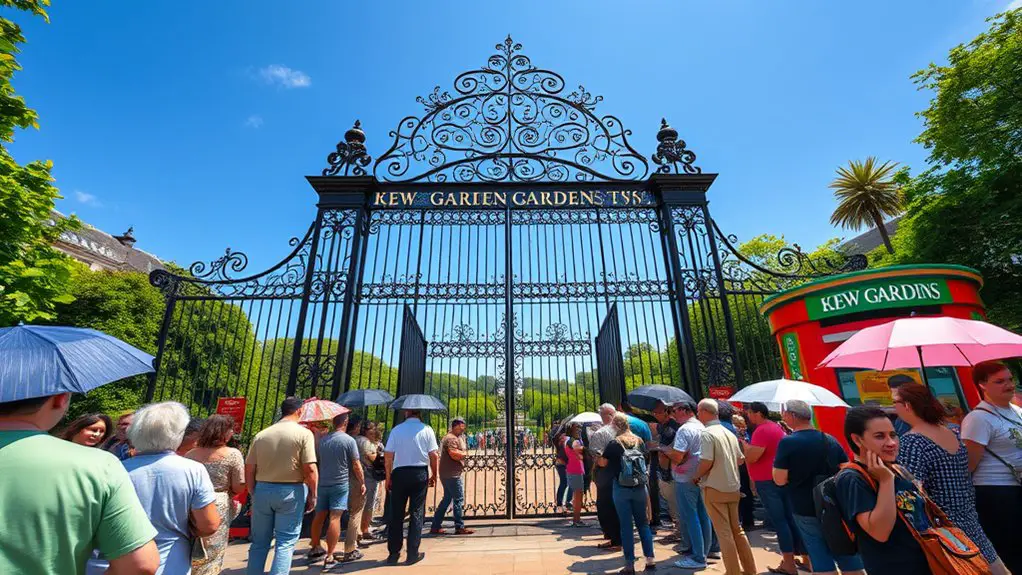
You can currently buy standard daytime Kew Gardens admission either online or at the entrance gates. Kew states that online booking gives the best-value tickets, so advance purchase is useful even when a normal daytime visit does not require a special attraction time slot.
For the Great British Summer Savings period running from June 25 through September 1, 2026, Kew currently lists these standard daytime prices:
- Adult: £21.85 online or £24.50 at the gate.
- Child aged 4–15: £1.75 online or £3.50 at the gate.
- Children under 4: free.
Prices change by season, and concessions or special schemes may apply. Check the official Kew Gardens tickets and prices page immediately before booking rather than relying on an older price list.
Bring your ticket on your phone or as a printout, plus any ID or evidence required for a concession ticket.
If your party contains 15 people or more, Kew currently offers group admission rates and separate group-booking arrangements. Smaller groups can use ordinary online tickets.
Standard garden entry includes a large number of Kew’s everyday attractions, but separately programmed events can have their own ticket or time-slot rules. Christmas at Kew, for example, requires separate event admission. Always check the event page when your trip revolves around a festival, exhibition, or evening experience.
Must-See Attractions at Kew Gardens
Kew’s scale means you do not need to see every corner to have a worthwhile visit. First-time visitors can build a strong route around the major glasshouses, Arboretum, and one or two family, art, or heritage attractions.
Iconic Glasshouse Highlights
- The Palm House: Kew’s famous Victorian tropical glasshouse dates from the 1840s and uses the curved iron-and-glass engineering associated with its shipbuilding-inspired construction.
- The Temperate House: The world’s largest Victorian glasshouse contains plants from temperate regions across Africa, the Americas, Asia, and Australasia, including rare and threatened species.
- The Princess of Wales Conservatory: This glasshouse contains ten contrasting environmental zones, ranging from tropical conditions to dry desert habitats.
Glasshouses are among Kew’s most popular attractions, but their opening times can be shorter than the main Gardens’ hours.
Exotic Plant Collections
Kew’s living collections let you see plants from rainforests, deserts, temperate forests, aquatic habitats, and other ecosystems without leaving London.
The titan arum, famous for the strong odour released during its rare bloom, is cultivated at Kew and is sometimes displayed in the Princess of Wales Conservatory. Because individual plants bloom unpredictably and displays change, do not plan a visit expecting to see one flowering.
Kew also maintains important aquatic collections, including giant waterlilies. Some aquatic specimens can be seen in the Princess of Wales Conservatory while other displays depend on seasonal growth and building availability.
Scenic Garden Walks
For outdoor exploration, three areas are especially useful for building an easy self-guided walk:
- The Arboretum: Kew’s vast tree collection stretches across roughly two-thirds of the Gardens and includes around 11,000 trees representing more than 2,000 species.
- Rhododendron Dell: A quieter landscape of mature rhododendrons and winding paths, usually at its colourful best in April and May.
- The lake and surrounding landscape: A relaxed outdoor option for visitors who want open views and a break between glasshouses and busier attractions.
Current Closure Note: As of July 25, 2026, Kew lists the Waterlily House as closed for renovation and the Treetop Walkway lift as closed for essential maintenance. Check planned closures and visitor notices before travelling because conditions can change.
Simple First-Time Kew Gardens Itineraries
Three- to Four-Hour Visit
Enter at Victoria Gate, visit the Palm House, continue toward the Princess of Wales Conservatory, then cross to the Temperate House. Use your remaining time for part of the Arboretum or another nearby seasonal highlight before returning to your chosen exit.
Half-Day Visit
Add a longer Arboretum walk, the Treetop Walkway when access allows, and a café or picnic stop. Families can substitute the Children’s Garden and The Hive for one of the longer botanical walks.
Full-Day Visit
A full day lets you combine the three major glasshouses with the Arboretum, family attractions, galleries or heritage buildings when open, a guided tour if available, and a slower lunch. Check attraction closing times before leaving a late-afternoon priority until the end.
Family-Friendly Activities and Facilities
Kew has several attractions that work particularly well for children rather than treating the entire visit as a long garden walk.
The Children’s Garden is designed for children aged 2–12 and uses climbing, running, balancing, and exploration to introduce what plants need to grow. Kew currently says no advance booking is required for ordinary daytime access, although the area can become busy during school holidays.
The Hive is a 17-metre-tall installation inspired by the life of a real bee colony, while the Treetop Walkway rises 18 metres above the ground and gives visitors a canopy-level view of Kew’s trees.
The Treetop Walkway has 118 steps and may close in poor weather or for maintenance. Buggies must be left at ground level. Check accessibility arrangements if a lift is essential.
Kew also operates family trails and seasonal activities throughout the year. These change regularly, so check the current family programme rather than relying on an old event schedule.
Dining and Refreshment Options
You can eat at several locations inside Kew Gardens or bring your own picnic. Current venues include:
- The Orangery: A casual option for breakfast, hot food, drinks, cakes, and lighter meals.
- Pavilion Bar and Grill: A larger food stop near the southern part of the Gardens, serving lunch alongside drinks, cakes, and snacks.
- Victoria Plaza Café: Convenient for coffee, cakes, sandwiches, and snacks near Victoria Gate.
- Family Kitchen & Shop: A family-focused food hall with options including pizza, sandwiches, salads, and ice cream.
- The Botanical Brasserie: A more formal option offering breakfast, lunch, and afternoon tea; a garden admission ticket is required before booking a table.
Opening hours vary by venue and some restaurants may close early for events or maintenance. Check Kew’s current eating and drinking information before planning a meal around a specific restaurant.
Picnics are allowed throughout the Gardens. Kew asks visitors to use grassy areas and not bring barbecues or picnic furniture. A picnic can be a useful option on a busy day when restaurant queues are longer.
Accessibility at Kew Gardens
Kew describes the Gardens as largely flat, with tarmac paths in most areas, but individual historic buildings and attractions have different restrictions.
- Manual wheelchairs are available in limited numbers at public entrance gates without advance booking.
- Mobility scooters can be borrowed if booked in advance and are currently available from Brentford, Victoria, and Elizabeth Gates.
- The Temperate House and Alpine House accept wheelchairs and mobility scooters.
- The Palm House is wheelchair accessible but does not admit mobility scooters.
- The Princess of Wales Conservatory accepts wheelchairs and mobility scooters, but its upper floor is not accessible to them.
- Accessible toilets are available near major attractions, cafés, and gates.
- Recognised guide, assistance, and service dogs are welcome.
Visitors with mobility, sensory, or other access requirements should review Kew’s current accessibility information and map before choosing an entrance and route.
Guided Tours at Kew Gardens
Kew offers seasonal guided walking tours led by experienced guides, with selected tours included in garden admission. Subjects and schedules change through the year, and places can be limited.
Specialist accessible tours, including British Sign Language and sensory tours, are also offered on selected dates. Larger groups can arrange private guided walking tours separately.
Check Kew’s current programme on the day of your visit rather than assuming a particular tour runs every day.
Tips for a Comfortable and Enjoyable Visit
Check the weather before leaving because a large part of Kew is outdoors. Comfortable walking shoes are more useful than formal footwear, even if your main priorities are indoor glasshouses.
Bring a lightweight waterproof layer when rain is possible, and use sunscreen and a hat during warm, bright weather. A refillable water bottle is useful for longer visits.
Download or review a garden map before arriving and identify your top three or four attractions. Kew’s size makes constant backtracking tiring, especially with children or anyone who has limited mobility.
There are no lockers or baggage-storage facilities inside the Gardens, so avoid arriving with large luggage. Kew currently directs visitors toward third-party storage services outside the Gardens when necessary.
Pets should be left at home. Kew welcomes recognised guide, assistance, and service dogs, including qualifying assistance dogs in training.
Bicycles, scooters, skateboards, roller skates, and similar vehicles normally have to remain outside the Gardens. Smoking and vaping are prohibited.
Children aged 16 and under must be accompanied by an adult, and adults should supervise children closely around Kew’s ponds and other deep bodies of water.
Pro Tip: Take a photo of the garden map or mark your preferred exit when you arrive. The gate closest to your final attraction may not be the gate closest to the station, bus stop, or car park you need for the journey home.
Frequently Asked Questions
Are pets allowed inside Kew Gardens?
No. Kew asks visitors to leave ordinary pets at home. Recognised guide, assistance, and service dogs are welcome, including recognised assistance dogs in training. They should remain under control and identifiable as working assistance animals.
Is there Wi-Fi available throughout Kew Gardens?
Do not rely on continuous Wi-Fi coverage across the outdoor Gardens. Kew provides visitor Wi-Fi in its buildings for some visitor and event uses, but the 320-acre site contains large outdoor areas where connectivity can vary. Download tickets, maps, and important journey information before arriving.
Can I bring my own food and drinks into Kew Gardens?
Yes. Kew allows picnics throughout the Gardens. Use grassy areas and follow the site’s current visitor rules. Barbecues and picnic furniture are not permitted, and you should take rubbish home or place it in the bins provided.
Are guided tours available at Kew Gardens?
Yes. Kew runs seasonal guided walking tours, with selected tours included in admission. Private group tours and accessible tours are also available in some circumstances. Programmes and times change, so check the current Kew schedule before your visit.
Is Kew Gardens accessible for visitors with disabilities?
Much of Kew is accessible, with largely flat grounds, tarmac paths, accessible toilets, wheelchairs at entrance gates, and bookable mobility scooters. However, access differs inside historic buildings and glasshouses, and Kew Gardens station itself has platform-specific step-free limitations. Review Kew’s accessibility map and TfL journey information before travelling.
How long should I spend at Kew Gardens?
Allow about three to four hours for a focused first visit covering the main glasshouses and a short outdoor walk. A full day is better if you want the Arboretum, family attractions, galleries, guided activities, or a relaxed lunch without rushing.
Which entrance is closest to Kew Gardens station?
Victoria Gate is the closest main entrance to Kew Gardens station. Kew lists the station at about 500 metres from the gate. Elizabeth Gate is more convenient for Kew Bridge station, while Brentford Gate serves the visitor car park.
Conclusion
A good Kew Gardens visit starts with three decisions: when you are going, which gate you will use, and which attractions matter most. Book online for the best current admission value, use public transport when practical, and check live opening times and closures shortly before leaving. With comfortable shoes and a realistic half-day or full-day route, you can enjoy Kew’s glasshouses, tree collections, family attractions, and seasonal displays without spending the day rushing from one end of the Gardens to the other.
Sources
- Royal Botanic Gardens, Kew — Getting Here — gates, stations, bus routes, parking, cycling, and river access.
- Royal Botanic Gardens, Kew — Tickets and Prices — current admission options and 2026 pricing.
- Royal Botanic Gardens, Kew — Opening and Closing Times — seasonal garden and attraction hours.
- Royal Botanic Gardens, Kew — Planned Closures — current attraction and access notices.
- Royal Botanic Gardens, Kew — Accessibility — wheelchair, mobility scooter, accessible parking, toilets, and attraction access.
- Royal Botanic Gardens, Kew — Dos and Don’ts — pets, picnics, bicycles, smoking, child supervision, and visitor rules.
