

Last Updated on September 11, 2026 by Daniel Globe
How far was Egypt from Canaan? There is no single exact number because both Egypt and Canaan covered large regions rather than single points on a map. A journey from the eastern Nile Delta into southern Canaan could cover a few hundred kilometers depending on the starting point, destination, and route. The Bible’s main point is even clearer: Israel did not take the shortest road, and the 40-year wilderness period was not simply the time required to walk from Egypt to Canaan.
Quick Answer
The Bible does not give one exact mileage from Egypt to Canaan. A commonly repeated estimate of 200 miles equals about 322 kilometers, not 623 kilometers. Exodus says Israel avoided the shorter road through Philistine territory, while the 40-year wilderness period was tied to the biblical story of rebellion, judgment, and wandering rather than normal travel time.
Key Takeaways
- 200 miles is about 322 kilometers; 623 kilometers is about 387 miles.
- The Bible never states an exact Egypt-to-Canaan mileage because the places involved are regions, not single coordinates.
- Exodus 13:17 says Israel did not take the shorter road through the land of the Philistines.
- Numbers 14 connects the 40 years with the spy episode and Israel’s rebellion, not with the physical distance alone.
- The King’s Highway appears later in the journey when Israel asked to pass through Edom; Edom refused.
Disclosure: As an Amazon Associate I earn from qualifying purchases. Some links on this page are affiliate links, at no extra cost to you.
How Far Is Egypt From Canaan?
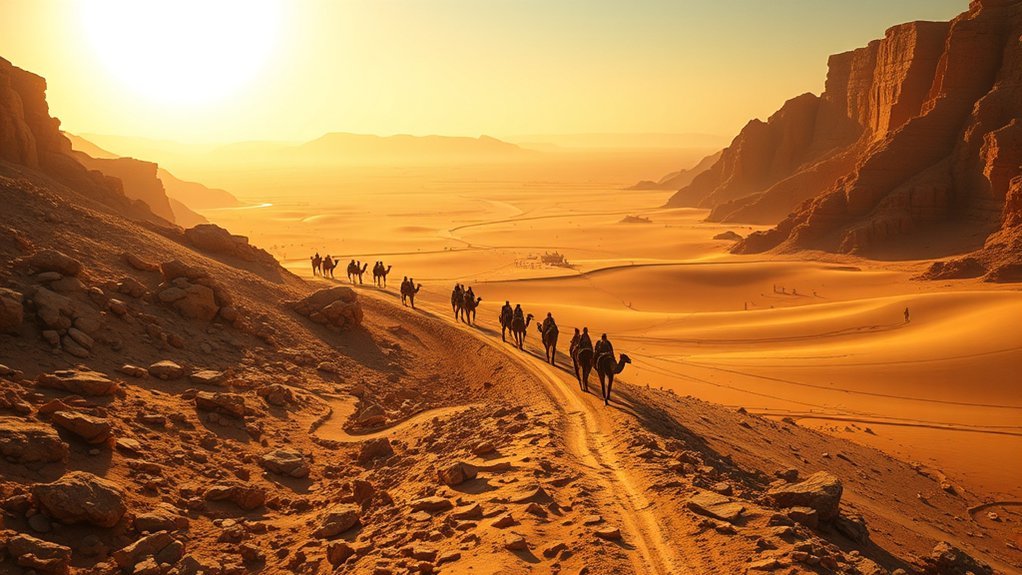
There is no single precise answer to how far Egypt is from Canaan. Ancient Egypt stretched along the Nile, while Canaan referred to a broad area of the southern Levant. The mileage therefore changes depending on whether you measure from the eastern Nile Delta to Gaza, farther inland toward the hill country, or to another part of Canaan.
One correction is essential: 200 miles is approximately 322 kilometers, not 623 kilometers. Likewise, 623 kilometers is roughly 387 miles. Because the Bible does not provide a single Egypt-to-Canaan mileage, it is safer to treat any modern distance figure as an estimate based on selected endpoints rather than as a biblical measurement.
What the Bible Actually Says About the Distance
Exodus 13:17–18 does not give miles or kilometers. Instead, it says that the road through the land of the Philistines was the nearer route, but Israel was led another way toward the wilderness. That makes the route choice more important to the biblical account than a modern straight-line distance calculation.
Note: Modern scholars can identify some ancient roads between Egypt and southern Canaan, but many specific locations in the Exodus itinerary remain debated. The biblical story and a modern archaeological route reconstruction should not be treated as exactly the same thing.
The Main Route From Egypt to Canaan
The most direct ancient road from northeastern Egypt toward southern Canaan ran across northern Sinai toward Gaza. Egyptian sources describe a fortified route often called the Ways of Horus, and scholars commonly connect this general corridor with the biblical “way of the land of the Philistines” in Exodus 13:17.
The biblical narrative says Israel did not take that shorter northern road. Instead, the story leads the people toward the wilderness and later records a long series of camps and movements through places including Succoth, Etham, Marah, Sinai or Horeb, Kadesh Barnea, areas around Edom, and finally the plains of Moab.
- Northern coastal road: The shorter corridor from Egypt toward Gaza and southern Canaan.
- Wilderness route: The route described in Exodus after Israel turns away from the shorter Philistine road.
- Kadesh Barnea: A major staging point in the biblical wilderness narrative.
- Transjordan: The later part of the journey east of the Jordan and Dead Sea region, where Edom, Moab, the Zered, the Arnon, and the King’s Highway become relevant.
This distinction matters because the original journey should not be pictured as one continuous march along a single highway. The biblical itinerary contains different geographical stages separated by camps, delays, conflicts, and long periods of wandering.
Why the Sinai Route Took 40 Years?
According to the biblical narrative, the 40 years were not required because Egypt and Canaan were physically 40 years apart. The decisive explanation appears in Numbers 13–14. After twelve spies explored Canaan for 40 days, most returned with a discouraging report. The people rebelled and refused to trust that they could enter the land.
Numbers 14:26–35 connects the wilderness period with that episode, describing 40 years corresponding to the 40 days of exploration. The story therefore presents the long delay primarily as a period of judgment and generational transition rather than as a problem of walking speed.
The 40 years are a biblical chronology of wilderness wandering and judgment, not a calculation of how long it normally takes to walk from Egypt to Canaan.
There is also an important 38-year figure. Deuteronomy 2:14 says 38 years passed from the departure from Kadesh Barnea until the crossing of the Zered Valley. That is a specific interval within the broader wilderness chronology; it should not be described as a separate “38-year decree.”
The Exodus Route on the King’s Highway
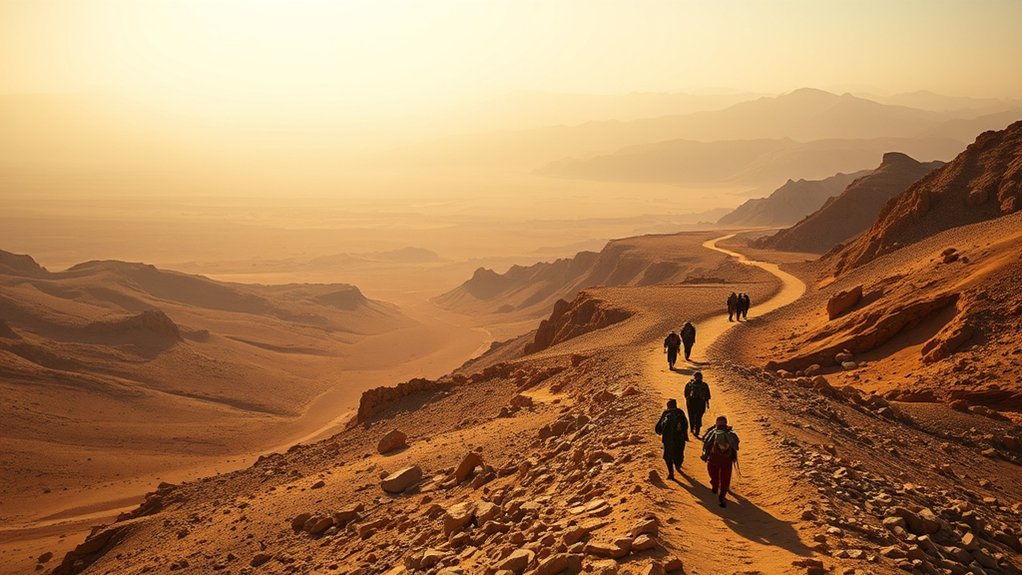
The King’s Highway belongs to a later stage of the biblical journey and should not be described as the main direct road from Egypt to Canaan. Historically, the name is associated with a north-south route through Transjordan, roughly east of the Dead Sea and Jordan Valley.
In Numbers 20:14–21, Moses sends messengers from Kadesh asking the king of Edom for permission to cross his territory using the King’s Highway. Edom refuses, forcing Israel to turn away rather than simply marching through Edomite territory.
| Location | Biblical Role | What Happened |
|---|---|---|
| Kadesh Barnea | Major wilderness staging point | Israel approached Edom from this area |
| Edom | Territory crossed by the King’s Highway | Permission to pass was refused |
| Route around Edom | Alternative movement | Israel turned away from the blocked passage |
| Moab and the Arnon region | Later Transjordan stage | The journey continued north toward the Jordan |
Archaeological and historical research also places the King’s Highway in the Transjordanian road network. A Cambridge University Press study describes a north-south corridor extending from the Aqaba or Ma‘an area toward northern destinations and passing important settlements in what is now Jordan. That is very different from the northern-Sinai road linking Egypt with Gaza.
Desert Travel Challenges in the Exodus
The biblical wilderness story includes repeated problems involving water, food, difficult terrain, uncertain movement, and the needs of a large traveling community. Exodus describes bitter water at Marah, lack of water at later camps, food complaints, and extended periods of camping rather than uninterrupted marching.
Desert and semi-desert travel would also require careful management of water, animals, supplies, and routes. However, it is important not to use those environmental difficulties to explain the entire 40-year period. In the biblical account, the decisive reason for the long wilderness chronology is theological and tied to the events in Numbers 13–14.
The geography also changes as the story progresses. The Zered and Arnon belong to the later Transjordan stage near Moab, not to the Sinai Peninsula. Keeping those stages separate makes the route much easier to understand.
Pro Tip: When reading an Exodus map, first separate the journey into three broad stages: departure from Egypt and northern Sinai, the wilderness/Kadesh period, and the later approach through Transjordan toward the Jordan River.
How Long the Journey Really Took
In the biblical narrative, Israel’s wilderness period lasted 40 years. That does not mean it took 40 years of walking to cover the geographical distance from Egypt to Canaan. The story includes prolonged camps, repeated movements, a failed attempt to enter Canaan, wandering, and a later northward approach from Transjordan.
A useful comparison appears in Deuteronomy 1:2, which describes the ordinary journey from Horeb to Kadesh Barnea by way of Mount Seir as an eleven-day journey. That verse does not give the distance from Egypt to Canaan, but it does show why the 40 years cannot reasonably be treated as ordinary travel time.
Route Length and Terrain
The original article’s repeated figure of 623 kilometers should not be treated as the established straight-line distance from Egypt to Canaan. The answer depends on which ancient Egyptian starting point and which Canaanite destination are selected.
What we can say with greater confidence is that:
- the eastern Nile Delta lay relatively close to the southwestern edge of Canaan;
- a direct northern route toward Gaza existed in antiquity;
- Exodus 13 says Israel did not take that nearer road;
- the biblical itinerary later reaches Sinai or Horeb, Kadesh, Edom, Moab, and the Jordan region;
- many specific Exodus place identifications remain disputed.
The ground certainly mattered. Northern Sinai, wilderness regions, hill country, wadis, and the highlands east of the Dead Sea all presented different travel conditions. But terrain should be discussed separately from the biblical reason given for the 40-year delay.
Extended Wilderness Delay
The extended wilderness period follows the spy episode in Numbers. The people reach the edge of the land, hear the report of the spies, and refuse to enter. The narrative then describes a generation remaining in the wilderness while Joshua and Caleb are singled out as exceptions.
Deuteronomy later gives another chronological marker: 38 years from Kadesh Barnea to the crossing of the Zered Valley. Taken together, these passages provide a better timeline than dividing a guessed geographical distance by 40.
Pace of the Journey
It is misleading to say the Israelites averaged 15 kilometers per year, one kilometer per month, or 43 meters per day. Those numbers assume continuous forward travel across one fixed 623-kilometer route. That is not how the biblical story describes the wilderness period.
A better way to understand the chronology is through the time markers the text actually gives:
- 40 days: the time the spies explored Canaan.
- 40 years: the wilderness period associated with that episode in Numbers 14.
- 38 years: the interval from Kadesh Barnea to the Zered crossing in Deuteronomy 2:14.
- 11 days: the stated ordinary journey from Horeb to Kadesh Barnea in Deuteronomy 1:2.
Those figures make an important point: the long chronology is about much more than physical mileage.
What the Exodus Route Means for Us

From a faith-based reading, the Exodus route can represent more than movement from one region to another. The biblical story presents a people learning dependence, obedience, patience, and identity during a long wilderness period. Those theological lessons are meaningful, but they should be distinguished from questions about exact mileage or archaeological reconstruction.
Journey Shaped By Trust
The Exodus story repeatedly connects the wilderness with trust. Israel experiences uncertainty, shortages, conflict, and fear while also receiving provision and instruction. For readers approaching the text devotionally, the journey can show how trust develops through situations in which the destination is known but the path is not easy.
- You can see how fear influenced major decisions.
- You can see how dependence developed in the wilderness.
- You can see how the covenant and Law helped shape community identity.
- You can see why reaching Canaan involved more than simply crossing geographical distance.
This is a theological application of the narrative rather than a measurement of the route, and keeping that distinction clear strengthens both the historical and spiritual discussion.
Patience Over Shortcut
The biblical story begins with a striking route choice: the nearer road through Philistine territory is not taken. Later, the wilderness years become associated with Israel’s own response to fear and unbelief. For a devotional reader, that creates a theme of patience over shortcuts.
It does not mean every delay in life is divinely imposed or that every long path is a punishment. Rather, the story can encourage reflection on how preparation, trust, and choices affect a journey toward a goal.
Prepared For Promise
By the end of the wilderness narrative, a new generation stands near the Jordan preparing to enter Canaan. That generational transition is central to the biblical story. The emphasis is not that Israel needed 40 years to physically walk the distance, but that the people who eventually approached Canaan were not the same generation that had originally refused to enter.
- The wilderness becomes a place of testing.
- The Law shapes communal life.
- Leadership passes toward a new generation.
- Joshua and Caleb remain important examples of trust within the narrative.
Why the Israelites Were Not Ready for Canaan
The phrase “not ready” is a useful summary, but Numbers 14 is more specific. The biblical account emphasizes fear, rebellion, unbelief, and refusal to enter the land after the spies returned. The people even speak of returning to Egypt rather than proceeding into Canaan.
The resulting wilderness period is therefore presented as judgment as well as generational transition. From a devotional perspective, readers may also see it as a period in which Israel’s identity, laws, worship, and dependence on God were formed. Those reflections fit the theological message of the article, but they should not replace the explicit reason given in the biblical text.
Why the Exact Exodus Route Is Uncertain
Maps of the Exodus often look precise, but modern scholarship cannot securely identify every place named in the narrative. Proposed locations for the Sea crossing, Mount Sinai, and several wilderness stations differ, sometimes substantially.
A Society of Biblical Literature scholarly treatment notes that attempts to identify Mount Sinai face serious geographical and literary problems, while another SBL-hosted discussion points out that archaeology cannot reconstruct the complete Exodus route as a securely documented historical itinerary.
Note: It is reasonable to discuss the route described by the biblical text. It is less accurate to present one modern map, one mileage figure, or one proposed location of Mount Sinai as universally settled fact.
Frequently Asked Questions
How Far Is It From Egypt to Canaan According to the Bible?
The Bible does not give an exact mileage or kilometer figure from Egypt to Canaan. Exodus 13:17 only indicates that the road through Philistine territory was the nearer route. Any modern distance estimate depends on which points in Egypt and Canaan are selected.
How Much Distance Is It From Egypt to Canaan?
There is no single universal distance because Egypt and Canaan were regions. A rough figure such as 200 miles may describe some chosen endpoints, but 200 miles equals about 322 kilometers, not 623 kilometers. The actual route could be longer depending on the destination and path used.
How Long Was the Trip From Canaan to Egypt for Joseph’s Brothers?
Genesis 42 says Joseph’s brothers traveled from Canaan to Egypt to buy grain, but it does not say how many days the journey took. Any specific travel-time estimate is therefore a modern reconstruction rather than a figure stated in Scripture.
Was Canaan Close to Egypt?
Relatively speaking, yes. Southern Canaan was connected with northeastern Egypt by well-established ancient roads across northern Sinai. Trade and military movement between Egypt and Canaan occurred long before the period described in the Exodus narrative.
Did the Israelites Take the King’s Highway From Egypt?
Not as a direct road out of Egypt. Numbers 20 places the King’s Highway later in the story when Israel asked Edom for permission to travel through its territory. Edom refused, so Israel turned away and followed another route.
Why Did the Journey Take 40 Years If Canaan Was Nearby?
According to Numbers 14, the 40 years were connected with Israel’s refusal to enter Canaan after the spies returned. The period is therefore presented as wilderness judgment and generational transition, not as the normal amount of time required to walk from Egypt to Canaan.
Conclusion
So, how far was Egypt from Canaan? The safest answer is that there was no single biblical mileage. The distance depended on the endpoints and route, and the often-repeated equation of 200 miles with 623 kilometers is incorrect. More importantly, the biblical story does not say the Israelites needed 40 years simply because the road was long.
Exodus says they avoided the nearer road through Philistine territory. Numbers connects the 40-year wilderness period with the spy episode and Israel’s rebellion. Deuteronomy later records 38 years from Kadesh Barnea to the Zered crossing, while the King’s Highway appears during the later approach through Edom and Transjordan. Read carefully, the journey is about geography, history, and—within the biblical narrative—faith, judgment, formation, and preparation.
Sources
- Bible Gateway — Exodus 13:17–18 — supports the statement that Israel did not take the nearer road through Philistine territory.
- Bible Gateway — Numbers 13–14 — supports the 40-day spy episode and the 40-year wilderness judgment.
- Bible Gateway — Deuteronomy 1:2 and 2:14 — supports the eleven-day Horeb-to-Kadesh comparison and the 38-year Kadesh-to-Zered interval.
- Bible Gateway — Numbers 20:14–21 — supports Israel’s request to use the King’s Highway through Edom and Edom’s refusal.
- Society of Biblical Literature — scholarly discussion of Exodus geography — supports the uncertainty surrounding the precise location of Mount Sinai and reconstruction of the wilderness itinerary.
- Cambridge University Press — Against Moab — supports the location and north-south character of the King’s Highway in Transjordan.
