

Last Updated on July 26, 2026 by Daniel Globe
“Hotel California” is the Eagles’ best-known recordings and one of the defining rock songs of the 1970s. It first appeared as the opening track of the band’s Hotel California album on December 8, 1976, before being released as a single in February 1977. Behind its mysterious hotel imagery is a carefully constructed song about excess, disillusionment, fame, and what Don Henley has called the darker side of the American dream.
Quick Answer
“Hotel California” was performed by the Eagles, with Don Henley singing lead vocals. Don Felder created the original instrumental idea, while Felder, Henley, and Glenn Frey received songwriting credit. The album arrived in December 1976, and the song became a No. 1 U.S. single in 1977.
Key Takeaways
- The Eagles recorded “Hotel California,” with Don Henley on lead vocals.
- Don Felder developed the instrumental demo; Felder, Henley, and Glenn Frey share the songwriting credit.
- The album was released December 8, 1976; the title track followed as a single in February 1977.
- The song is in B minor, runs about 6 minutes 31 seconds on the album, and ends with Don Felder and Joe Walsh trading and harmonizing guitar lines.
- Don Henley has described its themes as a journey from innocence to experience and an examination of excess, narcissism, the music business, and the darker side of the American dream.
How “Hotel California” Was Written
The documented origin of “Hotel California” begins with guitarist Don Felder rather than with a road trip by the three songwriters. Felder developed an instrumental demo that featured the chord progression and guitar ideas that would become the foundation of the finished song.
Felder later gave the demo to Don Henley and Glenn Frey. Henley and Frey developed the lyric concept and vocal melody, turning the instrumental into a cinematic story about a traveler entering an alluring but increasingly unsettling world. Felder, Henley, and Frey ultimately received songwriting credit.
The instrumental idea had a Latin-leaning feel. During its development, the band referred to it with the working title “Mexican Reggae,” a useful clue to the rhythmic character beneath the polished rock arrangement.
The result combined Felder’s musical framework with Henley and Frey’s interest in Los Angeles, ambition, celebrity, excess, and lost innocence. That combination is central to understanding why the song feels inviting and ominous at the same time.
The Song’s Impact on the Music Industry
“Hotel California” became one of the Eagles’ biggest commercial achievements. Although the album version runs more than six minutes, the song still reached No. 1 on the U.S. Billboard Hot 100 in May 1977.
Its success is more useful as evidence that an unusually long, carefully arranged rock single could become a major mainstream hit than as proof that the song single-handedly changed radio programming. Long rock tracks already existed, but “Hotel California” became an especially visible example of ambitious album-era production succeeding on pop radio.
The recording also strengthened the Eagles’ reputation for highly controlled studio work, detailed vocal arrangements, and layered guitars. That sound became closely associated with polished American rock in the late 1970s.
The Recording Academy awarded “Hotel California” the 1978 Grammy Award for Record of the Year.
The Lyrics and Meaning of “Hotel California”
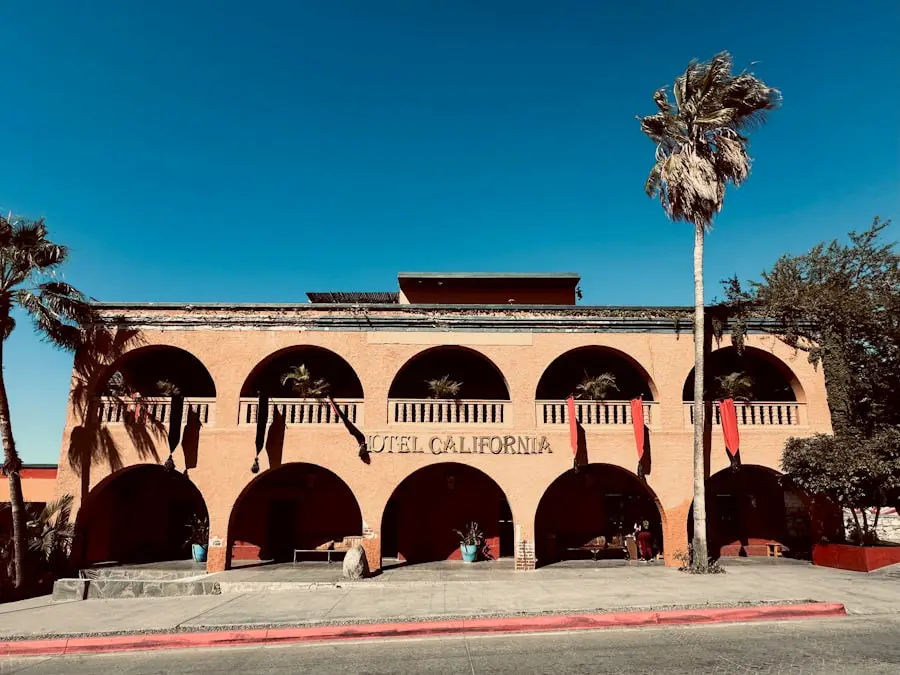
The lyrics present a traveler moving from curiosity and attraction into unease and entrapment. Rather than giving listeners a literal explanation of the mysterious hotel, the song uses the setting as an extended symbol.
Don Henley has repeatedly resisted the idea that there is one narrow interpretation. In a CBS News interview, he described the song as a journey from innocence to experience and connected it with the darker side of the American dream, excess, narcissism, and the music business.
That explanation fits the contrast at the center of the song. The hotel first appears desirable: luxurious, mysterious, and full of possibility. Gradually, the same environment begins to feel restrictive. Success and pleasure have turned into something harder to escape.
Note: The Eagles have not presented “Hotel California” as a literal account of one real hotel. Henley’s own explanations point toward a symbolic story about America, Los Angeles, fame, excess, and loss of innocence.
Listeners can therefore read the hotel in several compatible ways: as the high life in Los Angeles, the machinery of the entertainment business, personal temptation, or a broader American culture in which success can carry costs that were invisible at the beginning.
The Musical Composition and Arrangement
| Album Track Length | 6 minutes 31 seconds |
| Original Published Key | B minor |
| Approximate Tempo | About 76 BPM, moderate rock |
| Lead Vocal | Don Henley |
| Songwriters | Don Felder, Don Henley, Glenn Frey |
| Producer | Bill Szymczyk |
Musically, “Hotel California” is built around a repeating chord sequence in B minor. Licensed Musicnotes sheet music identifies the original published key as B minor and gives a moderate-rock tempo of about 76 beats per minute.
The arrangement is far more layered than a simple count of “10 instruments” suggests. Don Felder contributed 12-string and electric-guitar work, Glenn Frey also played 12-string guitar, Randy Meisner played bass, Don Henley handled drums, percussion, and lead vocals, and Joe Walsh contributed electric guitar. The recording also uses backing vocals and multiple guitar layers.
The famous ending belongs to both Felder and Walsh. They trade lead phrases and then join in harmonized guitar lines, creating the extended closing passage that became one of the recording’s defining features.
The album version is listed at 6:31 on Apple Music, making its success as a mainstream single particularly notable for the period.
Products Worth Considering


The Recording Process and Production
Producer Bill Szymczyk oversaw a recording process that was much more complicated than a single session at Criteria Studios. The song went through different recording attempts in Los Angeles and Miami as the band adjusted its arrangement, tempo, and vocal key.
The composition had originally been conceived in a higher key, but the final recording was brought down to B minor to better fit Henley’s lead vocal. Accounts from Henley, Felder, and Szymczyk describe repeated takes and careful editing before the master was completed.
The released recording was assembled with unusually meticulous analog editing. Szymczyk has described the master as containing dozens of tape edits drawn from several takes. That level of precision helps explain why the track sounds controlled even though its arrangement contains many overlapping guitar parts and vocal layers.
Felder and Walsh also spent considerable effort refining the ending. Their parts do not simply consist of one guitarist improvising while the other accompanies him. The two players alternate phrases before joining together, creating a deliberate two-guitar arrangement.
Products Worth Considering

Brand New in box. The product ships with all relevant accessories

Take It Easy

The Album “Hotel California”

The Eagles released Hotel California, their fifth studio album, on December 8, 1976. It was the band’s first studio album featuring Joe Walsh and the last Eagles studio album to feature founding bassist Randy Meisner.
The nine-track record opens with “Hotel California” and also includes “New Kid in Town,” “Life in the Fast Lane,” “Wasted Time,” “Victim of Love,” “Pretty Maids All in a Row,” “Try and Love Again,” and “The Last Resort.”
The album did not debut at No. 1 on the Billboard 200. It entered high on the chart and subsequently reached No. 1, ultimately accumulating eight weeks at the top rather than remaining there for eight uninterrupted weeks.
Its commercial standing has continued to grow. The Recording Industry Association of America lists a new certification for the album dated January 22, 2026. That recertification raised Hotel California to 28-times Platinum in the United States.
As of January 2026, Hotel California is certified 28× Platinum by the RIAA, decades after its original 1976 release.
The Song’s Legacy and Cultural Impact
The song’s legacy rests on several accomplishments that are easier to document than broad claims about it transforming the entire music industry. It became a No. 1 single, earned the Grammy Award for Record of the Year, became a centerpiece of the Eagles’ live shows, and remained closely associated with the band for decades.
Its narrative also helped distinguish it from a conventional love song or straightforward rock anthem. The listener enters a detailed fictional scene without being given a simple explanation of what every character and object represents. That ambiguity has helped generate continuing discussion about the song’s meaning.
The guitar arrangement has had an equally strong afterlife. Felder and Walsh’s closing interplay is frequently singled out by guitarists because it combines melodic lead playing, call-and-response phrasing, and harmonized lines rather than relying on one extended soloist.
The song also survived a major change in listening habits. Its original audience encountered it through radio, vinyl, and live performances; later generations encountered the same recording through CDs, digital downloads, streaming services, film, television, and online video.
Cover Versions and Adaptations
“Hotel California” has been interpreted by many performers in different styles. One of the best-known adaptations is by the Gipsy Kings, whose arrangement reshapes the song with their distinctive flamenco-influenced sound.
That version gained an additional life through the 1998 film The Big Lebowski. The film uses the Gipsy Kings recording rather than the original Eagles studio version, an important distinction when discussing the song’s film history.
Acoustic, instrumental, orchestral, and genre-crossing performances have also appeared over the years. Those adaptations work partly because the song has a highly recognizable harmonic progression and melody even when the familiar Eagles production is stripped away.
Rather than treating every cover as evidence of a specific cultural trend, the safer conclusion is that musicians continue to reinterpret the composition because its chord sequence, narrative atmosphere, and guitar-centered arrangement remain recognizable across very different performance styles.
Products Worth Considering

Big Lebowski Soundtrack
The Eagles’ Live Performances of “Hotel California”
“Hotel California” became a central part of the Eagles’ concert repertoire, requiring the band to reproduce a studio arrangement containing several overlapping guitar parts in a live setting.
One especially well-known reinterpretation came with the Eagles’ 1994 reunion. The version released on Hell Freezes Over uses a markedly different acoustic-oriented introduction and arrangement while preserving the song’s core melody and dramatic ending.
The official Eagles release identifies the performance as recorded for MTV in 1994. The reunion itself was culturally significant because the group had spent years apart before returning with new recordings and live material.
Later performances have generally returned to the recognizable electric-guitar identity of the original while adapting the individual parts to changing touring lineups.
Controversies and Urban Legends Surrounding the Song
The song’s deliberately surreal imagery has encouraged theories that go far beyond what its writers have said. Claims have linked it to drug addiction, occult practices, Satanism, secret institutions, and supposedly hidden backward messages.
There is no good evidence that the recording was constructed as a satanic message or that its meaning depends on playing it backward. Those stories belong to the wider history of backmasking rumors that have surrounded many popular recordings.
The stronger interpretation comes from Henley’s own comments. He has connected “Hotel California” with loss of innocence, excess, narcissism, the music business, and the dark side of the American dream while also allowing listeners room for different interpretations.
Note: Fan interpretations can be interesting, but they should be separated from explanations actually given by the songwriters. There is no verified need for a satanic or supernatural explanation to understand the song.
“Hotel California” in Popular Culture
The song has appeared in film and television as well as countless references, parodies, performances, and discussions about 1970s popular culture.
The Big Lebowski prominently uses the Gipsy Kings cover of “Hotel California.” The original Eagles recording also appears in The Sopranos, including the Season 3 episode “Mr. Ruggerio’s Neighborhood,” where it plays during a scene involving Tony and Carmela Soprano.
Those uses demonstrate two different forms of cultural recognition: filmmakers can use either the Eagles recording itself or a dramatically altered cover while still expecting an audience to recognize the composition.
The song’s continuing visibility also reflects the contrast built into its premise. Luxury and success appear attractive on the surface, while the story gradually reveals a sense of restriction and disillusionment underneath. That tension remains easy to apply to stories about wealth, celebrity, ambition, and personal compromise.
“Hotel California” therefore endures not because every listener agrees on one literal explanation, but because the recording combines a memorable narrative, Don Henley’s lead vocal, a distinctive B-minor progression, carefully layered production, and Don Felder and Joe Walsh’s two-guitar ending with themes broad enough to invite interpretation.
If you’re planning a trip to California and want to immerse yourself in the music scene, you might also find this guide to universal travel adapters useful for keeping phones, headphones, and other devices charged while traveling.
Frequently Asked Questions
Who sang “Hotel California”?
The Eagles performed “Hotel California,” and drummer Don Henley sings the lead vocal on the original studio recording.
When was “Hotel California” released?
The song first appeared on the Eagles’ Hotel California album, released December 8, 1976. The title track was then released as a single in February 1977.
Who wrote “Hotel California”?
Don Felder, Don Henley, and Glenn Frey are the credited songwriters. Felder developed the instrumental foundation, while Henley and Frey played central roles in developing the lyrics.
What is the meaning behind “Hotel California”?
Don Henley has described the song as a journey from innocence to experience and connected it with excess, narcissism, the music business, and the darker side of the American dream. The hotel works primarily as symbolic imagery rather than as one confirmed real location.
Is Hotel California a real hotel?
The songwriters have not identified one real hotel as the literal setting of the song. Henley’s explanations instead describe a symbolic story about America, Los Angeles, success, excess, and loss of innocence.
Who plays the guitar solo in “Hotel California”?
Don Felder and Joe Walsh both play the famous closing guitar section. They trade lead phrases before joining in harmonized lines toward the end of the recording.
What key is “Hotel California” in?
The original published key is B minor. Licensed sheet music describes the tempo as moderate rock at roughly 76 beats per minute.
Has “Hotel California” won any awards?
Yes. “Hotel California” won the Grammy Award for Record of the Year at the 20th Annual Grammy Awards in 1978.
Sources
- Recording Academy — 1978 Record of the Year — verifies the Eagles’ Grammy win and producer credit.
- RIAA Gold & Platinum Database — verifies the album’s January 22, 2026 certification update.
- Apple Music — Hotel California — verifies the December 8, 1976 album date and 6:31 album-track runtime.
- CBS News — Don Henley on “Hotel California” — supports Henley’s explanation of the song’s themes.
- Musicnotes — Licensed “Hotel California” Sheet Music — supports the original published key and approximate tempo.
