
Last Updated on July 22, 2026 by Daniel Globe
Emirgan is a historic neighborhood on Istanbul’s European shore, blending Byzantine and Ottoman influences that show up in its architecture and its centerpiece: Emirgan Park. Best known for the springtime Tulip Festival, the district also holds three restored Ottoman-era pavilions, waterfront views of the Bosphorus, and quiet streets worth wandering well outside of tulip season.
Quick Answer
Emirgan is a Bosphorus-side district in Istanbul’s Sarıyer area, home to Emirgan Park — famous for the spring Tulip Festival and three historic Ottoman pavilions. It’s free to enter, reachable by bus or ferry, and worth visiting any season, not just April.
Key Takeaways
- Emirgan’s history stretches from a Byzantine cypress forest to an Ottoman-era estate named after its 17th-century owner.
- Emirgan Park holds three restored 19th-century pavilions — the Yellow, Pink, and White Köşks — now cafés and event spaces.
- The Tulip Festival’s informal roots go back to the 1960s, but the city officially relaunched it as a major event in 2006.
- The park is free, open roughly from early morning to late evening, and reachable by public bus or ferry from central Istanbul.
Disclosure: As an Amazon Associate I earn from qualifying purchases. Some links on this page are affiliate links, at no extra cost to you.
The Origins of Emirgan: A Byzantine Heritage
Long before it took its current name, the area now known as Emirgan was a forested stretch along the Bosphorus that Byzantine sources referred to as Kyparades, or the “Cypress Forest,” for the dense cypress groves that once covered it. Little physical evidence of that period survives above ground today, but the name and the wooded character of the park still trace back to that era.
The land later passed to Ottoman hands, and it’s from this transition — not from any surviving Byzantine ruins — that Emirgan draws most of what visitors actually see and walk through today.
The Ottoman Influence on Emirgan
Emirgan takes its name from Emir Güne Han, a Persian prince whose estate here was later acquired by the Ottoman statesman İsmail Paşa. Under Ottoman ownership the property grew into an imperial retreat, and by the 16th and 17th centuries the area had become closely associated with royal garden culture — a legacy still visible in the park’s landscaping today.
Highlights of that Ottoman-era layer:
- Garden design: Formal plantings and pond features that echo Ottoman imperial garden traditions.
- Three historic pavilions: The Yellow (Sarı Köşk), Pink (Pembe Köşk), and White (Beyaz Köşk) pavilions, all dating to the 1870s.
- Continuity of use: All three pavilions still operate today as public cafés and restaurants rather than sitting empty as museum pieces.
Emirgan Park: A Floral Wonderland
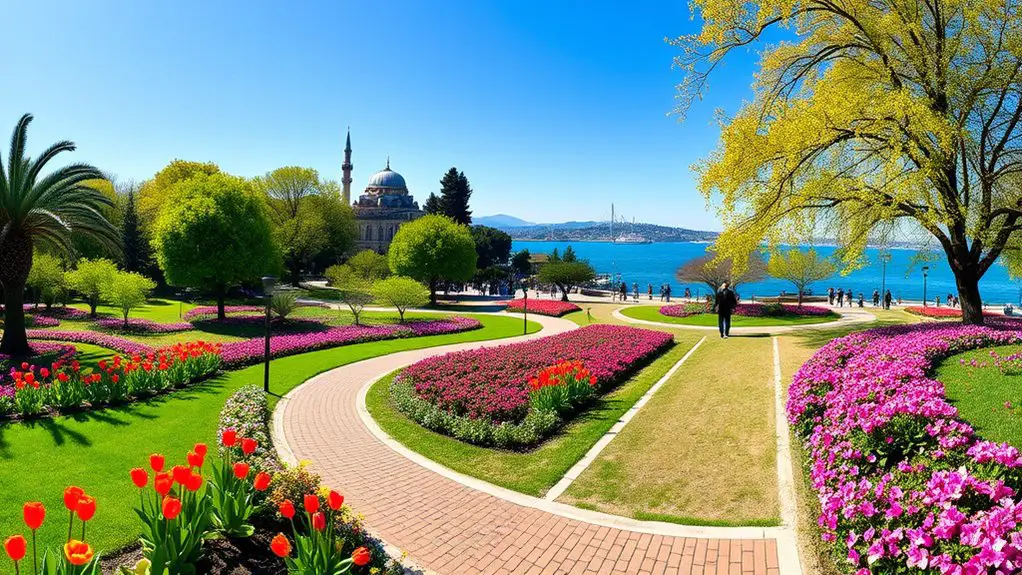
Emirgan Park sits directly on the Bosphorus and is best known for its tulip displays each spring, but it’s a genuine year-round green space — home to ash, horse chestnut, plane, and cedar trees, several ponds, a small artificial lake, and paths that wind through the hillside above the water.
| Activity | Description |
|---|---|
| Picnicking | Open lawns throughout the park are used for casual picnics |
| Photography | Tulip beds, ponds, and pavilion views are popular subjects |
| Walking Trails | Paved and dirt paths connect the park’s hillside sections |
| Pavilion Cafés | The Yellow, Pink, and White Köşks serve food and drinks |
| Cultural Events | The park hosts the Tulip Festival and periodic art shows |
The park is free to enter and generally open from around 5:30am to 10:30pm in summer (slightly earlier closing in winter), seven days a week.
Note: Tulips are widely associated with the Netherlands, but commercial tulip cultivation actually began in the Ottoman Empire centuries before the flower reached Dutch gardens — a piece of history Emirgan’s festival directly celebrates.
Historical Landmarks and Architecture
Emirgan’s most visible historical landmarks are its three pavilions, each built in the 1870s and each with a distinct character:
- Sarı Köşk (Yellow Pavilion): The main pavilion, now operating as a café with wooden Ottoman-era detailing.
- Pembe Köşk (Pink Pavilion): Set higher on the hillside, known for its Bosphorus views.
- Beyaz Köşk (White Pavilion): The smallest of the three, also run as a café.
Beyond the pavilions, the district’s streets still show 19th- and early 20th-century residential architecture, a quieter counterpart to the park’s grander garden structures.
The Role of Emirgan in Istanbul’s History
Emirgan’s significance grew mainly through its Ottoman-era role as a private garden estate rather than a public center, which is part of why so much of its character today is tied to the park itself rather than to monuments elsewhere in the district.
Ottoman Era Significance
Under Ottoman ownership, the estate functioned as a retreat and garden rather than a formal royal residence, reflecting a broader Ottoman interest in landscaped gardens as spaces for leisure. That garden tradition is the direct ancestor of today’s park layout and its pavilions.
Cultural Heritage Preservation
The three pavilions have been restored and adapted for public use rather than left as static monuments, which is part of how the site has stayed relevant rather than becoming a fenced-off historical curiosity. Local management continues to maintain the park’s plantings and structures as part of ongoing preservation efforts.
Traditional Cuisine: A Taste of Emirgan
Food in and around Emirgan reflects standard Istanbul home cooking rather than a distinct local cuisine of its own — but a few dishes are especially common at the neighborhood’s cafés and casual restaurants:
- Dolma: Vegetables stuffed with a seasoned rice mixture.
- Manti: Small Turkish dumplings typically served with yogurt and garlic sauce.
- Kebabs: Grilled meats seasoned with regional herbs and spices.
The park’s own pavilion cafés serve simpler fare — tea, pastries, and light meals — best enjoyed with a Bosphorus view.
Cultural Events and Festivals
Emirgan’s best-known event by far is the spring Tulip Festival, though the park also hosts smaller art exhibitions through the rest of the year.
Annual Tulip Festival
Informal tulip celebrations in Emirgan Park date back to the 1960s, tied to efforts to support tulip cultivation in the area. The city officially relaunched the event as the citywide Istanbul Tulip Festival in 2006, and it now spans multiple parks across the city, with Emirgan as its best-known site. Millions of tulip bulbs are planted here each year, with peak bloom typically falling in the last three weeks of April, sometimes extending into early May.
Warning: Weekends during peak bloom bring heavy crowds and traffic along the coast road. If you have a choice, visit on a weekday and consider the ferry instead of driving.
Local Art Exhibitions
Outside of festival season, Emirgan periodically hosts smaller art exhibitions and workshops, often tied to the park’s pavilions or nearby cultural venues. These are lower-key than the Tulip Festival but offer a quieter way to see the area’s creative side.
Scenic Views and Waterfront Attractions
Emirgan’s waterfront edge faces directly onto the Bosphorus, making it one of the more pleasant stretches along the strait for a walk or a coffee stop. Pembe Köşk in particular is known for its elevated view over the water.
A few spots worth prioritizing:
- Emirgan Park’s waterfront paths and pavilion terraces.
- The hillside sections of the park, which give height and better sightlines over the Bosphorus.
- Nearby waterfront cafés outside the park gates.
Pro Tip: Arrive right at opening in the morning — the park is noticeably quieter before mid-morning, especially during the Tulip Festival.
Tips for Exploring Emirgan Today
Emirgan Park is on the European side of the Bosphorus in the Sarıyer district. You can reach it by bus (the 25E from Kabataş or 40B from Beşiktaş both serve the area) or, on weekdays especially, by ferry from Eminönü, which takes roughly an hour and passes several other Bosphorus neighborhoods along the way.
Entry to the park itself is free. Parking near the park is limited and largely on-street, so if you’re driving, plan to arrive early or be prepared to circle for a spot — public transport is the more reliable option, particularly during the Tulip Festival.
Frequently Asked Questions
What is the best time to visit Emirgan?
Late April is peak tulip season and the busiest time to visit. If you’d rather skip the crowds, Emirgan Park is pleasant nearly year-round, with autumn offering cooler weather and fewer visitors.
Are there guided tours available in Emirgan?
Yes. Several Istanbul tour operators run guided walks through Emirgan Park, often combined with other Bosphorus-side stops, particularly during the Tulip Festival.
Is Emirgan accessible by public transportation?
Yes. Bus routes including the 25E (from Kabataş) and 40B (from Beşiktaş) serve Emirgan directly, and a ferry from Eminönü also reaches the area on a roughly one-hour route.
Are pets allowed in Emirgan Park?
Pets are generally permitted in Istanbul’s public parks on a leash, but rules can vary by season and event, especially during the Tulip Festival. Check current park signage or the municipal park authority before bringing a pet during festival dates.
What are the parking options in Emirgan?
Parking near Emirgan Park is limited and mostly on-street. Given how congested the coast road gets, especially on festival weekends, public transport or the ferry is generally a more reliable way to arrive than driving.
Conclusion
Emirgan rewards a slower visit than most tulip-season day-trippers give it. Beyond the springtime bloom, there’s a genuine layered history here — from a Byzantine cypress forest to an Ottoman garden estate to three still-functioning 19th-century pavilions — and a Bosphorus waterfront that’s worth seeing in any season. Whether you come for the tulips or simply for a quiet walk along the water, Emirgan offers a fuller picture of Istanbul than its festival reputation alone suggests.
Sources
- Inside Out In Istanbul — Emirgan Park — Byzantine-era origins, park hours, and access details
- Istanbul Tourist Information — Emirgan Park — The three historic pavilions (Sarı, Pembe, Beyaz Köşk)
- Inside Out In Istanbul — Istanbul Tulip Festival — History of tulip cultivation in the Ottoman Empire
- Let’s Travel to Türkiye — Istanbul Tulip Festival 2026 Guide — Official 2006 relaunch of the festival
- Forever Vacation — Emirgan Grove — Naming history and estate ownership
