
Last Updated on August 29, 2026 by Caleb Warren
Disclosure: As an Amazon Associate, we earn from qualifying purchases. If you click a link on this page and make a purchase, we may receive a small commission at no extra cost to you.
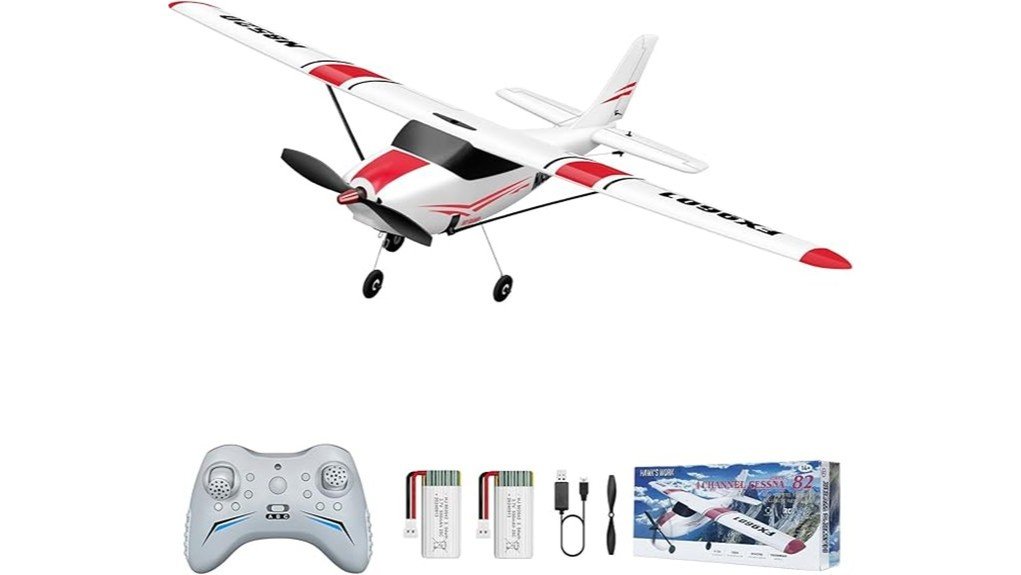
Learning to fly a true 4-channel RC airplane can be a bigger step than moving a simple toy plane around the sky. The HAWK’S WORK 4 Channel RC Plane tries to make that transition easier with gyro-assisted flight modes while still giving you separate aileron, elevator, rudder, and throttle control. Its strongest points are the 1504 brushless motor, three 2 g servos, 6-axis stabilization, and two included flight batteries. The main limitation is that it still requires practice, careful preflight checks, and suitable outdoor conditions, so it should not be treated as a crash-proof beginner toy.
Quick Verdict
Rating: 8/10
Best For: Beginners who want to learn true 4-channel controls with gyro assistance and experienced flyers who want a compact Cessna-style trainer.
Bottom Line: The combination of a brushless motor, three assisted flight modes, and approximately 200 meters of radio range gives you useful room to grow. You still need a calm, open flying area and enough practice to avoid the crashes that no stabilization system can completely prevent.
Key Specifications
| Specification | Detail |
|---|---|
| Brand | HAWK’S WORK |
| Aircraft type | 4-channel Cessna 182 RC trainer |
| Series | HAWK’S WORK lists its 4-channel Cessna 182 under the 9601 series |
| Channels | 4 |
| Stabilization | 6-axis gyro |
| Flight modes | 6G1, 6G2, and 3D |
| Motor | 1504 brushless motor |
| Servos | 3 × 2 g servos controlling ailerons, elevator, and rudder |
| Radio system | 2.4 GHz |
| Control distance | Approximately 200 meters under suitable conditions |
| Flight batteries | 2 × 3.7V 550 mAh rechargeable batteries |
| Advertised flight time | About 24 minutes combined with both included batteries |
| Included accessories | Remote controller, landing gear, spare propeller, screwdriver, USB charging cable, and English manual |
| Aircraft warranty | 1 year for qualifying non-user-caused problems |
| Battery warranty | 3 months for qualifying non-user-caused problems |
What Is the HAWK’S WORK 4 Channel RC Plane?
This HAWK’S WORK model is a Cessna 182-style radio-controlled airplane designed to give you full 4-channel control instead of the simplified steering found on many entry-level RC toys. The three servos operate the ailerons, elevator, and rudder, while the throttle controls power from the 1504 brushless motor.
The 6-axis gyro is the main training aid. You can use one of the assisted 6G modes while learning basic orientation and turns, then move to 3D mode when you are ready for less electronic assistance and aerobatic flying. This progression makes the plane more useful for skill development than a basic RC aircraft that gives you no room to advance.
Who Should Buy It?
Best For
- New pilots who want to learn aileron, elevator, rudder, and throttle control with gyro assistance.
- Flyers who want one plane that can progress from assisted cruising to basic aerobatic practice.
- Buyers who prefer a brushless motor and two included rechargeable flight batteries.
Skip If
- You do not have access to a large, open outdoor flying area.
- You need a plane that can handle strong wind or repeated crashes without risk of damage.
- You want a completely automatic aircraft that requires little practice or preflight checking.
Before You Buy: The manufacturer advises against flying this lightweight airplane in wind speeds above 5 m/s and recommends staying away from tall trees, buildings, and other places where a lost aircraft may be difficult to recover. Gyro stabilization helps you control the plane, but it does not make crashes impossible.
Flight Performance and Features
6-Axis Gyro and Three Flight Modes
The stabilization system gives you three modes rather than the generic beginner-versus-expert choice found on some trainers. In 6G1 and 6G2, the gyro remains active. HAWK’S WORK describes the two modes as allowing different climb-angle behavior. The 3D setting switches the gyro assistance off so you have more direct control for stunt flying.
For a first flight, the assisted modes are the sensible starting point. They reduce some of the workload while you learn orientation, especially when the aircraft is flying toward you and left-right inputs appear reversed from your viewpoint. Moving to 3D mode makes more sense after you can launch, turn, maintain altitude, and land consistently.
1504 Brushless Motor
The 1504 brushless motor is a meaningful step above the basic brushed motors often used in inexpensive RC toys. It gives the Cessna enough power for normal training flights as well as rolls and loops when your skill level allows.
Power does not remove the need for smooth control inputs. Sudden throttle changes or aggressive steering can still upset a lightweight airplane, especially close to the ground. Build confidence at a safe altitude before experimenting with harder maneuvers.
Three 2 g Servos and True 4-Channel Control
Three 2 g servos independently operate the ailerons, elevator, and rudder. Together with throttle control, this gives you the core control layout used on many hobby RC airplanes.
That matters if your goal is to develop transferable flying skills. You can practice banking with the ailerons, adjusting pitch with the elevator, coordinating turns with the rudder, and managing speed with the throttle rather than depending on a simplified steering system.
Control System and User Experience
The included 2.4 GHz radio system is rated for approximately 200 meters of control distance under suitable conditions. That is more than enough space for normal trainer flying, although you should always keep the aircraft close enough to maintain clear visual orientation.
HAWK’S WORK also states that the radio system allows multiple planes to operate without mutual signal confusion. If several people are flying, leave plenty of physical separation between aircraft and complete pairing carefully before takeoff.
Pro Tip: Before every launch, check that the ailerons, elevator, and rudder move in the expected direction while the plane is still on the ground. The manufacturer specifically recommends checking and correcting the rudder before flight.
Battery Life and Included Accessories
The package includes two 3.7V 550 mAh rechargeable flight batteries. HAWK’S WORK advertises about 24 minutes of combined flying time when both batteries are used. It does not clearly state an exact per-battery runtime on the product page, so you should treat the 24-minute figure as a combined estimate rather than assume every battery will deliver a fixed number of minutes.
Actual flight time can change with throttle use, wind, maneuvering, battery condition, and temperature. Let the battery and motor cool as directed by the manual rather than immediately pushing through repeated flights.
The package also includes the remote controller, landing gear, a spare propeller, screwdriver, USB charging cable, and English user manual. Having a spare propeller in the box is useful because propellers are among the parts most exposed to damage during rough landings.
How It Performs in Real Use
For First Training Flights
Start in a gyro-assisted mode and use a large open field. Your first sessions should focus on maintaining orientation, making wide turns, controlling altitude, and returning the airplane toward your position safely. A 4-channel plane gives you more control authority than a simple beginner toy, but it also gives you more controls to manage.
For Skill Progression
Once you can fly predictable circuits, the three-mode system gives you room to progress without immediately replacing the aircraft. The 6G modes provide assistance while you build muscle memory, while 3D mode gives experienced pilots direct control for aerobatic maneuvers.
For Aerobatic Practice
The manufacturer specifically lists rolls and loops among the aircraft’s capabilities. Attempt them only after you are comfortable with normal flight and only with enough altitude and open space to recover from a mistake. The gyro-off 3D mode is intended for pilots who already understand how the aircraft responds to full control inputs.
For Flying With Other RC Pilots
The 2.4 GHz system is designed so more than one compatible plane can fly in the same area without normal signal confusion. That can make the model useful for casual group flying, but radio separation does not prevent midair collisions. Maintain visual awareness and agree on safe flying boundaries.
Setup Tips Before First Use
- Read the manual first. HAWK’S WORK specifically recommends reviewing the instructions before you begin flying.
- Charge the flight batteries correctly. Use the supplied charging equipment and follow the battery instructions rather than substituting an incompatible charger.
- Inspect the control surfaces. Confirm that the ailerons, elevator, and rudder respond correctly before launching.
- Check the rudder alignment. The manufacturer identifies this as a preflight item.
- Choose a large open location. Avoid trees, buildings, roads, water, people, and other obstacles.
- Start in calm weather. Do not fly when wind exceeds the manufacturer’s 5 m/s guidance.
- Begin with assisted flight. Save gyro-off 3D flying for later, after you can reliably take off, steer, and land.
Compatibility and Safety
An RC aircraft can damage itself, property, or injure someone if it is operated carelessly. Keep your hands, hair, clothing, and other objects away from the propeller whenever the battery is connected. Children should use the plane only with appropriate adult guidance and supervision.
Do not assume stabilization will correct every mistake. Strong wind, low-altitude turns, incorrect control direction, loss of orientation, and flying too close to obstacles can still lead to a crash or lost aircraft. Follow the current HAWK’S WORK manual supplied with your specific unit because product revisions and setup details can change.
The official Cessna product page does not clearly specify the fuselage material, so this review does not label the aircraft as EPP, EPS, or another foam type without direct confirmation for this exact version.
Pros and Cons
Pros
- 6-axis gyro provides assistance while you learn basic 4-channel control.
- 6G1, 6G2, and 3D modes give you room to progress as your skills improve.
- 1504 brushless motor supports normal training and aerobatic maneuvers.
- Three independent 2 g servos provide aileron, elevator, and rudder control.
- Two 550 mAh batteries are included, with about 24 minutes of advertised combined flight time.
Cons
- Still requires practice and correct preflight setup despite the gyro assistance.
- Manufacturer advises against flying in winds above 5 m/s.
- Crash damage and a lost aircraft are not treated the same as qualifying warranty failures.
Warranty and Customer Support
HAWK’S WORK states that the aircraft is covered by a 1-year warranty and the batteries by a 3-month warranty for qualifying non-user-caused problems. Technical support is also available when you run into setup or flight issues.
The warranty should not be treated as crash insurance. Damage caused by collisions and an aircraft lost during flight may fall outside the manufacturer’s free after-sales coverage. That distinction matters for beginners because pilot error is one of the main ways an RC aircraft gets damaged.
| Support Type | Manufacturer-Stated Coverage |
|---|---|
| Aircraft warranty | 1 year for qualifying issues |
| Battery warranty | 3 months for qualifying issues |
| Technical support | Manufacturer support for setup and technical questions |
Is It Worth the Price?
The current selling price can change, so it is better to judge value by what the package gives you rather than lock the plane into a permanent budget or mid-range category. You get a brushless 4-channel trainer, gyro assistance, three flight modes, two rechargeable batteries, a 2.4 GHz transmitter, landing gear, spare propeller, charging cable, and basic tools in one package.
That combination offers stronger value for someone who specifically wants to learn proper 4-channel flying and continue into basic aerobatics. It makes less sense if you only want a very simple toy aircraft or do not have access to enough outdoor space to use its capabilities safely.
How It Compares to Alternatives
The VolantexRC Sport Cub 500 is another compact 4-channel trainer with gyro-assisted beginner, intermediate, and expert-style control modes. It is worth comparing if you want another small park-flyer approach to learning 4-channel controls.
Within HAWK’S WORK’s own lineup, the P-51D Mustang EXA768 offers a more warbird-focused design with 4-channel control, a brushless motor, and gyro-assisted modes. The Cessna reviewed here is the more natural choice if your priority is a trainer-style aircraft rather than the appearance and flight character of a P-51 warbird.
Frequently Asked Questions
Is the HAWK’S WORK 4 Channel RC Plane suitable for beginners?
Yes, it is designed as a trainer and includes a 6-axis gyro plus two assisted 6G modes. You should still expect a learning curve because ailerons, elevator, rudder, and throttle all require coordinated control.
How long does the battery last?
The manufacturer includes two 3.7V 550 mAh batteries and advertises about 24 minutes of combined flight time. It does not clearly promise a fixed per-battery runtime, and actual results can change with throttle use, wind, battery condition, and flying style.
What are the three flight modes?
The modes are 6G1, 6G2, and 3D. The two 6G settings keep gyro assistance active with different assisted flight behavior, while 3D turns the gyro assistance off for more direct aerobatic control.
Can you fly this RC plane indoors?
A normal home or small indoor area is not an appropriate flying location. Use a large, unobstructed outdoor area where you have enough room to launch, turn, recover from mistakes, and land safely.
How much wind can the plane handle?
HAWK’S WORK advises that the lightweight aircraft should not be flown when wind speed exceeds 5 m/s. Beginners will generally have an easier time learning in calmer conditions because wind adds another variable to every control input.
Does the plane require setup before the first flight?
Yes. Even though it is sold as a ready-to-fly style trainer, you still need to prepare the batteries, check the controls and rudder alignment, fit any required components according to the supplied manual, and complete normal preflight checks before launch.
What material is the HAWK’S WORK Cessna made from?
The official Cessna product information reviewed for this article does not clearly identify the fuselage material. Rather than assume it uses a particular foam such as EPP or EPS, check the current Amazon listing or the manual supplied with your exact aircraft revision.
The Bottom Line
The HAWK’S WORK 4 Channel RC Plane is worth considering if you want a Cessna-style trainer that can take you from gyro-assisted practice to more direct 4-channel and aerobatic flying. Its brushless motor, three servos, two batteries, and three flight modes are meaningful strengths, but you still need calm weather, adequate outdoor space, careful setup, and enough practice to protect the aircraft.
If you want a completely effortless toy or need to fly in small indoor spaces or stronger wind, this is not the best fit. For a buyer who specifically wants to build real RC airplane control skills, the overall package earns our 8/10 verdict.
