
Last Updated on July 31, 2026 by Caleb Warren
Disclosure: As an Amazon Associate, we earn from qualifying purchases. If you click a link on this page and make a purchase, we may receive a small commission at no extra cost to you.
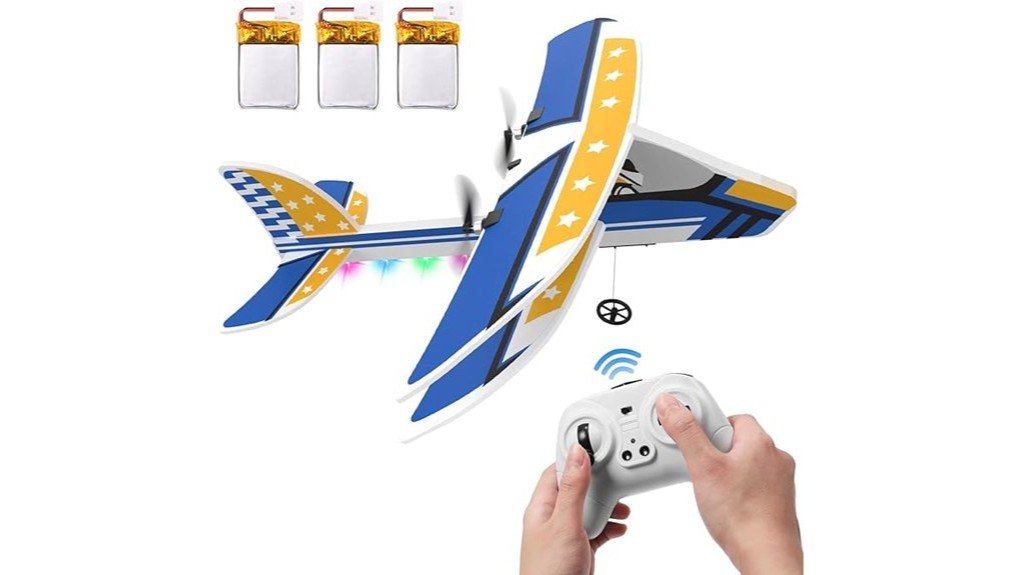
Learning to fly an RC plane can be frustrating when the controls feel too sensitive or a minor crash ends the session. The DEERC AU4-SQN-022-YW RC Plane keeps the learning curve simple with 2-channel control, a built-in 6-axis gyroscope, and a lightweight EPP foam body. Three included flight batteries provide up to 24 minutes of total flying time, but the compact airframe performs best in calm weather and a clear outdoor area. This review will help you decide whether its simple controls are ideal for your first flights or too limited for the skills you want to build.
Quick Verdict
Rating: 8/10, recommended with caveats
Best For: First-time pilots age 14 and older who want a small, stabilized plane for calm-weather practice.
Bottom Line: The 6-axis gyro, simple 2-channel controls, and three batteries make this DEERC plane approachable for beginners. Its light weight and basic control system also mean it is sensitive to wind and offers less room for skill progression than a 3-channel or 4-channel trainer.
| Specification | Detail |
|---|---|
| Brand | DEERC |
| Model | AU4-SQN-022-YW |
| Reviewed ASIN | B0BVPVD661 |
| Product type | 2-channel ready-to-fly RC airplane |
| Reviewed color | Yellow |
| Stabilization | Built-in 6-axis gyroscope |
| Radio system | 2.4GHz |
| Control range | Up to 164 feet (50 meters) |
| Control directions | Up, down, left, and right |
| Airframe material | Lightweight EPP foam |
| Motor setup | Dual motors |
| Aircraft batteries | Three 3.7V 185mAh LiPo batteries included |
| Flight time | About 8 minutes per battery, up to 24 minutes total |
| Charging time | About 30 to 40 minutes per battery |
| Remote batteries | Three AA batteries, not included |
| Product dimensions | 10.7 × 4.1 × 11 inches |
| Item weight | 14.4 ounces |
| Manufacturer age guidance | 14 years and older |
What Is the DEERC AU4-SQN-022-YW RC Plane?
The DEERC AU4-SQN-022-YW is a compact, 2-channel ready-to-fly airplane designed to reduce the amount of control coordination required from a new pilot. Its remote handles four basic directions, while the built-in 6-axis gyroscope works to keep the aircraft level and reduce sudden instability.
The airframe uses EPP foam, a light and somewhat flexible material commonly used in beginner RC aircraft. That construction helps the plane tolerate the bumps and rough landings that often happen during early practice, although the nose, propellers, and foam surfaces can still be damaged by hard impacts.
DEERC includes three 3.7V 185mAh LiPo batteries. Each battery provides about eight minutes of flight, giving you up to 24 minutes in total when all three are charged. This is more useful than one long battery because you can pause between flights, inspect the plane, and let the motors and batteries cool.
Who Should Buy It?
Best For
- First-time RC pilots who want simple controls and automatic stabilization.
- Teens and adults practicing in a calm, open yard, park, or sports field.
- Families who want several short flights from three included aircraft batteries.
Skip If
- You regularly fly in windy conditions or need a larger, heavier trainer.
- You want 3-channel or 4-channel control for more realistic flight and skill progression.
- You need a plane for unsupervised younger children or a small indoor room.
Before You Buy: The reviewed yellow model carries manufacturer guidance for ages 14 and older. Its small EPP airframe is also easy for wind to push off course, so plan to fly in calm weather with adult supervision where appropriate.
Design and Build Quality
The lightweight EPP foam airframe is one of this plane’s strongest beginner features. It keeps the aircraft light enough for the dual motors and makes low-speed impacts less destructive than they may be with a rigid plastic body. The compact size also creates a relatively small turning radius, which can help in a clear yard or field.
EPP is impact-resistant, not impact-proof. A direct hit on pavement, a tree, or a fence can crease the foam, bend a propeller, or knock components out of alignment. You should inspect the nose, wings, propellers, landing gear, and battery compartment after any rough landing before launching again.
Gyro Stabilization and Ease of Control
The built-in 6-axis gyroscope automatically corrects part of the plane’s movement to help it remain level. For a new pilot, this reduces the amount of constant stick correction needed during straight flight and broad turns. It is especially useful during the first few launches, when overcorrecting is common.
The gyro cannot cancel strong gusts, prevent every stall, or recover the aircraft from a poor launch at very low altitude. You still need enough open space to make gentle corrections. Starting with the plane close to you is safer than immediately testing the full 164-foot range.
Two-Channel Flight Controls
This DEERC model uses a simple 2-channel system with up, down, left, and right control. That limited control set is easier to understand than a full 4-channel transmitter, so a beginner can focus on orientation, throttle timing, and smooth turns instead of managing several control surfaces at once.
The tradeoff is limited progression. A 2-channel plane does not give you the same level of direct control or maneuver variety as a 3-channel or 4-channel trainer. It is a good entry point for learning basic orientation, but you may outgrow it once you want more realistic takeoffs, landings, and coordinated turns.
Battery Life and Charging
Each included 3.7V 185mAh LiPo battery provides about eight minutes of flight under suitable conditions. With three batteries charged, the total advertised flight time reaches up to 24 minutes. Actual time can vary with throttle use, wind, battery condition, and temperature.
Charging takes about 30 to 40 minutes per aircraft battery. The remote also needs three AA batteries, which are not included. Charge on a nonflammable surface, use the supplied charging equipment, and never leave a LiPo battery unattended while it is connected to power.
Pro Tip: Charge all three flight batteries before leaving home, label them 1 through 3, and rotate them in order. This makes it easier to track which battery is charged and gives you a natural inspection break between flights.
Control Range and Flying Space
The 2.4GHz radio system has a stated maximum range of 164 feet, or about 50 meters. That is enough room for beginner practice, but maximum range should not be your goal. A small plane becomes difficult to judge at a distance, and trees, structures, radio interference, or weak batteries can reduce practical control.
A clear sports field is usually a better learning area than a fenced backyard. You need room beyond the planned flight path in case the plane makes a wider turn than expected. Keep the aircraft in sight and stay away from roads, people, animals, power lines, water, and restricted flying areas.
How It Performs in Real Use
For First Takeoffs
The gyro and basic controls make the plane less intimidating than a more advanced trainer. The manual supports ground takeoff from a smooth surface and hand launching. Ground takeoff gives you more time to build speed, while a hand launch can help when grass is too tall for the landing gear. Follow the manual and keep the plane level during setup and launch.
For Open-Field Practice
In an open field, the small turning radius and 164-foot control range provide enough room to practice broad circuits. The plane is most useful for learning which way to steer when it is flying toward you, a skill that often confuses new RC pilots. Staying closer during early flights makes orientation easier.
For Light-Wind Conditions
The stabilization system helps with minor movement, but the airframe is still small and light. In a light, steady breeze, you may need more throttle and larger corrections. In gusty conditions, control can become inconsistent, so waiting for calmer air is the safer choice.
For Shared Family Sessions
Three batteries allow several short turns without a long charging break. That works well for supervised family sessions because each pilot can use one battery, then the group can inspect the plane before the next flight. The manufacturer age guidance remains 14 and older, so younger users should not be treated as the intended unsupervised audience.
Setup Tips Before First Use
- Read the manual first. Confirm the correct battery connection, controller layout, binding sequence, and takeoff method.
- Install fresh remote batteries. The controller requires three AA batteries, and weak transmitter power can cause avoidable control problems.
- Bind on a level surface. Place the plane flat while connecting and pairing it so the gyro can initialize correctly.
- Check the weather. Choose calm conditions, especially for the first flights. Early morning or late afternoon often has lighter wind.
- Inspect the aircraft. Make sure the propellers, wings, landing gear, and battery cover are secure before every launch.
- Start close. Use a wide, clear area but keep the first circuits well inside the maximum range until you understand the controls.
- Pause after a crash. Cut power, retrieve the plane safely, and inspect it before trying again.
Safety and Battery Care
Keep hands, loose clothing, hair, and faces away from the propellers whenever a battery is connected. Do not launch toward another person, and do not fly over crowds, roads, vehicles, pets, or wildlife. Avoid water and wet conditions because the plane and radio electronics are not described as waterproof.
LiPo batteries require careful handling. Do not charge a battery that is swollen, punctured, hot, wet, or visibly damaged. Use the specified charger, supervise charging, disconnect the battery after charging, and follow the manual’s storage and disposal instructions. You should also follow local rules for recreational RC aircraft in your flying area.
Pros and Cons
Pros
- 6-axis gyro reduces the correction burden for first-time pilots.
- Three included LiPo batteries provide up to 24 minutes of total flight time.
- Lightweight EPP foam is more forgiving during minor bumps and rough landings.
- Simple 2-channel control is easy to understand during early practice.
- Compact size and 164-foot range suit clear yards, parks, and sports fields.
Cons
- The small, light airframe is easily affected by wind and gusts.
- Two-channel control offers less skill progression than 3-channel or 4-channel trainers.
- Each battery lasts about eight minutes, and the remote requires three AA batteries that are not included.
Is It Worth the Price?
The DEERC AU4-SQN-022-YW sits in the budget-oriented beginner category. Its value comes from the complete basic setup, the 6-axis stabilization system, and three included aircraft batteries rather than advanced controls or a large airframe. For a first-time pilot who expects to fly only in calm conditions, that combination offers strong value for the price.
It is less compelling for someone who already understands RC orientation or wants a plane that can support longer-term skill development. A more capable 3-channel or 4-channel trainer may cost more and take longer to learn, but it can delay the need for an upgrade.
How It Compares to Alternatives
A 3-channel model such as the DEERC BF-109 gives you an extra level of control and may suit a beginner who wants more room to progress. A 4-channel trainer such as the VOLANTEXRC Sport Cub 500 offers even more realistic control, but it requires more coordination and a greater commitment to learning.
The DEERC AU4-SQN-022-YW makes the most sense when simplicity matters more than advanced maneuvering. It is easier to approach than those alternatives, but it is also the model you are most likely to outgrow first.
Frequently Asked Questions
What age is the DEERC AU4-SQN-022-YW recommended for?
The manufacturer guidance for the reviewed yellow model is age 14 and older. Younger children should not be treated as the intended unsupervised users, even though the controls are simple.
Is this DEERC RC plane suitable for a complete beginner?
Yes. The 2-channel control system and 6-axis gyro reduce the number of inputs you must manage. You still need calm weather, open space, and time to learn orientation and safe launching.
How long does each battery last?
Each 3.7V 185mAh LiPo battery provides about eight minutes of flight. With all three included batteries charged, total flight time can reach up to 24 minutes.
How long do the batteries take to charge?
Charging takes about 30 to 40 minutes per aircraft battery. The remote requires three AA batteries, and those are not included with the reviewed model.
Can the plane fly in windy conditions?
It can tolerate light, steady air better than gusty wind, but its small EPP airframe is easy to push off course. Calm conditions are the best choice for safe beginner practice.
Can you hand launch it or take off from the ground?
The manual describes both ground takeoff and hand launching. Ground takeoff needs a smooth, clear surface, while hand launching may be more practical in grass. Follow the manual’s setup and launch directions.
Are replacement parts available?
Replacement-part availability can vary by seller and over time. Check the current Amazon listing or DEERC support before buying if spare propellers, landing gear, or other parts are important to you.
What warranty does the DEERC RC plane include?
The sources reviewed did not confirm a universal one-year warranty for this exact ASIN. Check the current seller terms and DEERC support policy before ordering because coverage can depend on the seller and purchase location.
The Bottom Line
The DEERC AU4-SQN-022-YW is a practical first RC plane for pilots age 14 and older who want basic controls, gyro stabilization, and three short flight batteries. Its main strength is an approachable learning curve, while its main limitation is a light 2-channel design that struggles in wind and leaves less room for long-term skill growth. Skip it if you already want the control depth of a 3-channel or 4-channel trainer.
Ready to Buy?
Check the latest price, package contents, and seller terms before you decide.
