
Last Updated on July 25, 2026 by Daniel Globe
The Biltmore Hotel in Coral Gables, Florida, is one of South Florida’s best-known historic resorts. Opened in 1926 as a centerpiece of George E. Merrick’s vision for Coral Gables, the hotel is recognized for its Mediterranean Revival architecture, Giralda-inspired tower, enormous swimming pool, Donald Ross golf course, and unusual history as both a luxury resort and military hospital. In 2026, the Biltmore marks 100 years since its opening.
Quick Answer
The Biltmore Hotel is a historic luxury resort at 1200 Anastasia Avenue in Coral Gables, Florida. Designed by Schultze & Weaver and opened in 1926, it later served as a military and Veterans Administration hospital. Today it is a National Historic Landmark with 271 rooms, golf, a large resort pool, dining, spa facilities, and event spaces.
Key Takeaways
- The Biltmore opened in Coral Gables in January 1926 and celebrates its centennial in 2026.
- Coral Gables founder George Merrick helped create the project with hotelier John McEntee Bowman, while the architectural firm Schultze & Weaver designed the hotel.
- The War Department converted the property into a military hospital in 1942; it later became Pratt General Hospital and then a Veterans Administration hospital until 1968.
- Its Mediterranean Revival design is dominated by a tower inspired by the Giralda of Seville, Spain.
- The modern resort has 271 guestrooms, an 18-hole Donald Ross golf course, a roughly 23,000-square-foot pool, restaurants, a spa, fitness facilities, tennis, and pickleball.
- Some celebrity stories are well documented, while others—especially stories involving Al Capone—are better treated as part of the hotel’s long-running lore.
Disclosure: As an Amazon Associate I earn from qualifying purchases. Some links on this page are affiliate links, at no extra cost to you.
History of the Biltmore Hotel
The Biltmore grew out of Coral Gables founder George E. Merrick’s plan to create an elegant master-planned community during Florida’s 1920s land boom. Merrick partnered with hotelier John McEntee Bowman of the Bowman-Biltmore organization, and the $10 million hotel project was announced in November 1924. Ground was broken in March 1925.
Contrary to a common description, Merrick was not the hotel’s architect. The building was designed by the prominent New York firm Schultze & Weaver, whose partners Leonard Schultze and S. Fullerton Weaver specialized in major hotels. Merrick was the developer and visionary behind Coral Gables and played a central role in shaping the hotel’s concept.
The hotel formally opened in January 1926 amid elaborate celebrations. Special trains brought visitors from New York, while early guests could enjoy golf, tennis, aquatic shows, dining, and even gondola rides through the Coral Gables waterways. The original hotel had roughly 400 guestrooms, considerably more than its modern configuration.
The Biltmore opened during the height of Florida’s 1920s land boom and reached its 100th anniversary in 2026.
The hotel’s first years were turbulent. The September 1926 Miami hurricane caused only limited damage to the Biltmore itself, and the property sheltered people displaced by the storm. However, the hurricane accelerated the collapse of South Florida’s land boom. Merrick’s Coral Gables corporation eventually entered bankruptcy in 1929.
The property later experienced another period of success under new ownership, attracting entertainers, political figures, athletes, and other prominent visitors during the 1930s and early 1940s.
From Luxury Hotel to Military Hospital
The Biltmore’s role changed dramatically during World War II. According to the National Park Service’s landmark documentation, the War Department took over the hotel in November 1942 and converted it into a 1,200-bed convalescent hospital.
In 1946, the facility became Pratt General Hospital, named for Army flight surgeon Col. Fabian L. Pratt. The Veterans Administration took over in July 1947, and the property continued serving veterans until 1968. Its medical years required major interior changes, and many decorative details and furnishings were covered, altered, or lost.
The City of Coral Gables acquired the Biltmore property in 1972. After years of vacancy, restoration work returned the building to hotel use in the 1980s. The City of Coral Gables dates its restoration as a luxury hotel to 1987.
Note: The Biltmore’s wartime history is sometimes summarized incorrectly. The important dates are 1942 for the War Department takeover, 1946 for Pratt General Hospital, 1947 for Veterans Administration control, and 1968 for the end of its hospital era.
Architectural Features of the Biltmore Hotel
The Biltmore is a major example of Mediterranean Revival architecture, with Spanish, Moorish, and Italian influences. Its exterior uses stucco walls, tile roofs, arches, balconies, ironwork, and ornamental details that fit the architectural character George Merrick promoted throughout early Coral Gables.
The building’s dominant feature is its tower, commonly described as approximately 315 feet tall. Its design was inspired by the Giralda, the historic bell tower associated with Seville Cathedral in Spain. National Park Service documentation notes that the Biltmore’s tower follows the Giralda’s proportions, stages, and upper architectural elements.
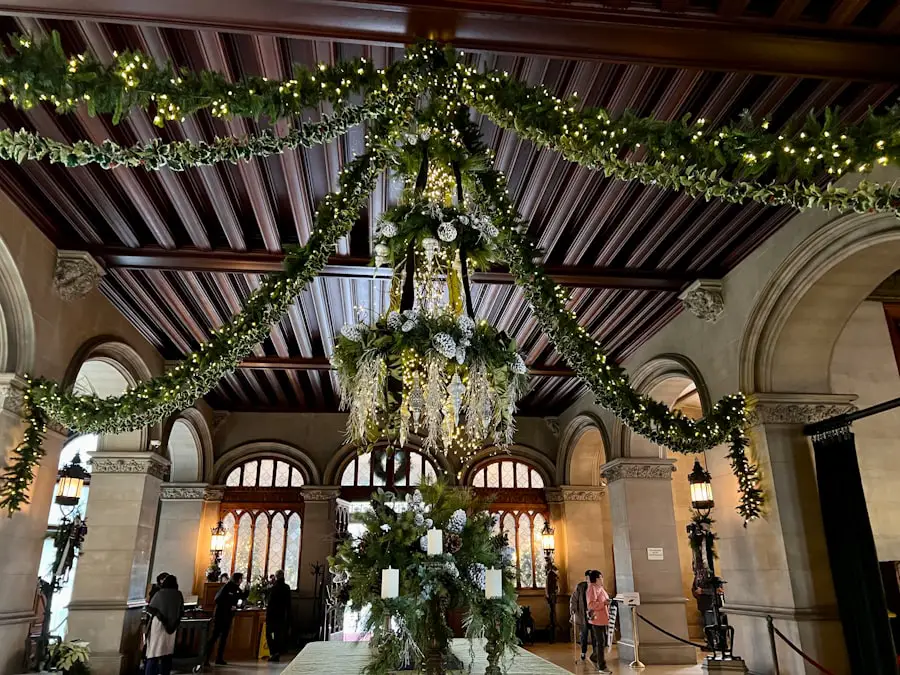
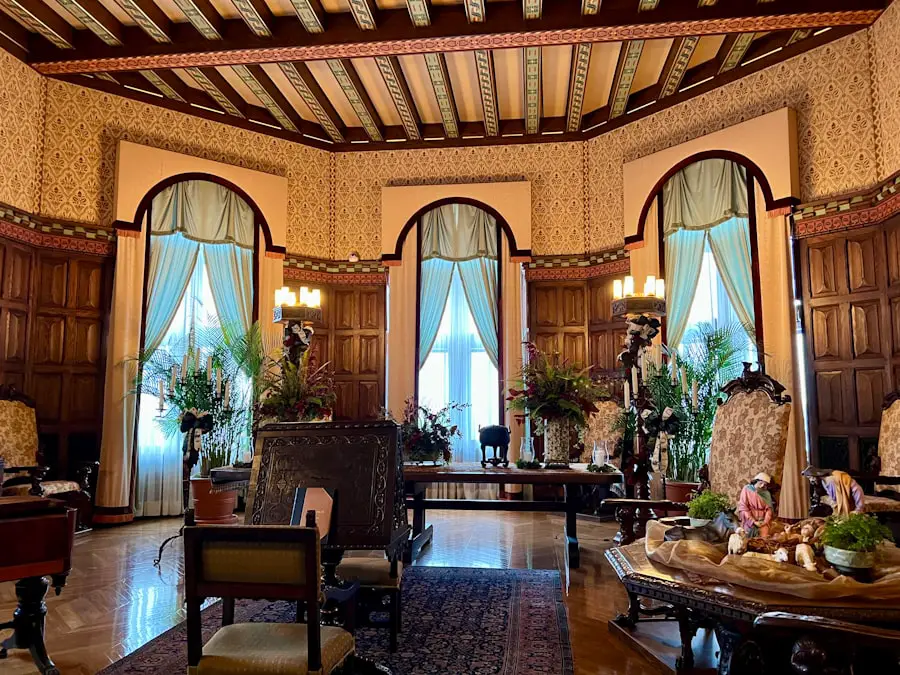
Inside, the hotel preserves or recreates many historic details. The lobby includes large columns, hand-painted vaulted ceilings, chandeliers, carved mahogany elements, and restored flooring. The hotel’s restoration also preserved important decorative areas such as the Alhambra spaces and tower suites.
The property was added to the National Register of Historic Places in 1972 and was designated the Miami-Biltmore Hotel & Country Club National Historic Landmark on June 19, 1996. The National Park Service continues to list it among Florida’s National Historic Landmarks.
Notable Guests and Events at the Biltmore Hotel
| Documented Person or Event | Connection to the Biltmore |
| Judy Garland | Listed by National Park Service historical documentation among prominent visitors during the hotel’s prewar years. |
| Bing Crosby | Also documented among the entertainers who visited the hotel during its early period. |
| Dwight D. Eisenhower | National Park Service records identify Eisenhower as a notable patient during the property’s military-hospital period. |
| 1926 Opening Celebrations | The formal opening included prominent guests, special trains from New York, a dinner dance, and extensive festivities. |
| Aquatic Shows and Golf Events | The pool and golf facilities became major entertainment attractions during the resort’s early decades. |
The Biltmore attracted a wide range of public figures. National Park Service documentation specifically names entertainers including Ginger Rogers, Judy Garland, Bing Crosby, Deanna Durbin, and Rudy Vallée among visitors during one of the hotel’s successful prewar periods.
The property’s enormous swimming pool also became an attraction in its own right. Aquatic performances, diving exhibitions, fashion shows, and celebrity gatherings were part of the Biltmore’s early entertainment program. Swimmer and future Tarzan star Johnny Weissmuller is closely associated with the pool’s history.
What About Al Capone?
Al Capone has long been linked to the Biltmore in hotel stories, and even current hotel material repeats the association. However, the claim deserves more caution than the original article gave it. Modern reporting on the hotel’s historical tours has noted that no written record has been found conclusively proving that Capone stayed at the property.
For that reason, it is more accurate to describe Capone’s connection as part of Biltmore lore rather than treat every story about him as established history. The hotel’s documented early history is colorful enough without turning legends into facts.
Pro Tip: When reading stories about famous Biltmore guests, distinguish between names documented in historical records and colorful traditions repeated through decades of local storytelling.
Dining and Entertainment at the Biltmore Hotel
The Biltmore’s dining lineup has changed over time, so older references to Palme d’Or should not be treated as current information. As of 2026, the hotel’s official website highlights several current dining and beverage venues.
Fontana is the hotel’s principal Italian-inspired restaurant, with indoor seating and an open-air courtyard centered around a fountain. It serves breakfast, lunch, and dinner, with hours and menus subject to change.
Other current options include Cascade for poolside dining, Fairways overlooking the golf course, The Biltmore Bar, Brandi’s, Posto DOLCE for grab-and-go food and drinks, afternoon tea, and in-room dining.
The hotel’s Signature Sunday Brunch remains one of its best-known dining traditions. Current offerings include breakfast and carving stations along with seafood, sushi, caviar, desserts, and bubbly. Reservations are recommended because availability can be limited.
The Biltmore also schedules seasonal dining programs, afternoon tea, poolside entertainment, holiday celebrations, fitness classes, and other events throughout the year.
Note: Restaurant hours, menus, entertainment, brunch availability, and special events can change. The hotel’s current dining and events pages are more reliable than older travel articles for planning a visit.
The Biltmore Hotel’s Role in the Coral Gables Community
The Biltmore is closely tied to the development and identity of Coral Gables. Merrick envisioned the hotel as one of the focal points of his planned “City Beautiful,” and its tower remains one of the city’s most recognizable architectural landmarks.
The relationship is more than symbolic. The City of Coral Gables acquired the property in 1972 after its hospital era and years of uncertainty. The city’s preservation efforts eventually helped return the building to hotel use, preventing the loss of one of South Florida’s most important surviving resort buildings from the 1920s boom.
Today, the property continues to support tourism, weddings, meetings, golf, dining, community events, and cultural activities. City records also continue to identify the Biltmore as a city-owned property operated through long-term lease arrangements.
The hotel’s centennial in 2026 gives that relationship added significance: both the Biltmore and the community around it have reached the century mark while retaining much of the Mediterranean-inspired identity established during Coral Gables’ earliest years.
Activities and Amenities at the Biltmore Hotel
The present-day Biltmore is a full resort rather than simply a historic hotel. According to its current fact sheet and website, it has 271 guestrooms, including 173 suites, with views that may include the pool, golf course, or surrounding city.
Products Worth Considering

[Retractable Canopy & Washable Cushions]: With a retractable canopy, you can enjoy sunbathing or keep cool. In addition, the seat and back cushions of the outdoor round...
Swimming Pool
The Biltmore pool covers approximately 23,000 square feet and holds about 600,000 gallons of water, making it one of the largest hotel pools in the United States. Private cabanas and daybeds are available under the hotel’s current access and reservation policies.
Golf
The Biltmore Golf Course is an 18-hole, par-71 championship course originally designed by Donald Ross in 1925 and later updated for modern play. The property also has practice facilities, a golf shop, instruction, and club rentals.
Spa and Fitness
The current Biltmore Spa occupies approximately 12,000 square feet and offers massages, facials, skin-care treatments, steam rooms, and sauna facilities. Spa services are currently limited to guests age 18 and older.
The resort also maintains a roughly 10,000-square-foot fitness center. Tennis courts, pickleball courts, group fitness activities, and personal training add further recreational options.
Events and Celebrations
The Biltmore’s historic ballrooms, meeting rooms, gardens, and outdoor spaces remain in active use for weddings, conferences, corporate meetings, holiday celebrations, and other events. This continues a tradition dating to the hotel’s earliest years, when dances, sporting events, and social gatherings were central to the Biltmore experience.
Visiting the Biltmore Without Staying Overnight
An overnight reservation is not the only reason to visit the Biltmore. Members of the public can make reservations for services such as dining, brunch, afternoon tea, golf, spa treatments, and many scheduled events, subject to the hotel’s individual access rules and availability.
Some resort facilities have more restrictive policies. Pool access, for example, should not be assumed to be open to walk-in visitors, and certain amenities are reserved for registered hotel guests or members.
History tours have also been offered on scheduled dates in partnership with preservation organizations. They should not be described as an always-available daily attraction: previous tours required advance registration, and availability depends on the current events schedule.
Warning: Do not assume that being able to enter the hotel or make a restaurant reservation includes access to the pool, fitness center, guest floors, or other hotel-only facilities. Each amenity has its own access policy.
Products Worth Considering

Not redeemable at hotel locations or if you choose the Pay at Hotel option online.

Not redeemable at hotel locations or if you choose the Pay at Hotel option online

Get thousands of restaurants, convenience stores, pet stores, grocery stores, gifts, and more at your fingertips.
The Biltmore Hotel’s Legacy and Impact
The Biltmore has survived the collapse of Florida’s 1920s land boom, a major hurricane, wartime conversion, decades of medical use, years of vacancy, and an extensive restoration. That history makes the property much more than a visually impressive resort.
Its architectural importance was formally recognized when the Miami-Biltmore Hotel & Country Club became a National Historic Landmark in 1996. National Park Service documentation identifies the property as nationally significant for its architecture and as an important surviving monument to South Florida’s boom-era development.
The hotel’s continuing appeal comes from the combination of those historic elements with an active modern resort. Guests today still encounter the Giralda-inspired tower, historic lobby spaces, enormous swimming pool, and Donald Ross golf course while using contemporary guestrooms, restaurants, spa facilities, and event venues.
For travelers planning other outdoor portions of a Florida trip, the existing guide to the best ultralight tent for backpacking offers additional packing information for trips that extend beyond a hotel stay.
Sources
- National Park Service — National Historic Landmarks by State — verifies the Miami-Biltmore Hotel & Country Club’s National Historic Landmark designation.
- National Park Service — Miami-Biltmore Hotel & Country Club Landmark Nomination — documents the architecture, Schultze & Weaver attribution, opening era, military use, hospital history, restoration, and historic guests.
- City of Coral Gables — Historical Landmarks — supports the hotel’s local history, city acquisition, architecture, and restoration.
- U.S. Department of Veterans Affairs — Miami VA History — provides additional context for the property’s military and veterans-hospital period.
- The Biltmore Hotel — Official Website — current 2026 information on guestrooms, dining, recreation, golf, wellness, and the centennial.
- The Biltmore Hotel — History — current hotel history and centennial-era background.
Frequently Asked Questions
What is the Biltmore Hotel?
The Biltmore is a historic luxury resort in Coral Gables, Florida. Opened in 1926, it is known for its Mediterranean Revival architecture, Giralda-inspired tower, large swimming pool, Donald Ross golf course, restaurants, spa, and event spaces.
Where is the Biltmore Hotel located?
The Biltmore Hotel is located at 1200 Anastasia Avenue, Coral Gables, Florida 33134.
Who designed the Biltmore Hotel?
The hotel was designed by the New York architectural firm Schultze & Weaver. George E. Merrick, the founder and developer of Coral Gables, created the broader vision for the project with hotelier John McEntee Bowman.
What are some notable features of the Biltmore Hotel?
Notable features include its Mediterranean Revival architecture, approximately 315-foot Giralda-inspired tower, 18-hole Donald Ross golf course, roughly 23,000-square-foot swimming pool, spa, fitness center, restaurants, courtyards, historic public rooms, and event spaces.
Is the Biltmore Hotel open to the public?
Yes. Non-overnight guests can use various public-facing services such as restaurants, brunch, afternoon tea, golf, spa appointments, and scheduled events. Access to facilities such as the pool, fitness center, and guest areas is subject to separate hotel policies.
Is the Biltmore Hotel a historic landmark?
Yes. The Miami-Biltmore Hotel & Country Club was listed on the National Register of Historic Places and was designated a National Historic Landmark in 1996.
Can visitors tour the Biltmore Hotel without staying there?
The Biltmore has offered scheduled history tours focusing on its architecture and cultural heritage, but these should not be treated as a permanent walk-in attraction. Past tours required advance registration, and current availability depends on the hotel’s event schedule.
Was the Biltmore Hotel used as a hospital?
Yes. The War Department took over the property in 1942 and converted it into a military convalescent hospital. It became Pratt General Hospital in 1946, transferred to the Veterans Administration in 1947, and continued serving as a VA hospital until 1968.
Did Al Capone stay at the Biltmore Hotel?
Al Capone is strongly associated with Biltmore folklore, and the hotel itself has repeated the story. However, the historical record is less certain, and no definitive written documentation has been identified proving that he stayed there. The connection is best described as a famous hotel legend rather than an unquestioned fact.
