

Last Updated on July 25, 2026 by Daniel Globe
Traveling from London to Paris by Eurostar is one of the simplest ways to move between the two city centers, but first-time passengers need to plan for more than just the train ride. You’ll depart from London St Pancras International, complete security and border checks before boarding, travel directly to Paris Gare du Nord, and then connect easily to the Metro, RER, buses, or a walk through central Paris.
Quick Answer
For a smooth London-to-Paris Eurostar trip, book early, complete your passenger information, bring the correct passport or travel documents, and arrive at St Pancras at the time shown on your ticket. You’ll clear security and border checks before boarding, then arrive directly at Paris Gare du Nord in about 2 hours 16 minutes on the fastest services.
At a Glance
| Time Required | Fastest London–Paris trains take about 2 hours 16 minutes, plus pre-departure time at St Pancras. |
| Difficulty | Easy once tickets and travel documents are prepared. |
| Tools Needed | Eurostar ticket, valid passport or other accepted travel document, payment card or phone, and your luggage. |
| Cost | Eurostar fares vary by travel date, demand, and class. In Paris, a standard Metro-Train-RER ticket is €2.55 as of July 2026, excluding airport journeys. |
Key Takeaways
- Book Eurostar tickets early and compare flexible dates because fares can rise as popular trains fill.
- Travel classes are now Eurostar Standard, Eurostar Plus, and Eurostar Premier.
- For London departures, follow the arrival time printed on your ticket. Current guidance is generally 75 minutes for Standard and Plus and 45 minutes for Premier.
- Bring the correct passport and complete any required Advance Passenger Information before traveling. Many non-EU travelers are also covered by the EU Entry/Exit System.
- Standard and Plus normally include two main bags plus hand luggage, with no fixed weight limit as long as you can safely carry the bags yourself.
- Eurostar arrives at Paris Gare du Nord, where you can connect directly to the Metro, RER, buses, taxis, or continue on foot.
Disclosure: As an Amazon Associate I earn from qualifying purchases. Some links on this page are affiliate links, at no extra cost to you.
Check Your Passport, API, EES, and ETIAS Requirements
Before booking your journey, confirm the entry rules that apply to your nationality and travel status. These rules can change, so use the official Eurostar travel-document guidance and the government advice for your passport.
Passengers traveling to or from the UK must provide required Advance Passenger Information (API). Eurostar states that passengers should complete this information before departure and that tickets may not be available for collection until the required details have been supplied.
For British passport holders visiting France for a short stay, the passport normally must have been issued less than 10 years before the date of entry to the EU and remain valid for at least three months after the planned departure from the EU. British visitors can normally spend up to 90 days in any 180-day period in the Schengen area without a visa for tourism and certain other short visits. Check the latest GOV.UK France entry requirements before traveling.
Note: The EU Entry/Exit System, or EES, records many non-EU short-stay travelers entering or leaving participating European countries. At St Pancras, eligible passengers may complete biometric border procedures before leaving the UK. Allow the arrival time shown on your Eurostar ticket rather than relying on old check-in advice.
As of July 2026, ETIAS is not yet in operation. The European Union currently says ETIAS is expected to start in the last quarter of 2026. Do not pay unofficial websites to obtain an ETIAS before the system officially opens.
Booking Your Eurostar Tickets
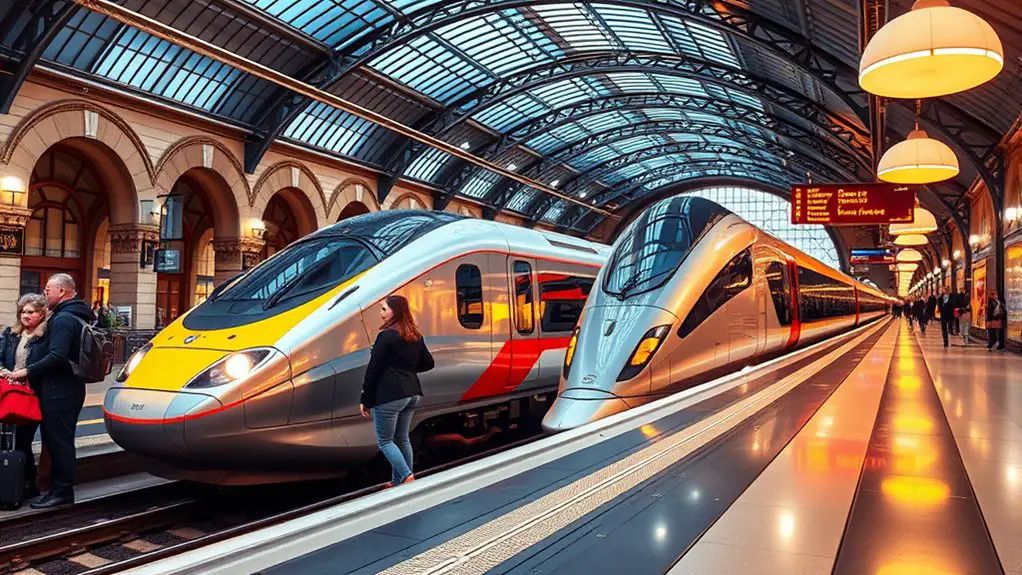
When you’re ready to begin your Eurostar journey from London to Paris, start by comparing travel dates and the three current classes: Eurostar Standard, Eurostar Plus, and Eurostar Premier.
The cheapest seats on popular departures can sell out, so booking ahead is usually wise. Fares vary with availability and demand rather than following a single fixed price. Flexible travel dates can help you compare more options, and quieter departures may cost less than the busiest trains.
Use the official Eurostar website or app to check live schedules, fares, ticket conditions, engineering work, and service updates.
Eurostar’s current London-route classes are Standard, Plus, and Premier—not the former Standard Premier and Business Premier names.
Choosing Your Eurostar Travel Class
| Class | Best For | Key Features |
|---|---|---|
| Eurostar Standard | Lower-cost city-to-city travel | Standard seating, free Wi-Fi, at-seat power, two main bags plus hand luggage, food and drinks available to buy. |
| Eurostar Plus | More space and an included meal | Extra-spacious seating, free Wi-Fi, power, two main bags plus hand luggage, and dishes and drinks served at your seat on London routes. |
| Eurostar Premier | Maximum flexibility and premium service | Priority gates on London routes, lounge access in London and Paris, extra-spacious seating, premium dining on selected routes, and three main bags plus hand luggage. |
Ticket exchange and refund conditions also differ by class, so read the fare terms before purchasing. See Eurostar’s current travel-class comparison for the latest inclusions.
Pro Tip: Download or refresh your ticket shortly before travel. Eurostar says the recommended station arrival time shown on your ticket is the best guidance because border procedures and station conditions can change.
Arriving at London St Pancras International
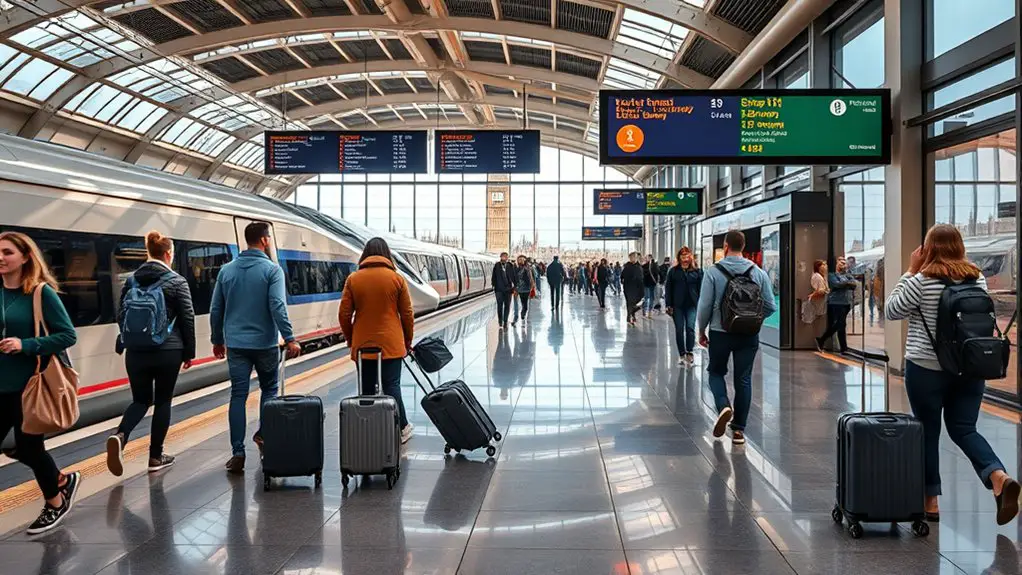
London-to-Paris Eurostar trains leave from London St Pancras International. Do not wait until the last minute: international Eurostar departures involve ticket, security, and border checks before boarding.
Eurostar currently recommends arriving about 75 minutes before departure for Standard and Plus and about 45 minutes for Premier at London St Pancras. Travelers using accessible travel services are advised to allow around 60 minutes. These are guidance times, so always follow the current arrival time printed on your ticket.
The normal departure process is straightforward:
- Go to Eurostar Departures. You do not need to find the train platform first.
- Scan your ticket. Scan each traveler’s barcode or QR code individually at the ticket gates.
- Pass through security. You and your luggage will be screened.
- Complete passport and border checks. For London departures, passports are checked before you board, including the relevant French border formalities.
- Wait in the Eurostar departure lounge. Shops, refreshments, toilets, Wi-Fi, and seating are available.
- Watch for boarding. Your platform is displayed inside the departure lounge once boarding begins.
Eurostar says boarding is normally announced around 20 minutes before departure. Current ticket gates at St Pancras close 30 minutes before departure for Standard and Plus and 15 minutes before departure for Premier, but arriving at the gate-closing time is much too late for a comfortable journey.
Check the latest official Eurostar station-arrival guidance before setting out.
Warning: Do not treat Eurostar like a normal domestic train where you can walk onto the platform a few minutes before departure. Ticket gates, security, passport controls, and possible EES procedures all take place before boarding.
What to Expect on Board
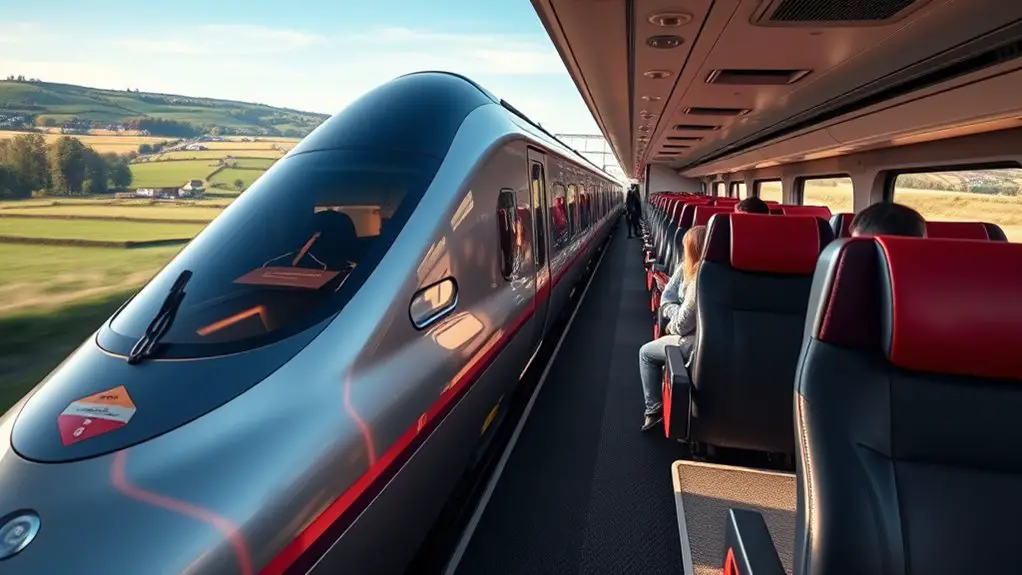
Once you step aboard, your reserved coach and seat number make settling in simple. The fastest direct London-to-Paris Eurostar journeys take about 2 hours 16 minutes, although the exact timetable varies by train.
Seating Options Available
All three Eurostar classes provide a reserved seat, but the amount of space, food service, luggage allowance, ticket flexibility, and lounge access varies.
Standard is usually the practical choice for travelers focused on price. Plus provides extra space and a meal and drinks at the seat on London routes. Premier adds the most flexible ticket conditions, lounge access, priority gates on London routes, extra luggage, and premium service.
Onboard Amenities Overview
Eurostar provides free onboard Wi-Fi and power sockets at the seat. The connection uses mobile networks along the route, so speeds can change as the train moves and coverage may drop in some areas.
Basic web browsing, messaging, and email are more realistic expectations than relying on the train connection for large downloads or high-bandwidth streaming. Eurostar also provides onboard entertainment content on supported services.
Bring headphones and download important work, maps, tickets, music, or entertainment before leaving London if you need guaranteed offline access.
Dining Choices Offered
Dining depends on your travel class rather than a single menu for the whole train.
| Travel Class | Food Service |
|---|---|
| Standard | Snacks, light bites, and drinks can be purchased from Eurostar Café. |
| Plus | On London routes, a choice of dishes and drinks is served at your seat. |
| Premier | Premium onboard dining is included on applicable services. |
You can also bring your own suitable snacks for the journey, subject to customs and prohibited-item rules.
Eurostar Luggage Rules
Eurostar’s luggage policy is more generous than many airline baggage rules, but the original 32 kg claim does not apply.
For trains to and from London, Eurostar currently allows:
- Standard: two main pieces of luggage plus one piece of hand luggage.
- Plus: two main pieces of luggage plus one piece of hand luggage.
- Premier: three main pieces of luggage plus one piece of hand luggage.
Each main piece can be up to 85 cm long on routes to and from London. Eurostar does not impose a general luggage weight limit, but you must be able to carry and lift your bags safely yourself.
Check the latest Eurostar luggage allowance before packing, especially if you plan to carry unusually large equipment or an item that may fall under separate restrictions.
Tips for Navigating Paris Upon Arrival
The London Eurostar arrives at Paris Gare du Nord. Because the main border checks take place before departure from London, you can normally leave the train with your luggage and continue directly into the station.
Gare du Nord connects to the Paris Metro, RER suburban trains, buses, taxis, and local streets. Download an offline map or the Île-de-France Mobilités transport app before your trip so you are not dependent on mobile data after arrival.
The Metro is usually the fastest way to reach central neighborhoods, while walking can be an enjoyable option when your hotel or first attraction is reasonably close.
Warning: Keep your passport, phone, wallet, and cards secure around Gare du Nord, on the Metro, and on RER trains. Current UK travel advice warns that pickpockets operate on Paris public transport and at mainline stations.
A polite “Bonjour” before asking a question is a simple way to start an interaction with station staff, shopkeepers, or local residents.
How Paris Public Transport Tickets Work in 2026
Paris transport ticketing changed significantly in recent years. For occasional visitors, the standard Metro-Train-RER Ticket is now a simple option for Metro, train, and RER journeys throughout Île-de-France, excluding airport stations.
As of July 2026, the full-fare Metro-Train-RER ticket costs €2.55. It can be loaded onto a Navigo Easy pass or purchased and validated with a compatible smartphone. A separate Bus-Tram ticket is used for most bus and tram journeys.
See the latest rules and prices from Île-de-France Mobilités before your visit.
Should You Buy Paris Visite?
The Paris Visite pass still provides unlimited travel for 1, 2, 3, or 5 consecutive days across zones 1–5, including airport transport covered by the pass. However, it is not automatically the cheapest option.
If you plan only a few central Paris journeys, individual tickets may cost less. Paris Visite becomes more appealing when you value unlimited travel, expect to make many journeys, or need the wider regional and airport coverage included with the pass.
Pro Tip: Estimate how many Metro, RER, bus, and airport journeys you will actually make before buying an unlimited tourist pass. Convenience and lowest cost are not always the same thing.
Making the Most of Your Time in Paris
Once you arrive in Paris, a little planning helps you spend more of your day exploring and less of it crossing the city unnecessarily.
Group nearby attractions together, leave realistic time for museums and meals, and use the Metro for longer jumps between neighborhoods.
Must-See Attractions
For a first visit, the Eiffel Tower, Louvre Museum, Seine, Notre-Dame area, Montmartre, and Palais Garnier are popular starting points.
Do not try to squeeze every major sight into a single day. The Louvre alone can occupy several hours, and major attractions may require timed tickets or advance reservations.
A practical itinerary groups sights geographically. For example, you might combine the Louvre and Seine, or spend a separate block of time around Montmartre rather than repeatedly crossing Paris.
Local Cuisine Highlights
Food is part of the Paris experience, whether you stop for a flaky croissant at a neighborhood bakery, try cheese and produce from a market, order a crêpe, or sit down for a relaxed bistro meal.
Rather than treating every meal as another attraction to rush through, leave space in your schedule to sit down and enjoy it. A simple bakery breakfast or picnic can also save time and money during a busy sightseeing day.
Efficient Transportation Options
- Metro: Usually the fastest option for short-to-medium journeys across central Paris.
- RER: Useful for longer cross-city journeys and destinations beyond the central Metro network.
- Buses: Slower in traffic but useful when you want to see the city above ground.
- Walking: Excellent for clusters of nearby sights and neighborhoods.
- Unlimited passes: Worth comparing when your itinerary involves frequent journeys rather than assuming they always save money.
Check live service information before setting out because maintenance, demonstrations, events, or industrial action can affect routes.
Essential Items to Pack for Your Journey
Start with your travel documents. Keep your passport, Eurostar ticket, and any visa, residence, or other required documentation somewhere secure but easy to reach during border checks.
Pack comfortable shoes for Paris and use light layers that are easy to add or remove. A small daypack or secure cross-body bag is useful once you have left your larger luggage at your accommodation.
A sensible first-time packing list includes:
- Valid passport or accepted travel document.
- Eurostar ticket available offline as well as in your app where possible.
- Payment card and a backup payment method.
- Phone charging cable and power bank.
- Comfortable walking shoes.
- Light layers or a weather-appropriate jacket.
- Headphones and downloaded entertainment.
- Any medicines you need during the trip.
- Reusable water bottle and suitable snacks.
Do not hide your passport deep inside a large suitcase. You will need it during the pre-departure border process.
Accessibility and Family Travel
Passengers who need travel assistance should arrange it ahead of the trip and follow Eurostar’s specific accessible-travel arrival guidance. Eurostar currently recommends allowing about 60 minutes at London St Pancras for travelers using accessible travel services.
Families should also allow extra time to organize tickets, passports, luggage, strollers, and children before approaching the gates. Children have their own luggage rules, so check the current allowance before packing.
What to Do if Your Eurostar Is Delayed or Canceled
Check the Eurostar app, website, station screens, and messages linked to your booking whenever disruption occurs.
For a Eurostar delay of 60 minutes or more, passengers may qualify for compensation. Eurostar currently offers different cash-refund or e-voucher amounts according to the length of the delay. For example, its passenger-rights policy provides a cash compensation level of 25% of the affected ticket price for delays of 60–119 minutes and 50% for delays of 120 minutes or more, subject to the applicable conditions.
Keep your ticket and booking information until any claim is resolved. Read Eurostar’s current Customer Charter and delay compensation policy for the latest claim deadlines and options.
Frequently Asked Questions
How early should I arrive at London St Pancras for Eurostar?
Follow the recommended arrival time printed on your Eurostar ticket. Current guidance for London St Pancras is generally 75 minutes before departure for Standard and Plus, 45 minutes for Premier, and around 60 minutes for accessible travel. Arriving at the recommended time gives you time for ticket, security, passport, and any applicable EES checks.
Can I bring my pet on the London-to-Paris Eurostar?
Ordinary pets are not permitted on Eurostar trains to and from London. Guide and assistance animals are an exception, subject to Eurostar’s booking and documentation requirements. Eurostar asks travelers with an eligible guide or assistance animal to contact the company at least 24 hours before departure.
Are there luggage restrictions on Eurostar?
Yes. Standard and Plus passengers normally receive two main pieces of luggage plus one piece of hand luggage, while Premier includes three main pieces plus hand luggage. On London routes, each main item may be up to 85 cm long. Eurostar does not impose a general weight limit, but you must be able to safely carry your bags yourself.
Is Wi-Fi available on the Eurostar?
Yes. Eurostar provides free onboard Wi-Fi and at-seat power. Because the connection relies partly on mobile networks along the route, speed and availability can vary. Download important files, maps, or entertainment before departure if you need reliable offline access.
What happens if my Eurostar is delayed or canceled?
Check Eurostar’s live updates and follow the instructions for your specific service. Delays of at least 60 minutes can qualify for compensation, with the amount depending on the length of the delay and whether you choose a refund or an eligible Eurostar voucher. Keep your ticket and booking details until the claim is complete.
Do I need a passport to travel from London to Paris on Eurostar?
Most London-to-Paris passengers need a valid passport or another travel document specifically accepted for their circumstances. British passport holders should check Schengen passport-validity rules before travel. Visa, residence-status, Advance Passenger Information, EES, and future ETIAS requirements depend on nationality and immigration status.
Where does the Eurostar arrive in Paris?
Direct Eurostar trains from London arrive at Paris Gare du Nord. From there, you can connect to Metro and RER lines, buses, taxis, or continue on foot depending on your destination.
Conclusion
A first London-to-Paris Eurostar trip is straightforward once you know the sequence. Book the right class, check your passport and border requirements, complete your passenger information, arrive at St Pancras at the time shown on your ticket, and allow time for security and passport checks before boarding.
After the direct journey, you’ll step off at Paris Gare du Nord with the Metro, RER, buses, taxis, and central Paris within easy reach. With your documents, luggage, and Paris transport plan sorted before departure, you can spend less time solving travel problems and more time enjoying the city.
Sources
- Eurostar — Travel Classes — current Standard, Plus, and Premier inclusions and ticket conditions.
- Eurostar — When to Arrive at the Station — current London St Pancras recommended arrival and gate-closing times.
- Eurostar — Luggage Allowance — bag numbers, dimensions, and weight policy.
- Eurostar — Traveling With Pets — London-route pet restrictions and assistance-animal exception.
- UK Government — France Entry Requirements — passport, Schengen-stay, and EES guidance.
- Île-de-France Mobilités — Metro-Train-RER Ticket — current Paris-region public-transport ticket rules and fares.
