

Last Updated on July 27, 2026 by Daniel Globe
The right hiking gear should help you stay comfortable, navigate confidently, and handle an unexpected delay or change in weather. Start with the basic hiking essentials, then adjust your footwear, clothing, water, food, and emergency equipment for the trail, season, terrain, trip length, and local rules. A short maintained trail may require a different setup than an all-day mountain hike or multi-day backpacking trip.
Quick Answer
Essential hiking gear includes navigation, sun protection, extra clothing, a headlamp, first aid, fire or emergency-heat supplies, repair tools, extra food, water plus treatment supplies, and emergency shelter. Add properly fitted footwear, a comfortable backpack, weather protection, personal medication, and any equipment required for your specific trail or conditions.
Key Takeaways
- Choose hiking shoes or boots based on terrain, weather, pack weight, and fit rather than assuming every hike requires a heavy boot.
- Dress in removable layers and carry rain protection plus an extra insulating layer for changing conditions.
- Fit your backpack to your torso and hips, and choose enough capacity for your water, food, layers, and emergency equipment.
- Carry a physical navigation backup even when you use a GPS device or smartphone app.
- Carry enough water for the route and use an appropriate treatment method before drinking water of uncertain quality.
- Pack the full Ten Essentials, not just the gear you expect to use under ideal conditions.
The 10 Essentials: A Complete Hiking Gear Checklist
The National Park Service recommends the Ten Essentials as basic preparedness systems for outdoor trips. The exact items inside each category should change with your route, weather, season, group, and local hazards.
| Essential | What to Carry |
| Navigation | Map, compass, GPS or offline map, plus the knowledge to use them. |
| Sun Protection | Sunglasses, sunscreen, hat, and protective clothing as conditions require. |
| Extra Clothing | Insulating layer, rain shell, hat, gloves, or other protection appropriate to the worst reasonable conditions. |
| Illumination | Headlamp or flashlight plus spare batteries or another reliable power source. |
| First Aid | Trip-appropriate first-aid supplies, blister care, and personal medications. |
| Fire / Emergency Heat | Waterproof matches, lighter, or another legal emergency fire-starting option where appropriate. |
| Repair Kit and Tools | Multi-tool or knife where legal, tape, and repair items matched to your equipment. |
| Nutrition | Enough food for the hike plus extra no-cook food for an unexpected delay. |
| Hydration | Adequate water plus treatment supplies when you may need to collect natural water. |
| Emergency Shelter | A lightweight tarp, emergency bivy, space blanket, tent, or another shelter appropriate to the trip. |
Note: The Ten Essentials are a starting point, not a universal packing limit. Winter travel, high altitude, desert heat, bear country, remote backcountry routes, water crossings, and overnight trips can require additional equipment.
Plan Before You Go
Good hiking preparation starts before you pack. Check the route distance, elevation change, expected terrain, daylight, weather forecast, current closures, fire restrictions, water availability, and other land-manager alerts. Pick a trail that everyone in your group can complete safely rather than choosing only by mileage.
The National Park Service Hike Smart guidance also recommends leaving a trip plan with someone who is not hiking with you. Include your trail or route, trailhead, group members, vehicle information when useful, expected return time, and what that person should do if you do not check in.
Set a turnaround point before conditions force the decision. A summit, waterfall, or viewpoint is optional; returning safely is not. Check local rules for wildlife, food storage, pets, fires, permits, and seasonal hazards before leaving the trailhead.
Warning: Do not assume cell service will be available. Download maps before the trip, carry a non-electronic navigation backup, and consider a personal locator beacon or satellite communicator for remote routes where outside help may be difficult to reach.
Hiking Footwear: Choose Boots or Shoes for the Terrain
Selecting appropriate hiking footwear can significantly affect comfort and control on the trail. The right choice depends on the terrain, weather, pack weight, trip duration, and your feet. Lightweight hiking shoes may work well on maintained trails, while more supportive hiking boots can be useful on rough, uneven terrain, in wet conditions, or when carrying a heavier load.
For multi-day backpacking or rugged routes, look for footwear with durable outsoles and enough support for the terrain. Waterproof footwear can be useful in consistently wet conditions, while more breathable footwear may be more comfortable in hot, dry environments. Merrell, Salomon, and Vasque are among the many brands that offer footwear for different hiking conditions, but brand name matters less than correct fit and appropriate design.
Fit is paramount. Current hiking-footwear fitting guidance recommends a fit that feels secure without being tight and leaves room to move your toes. Trying footwear later in the day can help account for the normal swelling that occurs during activity.
Wear the socks and any insoles or orthotics you intend to use on the trail when trying on footwear. Sock thickness can change the fit, so do not automatically assume you need a specific half-size increase. Test the complete footwear system instead.
New footwear should also be tested before a demanding trip. Lightweight shoes may require little break-in, while stiff leather boots can take longer. Start with short walks and hikes, then gradually increase mileage and pack weight. A break-in period can help reveal pressure points, but it cannot fix footwear that is fundamentally the wrong shape or size.
Pro Tip: Test new footwear on an incline before committing to a long hike. Your heel should remain reasonably secure while descending, and your toes should not repeatedly strike the front of the shoe.
Products Worth Considering

OMNI-TECH: For prolonged exposure to moderate rain and snow. Multilayered, waterproof, seam-sealed construction that allows the inside to breathe, keeping feet dry and comfortable no matter the conditions.

Comfortableness: NORTIV 8 Men's Waterproof Hiking Boots certainly delivers on all-day comfort! Removable and shock-absorbent cushioned insoles offer the support for your feet.
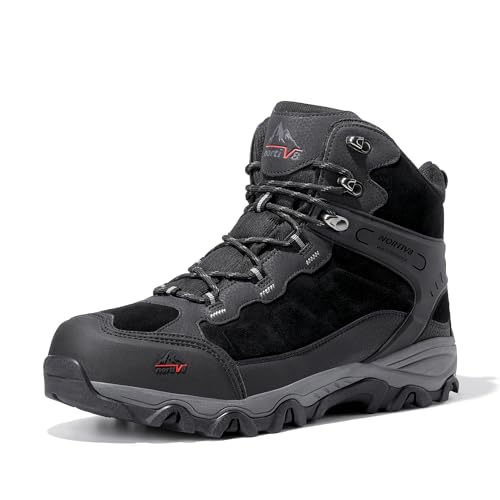
Waterproof Build: These men’s hiking boots feature a waterproof membrane construction that keeps your feet dry when trudging through any mud or water.
Clothing: Layering for Comfort and Protection
Layering lets you adjust clothing as temperature, wind, precipitation, and exertion change. Start with a base layer that manages moisture next to your skin. Merino wool and quick-drying synthetic fabrics such as polyester are common hiking choices.
The middle layer provides insulation. Fleece jackets, synthetic insulated jackets, and down garments can provide warmth without requiring a bulky single layer. Choose the insulation level for the expected temperature and the consequences of getting wet.
The outer layer protects against wind and precipitation. A waterproof or weather-resistant shell can help keep rain and wind out while allowing you to change or remove inner layers as you warm up. Gore-Tex is one familiar waterproof-breathable technology, but many manufacturers offer alternatives.
Carry an extra insulating layer when sudden temperature drops are realistic, even if the hike begins in warm weather. Wool and many synthetic materials remain more useful when damp than ordinary cotton clothing, which tends to hold moisture and dry slowly.
Backpacks: Finding the Ideal Pack for Your Needs
Choose a backpack based first on the equipment you actually need to carry. Many hikers find roughly 20–35 liters practical for a full day, while overnight and multi-day trips commonly require more capacity. Season, food, water, sleeping equipment, group gear, and how compactly you pack can shift those numbers substantially.
A well-organized pack can make frequently used items easier to reach, but fit matters more than the number of pockets. Your pack should carry the intended load without creating painful pressure points.
For larger hiking and backpacking packs, torso length is one of the most important sizing measurements. Many packs include adjustable suspension systems that let you match the harness more closely to your torso.
Note: A hip belt on a load-carrying pack should sit around the top of your hip bones and help transfer weight away from your shoulders. Shoulder, sternum, and load-lifter straps then fine-tune stability and fit rather than compensating for an incorrectly sized pack.
Padded shoulder straps, a supportive hip belt, ventilation, and load-adjustment straps can improve comfort with heavier loads. Hydration-reservoir sleeves and external bottle pockets can also make water easier to reach without unloading the pack.
Products Worth Considering

NOT YOUR BASIC BACKPACK: Feature rich at this price point; Comfort and balanced backpack for men and women.

WATER-RESISTANT AND STURDY MATERIAL: SKYSPER 20l Hiking Backpack is made of high-density 600D polyester and 210D nylon plaid fabric, which is impermeable, water-resistant, tear resistant and wear-resistant. All of the backpack's stress points and shoulder straps are reinforced with lap-knots to ensure long lasting durability

Lightweight & Packable for Easy Travel: Weighing only 0.94 lb (15L) / 1.1 lb (20L), this backpack folds into its own compact pocket for easy storage. The 15L small backpack expands to 15.7 × 10.6 × 6.5 in, folds to 7 × 7.5 × 3.6 in, The 20L hiking backpack expands to 17.7 × 11.8 × 6.9 in, folds to 7.9 × 7.5 × 4 in. Perfect for travel, day trips, or as a backup bag in your suitcase.
Navigation: Tools for Finding Your Way on the Trail
| Navigation Tool | Main Benefit |
| Map and Compass | Reliable physical backup that does not depend on a charged battery. |
| GPS Device | Can display position, route information, waypoints, and a recorded track. |
| Trail Markers | Help confirm your route on established and maintained trails. |
| Smartphone Apps | Convenient access to downloaded maps, tracks, and route information when prepared in advance. |
Topographic maps are especially useful in unfamiliar terrain because they show the shape and elevation of the land with contour lines. The U.S. Geological Survey explains topographic maps as maps that use elevation contours to show landform shape and slope.
Learn the map symbols, contour interval, trail junctions, major landmarks, and your planned route before leaving. A compass becomes much more useful when you already know how to orient the map and take or follow a bearing.
GPS units and smartphone apps such as AllTrails or Gaia GPS can make route tracking convenient, especially when maps are downloaded for offline use. They should not be your only navigation method. Batteries fail, devices break, and cell service may be unavailable even when satellite positioning still works.
A downloaded phone map is useful; a charged phone plus a physical backup and the skill to use it is much safer.
Products Worth Considering

Compact and lightweight GPS handheld navigator boasts an anti-slip design offering a bright 3.2" screen that is sunlight readable, even in bright sunlight, plus, physical buttons provide more versatility in any conditions

Explore confidently with the reliable handheld GPS

Hydration: Staying Safe and Healthy with the Right Water Gear
Physical activity increases water needs, and heat, altitude, humidity, pace, distance, and individual physiology all affect how much water a hiker may require. Plan your supply around the specific route rather than relying on a single universal amount.
A hydration reservoir offers hands-free access through a drinking tube, while ordinary water bottles are simpler to inspect, refill, and ration. Insulated bottles can keep water cooler, but insulation adds weight. The best system is the one you can carry comfortably and use consistently.
Research water availability before leaving. A stream marked on a map may be seasonal or dry, and natural water should not automatically be considered safe to drink.
The CDC backcountry water-treatment guidance identifies boiling as the most reliable way to kill germs. When boiling is not practical, the appropriate filter, purifier, disinfectant, or combination depends on the water and the organisms the product is designed to address. Always follow the treatment manufacturer’s instructions, including required contact time.
Warning: A basic filter or a single type of purification tablet does not automatically remove or kill every possible contaminant. Know what your treatment device is designed to handle and carry a backup method when the consequences of failure are significant.
Nutrition: Packing the Right Snacks and Meals for Energy
Snacking for Sustained Energy
Hiking food should be easy to carry, simple to eat, and appropriate for the length and intensity of the trip. Trail mix combining nuts and dried fruit is popular because it provides energy in a compact package. Other options include dried fruit, crackers, nut or seed butter packets, jerky, cheese that can safely tolerate your conditions, and snack bars.
Pack foods you already know your body tolerates. On demanding trips, convenience and adequate food are generally more useful than rigid rules about whether a snack looks “natural.”
Meal Preparation for Longer Trips
For longer hikes or multi-day trips, choose meals that match your cooking setup, food-storage requirements, and available water. Dehydrated meals are common among backpackers because they reduce carried water weight before preparation, although they require enough clean water and fuel to prepare safely.
A portable stove can be more dependable and lower impact than planning to cook over a campfire. Where fires are allowed, follow current fire restrictions and never assume a legal fire today will still be permitted when conditions change.
Energy Bars: A Convenient Snack
Energy bars are useful because they are compact and require no preparation. Compare serving size, calories, carbohydrates, protein, fat, sodium, allergens, and ingredients according to your needs rather than assuming one formula is best for every hiker.
Carry extra food beyond the amount you expect to eat so an unexpected delay does not immediately leave you without a food reserve.
Safety: Essential First Aid and Emergency Supplies
A hiking first-aid kit should match the route, group size, trip length, remoteness, and your training. Common basics include adhesive bandages, gauze, medical tape, antiseptic supplies, blister treatment, and any personal medication you may need.
Check medication and supply expiration dates before leaving, and learn how to use what you carry. A large kit provides little value if no one in the group knows what the contents are for.
Useful signaling equipment can include a whistle and, where appropriate, a signal mirror. A whistle lets you signal repeatedly without relying only on your voice. In remote areas, a personal locator beacon or satellite communicator may provide an additional way to request assistance, but it does not replace navigation skill or the other essential equipment.
An emergency blanket, bivy, tarp, or other lightweight shelter can reduce exposure to wind and precipitation if an injury, navigation problem, or unexpected delay keeps you out longer than planned.
Headlamp and Illumination
Carry a headlamp or flashlight even if you intend to finish well before sunset. Delays happen, and navigating after dark without a dedicated light can turn a manageable problem into a more serious one. Pack spare batteries or another reliable backup power source appropriate to the light.
Repair Kit and Multi-Tool
A compact repair kit can solve problems such as a torn strap, damaged shelter, loose equipment, or broken buckle. Depending on your gear, useful items can include tape, cord, repair patches, a small multi-tool, or a knife where possession and use are legal.
Fire and Emergency Heat
Matches, a lighter, and suitable fire-starting material are traditionally part of the Ten Essentials because heat or fire can be useful during some emergencies. However, wildfire danger and land-management rules take priority. Check current restrictions and never start an open fire where fires are prohibited or unsafe.
Extras: Must-Have Gear for Comfort and Convenience
After the core safety equipment is covered, a few additional items can make the trail more comfortable. Trekking poles can improve balance on uneven ground and give you extra points of contact during steep climbs or descents. Adjust them correctly and practice before relying on them on difficult terrain.
A lightweight camp chair or compact seating pad can make longer breaks more comfortable, particularly on camping trips. A tarp or groundsheet is another versatile addition that can provide a cleaner resting area or supplemental weather protection, although it should not displace the emergency equipment required for your route.
Sunscreen, sunglasses, a brimmed hat, and sun-protective clothing deserve a place in your core kit rather than being treated as optional luxuries. Insect repellent can also be important where mosquitoes, ticks, or other biting insects are active.
Trail Etiquette and Leave No Trace
Good preparation also includes protecting the places you visit. Stay on established trails where required, avoid cutting switchbacks, carry out trash and food scraps, and follow the land manager’s rules for human waste, pets, campsites, fires, and food storage.
Observe wildlife from a safe distance and never feed animals. Local wildlife guidance varies significantly, so check destination-specific instructions before your hike rather than relying on one rule for every region.
By choosing trail-appropriate footwear, layering clothing, fitting your pack correctly, carrying complete navigation and emergency equipment, and preparing for water, food, weather, and unexpected delays, you can make a hiking trip more comfortable and far better prepared for changing conditions.
Planning a camping-focused trip as well? The older seasonal roundup 5 Amazing Tent Camping Spots Near You This Spring 2025 may still provide destination ideas, but verify current 2026 access, reservations, closures, fire restrictions, and local conditions before traveling.
Frequently Asked Questions
What are the essential items for hiking?
Start with the Ten Essentials: navigation, sun protection, extra clothing, illumination, first aid, fire or emergency-heat supplies, repair tools, extra food, water plus treatment equipment, and emergency shelter. Add suitable footwear, a backpack, personal medication, and any gear required by the route or local conditions.
What type of clothing is best for hiking?
Use layers that can be added or removed as conditions change. A moisture-managing wool or synthetic base layer, an insulating middle layer, and a weather-protective outer shell form a versatile system. Carry additional insulation when cold, wind, or precipitation is reasonably possible.
What kind of backpack is suitable for hiking?
Choose enough capacity for your actual equipment without carrying unnecessary bulk. Many day hikers use packs around 20–35 liters, while overnight and multi-day trips commonly require larger packs. Fit the pack to your torso and hips and test it with realistic weight before a long trip.
Why should I bring a map and compass when hiking?
A physical map and compass provide a navigation option that does not depend on cell service or a charged electronic device. They are most useful when you learn how to use them before the trip and understand the route, terrain, and important landmarks.
What should I include in a first aid kit for hiking?
A basic hiking kit commonly includes adhesive bandages, gauze, medical tape, antiseptic supplies, blister treatment, and personal medications. Customize it for your group, trip duration, remoteness, medical needs, and training, and check expiration dates before leaving.
How much water should I bring hiking?
There is no single amount that works for every hike. Your needs depend on temperature, humidity, altitude, pace, exertion, distance, body size, water availability, and individual needs. Plan the route in advance, carry an appropriate reserve, and know how you will safely treat additional water if necessary.
Can I rely only on my phone for hiking navigation?
No. A phone with downloaded maps can be extremely useful, but batteries can run down and devices can be damaged or lost. Carry an appropriate physical navigation backup and know how to use it, especially on unfamiliar or remote trails.
Do I always need hiking boots?
Not necessarily. Hiking shoes can work well for many maintained trails, while supportive boots may be preferable for rough terrain, wet conditions, off-trail travel, or heavier loads. Correct fit and suitability for the route matter more than simply choosing the heaviest footwear.
Sources
- National Park Service — Ten Essentials — core hiking preparedness systems, navigation, sun protection, illumination, first aid, emergency shelter, hydration, food, and repair equipment.
- National Park Service — Hike Smart — trip planning, weather, trail selection, emergency preparation, footwear, and additional equipment.
- Centers for Disease Control and Prevention — Backcountry Water Treatment — boiling, filtration, purification, and disinfection guidance for water of uncertain quality.
- U.S. Geological Survey — What Is a Topographic Map? — contour lines, elevation, terrain shape, and map features.
- REI Co-op Expert Advice — How to Choose Hiking Boots and Shoes — footwear types, fit, socks, and trail-use considerations.
- REI Co-op Expert Advice — Backpack Fit and Torso Size — torso measurement, hip-belt position, shoulder straps, suspension, and pack adjustment.
