
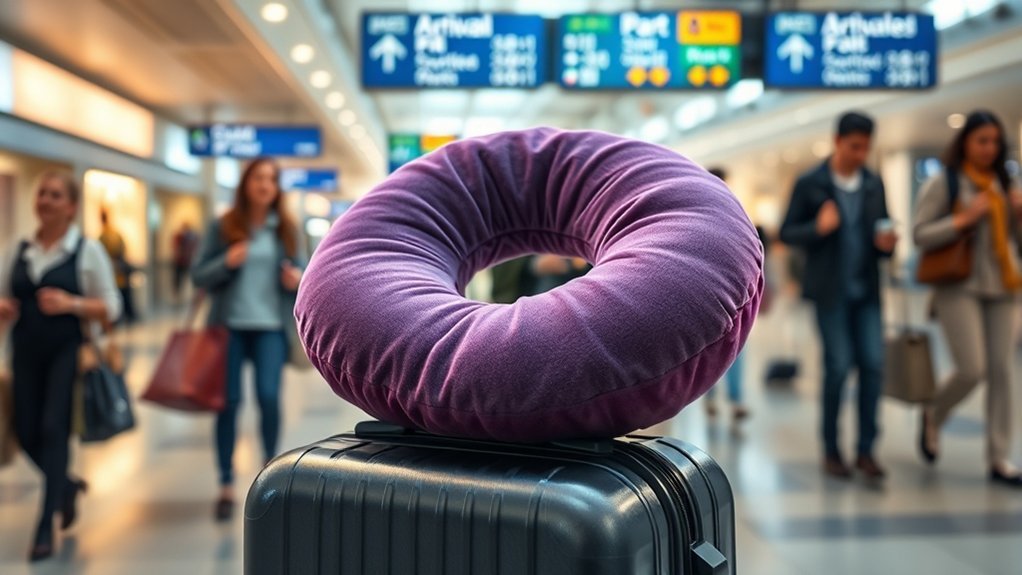
Last Updated on July 24, 2026 by Caleb Warren
On most major US airlines, a standard neck pillow worn around your neck or attached to your bag does not count as your one personal item or carry-on bag. However, if you store a bulky or full-sized travel pillow inside a separate tote, or if you are flying on ultra-budget carriers like Spirit or Frontier, gate agents may require it to fit inside your designated personal item bag (typically 18 x 14 x 8 inches) or charge an unexpected gate fee.
Quick Answer
A travel neck pillow usually does not count as a personal item if you wear it around your neck while boarding. However, full-sized bed pillows or extra bags used to carry travel pillows must fit entirely within your airline’s under-seat personal item size limit (ranging from 16.25 x 13.5 x 8 inches to 18 x 14 x 8 inches depending on the carrier).
Key Takeaways
- Wear It to Board: Legacy airlines (American, Delta, United) almost universally allow you to wear a travel neck pillow onto the plane without counting it against your baggage allowance.
- Watch Budget Carriers: Ultra-budget airlines (Spirit, Frontier, Allegiant) strictly enforce 1-bag limits at the gate and may demand your pillow be stuffed inside your personal item.
- Know Specific Size Limits: Under-seat personal item dimensions vary by airline—from 17 x 10 x 9 inches on United to 18 x 14 x 8 inches on American.
- TSA Clearance: All travel pillows (memory foam, inflatable, microbead) are fully permitted through airport security checkpoints by the Transportation Security Administration (TSA).
Disclosure: As an Amazon Associate I earn from qualifying purchases. Some links on this page are affiliate links, at no extra cost to you.
What Is Considered a Personal Item on US Airlines?
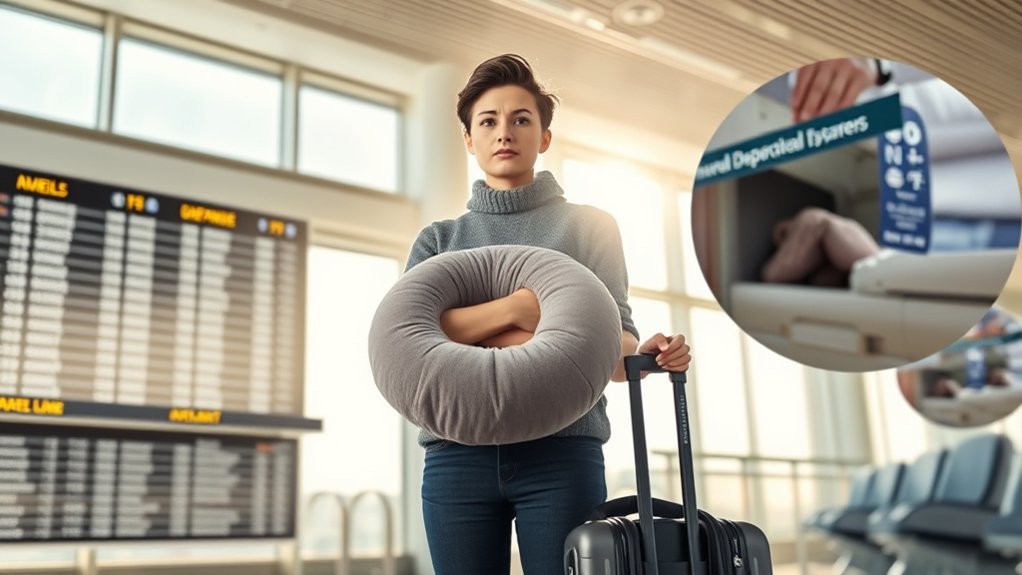
When preparing for a flight, understanding what qualifies as a personal item on US airlines prevents costly surprises at the boarding gate. A personal item is officially defined as a small bag or container that fits entirely beneath the seat directly in front of you during flight.
Standard personal items include small backpacks, purses, laptop bags, briefcases, and tote bags. Every airline enforces specific dimensional boundaries for personal items to guarantee they do not obstruct footwell space or emergency evacuation routes. Exceeding these dimensions can result in gate-check fees ranging from $35 to $99 per bag.
Note: Outerwear, umbrellas, duty-free shopping bags, and assistive devices (such as crutches or CPAP machines) do not count toward your airline personal item or carry-on baggage allowance on US flights under Federal Aviation Administration guidelines.
Is a Travel Pillow Considered a Personal Item?
Whether a travel pillow counts as a personal item depends on its size, how you carry it, and the airline’s specific boarding policies. Standard U-shaped neck pillows worn around your neck or clipped to the handle of a backpack almost never count as an individual piece of luggage on major legacy carriers.
However, if your travel pillow is a full-sized bed pillow, carried inside an extra plastic or fabric shopping bag, or brought aboard an ultra-budget airline, gate agents may classify it as a second personal item or carry-on bag.
At a Glance: Travel Pillow Types & Airline Acceptance
| Pillow Type | Key Benefits | Baggage Classification |
| Inflatable Neck Pillow | Deflates flat; takes zero extra baggage space | Packs inside personal item |
| Compact Memory Foam Neck Pillow | Provides ergonomic cervical spine support | Exempt when worn around neck |
| Bulkier Travel Pillow or Bed Pillow | Maximum sleeping comfort and head support | Counts as personal item or carry-on |
What Are the Size Limits for Travel Pillows?
Airline rules for travel pillows correlate directly with overall personal item dimensions. If your travel pillow is stored inside your backpack or under-seat bag, your bag must strictly fit within the sizer box located at the airport boarding gate.
Common Size Restrictions
Most major airlines require personal items to measure no larger than 18 x 14 x 8 inches (45 x 35 x 20 cm). Standard memory foam neck pillows typically measure approximately 11 x 11 x 4 inches, allowing them to comfortably fit inside or clipped outside a compliant bag.
“Under-seat space varies significantly across aircraft models. A compact travel pillow measuring under 12 inches across ensures you retain adequate legroom while maintaining full compliance with airline bag size gauges.”
Airline-Specific Guidelines
Baggage dimensions are not universal across US carriers. Always review the exact size limitations established by your specific airline prior to packing:
| Airline | Personal Item Size Limit | Travel Pillow Policy Notes |
|---|---|---|
| American Airlines | 18 x 14 x 8 in (45 x 35 x 20 cm) | Neck pillows worn around neck do not count toward limits. |
| United Airlines | 17 x 10 x 9 in (43 x 25 x 22 cm) | Strict basic economy enforcement; pillow must fit under seat. |
| Delta Air Lines | Must fit under seat (~18 x 14 x 8 in) | No published linear limit; neck pillows permitted freely. |
| Southwest Airlines | 16.25 x 13.5 x 8 in (41 x 34 x 20 cm) | Generous 2 free checked bags policy makes packing easy. |
| Spirit / Frontier | 18 x 14 x 8 in (45 x 35 x 20 cm) | Strict enforcement; extra unattached items trigger fees. |
Warning: Ultra-budget carriers like Spirit, Frontier, and Ryanair enforce strict “one single item” gate policies. Carrying a separate bag containing only a pillow can result in an immediate $50–$99 gate baggage fee. Always clip or wear your pillow before walking up to the gate agent.
How to Pack a Travel Pillow Efficiently?
Packing a travel pillow efficiently maximizes space for other travel gear while preventing damage to the pillow’s internal structure. Selecting the right pillow technology determines how much volume you save.
- Opt for Inflatable Models: Inflatable travel pillows collapse completely flat, allowing you to slide them into laptop sleeves or side pockets without using up core bag volume.
- Use Compression Straps: Compressible memory foam pillows often come with integrated cinch bags or travel straps that compress the foam down to 50% of its expanded size.
- Attach to External Straps: Secure your neck pillow directly onto the top handle or side carabiner of your carry-on bag using the pillow’s snap button.
- Pack Inside Clothing: Protect memory foam from dirt by wrapping the pillow inside an extra sweatshirt or jacket stored in your main bag.
Pro Tip (The Pillowcase Hack): Many frequent flyers buy a hollow, zippered neck pillow cover and stuff soft clothing items—such as socks, t-shirts, and underwear—inside it. This provides comfortable neck support while serving as extra packing space that gate agents consistently treat as a wearable pillow.
Tips for Maximizing Comfort With Your Travel Pillow
Getting restful sleep in an upright airplane seat requires proper ergonomic positioning and cushion inflation levels. Follow these guidelines to optimize comfort during long-haul flights:
- Rotate the Pillow Forward: Turn your U-shaped neck pillow around so the thickest cushion rests beneath your chin. This prevents your head from dropping forward—the primary cause of neck strain during flight.
- Avoid Over-Inflation: If using an inflatable travel pillow, inflate it to roughly 70% to 80% capacity. Fully rigid pillows exert excessive pressure against your neck and head.
- Adjust for Altitude Pressure Changes: Air pressure inside the aircraft cabin decreases as the plane climbs to cruising altitude, causing trapped air in inflatable pillows to expand. Adjust valve pressure once airborne.
- Pair with Lumbar Support: Place a folded jacket or small cushion behind your lower back to maintain natural spinal curvature while using your neck pillow.
Other Items to Pack With Your Travel Pillow
Combining your travel pillow with key in-flight accessories creates an ideal environment for rest, even in middle economy seats.
Essential Travel Comfort Items
Pack these complementary comfort accessories directly alongside your neck pillow in an easily accessible pocket of your personal item:
- Active Noise-Canceling (ANC) Headphones: Block out jet engine noise and cabin chatter.
- Contoured Eye Mask: Prevents light leakage without pressing against your eyelids.
- Compression Socks: Promotes circulation during long periods of sitting, reducing foot fatigue.
- Refillable Water Bottle: Maintains hydration in low-humidity cabin air (fill after passing TSA security).
Organized Packing Strategies
Maintain quick access to your gear during flight by organizing your personal item logically. Place items you need during takeoff and landing in top external pockets. Stow your travel pillow, eye mask, and headphones together in a dedicated pouch so you can retrieve your sleep setup in one smooth motion once the seatbelt sign turns off.
Frequently Asked Questions
Can I use a travel pillow during takeoff and landing?
Yes. You can wear a neck pillow around your neck during takeoff and landing, provided it does not obstruct your seatbelt fastening or block the aisle pathway in an emergency evacuation.
Are inflatable travel pillows allowed through airport security (TSA)?
Yes. According to the TSA guidelines, all types of travel pillows—including inflatable, memory foam, microbead, and down-filled models—are fully permitted through airport security checkpoints in both carry-on and checked luggage.
Do travel pillows need to be stored during flights?
No. You do not need to stow a neck pillow in the overhead bin or under the seat during the flight. You may keep it around your neck or in your lap throughout the entire journey.
Can I carry multiple travel pillows on board?
Carrying multiple loose pillows may trigger gate scrutiny. While wearing one neck pillow is universally accepted, carrying two or three unbagged pillows will likely cause gate agents to count them as additional carry-on items.
What if my travel pillow exceeds the size limit?
If your pillow is too bulky to fit inside your personal item bag or under the seat, compress it using a compression bag, wear it around your neck before boarding, or check your bag to avoid gate-check penalty fees.
Conclusion
In short, a standard travel neck pillow usually will not count as your personal item on major airlines as long as you wear it around your neck or attach it neatly to your main bag. By checking your carrier’s specific under-seat dimensions—such as American Airlines’ 18x14x8 limits or United Airlines’ 17x10x9 limits—and opting for compact memory foam or inflatable designs, you can travel comfortably without incurring unexpected gate fees.
Sources
- TSA Official Guidelines: Pillows — Official screening rules for travel and bed pillows at security checkpoints.
- American Airlines Carry-On Baggage Policy — Published personal item size requirements and carry-on rules.
- United Airlines Baggage Guidelines — Personal item dimensions and under-seat restriction details.
- Delta Air Lines Carry-On Baggage Information — Official standards for personal items and under-seat stowage.
- Southwest Airlines Baggage Limits — Dimensional requirements for personal items and carry-on bags.
