

Last Updated on July 24, 2026 by Caleb Warren
Navigating airline baggage rules can be confusing, especially when deciding whether to wear, pack, or strap your favorite neck pillow to your luggage. On most major legacy airlines, a standard travel pillow is treated as a personal accessory that does not count against your carry-on or personal item allowance. However, strict dimensional limits and differing carrier policies—particularly on budget airlines—mean you need to know how your airline handles travel gear before arriving at the gate.
Quick Answer
On major legacy carriers like Delta, United, and American Airlines, a travel pillow generally does not count as a carry-on or personal item, allowing you to bring it aboard for free in addition to your allowance. However, on ultra-low-cost carriers like Spirit, Frontier, and Ryanair, any bulky pillow that cannot fit inside your single personal item bag may trigger extra gate fees.
Key Takeaways
- Legacy vs. Budget Carriers: Full-service airlines usually treat neck pillows as free personal accessories, whereas ultra-low-cost carriers enforce strict one-bag limits.
- Under-Seat Fit: To qualify as a personal item, a travel pillow or bag must fit within the space under the seat in front of you (typically under 18 x 14 x 8 inches).
- Inflatable & Compressible Pillows: Inflatable or compact memory foam options are ideal for preventing space issues and gate-check disputes.
- TSA Clearance: All travel pillow types easily clear TSA airport security checkpoints when placed in screening bins.
Disclosure: As an Amazon Associate I earn from qualifying purchases. Some links on this page are affiliate links, at no extra cost to you.
What Is a Personal Item According to Airlines?
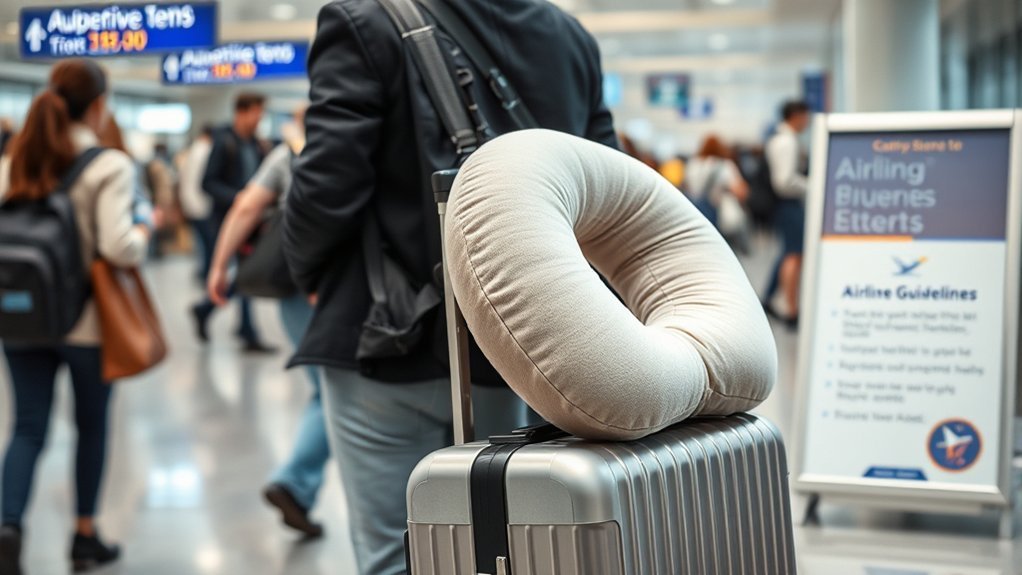
When traveling by air, understanding what qualifies as a personal item is essential to avoiding unexpected fees. A personal item is generally defined as a small bag or accessory that can fit completely under the seat in front of you during flight. Standard examples include purses, briefcases, laptop bags, and small backpacks.
Personal item dimensions vary across airlines. For example, American Airlines allows dimensions up to 18 x 14 x 8 inches, while United Airlines sets its limit slightly smaller at 17 x 10 x 9 inches. Knowing your airline’s specific dimensional boundaries ensures you avoid gate-checking hassles or extra charges.
How Do Airlines Define Carry-On Luggage?
Unlike personal items that store under the seat, carry-on bags are larger items designed to fit in the overhead storage bin. Most major U.S. domestic carriers enforce standard maximum dimensions for carry-on luggage:
| Airline | Carry-On Maximum Dimensions |
|---|---|
| United Airlines | 22” x 14” x 9” (56 x 35 x 23 cm) |
| Delta Air Lines | 22” x 14” x 9” (56 x 35 x 23 cm) |
| Southwest Airlines | 24” x 16” x 10” (61 x 40 x 25 cm) |
| American Airlines | 22” x 14” x 9” (56 x 35 x 23 cm) |
Oversized or firm non-compressible travel pillows placed loose in overhead bins may be questioned if overhead space is full. Keeping your pillow compact guarantees smooth boarding.
Does a Travel Pillow Count as a Personal Item?
In most instances on major airlines, a standard travel neck pillow does not count against your personal item allowance. Carriers such as United Airlines and Delta Air Lines explicitly consider small neck pillows to be reasonable personal effects or attire accessories, similar to a coat or umbrella.
You can wear your neck pillow onto the aircraft, wrap it around your handbag handle, or slide it underneath the seat in front of you without penalty.
Warning for Budget Airline Travelers: Ultra-low-cost carriers (ULCCs) like Spirit Airlines, Frontier Airlines, and Ryanair strictly enforce a “one single bag” policy. Gate agents on these flights may count a travel pillow worn around your neck or clipped outside your bag as a second piece of luggage, potentially charging steep gate fees. Always consolidate your pillow inside your approved personal bag before scanning your boarding pass on budget flights.
Are Inflatable Pillows Treated Differently From Regular Pillows?
Inflatable travel pillows offer distinct advantages over traditional plush or memory foam options. Because they can be deflated completely and folded down to the size of a wallet, inflatable options eliminate size limit concerns entirely.
When selecting a travel pillow material, evaluate the balance between packing efficiency and sleeping support:
| Material Type | Packability | Main Benefits |
|---|---|---|
| Inflatable | Highest (Deflates flat) | Ultra-lightweight, customizable firmness, zero bulk. |
| Compact Memory Foam | Medium (Compressible) | Superior neck support, ergonomic cushioning. |
| Microbead | Low (Non-compressible) | Lightweight and squishy, but bulkier to pack. |
| Polyester Fill | Low–Medium | Soft, machine washable, traditional cushion feel. |
The Clothing-Stuffed Pillowcase Hack: Is It Allowed?
A popular travel trend involves filling a hollow zippered travel pillowcase with soft clothing items (such as t-shirts, socks, and hoodies) to expand packing capacity without paying extra bag fees.
While many travelers successfully use this hack on full-service airlines, gate agents on ultra-low-cost carriers have become vigilant. If a stuffed pillowcase looks excessively heavy, rigid, or bulging like a duffel bag, staff may require you to fit it into the luggage sizer box or pay a fee. Use this technique cautiously and avoid overstuffing.
TSA Security Screening Rules for Travel Pillows
According to official guidance from the Transportation Security Administration (TSA), travel pillows of all materials (memory foam, inflatable, microbead, down) are permitted through security checkpoints in both carry-on bags and checked luggage.
Pro Tip for TSA Security: If you are wearing your travel pillow through the TSA checkpoint lane, send it through the X-ray machine scanner inside a bin alongside your coat and belt to prevent delays.
Tips for Packing a Travel Pillow Efficiently
If you prefer not to wear your pillow around your neck while walking through the airport terminal, efficient packing strategies can help save critical luggage space.
Choose Compact Travel Pillows
Select compressible memory foam pillows that come with dedicated travel cinch sacks. These compression sacks allow you to reduce the pillow’s physical volume by up to 50%, allowing it to tuck neatly into personal item bags.
Utilize Compression Bags
Vacuum-style or roll-up compression bags work exceptionally well for traditional plush or polyester-filled travel pillows. Sealing the pillow in a compression sack flattens out air pockets, keeping your luggage organized and streamlined.
Layer With Clothing Items
If your carry-on bag is structured, place your travel pillow in the center gap surrounded by rolled shirts or pants. This smart layering technique cushions internal contents while making effective use of void space inside your bag.
Key Airline Policies on Bringing Pillows
To avoid gate confusion, review the specific personal item dimensions enforced by top domestic and international carriers:
| Airline | Personal Item Size Limit | Travel Pillow Allowance Notes |
|---|---|---|
| American Airlines | 18 x 14 x 8 inches | Free neck pillows permitted as additional accessories. |
| Delta Air Lines | Must fit under seat (~18 x 14 x 8 in) | Standard neck pillows do not count toward bag limits. |
| United Airlines | 17 x 10 x 9 inches | Pillows are welcome as additional free items. |
| Southwest Airlines | 16.25 x 13.5 x 8.5 inches | Neck pillows are allowed for free without counting as bags. |
| Spirit / Frontier | 18 x 14 x 8 inches | Strict enforcement: Pillow must fit inside your single personal bag. |
Frequently Asked Questions
Can I use my travel pillow during the flight?
Yes, you can use your travel pillow throughout the flight, including during takeoff and landing. However, flight attendants may ask you to remove bulky chest-supporting inflatable pillows during taxiing, takeoff, and landing for safety compliance.
Are travel pillows allowed in the cabin or only in checked baggage?
Travel pillows are permitted in both cabin baggage and checked luggage. Carrying your pillow into the cabin is recommended so you can use it for neck support during long flights.
Can I carry multiple travel pillows on board?
Carrying one standard neck pillow is typically allowed as a free accessory. Carrying multiple full-size travel pillows may prompt gate agents to count the extra pillows as an additional carry-on bag or personal item.
Do airlines provide travel pillows, or must I bring my own?
Complimentary pillows are generally provided only on long-haul international flights or premium cabin seats (First/Business class). Domestic economy flights rarely provide pillows, so bringing your own is recommended.
What happens if my travel pillow exceeds size limits?
If your pillow is excessively large and cannot fit inside your personal item bag or underneath the seat in front of you, airlines may require you to check it or pay a carry-on fee.
Conclusion
Understanding airline baggage policies ensures a stress-free travel experience. On major full-service airlines, a standard travel pillow is treated as a complimentary comfort accessory that won’t count against your bag limit. However, when flying on ultra-low-cost carriers, packing a collapsible or inflatable pillow inside your single personal item bag prevents unexpected fees at the gate. By choosing compact designs and double-checking your airline’s specific dimensional rules, you can travel comfortably on every journey.
Sources
- Transportation Security Administration (TSA) — Checkpoint security guidelines for travel pillows and comfort items.
- American Airlines Carry-On Bag Policy — Official personal item size limits and carry-on allowances.
- Delta Air Lines Baggage Allowance — Detailed specifications for personal effects and carry-on items.
- United Airlines Baggage Rules — Standard dimensional limits for personal items and carry-on luggage.
- Southwest Airlines Luggage Guidelines — Dimensions and rules for carry-on and personal belongings.

