
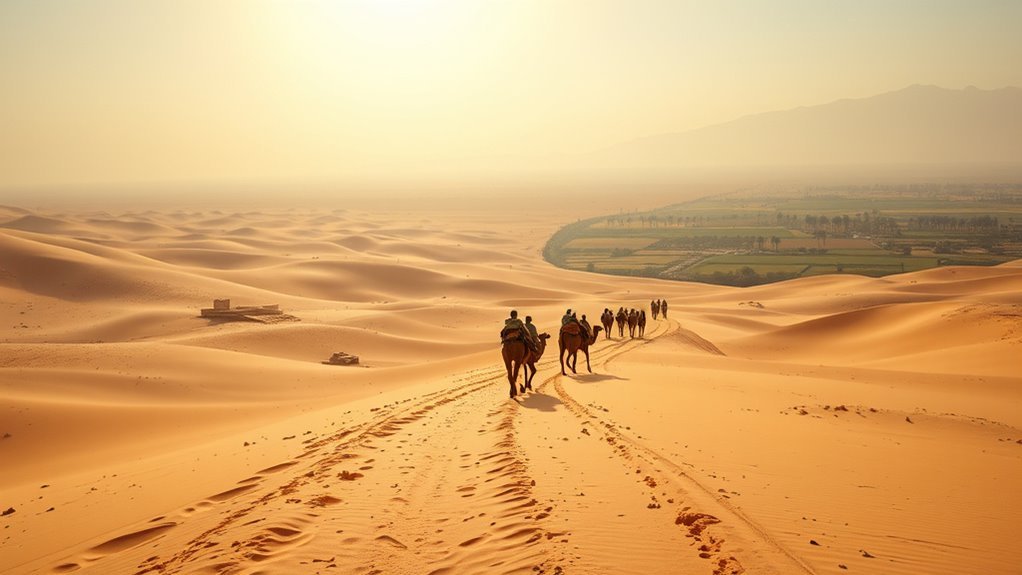
Ancient Canaan and Egypt were separated by about 5,771 miles (9,292 kilometers), so you’re looking at a major long-haul trip today, often 14 to 18 hours by air with layovers. For the Israelites, though, the journey covered roughly 700 km and took 47 days, because they didn’t take the fast coastal route. Instead, they followed a divinely guided path through the wilderness, with key stops that shaped the Exodus story and its lessons.
What Is the Distance Between Egypt and Canaan?

The distance from Egypt to Canaan is approximately 5,771 miles (9,292 kilometers), so traveling between the two usually requires long-haul planning rather than a simple direct trip.
The distance from Egypt to Canaan spans roughly 5,771 miles, making travel a long-haul journey.
You’re looking at a major regional span that shapes travel logistics, trade, and movement. Because no direct connections usually exist, you’d typically combine flights with bus transfers. That makes the route more complex than its map line suggests.
Average flight times run about 14 to 18 hours, depending on layovers and routing. Costs also vary widely, often from $340 to $1,900, so you’ll need to compare options carefully.
Canaan sits 6 hours ahead of Egypt, which can affect scheduling and coordination.
This distance carries historical significance, since it’s connected to long-standing movement, exchange, and memory across the region. It also supports cultural exchanges, showing how geography shapes contact, negotiation, and liberation-oriented connections between peoples.
How Long Did the Israelites’ Journey Take?
From a travel-distance perspective, the Israelites’ movement wasn’t a single trip but a staged journey with distinct segments and long pauses. You can measure the journey duration in two ways: the active march and the waiting periods that shaped it.
The full move from Egypt to Mt. Sinai covered about 700 km and lasted 47 days, from Nisan 15 to Sivan 1 in 1446 BC. Key markers show why the travel significance mattered:
- 9 days at Succoth, waiting for Hebrew mining slaves.
- 25 days crossing the Red Sea, with 8 days camped under pursuit.
- 39 days to Dophkah, then hardship at Rephidim and water from the rock.
Afterward, you see another 11 months from Mt. Sinai to Kadesh Barnea, with 20 stops.
Then they camped there 38 years. A pillar of cloud by day and fire by night showed that liberation moved with guidance, not haste.
Which Route Did the Israelites Follow?
Likely, the Israelites didn’t take a straight northbound road from Egypt to Canaan; instead, they followed a divinely guided detour that first led them from Rameses, probably Pi-Ramesses, toward Succoth and then down to the Straits of Tiran and the Red Sea.
You can read this route as strategic desert navigation, not random wandering. The evidence points to a roughly 700-km path shaped by divine guidance, with Israel avoiding the fast coastal corridor that would’ve exposed a newly freed people to war and return.
At the Red Sea, they paused while Pharaoh’s forces pressed behind them, then crossed and moved into the Wilderness of Sin.
This route shows liberation unfolding through movement, waiting, and instruction, not speed alone. If you trace the sequence, you see a people led away from empire’s grip and into a harder but freer road, one that trained them to trust guidance beyond human maps.
What Were the Main Stops on the Route?
Along the route from Goshen to Mt. Sinai, you can trace several significant stops that shaped the Israelites’ movement and endurance. These journey highlights aren’t random; they mark measurable stages in a liberation trek from Egypt.
- Succoth, reached on Day 9, served as an early assembly point as you moved out of Goshen.
- The Red Sea, crossed on Day 25, became an eight-day camp and a decisive break from bondage.
- The Wilderness of Sin, entered on Day 31, held an eight-day stay where you learned about Manna’s provision.
You also pass Straits of Tiran on Day 15, Dophkah, where spiritual growth continued, and Rephidim, where water complaints tested morale.
The route ends with Moses at Mt. Sinai on Day 47, a documented endpoint that anchors the journey in historical sequence and covenant formation.
Why Did God Lead Them This Way?
You can see that God led Israel by a longer route to avoid an early battle with the Philistines and reduce the risk that they’d return to Egypt in fear (Exodus 13:17).
The wilderness wasn’t wasted time; it became training for trust, as God provided manna and taught dependence on His care (Exodus 16; Deuteronomy 8:2-3).
Divine Detour
God didn’t take the Israelites straight from Egypt to Canaan because the route was strategically and spiritually risky: Exodus 13:17-18 says He led them away from the Philistines so they wouldn’t turn back in fear.
You can see divine guidance in that detour, which prioritized freedom over speed. The 700-km journey took about 47 days, so patience mattered.
- The path reduced enemy pressure.
- The pillar of cloud and fire kept you oriented.
- Mt. Sinai showed that covenant came before conquest.
Along the way, shortages of water and food delivered faith lessons, pushing you to rely on God’s provision rather than panic.
This wasn’t wasted time; it was purposeful direction toward liberation.
Wilderness Training
Wilderness travel wasn’t just a route to Canaan; it was training for life with God. You can see the evidence in Exodus 16:4: God led Israel into hardship to test whether you’d trust Him.
What should’ve been an 11-day trip stretched to 40 years because unbelief at Kadesh Barnea delayed the journey. In that school of survival, you learned faith lessons through daily dependence. God sent manna and quail, showing divine provision when human supply ran out.
By day, a cloud guided you; by night, fire did the same. The wilderness exposed your limits, but it also proved God’s steady care.
For a people seeking liberation, this mattered: freedom required more than escape from Egypt. It required learning obedience, trust, and endurance under God.
Covenant Preparation
By leading Israel along a longer, safer route from Egypt to Canaan, the Lord was doing more than rerouting a migration; He was preparing a covenant people. You can see His strategy in the evidence:
- He avoided Philistine conflict, protecting fragile faith.
- He delivered them through the Red Sea, proving His power.
- He kept them at Sinai to receive Law and practice holy living.
This wasn’t wasted time. The manna, water, and 40-year discipline trained you to depend on God, not empire.
That delay carried covenant significance: liberation needed structure, and freedom required spiritual commitment.
Before you entered the land, God shaped your identity, tested obedience, and built the maturity needed to live as a redeemed people under His rule.
What Happened at the Red Sea?
On day 25 of the journey, the Israelites reached the Red Sea just as Pharaoh’s army was closing in behind them. You can see the event as a decisive break from Egypt: at God’s command, Moses stretched out his staff, the waters parted, and you’d find a dry path across the Red Sea.
Scholars place the crossing on the eastern shore, which supports the view that this wasn’t a vague legend but a real escape point from bondage. The Miracle Significance lies in deliverance, not spectacle; it protected a people seeking freedom from Pharaoh’s Pursuit.
When the waters returned, Pharaoh’s army was destroyed, ending the threat. Afterward, you witness the people’s response: a Celebration Song of praise for salvation.
The scene shows liberation as both historical action and communal memory.
What Happened at Mount Sinai?
At Mount Sinai, the Israelites entered a decisive new phase: Moses ascended the mountain, and on day 48 after their arrival, God recited the Ten Commandments. You can trace Moses’ encounter with God as the point where Divine law moved from promise to public covenant. The sequence matters:
- Day 48: God spoke the core commandments.
- Day 50: preparation for God’s descent underscored holiness and readiness.
- Over 40 days: God gave Moses the law, shaping Israel’s constitutional identity.
This wasn’t abstract religion; it was organized freedom. You see a people leaving slavery and learning how to live as a nation under just authority.
After the law was given, they camped 343 days at Sinai, where formation, discipline, and community building took priority. The evidence shows Mount Sinai functioned as a legal and spiritual turning point, not a pause in history, but a redefinition of collective life.
What Happened at Kadesh Barnea?
Kadesh Barnea became one of the most consequential stops in Israel’s wilderness journey, serving as the base where the people tested their trust in God and where the long years of wandering began.
You can trace its Kadesh significance in two major events: the spy mission and the water crisis. From here, Moses sent twelve scouts into Canaan. When most returned with fearful reports, you see how quickly uncertainty turned into Israelite rebellion against Moses and God. That resistance brought the decree of forty years in the desert until that generation died.
At Kadesh, you also witness Moses striking the rock to bring water for a complaining community. The act met real need, yet it also marked his disobedience.
Scholars often link Kadesh Barnea with modern Petra, a stronghold whose setting fits the site’s strategic role in biblical history.
Why Does the Exodus Journey Still Matter?
Although the Exodus route from Egypt to Canaan stretches roughly 700 km, its importance goes far beyond geography because it records Israel’s movement from bondage to freedom under divine guidance.
You see faith significance in the Red Sea crossing and Mt. Sinai, where covenant and law shaped a people seeking liberation. In historical context, the route through Succoth and Kadesh Barnea shows that provision and testing worked together.
- Liberation themes: you learn that freedom requires more than escape; it needs obedience.
- Trust lessons: the wandering period warns you that unbelief delays promise.
- Identity formation: the journey formed a people who remembered God’s acts and their own calling.
If you desire liberation, this narrative invites spiritual reflection. It shows perseverance importance, because lasting change comes when you rely on divine guidance, remember past faithfulness, and keep moving forward even when the path feels uncertain.
Frequently Asked Questions
What Modern Travel Options Connect Canaan and Egypt?
You can travel between Canaan and Egypt today by flights, buses, and cross-border roads via Sinai or Israel. Modern transport supports cultural exchanges, while archaeological findings and historical significance shape your route choices.
Which Cities Lie Closest to the Ancient Route?
Gaza, Rafah, and el-Arish lie closest to the ancient route; you’d also track Hebron, Beersheba, and Pelusium by geographical landmarks. Ancient trade linked these cities, and you can map evidence through desert corridors and coastal roads.
Is the Canaan-Egypt Distance Measured by Road or Straight Line?
You’d think it’s one tidy number, but it usually isn’t: scholars estimate Canaan-Egypt distance by straight line for comparison, then examine road routes for historical significance and geographical challenges. You should check the method used.
What Are the Best Guided Tours for Exodus Sites?
You’ll get the best guided tours from reputable Israel and Egypt operators that visit Exodus landmarks like Sinai, Goshen, and the Nile Delta. Choose guides who explain historical significance with evidence, archaeology, and liberation-focused context.
Are There Border Crossings Near the Ancient Canaan-Egypt Path?
Yes—today you’ll find crossings near the ancient route, especially through Sinai and Israel-Egypt points like Taba and Kerem Shalom. Border security controls access, while ancient trade paths followed caravan corridors, not fixed gates.
Conclusion
So, if you’re tracing the distance between Canaan and Egypt, you’ll see why the Exodus was less about miles and more about purpose. The direct route is only about 200 miles, yet the Israelites’ journey stretched around 40 years. That striking gap shows how geography, history, and faith intersected. For you, the key takeaway is clear: the route’s length, stops, and challenges still reveal how a short journey can become a defining national story.