
Last Updated on July 27, 2026 by Daniel Globe
San Marino City packs medieval fortifications, mountain views, museums, local food, and centuries of republican history into a remarkably compact hilltop capital. Its UNESCO-listed historic centre sits on Mount Titano, where visitors can walk between ancient towers, explore stone streets and public squares, ride a panoramic cable car, and follow trails through the surrounding landscape.
Quick Answer
The top things to do in San Marino City are walking the UNESCO-listed Old Town, visiting Guaita and Cesta towers, seeing Piazza della Libertà and the Basilica of Saint Marinus, exploring the State Museum, riding the Borgo Maggiore cable car, hiking on Mount Titano, and trying traditional Sammarinese food.
Key Takeaways
- San Marino Historic Centre and Mount Titano have been a UNESCO World Heritage Site since 2008.
- Guaita and Cesta can normally be visited, while the third tower, Montale, is open to exterior viewing only.
- The Rupe Path is a real Mount Titano hiking option, but its steep sections make suitable shoes important.
- The cable car from Borgo Maggiore is one of the easiest and most scenic ways to reach the Old Town.
- Traditional foods include piadina, fresh pasta, bustrengo and Torta Tre Monti, accompanied by locally produced wines.
Disclosure: As an Amazon Associate I earn from qualifying purchases. Some links on this page are affiliate links, at no extra cost to you.
Explore San Marino’s UNESCO Historic Centre
The historic centre is the best place to begin. UNESCO inscribed San Marino Historic Centre and Mount Titano on the World Heritage List in 2008, recognizing the site’s exceptional testimony to the continuity of an independent republic since the Middle Ages.
The designation covers Mount Titano and the historic urban centre, including fortification towers, defensive walls, gates, religious buildings and public institutions. Although San Marino feels strongly medieval, visitors should not assume every stone building dates unchanged from the Middle Ages. The historic centre also reflects later restoration and reconstruction, particularly work carried out around the late 19th and early 20th centuries.
San Marino’s World Heritage value comes not only from its architecture but from the continuing civic life of an independent republic whose institutions have endured for centuries.
Visit the Basilica of Saint Marinus
The Basilica of Saint Marinus is one of the capital’s main religious landmarks. Construction of the present neoclassical building began in 1826, and it opened after completion of the work in 1838. Its entrance is fronted by eight Corinthian columns, while the interior is divided into three naves.
The basilica is dedicated to Saint Marinus, the traditional founder and patron saint of the republic. It remains closely tied to national ceremonies, including the September 3 Feast of Saint Marinus and the twice-yearly investiture of the Captains Regent. Visitors should remember that access may be restricted during religious services or official ceremonies.
See Piazza della Libertà and Palazzo Pubblico
Piazza della Libertà is the civic heart of San Marino City. Its landmark is Palazzo Pubblico, the Government Palace and seat of major state institutions including the Captains Regent and the Great and General Council. The present palace was constructed between 1884 and 1894.
Note: As of July 2026, Palazzo Pubblico is closed to interior visits from April 2 through September 30, 2026 for restoration. The square and exterior remain important stops, and the outdoor Changing of the Guard is scheduled separately.
During the 2026 summer season, the Changing of the Guard is scheduled from June 15 through September 20 at 9:30 a.m. and then hourly through 6:30 p.m. Because schedules and restoration work can change, confirm the latest information before making the ceremony the centerpiece of your visit.
Explore the State Museum
The State Museum in Palazzo Pergami Belluzzi adds useful context to everything seen outside. Its collection contains roughly 5,000 pieces of archaeological, artistic and numismatic interest, including material connected directly to the republic’s history.
It is a worthwhile stop for travelers who want to understand San Marino as more than a scenic photo destination. Exhibits cover archaeology, republican art, donated collections, coins and medals.
Hiking and Nature Walks Around Mount Titano
San Marino has a much stronger trail network than the original description suggests. Rather than relying on an unnamed route toward Serravalle, hikers can follow documented paths maintained and promoted through the country’s official nature-trail network.
Walk the Rupe Path
The Rupe Path is one of the most interesting choices close to San Marino City. The route connects the historic areas of Borgo Maggiore and San Marino City while passing below Mount Titano’s rocky cliffs.
The official route is about 4.76 kilometers long, takes roughly two hours and involves about 263 meters of elevation difference. It is rated medium to difficult because several short sections are steep and challenging. Along the way, hikers pass woodland, natural terraces and viewpoints facing toward the Adriatic side of the landscape.
Warning: Mount Titano trails can be steep, rocky or slippery after rain. Wear shoes with reliable grip, carry water and avoid treating the Rupe Path as an ordinary paved sightseeing walk. Check weather and daylight before starting.
Consider the Cammino del Titano
Travelers who want a longer outdoor experience can explore sections of the Cammino del Titano. The main loop extends for about 43 kilometers and links the republic’s nine Castelli, while the broader network connects numerous shorter nature itineraries across San Marino.
You do not need to walk the whole circuit. A short section can add woodland, rural landscapes and quieter viewpoints to a day otherwise focused on the busy Old Town.
Visit the Three Towers of San Marino
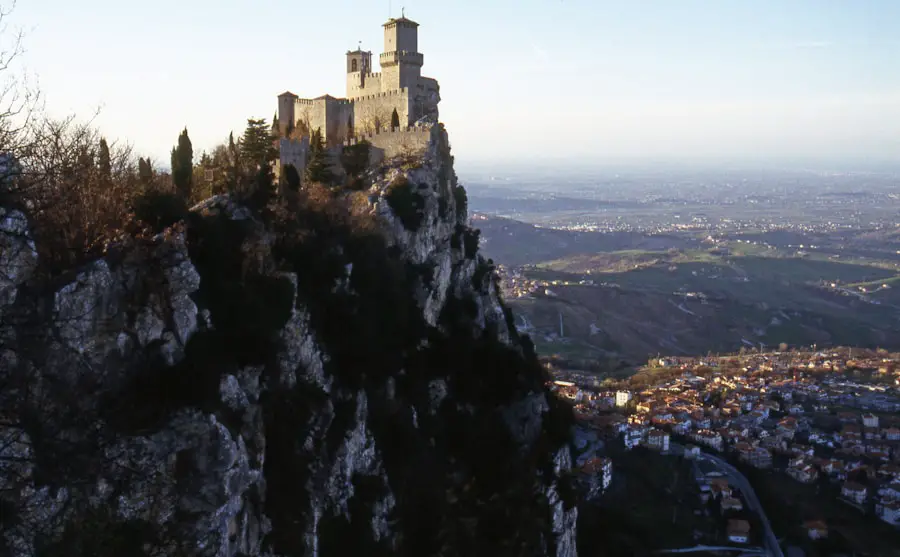
The Three Towers are San Marino’s best-known symbols. They stand along Mount Titano’s ridge and appear on the republic’s coat of arms. Each has a different history and a different level of visitor access.
First Tower: Guaita
Guaita is the oldest of the three. Defensive structures existed here around the beginning of the second millennium, and the fortress was enlarged and restored repeatedly over later centuries.
Visitors can walk through its defensive spaces and enjoy wide views from the ridge. For several centuries the fortress also served as a prison, a role that continued until 1975.
Second Tower: Cesta
Cesta, which dates to the 13th century, occupies another dramatic point on Mount Titano. It houses the Museum of Ancient Weapons, whose collection includes about 700 examples dating from the 13th through 19th centuries.
The ridge walk between Guaita and Cesta is one of the most memorable parts of a visit, combining defensive architecture with open views across the surrounding hills.
Third Tower: Montale
Montale is the smallest and most isolated of the three towers. It once played an important lookout role and contains an eight-meter-deep prison chamber inside.
Unlike Guaita and Cesta, Montale can currently be visited only from the outside. Walking toward it is still worthwhile for the quieter wooded setting and the chance to complete the visual journey along the Three Towers ridge.
Pro Tip: Visit Guaita early, continue along the ridge toward Cesta, then walk toward Montale. This follows the natural layout of the towers and avoids repeatedly climbing the same streets.
Sample Traditional San Marino Food and Wine
San Marino’s food reflects the agricultural traditions it shares with the surrounding Romagna and Montefeltro areas while retaining a distinct Sammarinese identity. Fresh pasta, grilled meats, cheeses, bread, local olive oil and wine all play an important role.
| Specialty | What to Expect |
| Piadina | A thin local-style flatbread commonly paired with cheese, cured meat and other fillings. |
| Fresh Pasta | Traditional preparations include tagliatelle, pappardelle, tagliolini and other handmade pasta served with meat, vegetables or legumes. |
| Bustrengo | A traditional rustic cake rooted in San Marino’s resourceful rural cooking traditions. |
| Torta Tre Monti | Round wafer layers filled with cocoa and hazelnut cream and finished with chocolate, named for San Marino’s Three Towers. |
| Local Wine | Sammarinese labels include wines such as Brugneto, Tessano, Sterpeto, Biancale and Roncale. |
The official tourism board’s guide to Sammarinese gastronomy also highlights local olive oil, cured meats, grilled dishes and a variety of traditional cakes.
Rather than searching only for internationally familiar Italian dishes, look for menus that identify Sammarinese or regional preparations. This is a better way to experience the area’s agricultural traditions.
Shop for Authentic San Marino Souvenirs
Shopping is more rewarding when the souvenir has a real connection to the republic. Locally produced food, wine, commemorative products, stamps and coins are stronger choices than goods merely associated with other parts of Italy.
San Marino issues its own euro coins under a monetary agreement with the European Union, and its philatelic and numismatic traditions have long attracted collectors. The Stamp and Coin Museum in the historic centre can provide useful context before buying collector-oriented items.
Food gifts are another practical option. Torta Tre Monti, locally produced wines, olive oil and other products carrying a clear San Marino origin are easy ways to take home something tied to the territory.
Note: “Ceramica di Faenza” refers to the famous ceramic tradition of Faenza in Italy and should not be presented as a uniquely Sammarinese handicraft.
Enjoy San Marino Festivals and Ceremonies
San Marino’s strongest cultural events are connected to the republic’s civic institutions, patron saint and historic military traditions. Dates and programs can change, so the official tourism calendar should be checked before travel.
Feast of Saint Marinus and Foundation of the Republic Day
September 3 is one of the most important dates on the national calendar. The 2026 program includes religious ceremonies, a procession with a relic of the saint, a historical parade, the Big Crossbow Tournament, music and an evening fireworks display.
Investiture of the Captains Regent
San Marino appoints two Captains Regent every six months. Their formal investiture takes place on April 1 and October 1 and includes processions and state ceremonies through the historic centre.
Crossbow, Archery and Medieval Traditions
Crossbow shooting has deep historical roots in San Marino. The San Marino Crossbowmen’s Federation maintains traditions involving historical costumes, flag throwing, music, parades and competition.
San Marino also hosts changing historical events. In 2026, for example, San Marino Antiqua brought medieval reenactments, demonstrations, archery and crossbow activities into the Old Town. Check the current year’s program rather than assuming that the same festival format occurs on identical dates every year.
Relax at Wellness Centers and Slow Down
San Marino is better described as a place for general wellness and relaxation than as a major natural thermal-spa destination. The country’s official tourism information promotes wellness activities and experiences, but it does not support treating a facility called “Terme di San Marino” as a principal natural thermal attraction.
Travelers who want a slower break can instead look for accommodation or wellness facilities offering services such as massage, sauna, fitness or relaxation treatments. Anyone specifically seeking mineral-rich thermal bathing should verify the water source and facilities of a dedicated thermal destination before booking.
There is also a simpler way to unwind here: spend an hour away from the busiest central streets, find a quiet viewpoint, or walk part of Mount Titano’s wooded trail network.
Take in Panoramic Views from Mount Titano
Mount Titano is the defining feature of the capital, and the views are one of the main reasons to visit. From the towers, ridge paths and panoramic terraces, the landscape opens across the hills surrounding the republic and toward the Adriatic side of Italy.
Clear weather matters. Haze can limit long-distance visibility, while early morning and late afternoon often provide softer light for photography. Sunset can be particularly attractive once many day-trippers have started to leave.
The summit area does not require a strenuous mountain ascent from the Old Town because the historic centre itself already occupies the upper slopes. Visitors arriving from below can also use the cable car.
Ride the Cable Car from Borgo Maggiore
The cable car links Borgo Maggiore with San Marino City’s Old Town. According to the official tourism board, the trip takes less than two minutes while gaining roughly 200 meters in elevation.
This makes it especially useful for travelers who want to avoid driving all the way toward the upper historic centre. Parking is available around Borgo Maggiore, including visitor parking convenient for the lower cable-car station.
Pro Tip: Parking near Borgo Maggiore and riding the cable car turns transportation into part of the sightseeing experience. On a clear day, the ascent also gives you an immediate view across the surrounding countryside.
How to Get to San Marino
San Marino has no mainline railway station or commercial airport, so most international visitors arrive through Italy. The official tourism board recommends Rimini as the main rail connection, with buses continuing from Rimini to San Marino every day, including weekends and holidays.
Drivers commonly approach from Italy via the A14 motorway and the Rimini-San Marino road connection. Numerous paid car parks serve the Old Town and surrounding areas.
San Marino is an independent country and is not an EU member, but its border with Italy is open and ordinary travelers do not normally pass through passport control when crossing between Italy and San Marino. The euro is the official currency.
Plan a One-Day San Marino Itinerary
Morning: Old Town and the First Tower
Arrive early, walk through the historic centre and stop at the Basilica of Saint Marinus and Piazza della Libertà. Continue uphill to Guaita before the busiest part of the day.
Late Morning: Walk to Cesta
Follow the ridge route toward Cesta, enjoying the viewpoints between the first two towers. Visit the Museum of Ancient Weapons if it interests you, then continue toward Montale for exterior views.
Lunch: Try Local Food
Return toward the centre for piadina, handmade pasta or another regional dish. Save room for Torta Tre Monti if you want to try San Marino’s best-known packaged dessert.
Afternoon: Museum or Trail
Spend the afternoon at the State Museum if history is your priority. Outdoor travelers can instead take a short walk beyond the central streets or devote more time to a section of the Mount Titano trail network.
Evening: Views and Old Town Streets
Stay into late afternoon or evening when possible. The streets often feel calmer after the peak day-trip period, and the mountain viewpoints can be especially attractive as the light softens.
Best Time to Visit San Marino City
Spring and early autumn are excellent choices for travelers who expect to walk extensively because temperatures are generally more comfortable than during the hottest part of summer. April through June and September into early autumn also provide a good balance between outdoor sightseeing and seasonal activity.
July and August bring long daylight hours and a busy events calendar, but they can also mean hotter conditions and larger crowds. Winter is quieter and can make the Old Town atmospheric, although daylight is shorter and weather can limit distant views or hiking.
September 3 is especially appealing for travelers interested in San Marino’s national traditions, while April 1 and October 1 offer the Captains Regent investiture ceremonies.
Practical Tips for Walking Around San Marino
San Marino City is compact, but it is not flat. Expect steep streets, stone steps, cobblestones and repeated changes in elevation. Comfortable footwear matters far more here than the small size of the Old Town might suggest.
Visitors with limited mobility should research accessible routes in advance. The cable car can eliminate part of the climb from Borgo Maggiore, but medieval streets and fortress areas still contain uneven surfaces and steps.
Carry water during warmer months and give yourself more time than a map might suggest. Distances are short, but stopping for viewpoints, tower interiors and uphill streets can turn a simple walk into several hours of sightseeing.
What to Pack for San Marino
A light day bag, comfortable walking shoes, water and weather-appropriate layers are enough for most visits. Travelers arriving as part of a longer European trip may also find it useful to compare carry-on luggage for international travel before departure.
Because San Marino involves plenty of walking and elevation change, comfortable socks can make a noticeable difference on a full sightseeing day. Merino wool travel socks are one option for managing moisture during long walks.
For a compact toiletry kit, a small travel toothbrush can also save space. The most important items for San Marino itself, however, are dependable footwear and enough layers for changing conditions on Mount Titano.
Frequently Asked Questions
What are the top things to do in San Marino City?
The highlights are Guaita and Cesta towers, the UNESCO-listed Old Town, Piazza della Libertà, the Basilica of Saint Marinus, the State Museum, Mount Titano viewpoints, the cable car from Borgo Maggiore and the area’s hiking trails.
Is San Marino City safe for tourists?
San Marino is widely visited and normal travel precautions are appropriate, but no destination should be described as risk-free. Keep valuables secure and check your government’s latest travel advice before departure. The U.S. State Department currently includes San Marino with its Italy travel guidance and advises travelers to exercise increased caution because of terrorism.
What is the best time to visit San Marino City?
Spring and early autumn are especially comfortable for walking. Summer offers long days, the Changing of the Guard and more events but can be hotter and busier. September 3 is a particularly interesting date because San Marino celebrates its patron saint and foundation tradition.
What cultural attractions should I visit in San Marino City?
Good choices include the State Museum, Basilica of Saint Marinus, Palazzo Pubblico and Piazza della Libertà, the Museum of Ancient Weapons inside Cesta, and the Stamp and Coin Museum.
What outdoor activities are available in San Marino City?
Visitors can walk the Mount Titano ridge, hike the Rupe Path, explore sections of the Cammino del Titano and follow other nature trails across the republic. Check trail difficulty and weather before starting.
What traditional food should I try in San Marino?
Look for piadina, handmade pasta, grilled meats, local cheeses, bustrengo and Torta Tre Monti. San Marino also produces olive oil and wines including Brugneto, Tessano, Biancale and Roncale.
Can you visit all three towers in San Marino?
You can normally enter Guaita and Cesta during their opening periods. Montale, the third tower, is not open internally and can currently be viewed only from the outside.
Can I visit San Marino without a car?
Yes. Travelers can take a train to Rimini in Italy and continue to San Marino by bus. Once there, most major Old Town sights are within walking distance, and the cable car connects Borgo Maggiore with the historic centre.
Sources
- UNESCO World Heritage Centre — San Marino Historic Centre and Mount Titano — UNESCO status, historic significance and heritage context.
- Visit San Marino — Palazzo Pubblico — government-palace history and the 2026 restoration closure.
- Visit San Marino — Changing of the Guard — current 2026 seasonal ceremony dates and times.
- Visit San Marino — Rupe Path — route length, walking time, elevation and difficulty.
- Visit San Marino — Sammarinese Gastronomy — traditional foods, cakes, olive oil and local culinary heritage.
- Visit San Marino — How to Get to San Marino — road, rail, bus and visitor transport information.
