
Last Updated on September 11, 2026 by Daniel Globe
Condor has carried leisure travelers since 1956, but an airline’s age alone does not prove that it is safe. A useful review should look at regulatory oversight, aircraft, accident history, onboard procedures, and the airline actually operating your flight. Based on those factors, Condor is generally a reasonable choice for air travel, although no airline or flight can be described as completely risk-free.
Quick Answer
Yes. Condor is generally considered a safe airline. It operates under German and EU aviation oversight, is not on the EU Air Safety List, and now uses an all-Airbus fleet. Its history includes a fatal 1988 accident, so the fairest verdict is positive but evidence-based—not a claim that any airline is risk-free.
Key Takeaways
- Condor is a German airline operating within the European aviation-safety system and is not named on the current EU Air Safety List.
- The airline has operated for 70 years and has used an all-Airbus fleet since retiring its final Boeing 757 in November 2025.
- Condor’s record includes a fatal 1988 crash that killed all 16 people aboard; a balanced review should not hide that history.
- Current cabin-bag dimensions are 55 x 40 x 23 cm for an overhead bag and 40 x 30 x 15 cm for a small bag, but entitlement depends on the fare and route.
- Customer complaints about delays, seats, refunds, or food can affect service quality, but they are not the same as evidence of unsafe flight operations.
How Safe Is Condor Today?
Condor is generally considered safe for normal passenger travel. It is a German carrier operating under European aviation rules, and Condor does not appear on the European Commission’s current EU Air Safety List of airlines subject to operating bans or restrictions.
That is reassuring, but it should be interpreted correctly. The EU list identifies airlines with serious regulatory concerns; it is not a league table that ranks every unlisted airline as equally safe. No regulator, aircraft type, or airline history can guarantee that a future flight will be free from risk.
Condor’s current regulatory status and modern fleet support a positive safety assessment, but safety should never be reduced to a slogan or customer-review score.
Safety Oversight and Condor’s Fleet
Condor operates as a German airline and must comply with the aviation rules that apply to commercial carriers based in Germany and the European Union. Those rules cover areas such as crew qualifications, aircraft maintenance, operating procedures, continuing airworthiness, and incident reporting.
According to Condor’s official company history, the airline retired its final Boeing 757 in November 2025 and now operates an all-Airbus fleet. Its long-haul flying centers on the Airbus A330neo, while newer A320neo and A321neo aircraft are being introduced on short- and medium-haul routes.
Does a Newer Fleet Make an Airline Safer?
New aircraft can offer updated systems, better diagnostics, and improved efficiency, but aircraft age alone does not determine safety. A well-maintained older aircraft can operate safely, while a new aircraft still depends on proper maintenance, trained crews, sound procedures, and effective regulatory oversight.
Note: A fleet-renewal announcement is useful background, but it should not be treated as a substitute for maintenance standards, crew training, and regulatory compliance.
Condor Accident and Incident History
Condor has a long operating history, but that history is not accident-free. The Aviation Safety Network records that Condor Flight 3782, a Boeing 737-200, crashed near Seferihisar, Turkey, on January 2, 1988. All 11 passengers and five crew members were killed.
That accident remains an important part of the airline’s record and should be acknowledged in any honest safety review. It involved an older aircraft generation and operating environment, so it does not by itself establish the risk of flying on Condor today. Likewise, a long period without another fatal passenger crash does not make future risk zero.
Nonfatal diversions, technical returns, rejected takeoffs, bird strikes, medical diversions, and precautionary landings can occur at any airline. Such an event is not automatically evidence of poor safety; in many cases, diverting or returning is the correct risk-control decision.
Condor Onboard Safety Measures
Condor’s core onboard safety measures are similar to those used by other regulated European airlines. Before takeoff, the crew gives or displays a safety briefing, checks that baggage is secured, confirms that seats and tray tables are in the required position, and prepares the cabin for departure.
Passengers should keep their seat belt fastened whenever seated, follow instructions about electronic devices, leave emergency equipment untouched, and keep aisles and exits clear. During turbulence or an abnormal event, crew instructions take priority over personal preference or convenience.
Condor uses cashless payment for onboard purchases. That reduces cash handling, but it is primarily a service policy rather than evidence of flight safety. Carry a supported credit or debit card if you plan to buy food, drinks, or other items during the flight.
Face Masks, Hygiene, and Cabin Air
Condor’s current hygiene information says masks are no longer generally mandatory on its flights. Passengers may still wear a medical mask by choice, and a departure airport, destination, health authority, or operating partner could introduce a separate requirement.
Condor also states that cabin air is replaced about every three minutes, flows from the top toward the bottom of the cabin, and passes through high-performance filters. The airline says its aircraft receive intensive cleaning after each flight.
Filtered air and cleaning can reduce some health risks, but they do not create a sterile cabin. Wash or sanitize your hands, cover coughs and sneezes, avoid traveling while contagious, and bring your own well-fitting mask if you want added protection in crowded terminals or onboard.
Pro Tip: Pack any mask, sanitizer, prescription medicine, and disinfecting wipes in your small under-seat bag rather than an overhead suitcase so they remain accessible throughout the flight.
Boarding and Disembarking Safely
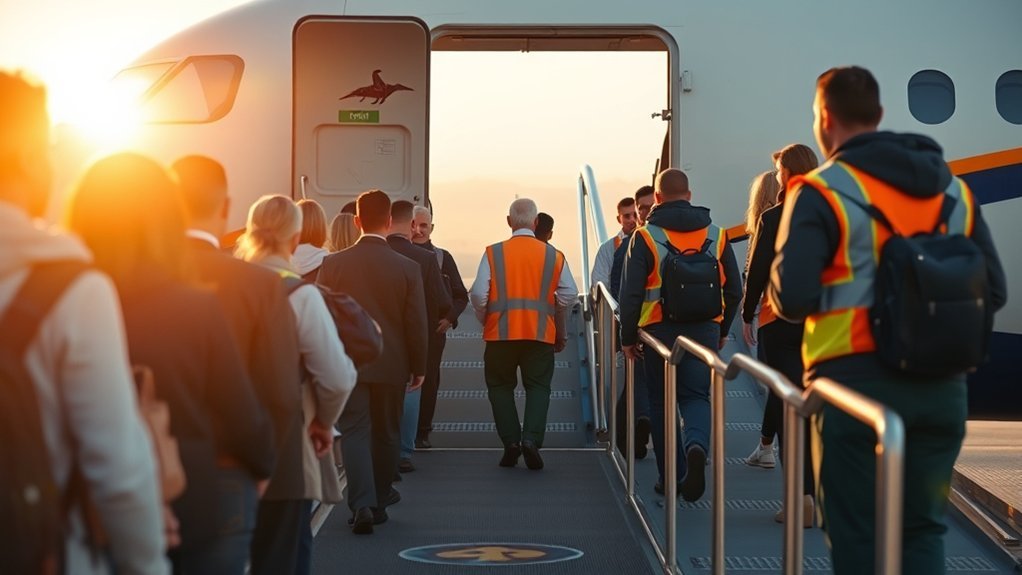
Boarding arrangements can vary by airport, aircraft, destination, passenger-assistance needs, and gate setup. You may board through a jet bridge, walk across the apron, or take a bus to the aircraft. Listen for the group, row, or priority category shown on your boarding pass instead of assuming every Condor flight uses the same sequence.
Small Group Boarding
Some gates call passengers in smaller groups to reduce congestion, but small-group boarding should not be described as a universal Condor safety rule. Priority passengers, families, travelers needing assistance, and different fare classes may be invited to board at different times.
Keep your passport and boarding pass ready, respect the line, and do not block the boarding area before your group is called. Once onboard, place the larger cabin bag in the overhead bin and keep the smaller item fully beneath the seat unless the crew directs otherwise.
Row-By-Row Exit
A row-by-row exit may be requested on a particular flight, but it is not guaranteed on every arrival. Remain seated while the seat-belt sign is on, open the overhead bin carefully, and follow the crew’s instructions. If stairs or a bus are used, take extra care with children, loose straps, and wheeled bags.
Warning: Never retrieve baggage or stop to collect personal items during an emergency evacuation. Leave everything behind and follow the illuminated exits and crew commands.
Condor Carry-On Rules and Baggage Limits

Condor changed its cabin-bag dimensions on May 1, 2026. Under the current Condor carry-on rules, a small under-seat bag may measure up to 40 x 30 x 15 cm. An overhead cabin bag may measure up to 55 x 40 x 23 cm.
Those dimensions do not mean that an overhead bag is included with every ticket. The number of bags and permitted weight depend on the booked fare, travel class, route zone, and operating airline. Economy Zero and other restrictive fares may require you to purchase an overhead-bag allowance separately.
Carry-On Size Limits
- Small under-seat bag: Maximum 40 x 30 x 15 cm.
- Overhead cabin bag: Maximum 55 x 40 x 23 cm.
- Economy weight: An 8 kg limit is common when an overhead bag is included, but verify the allowance shown in your booking.
- Premium and Business: Higher or multiple-piece allowances may apply, subject to route and fare conditions.
- Additional cabin bag: A second item may be bookable on selected flights.
Measure the wheels, handles, and exterior pockets, not only the main shell. Condor may check baggage at the airport or gate, and route-specific gate charges can be substantially higher than advance-purchase prices.
Liquid and Item Rules
For departures subject to the standard cabin-liquid rules, each liquid, aerosol, gel, paste, or cream container must hold no more than 100 ml. Place the containers in one transparent, resealable bag with a capacity of no more than 1 litre.
Common exceptions can include essential medicines, baby food needed during the journey, and qualifying duty-free liquids sealed with proof of purchase. Security officers may ask you to present exempt items separately or provide supporting information.
Knives, larger scissors, and other pointed or sharp objects do not belong in cabin baggage. Condor also publishes a stricter warning against bringing lighters on flights to or connecting through the United States. Check Condor’s current dangerous-goods instructions and the security rules at every departure airport.
Warning: Power banks and spare lithium batteries normally belong in cabin baggage, not checked baggage. Protect exposed terminals and do not pack a damaged, swollen, or recalled battery.
What’s Allowed in Your Carry-On?
You can normally take ordinary travel essentials in your cabin baggage as long as they comply with the size, weight, liquid, battery, security, and dangerous-goods rules that apply to your itinerary.
Condor’s current bag dimensions are fixed, but your entitlement to an overhead bag is controlled by the fare, route zone, travel class, and operating carrier shown in your booking.
- Travel documents, money, keys, jewelry, and other valuables.
- Phones, tablets, laptops, cameras, and approved charging equipment.
- Prescription medicine and necessary medical supplies.
- Baby food and care items needed during the journey.
- Liquids in compliant containers and a one-litre resealable bag.
- Qualifying sealed duty-free purchases with the receipt.
- A change of clothing and essential toiletries in case checked baggage is delayed.
Infants under age 2 do not receive a separate Condor cabin-bag allowance. Separate provisions apply to infant checked items, strollers, car seats, and other child equipment, so review the family-travel rules before arriving at the airport.
Pro Tip: Take a photo of your bag beside a tape measure and photograph the contents before leaving home. The images can help with last-minute size questions or a later baggage claim.
Check the Operating Carrier
A flight purchased through Condor may include a segment operated by a partner airline. Look for the words “operated by” on the booking confirmation and boarding pass. The operating carrier controls the aircraft, onboard procedures, baggage acceptance, accessibility arrangements, and many service details for that segment.
Do not assume that every rule in this article applies unchanged to a codeshare, wet-lease, or connecting flight. Compare the requirements of each operating carrier, especially when the itinerary includes more than one airline.
Note: The safety assessment in this article applies primarily to flights operated by Condor. A partner-operated flight should be evaluated under that partner airline’s record and rules.
Condor Delays, Cancellations, and Entry Requirements
Flight Status and Passenger Rights
Check your flight status through Condor’s website or app before leaving for the airport and again after arrival. Weather, air-traffic restrictions, technical inspections, crew limitations, airport disruptions, and security conditions can all change a schedule.
Depending on the itinerary and circumstances, EU Regulation 261/2004 may provide care, rerouting, reimbursement, or compensation for a cancellation, long delay, or involuntary denied boarding. Condor’s official EU261 passenger notice lists possible compensation levels of €250, €400, or €600 according to flight distance and other conditions.
Compensation is not automatic in every disruption. Extraordinary circumstances, the amount of advance notice, the final arrival delay, the route, and any replacement transportation can change eligibility. Submit a documented claim directly to Condor before deciding whether to pay a third-party claims company.
Entry Documents and Health Rules
You are responsible for carrying the passport, visa, residence permit, transit authorization, vaccination record, or other document required by the countries on your itinerary. Check transit rules as well as the rules for your final destination, since changing planes can create a separate entry or documentation requirement.
Use official government or embassy guidance close to departure. Rules may change after booking, and an airline can refuse transport when required documents are missing or invalid.
Travel insurance may help with some cancellation, medical, delay, or baggage costs, but coverage depends on the policy wording, exclusions, covered reasons, limits, and documentation requirements. Read the policy rather than assuming every disruption is covered.
Note: Passenger-rights information is general guidance, not legal advice. Keep receipts, delay notices, boarding passes, rebooking messages, and screenshots because claim eligibility depends on the facts of the individual journey.
Service Quality Versus Airline Safety
Condor receives both positive and negative traveler feedback. Common review topics include seat comfort, check-in, baggage handling, meals, refunds, schedule changes, and customer support. These details matter when deciding whether the fare offers good value.
However, a poor customer-service experience does not automatically prove unsafe flight operations. The reverse is also true: friendly staff, good food, or a comfortable seat does not establish that an airline is safe. Use service reviews to judge comfort and reliability, and use regulatory, fleet, maintenance, and accident information to assess safety.
Frequently Asked Questions
Is Condor a safe airline to travel with?
Yes, Condor is generally considered a safe choice. It operates within the German and EU aviation system, is not named on the current EU Air Safety List, and uses an all-Airbus fleet. Its record includes a fatal accident in 1988, so no responsible review should describe it as completely risk-free.
Does Condor offer free meals on international flights?
It depends on the route. On most long-haul Economy flights, Condor includes a standard meal, a later snack or breakfast, and nonalcoholic drinks. Food and drinks on short- and medium-haul flights are generally sold onboard. Check the service listed for your route and fare.
Is Condor owned by Lufthansa?
No. Condor is not a Lufthansa subsidiary. European asset manager Attestor became Condor’s majority shareholder in 2021. Always check current company announcements when ownership is important to your booking decision because corporate structures can change.
Is Condor highly rated?
Ratings depend on what is being measured. Professional product assessments can be positive, while public customer reviews are mixed. Service ratings cover areas such as seats, food, staff, and airport experience; they should not be mistaken for an operational-safety rating.
What is Condor’s current carry-on size?
The current maximum is 55 x 40 x 23 cm for an overhead cabin bag and 40 x 30 x 15 cm for a small under-seat bag. Whether the overhead bag is included, and its permitted weight, depends on your fare, class, route zone, and operating carrier.
Are masks required on Condor flights?
Condor says masks are no longer generally mandatory onboard. You may wear one by choice, and a destination, airport, health authority, or partner airline could apply a separate rule. Bring your own mask when you prefer to use one.
Sources
- Condor: Company History — the airline’s 70-year history, fleet renewal, ownership background, and transition to an all-Airbus fleet.
- European Commission: EU Air Safety List — the current list of airlines subject to EU operating bans or restrictions.
- Aviation Safety Network: Condor Flight 3782 — details of the fatal January 2, 1988 accident.
- Condor: Hygiene and Protective Measures — current mask guidance, cabin-air information, and cleaning claims.
- Condor: Carry-On Rules — current bag dimensions, fare-dependent allowances, liquid rules, restricted items, and infant provisions.
- Condor: EU Regulation 261/2004 Passenger Notice — delay, cancellation, denied-boarding, care, refund, and compensation information.
Conclusion
Condor is generally a safe airline based on its current regulatory standing, modern all-Airbus fleet, and continued operation within the European aviation system. Its history includes a fatal accident in 1988, and no airline can promise a risk-free journey, so the strongest conclusion is a measured one rather than an absolute guarantee.
Before flying, confirm the operating carrier, check the baggage allowance attached to your fare, review current entry documents, monitor the flight status, and follow airport and crew instructions. These practical checks will do more for your trip than relying on old pandemic procedures or an unsourced airline-rating claim.
