

Last Updated on September 10, 2026 by Daniel Globe
Hiking poles are easy to pack for a road trip, but flying with them is more complicated. Whether you can take hiking poles on a plane depends on airport-security rules, the design of the pole tips, your airline’s baggage limits, and—in some countries—biosecurity requirements. Checking all four before you leave can prevent a surprise at the security checkpoint.
Quick Answer
In the United States, TSA currently allows blunt-tipped hiking poles in carry-on or checked bags, subject to screening and the officer’s final decision. Sharp-tipped hiking poles are not allowed in carry-on bags and should be checked. Your airline can still impose its own size, baggage, and special-item limits.
Key Takeaways
- For U.S. checkpoints, TSA distinguishes between blunt-tipped and sharp-tipped hiking poles.
- Sharp-tipped recreational hiking poles should go in checked baggage.
- Collapsible poles are easier to pack, but folding down does not override airport-security rules.
- Security approval and airline baggage approval are separate issues, so check both before flying.
- Rules can change on an international return flight; UK airports, for example, list walking and hiking poles as hold-luggage items rather than hand luggage.
- Clean used hiking gear before international travel because destinations such as New Zealand and Australia have biosecurity requirements for outdoor equipment.
At a Glance
| Time Required | About 10–15 minutes to verify current security and airline rules before packing |
| Difficulty | Easy |
| Tools Needed | Airline and airport-security websites, protective tip covers, and preferably a padded bag or protective case |
| Cost | Usually no extra packing cost if you already have suitable luggage; normal checked-bag or oversize fees may apply depending on the airline and fare |
Can You Take Hiking Poles on a Plane?
Yes, hiking poles can travel by air, but that does not mean every pole can go into the cabin. For flights departing from U.S. airports, the Transportation Security Administration’s hiking-pole guidance distinguishes between blunt and sharp tips.
Blunt-tipped hiking poles are allowed in carry-on or checked baggage and must go through screening like other property. Sharp-tipped hiking poles are not permitted as carry-on items. TSA also states that its officers make the final decision at the security checkpoint.
The key question for a U.S. security checkpoint is not simply whether the pole folds down—it is whether the pole is acceptable under TSA’s current tip and screening rules.
Airline rules are separate. A pole that security permits may still be too long for your airline’s carry-on allowance or may be subject to a special-item policy. As one example, American Airlines requires its standard carry-on bag to fit in the airport sizer and limits it to 22 × 14 × 9 inches, including handles and wheels. Other airlines can set different limits.
Warning: Do not assume that a collapsible pole automatically qualifies for cabin baggage. If the pole has a sharp exposed tip or you are unsure how security will classify it, checked baggage is the lower-risk choice for a recreational hiking pole.
Packing and Storing Hiking Poles
Good packing protects both the poles and the people who handle your luggage. Collapse or fold adjustable poles to their shortest practical length before packing them. If your model separates into sections, follow the manufacturer’s instructions rather than forcing the sections apart.
Clean off dirt and moisture before packing. Fit protective covers over exposed tips, secure loose straps, and remove detachable baskets only when doing so is straightforward and does not risk losing parts.
A padded trekking-pole bag or other protective case offers the best protection against impacts and bending. When a dedicated case is not available, wrap the poles in clothing or another soft layer and place them toward the center of the suitcase rather than directly against its outer shell.
Carbon-fiber poles deserve particular protection from crushing or direct impacts, while aluminum poles can bend if heavy luggage presses against an unsupported section. In either case, avoid leaving a long pole loosely attached to the outside of checked luggage where it could snag during baggage handling.
Pro Tip: Put your name, phone number, and email address on the pole bag or case. If the poles become separated from your suitcase during handling, clear identification gives baggage staff a better chance of reconnecting them with you.
Security Screening Process
At a U.S. airport, hiking poles must be screened like other property. There is no universal TSA instruction requiring every traveler to remove hiking poles from a bag and place them in a separate bin. Pack them so they are reasonably accessible and follow the TSA officer’s directions if additional inspection is required.
The distinction between blunt and sharp tips matters. According to TSA’s current hiking-pole guidance, blunt-tipped hiking poles can be permitted in carry-on bags, while sharp-tipped hiking poles cannot.
Even an item that normally qualifies can receive additional screening, and TSA officers retain final authority at the checkpoint. That is one reason a traveler who absolutely needs the poles at the destination may prefer to pack recreational sharp-tipped trekking poles securely in checked baggage rather than risk surrendering an item at security.
Note: A recreational trekking pole is not necessarily treated the same way as a cane or another assistive device used because of a disability or medical condition. Travelers who need an assistive device should review the applicable security and airline accessibility procedures rather than relying on recreational-equipment guidance.
Check the Airline as Well as Airport Security
Airport security determines whether an item can pass through the checkpoint. The airline determines whether it can be accepted on the aircraft under its cabin-baggage and checked-baggage policies. You need to satisfy both.
Before leaving for the airport, check:
- Whether your poles are blunt-tipped or sharp-tipped.
- The collapsed or folded length of the poles.
- Your airline’s maximum carry-on dimensions.
- Your checked-bag allowance and weight limit.
- Whether the airline has a special policy for sporting equipment.
- Whether a connecting carrier uses different baggage rules.
If security permits the pole but the airline considers it too large for the cabin, the airline may require it to be checked. Likewise, an airline’s willingness to carry an item does not override security restrictions at the departure airport.
International Travel Considerations
International travel adds another layer because the security rules on your return trip may be different from the rules at your U.S. departure airport. Always check the rules for every airport from which you will pass through security, not only the country you are visiting.
| Jurisdiction | What Travelers Should Know |
| United States | TSA currently allows blunt-tipped hiking poles in carry-on or checked bags. Sharp-tipped hiking poles are not allowed in carry-on baggage. The final checkpoint decision rests with TSA. |
| United Kingdom | UK government hand-luggage guidance lists walking and hiking poles as not allowed in hand luggage but allowed in hold luggage. |
| New Zealand | Used outdoor equipment can be a biosecurity risk item. Travelers should clean hiking equipment before arrival and declare used outdoor equipment as required by New Zealand’s border rules. |
| Australia | Camping and sporting equipment is permitted, but Australian border guidance says equipment must arrive clean and dry and be free from soil, mud, plant material, and similar contamination. |
For example, UK government airport-security guidance says walking and hiking poles cannot be carried in hand luggage but can travel in hold luggage. This means a pole that was acceptable in your cabin baggage when leaving the United States may need to be checked for a flight departing from a UK airport.
Biosecurity Rules for Used Hiking Gear
Some destinations are especially concerned about soil, seeds, plant material, and organisms carried on outdoor equipment. These requirements are more relevant to hikers than broad claims about carbon fiber or metal construction.
New Zealand’s Ministry for Primary Industries identifies equipment used for hiking and other outdoor activities as potential biosecurity risk goods. Used outdoor equipment must be declared, and gear may be inspected. Travelers should clean equipment before arrival and keep it accessible in their luggage.
Similarly, Australian Border Force guidance says camping and sporting equipment must be clean and dry on arrival. Soil, mud, clay, plant material, and contamination from freshwater environments can trigger inspection or treatment requirements.
Warning: Do not check only your outbound U.S. flight. Security rules at a connecting or return airport can be stricter, so verify every country from which you will pass through passenger screening.
Tips for Smooth Travel with Hiking Poles
A few minutes of preparation can make traveling with hiking poles much easier.
- Check the current security rule. For a U.S. departure, confirm the TSA hiking-pole guidance shortly before traveling.
- Inspect the tips. If the poles have sharp tips, plan to put them in checked baggage rather than relying on cabin acceptance.
- Measure the collapsed poles. Compare their packed dimensions with the operating airline’s current baggage limits.
- Protect the poles. Collapse them, secure loose straps and parts, cover the tips, and use padding or a protective case.
- Clean outdoor equipment. Remove soil, seeds, vegetation, and moisture before an international trip.
- Check the return journey. Look up the rules at the airport where you will pass through security on the way home.
- Label the case. Add reliable contact information in case the equipment becomes separated from your baggage.
Save or bookmark the relevant airline and government guidance before departing. That makes it easier to recheck the rule if your itinerary changes or you are moved to another carrier.
Alternative Hiking Pole Options
Travelers who fly frequently may find compact trekking poles easier to manage than fixed-length models. Folding poles often break down into shorter sections, while telescoping poles slide into themselves. Either design can reduce packed length and make it easier to fit the poles inside a suitcase.
Material also affects travel convenience. Aluminum trekking poles are generally resistant to everyday knocks but can bend under a strong load. Carbon-fiber poles can offer lower weight but deserve protection from crushing and direct impacts during baggage handling.
Adjustable poles can also be useful after arrival because their length can be changed for different users or terrain. Shock-absorbing systems are available on some models, although they do not change airport-security rules.
The main advantage of a travel-oriented pole is therefore packability. A compact design can solve airline-size and luggage-storage problems, but it does not automatically make a sharp-tipped pole acceptable in cabin baggage.
Products Worth Considering

【Upgraded Tri-fold Trekking Poles】 Covacure Hiking poles provids telescopic and foldable tri-fold design. So that you can freely adjust the lenght from 39.4"/100cm to 47.2"/120cm to fit your height comfortably after easy installing. What's more, they are easy to be folding down less than 14"/35.5cm to store in your backpack, luggage cases, or duffel bags.
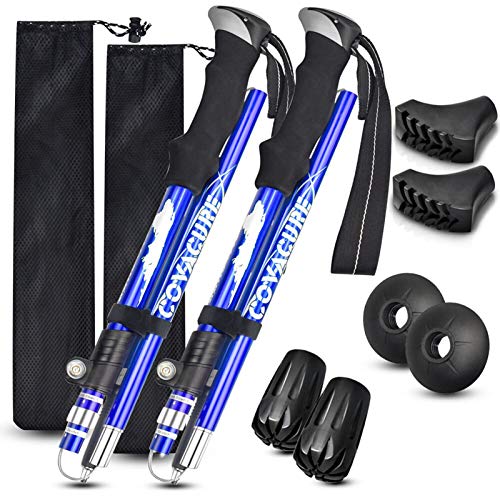
【Upgraded Tri-fold Design】 - Covacure Hiking poles provids telescopic and foldable tri-fold design. You can freely adjust the lenght from 43" to 51" (110-130cm) to fit your height comfortably after easy installing. What's more, they can folding down less than 14"/35.5cm to store in your backpack, luggage, or duffel bags.

Increase Your Foot Print! Trek-Z Ergonomic Trekking Poles (set of 2) give you reason to increase the steps you take. Providing extra support and walk comfortably with these hiking poles. EVA grip wicks away sweat from hands keeping them drier. Firmer grip in muddy areas with added mud stops. EVA foam shafts allow for a strong grip in extreme all terrain environments. Trek-Z poles are the perfect gift for outdoor hikers who enjoy light and compact gear!
Potential Restrictions and Limitations
Travelers need to account for several separate restrictions. A security agency can prohibit an item from the cabin, an airline can reject an oversized item, and a destination can impose border or biosecurity requirements.
Cabin space is another practical limitation. Even when a blunt-tipped pole is permitted through a U.S. security checkpoint and meets the carrier’s stated dimensions, limited overhead-bin space or aircraft-specific restrictions may result in an item being gate-checked.
Policies may also differ between airlines on one itinerary. A ticket sold by one carrier can include a flight operated by another airline, so check the rules of the operating carrier when possible.
Note: When the security authority and airline appear to give different answers, follow the stricter requirement. Security permission does not force an airline to accept an oversized item in the cabin, and airline permission does not override checkpoint restrictions.
Conclusion and Final Considerations
You can fly with hiking poles, but the safest packing choice depends on the pole and the route. For U.S. departures, current TSA guidance allows blunt-tipped hiking poles in carry-on or checked bags but prohibits sharp-tipped hiking poles from carry-on baggage. Airline size and baggage policies apply in addition to TSA rules.
For international travel, check every airport where you will pass through security, including your return departure point. Clean used outdoor equipment before crossing borders, especially when visiting destinations with strict biosecurity controls. Collapsible poles make packing easier, but checking the rules—and protecting the poles properly—is what prevents most airport problems.
If you also travel with other long sporting equipment, the same basic principles apply: protect vulnerable parts, keep the gear contained, and verify the carrier’s baggage limits. This guide to the best golf travel bags explains another approach to protecting sporting equipment while flying.
Sources
- Transportation Security Administration — Hiking Poles — U.S. carry-on and checked-baggage rules for blunt- and sharp-tipped hiking poles.
- American Airlines — Carry-On Bags — example of airline cabin-baggage size requirements.
- GOV.UK — Hand Luggage Restrictions: Sports Equipment — UK rules for walking and hiking poles.
- New Zealand Ministry for Primary Industries — Declaring Items on Arrival — declaration and inspection rules for used outdoor equipment.
- Australian Border Force — Items You Can and Can’t Bring In — clean-and-dry requirements for camping and sporting equipment.
Frequently Asked Questions
Can I take hiking poles on a plane?
Yes, but whether they can travel in your carry-on depends on the security rules at your departure airport and your airline’s baggage policy. In the United States, TSA currently permits blunt-tipped hiking poles in carry-on or checked baggage but does not allow sharp-tipped hiking poles in carry-on bags.
Are there restrictions on taking hiking poles through TSA?
Yes. TSA distinguishes between blunt-tipped and sharp-tipped hiking poles. Blunt-tipped poles can be permitted in carry-on or checked bags, while sharp-tipped hiking poles are not permitted in carry-on baggage. TSA officers make the final checkpoint decision.
How should I pack hiking poles for a flight?
Collapse or fold the poles, clean and dry them, cover exposed tips, secure straps and loose pieces, and place the poles in a padded bag or protective case. Inside a suitcase, position them away from the outer shell and surround them with soft items to reduce impact damage.
Do international flights have different hiking-pole rules?
They can. The security rules at the airport where you depart apply when you pass through its checkpoint. Check your outbound, connecting, and return airports individually because an item accepted on one leg of the trip may have to be checked on another.
Can I take hiking poles in hand luggage at a UK airport?
UK government guidance currently lists walking and hiking poles as not allowed in hand luggage but permitted in hold luggage. Check the current guidance again before traveling because security rules can change.
Can I bring collapsible hiking poles on a plane?
Collapsible poles are easier to fit inside luggage, but folding or collapsing a pole does not override security rules. For U.S. carry-on baggage, you still need to consider whether the pole is blunt-tipped or sharp-tipped and whether it meets the airline’s size requirements.
Does putting a rubber cover on a trekking-pole tip guarantee carry-on approval?
No carry-on approval should be assumed solely because a removable tip cover has been added. TSA’s published hiking-pole guidance distinguishes blunt-tipped from sharp-tipped poles and leaves the final decision to its officers. When you are uncertain about a recreational pole with a sharp underlying point, checked baggage is the safer plan.
Do I need to clean hiking poles before an international flight?
It is a good practice, and it can be a border requirement in destinations with strict biosecurity rules. New Zealand treats used outdoor equipment as a potential biosecurity risk, while Australian guidance requires camping and sporting equipment to arrive clean and dry. Remove soil, seeds, vegetation, and other debris before packing.
