
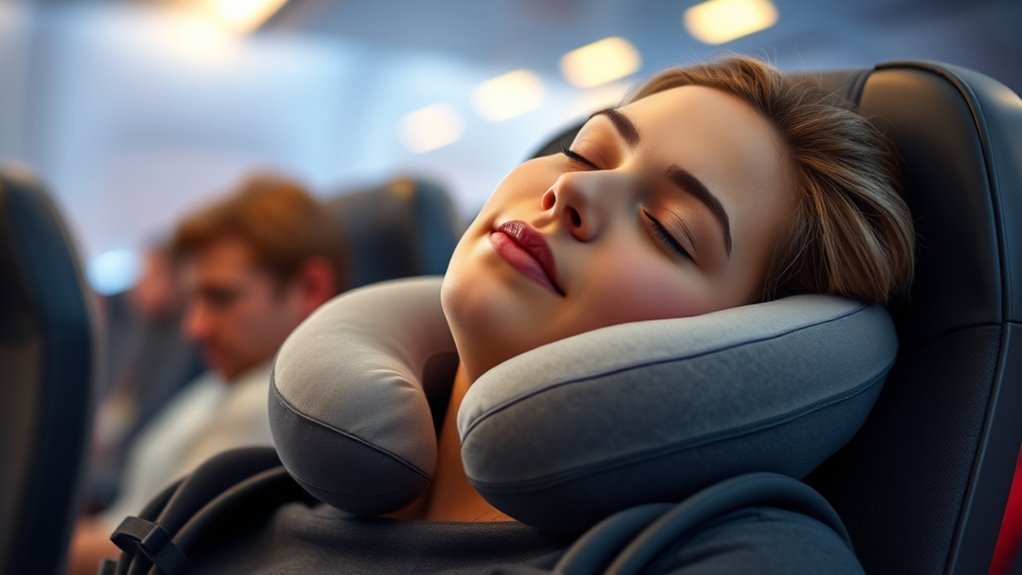
Last Updated on September 10, 2026 by Daniel Globe
Keeping your neck comfortable in an economy seat starts with supporting your whole seated posture, not forcing your head into one rigid position. Sit fully back, support your lower back, keep your head over your torso, and raise screens closer to eye level. A well-fitted travel pillow and regular, gentle movement can also reduce stiffness.
Quick Answer
To keep your neck aligned in an economy seat, sit with your back fully supported, place a small lumbar roll at your belt line, and keep your ears roughly above your shoulders. Use a travel pillow that limits head drop without pushing your chin forward. Change position regularly and walk only when the crew permits it.
Key Takeaways
- Support your lower back first because slumping through the torso often pushes the head forward.
- Your pillow should support the sides or front of your head without forcing your chin toward your chest.
- Keep phones and tablets higher so you do not spend long periods looking down.
- Move your shoulders, neck, ankles, and legs regularly, but remain seated whenever the seat-belt sign is on.
- Seek medical care for persistent pain, radiating pain, numbness, weakness, fever, trouble walking, or severe pain after an injury.
At a Glance
| Time Required | About 3 to 5 minutes for the initial seat setup, followed by brief adjustments during the flight |
| Difficulty | Easy |
| Tools Needed | Optional travel pillow, rolled sweater or lumbar cushion, and a safe way to raise your phone or tablet |
| Cost | $0 with clothing you already carry, or about $15 to $50 for optional support accessories |
Disclosure: As an Amazon Associate I earn from qualifying purchases. Some links on this page are affiliate links, at no extra cost to you.
Understanding the Importance of Neck Alignment in Economy Seats
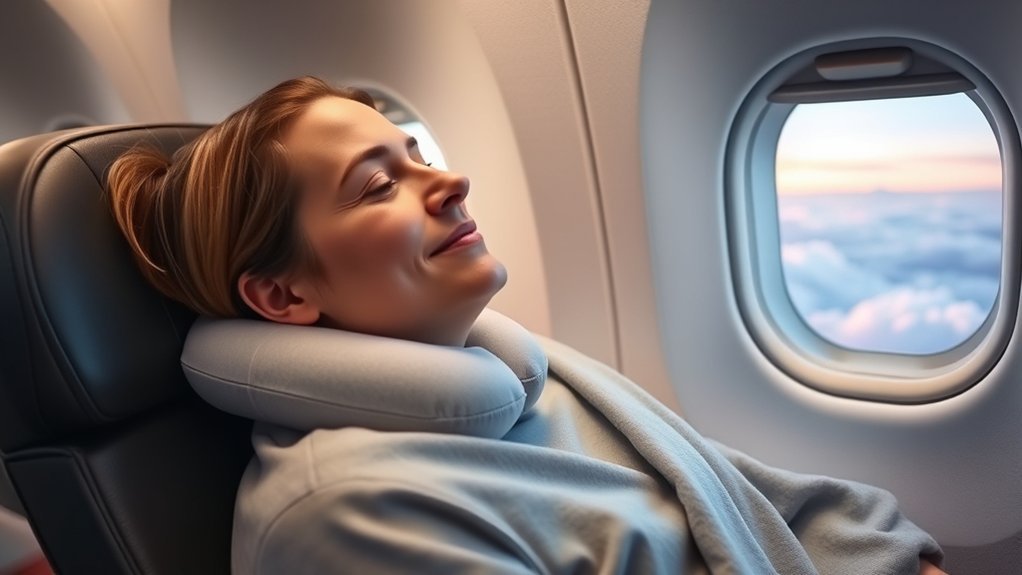
Economy seats can make it difficult to support your lower back, shoulders, and head at the same time. When your pelvis slides forward or your upper back rounds, your head often moves forward too. Holding that position for a long period can contribute to muscle fatigue and temporary stiffness.
A practical neutral position places your head and neck roughly in line with your torso. Your ears should be close to being above your shoulders rather than far in front of them. Your shoulders should remain relaxed, and your headrest should not force your head forward. These principles are consistent with the neutral seated-posture guidance published by OSHA.
Note: You do not need to hold one perfect posture for the entire flight. A supported position combined with safe, regular changes is usually more comfortable than staying rigid for several hours.
How to Set Up Your Economy Seat Before Takeoff
- Sit fully back in the seat. Move your hips toward the backrest instead of perching near the front edge.
- Support your lower back. Place a small rolled sweater, blanket, or lumbar cushion around your belt line. Avoid placing a thick roll high between your shoulder blades.
- Center your torso. Keep your shoulders facing forward rather than twisting toward a window, companion, or screen.
- Check the headrest. If the headrest moves, position it so it supports the back or sides of your head without pushing your chin downward.
- Use a slight recline when permitted. A small amount of recline may reduce forward slumping. Return the seat to the required upright position for takeoff, landing, and whenever the crew instructs you.
- Support your feet. Keep both feet on the floor or on a stable footrest. Avoid resting only on your toes for long periods.
- Bring screens higher. Hold a phone closer to eye level or place a tablet on a stable stand. Do not balance devices where they could become projectiles during turbulence.
Pro Tip: Set up your lower-back support before adding a neck pillow. Supporting the torso often reduces how much extra padding your neck needs.
Choosing the Best Seat for Neck Comfort on Flights
No seat location can guarantee that you will avoid neck pain. Choose a seat based on how easily you can move, how you prefer to sleep, and the aircraft’s actual layout.
| Seat Option | Possible Benefit | Trade-Off |
|---|---|---|
| Aisle seat | Makes it easier to stand, stretch your legs, and walk when permitted | You may be disturbed by other passengers or the service cart |
| Window seat | Provides a side surface that may help support a pillow | It is harder to get up, and leaning directly against the wall may bend the neck sideways |
| Bulkhead or exit row | May provide extra legroom on some aircraft | Space varies, armrests may be fixed, floor storage may be restricted, and exit-row passengers must meet airline requirements |
| Extra-legroom economy | Additional pitch may make it easier to adjust your legs and torso | Recline, headrests, seat width, and lumbar support still vary by airline and aircraft |
| Rear economy rows | May be suitable when price or proximity to a restroom matters | There is no universal neck-alignment reason to avoid them; check whether the final row has limited recline |
Warning: Turbulence can occur without warning. The FAA advises passengers to keep their seat belts fastened while seated and to obey the seat-belt sign and crew instructions. Do not stand or perform large stretches during turbulence.
Essential Travel Accessories for Neck Support
A travel pillow, lumbar cushion, or folded garment may make an economy seat more comfortable, but none of these products can guarantee pain prevention. Fit matters more than marketing language or a specific filling material.
Travel Neck Pillows
A travel pillow may help limit side-to-side head movement or prevent your head from dropping forward while you rest. Research on ordinary sleeping pillows suggests that pillow height and shape can affect neck position, but there is no single pillow design that works for every traveler. The evidence should not be treated as proof that every travel pillow prevents pain or improves sleep. You can review the relevant systematic review of pillow design and spinal alignment.
Check these features before using a travel pillow:
- Correct height: The pillow should fill empty space without forcing your head forward.
- Side support: It should limit uncomfortable side bending when you fall asleep.
- Front support: A clasp or raised front section may help if your chin tends to drop.
- Adjustability: Inflatable models let you release air if the pillow feels too thick.
- Breathing room: The pillow should not feel tight around your throat or restrict normal movement.
- Stable fit: It should remain in place without requiring you to tense your shoulders.
Many traditional U-shaped pillows are thickest at the back. In a seat with a prominent headrest, that extra thickness can push the head forward. Try rotating the pillow, reducing its inflation, or using a thinner design if your chin is forced toward your chest.
Lumbar Support Cushions
A small lumbar cushion can help you avoid collapsing through the lower back. Position it around the natural inward curve near your belt line. If the cushion is too thick, it may push your torso forward and make the neck position worse.
| Accessory | How to Use It | Avoid |
|---|---|---|
| Travel neck pillow | Fill the side or front gaps while keeping the chin in a comfortable position | A thick rear section that pushes the head forward |
| Lumbar cushion | Place it at the belt line and keep both shoulders against the seat | A large cushion that moves the entire torso away from the backrest |
| Rolled sweater or blanket | Use it as a thin lumbar roll or gentle side support | A bulky roll placed directly behind the head |
| Tablet or phone support | Raise the screen and keep your shoulders relaxed | Looking down into your lap for a long period |
Techniques for Neck Alignment During Flights
- Keep your back against the seat. Avoid sliding your hips forward while leaving your shoulders against the backrest.
- Balance your head over your torso. Bring your chin slightly back without forcing it down.
- Relax your shoulders. Do not lift them toward your ears to hold a loose pillow in place.
- Use the headrest wings. If the seat has adjustable wings, angle them inward enough to reduce side-to-side head movement.
- Support the direction your head falls. Side support may matter more than thick padding behind your neck.
- Raise reading material and screens. Long periods of looking down can fatigue the neck and shoulder muscles.
- Change position before discomfort builds. Small adjustments are often more useful than waiting until your neck becomes stiff.
The goal is not to freeze your neck in one position. Support it, avoid extreme angles, and change position safely throughout the flight.
Stretching and Moving to Alleviate Neck Discomfort
Gentle movement can reduce the discomfort that develops when you remain in one position. Move within a comfortable range and never force your head farther than it naturally wants to go.
Warning: Stop a stretch if it causes sharp pain, dizziness, nausea, numbness, tingling, weakness, or pain that travels into an arm. Remain seated whenever the seat-belt sign is on.
| Movement | How to Do It | Suggested Amount |
|---|---|---|
| Gentle chin tuck | Draw your chin slightly backward while keeping your eyes level | 5 slow repetitions |
| Side tilt | Bring one ear gently toward the same-side shoulder without lifting the shoulder | Hold 10 to 15 seconds per side |
| Gentle head turn | Turn your head slowly to look left and right while keeping your torso forward | 3 to 5 turns per side |
| Shoulder roll | Lift your shoulders gently, roll them back, and let them drop | 5 rolls in each direction |
| Shoulder-blade squeeze | Draw your shoulder blades gently together without arching your lower back | Hold 3 seconds and repeat 5 times |
| Ankle pumps | Raise and lower your heels and toes while seated | 10 to 20 repetitions regularly |
| Aisle walk | Stand and walk briefly only when the crew permits it | About every 1 to 2 hours on a long flight when safe |
The CDC recommends moving your legs frequently during long trips and walking periodically when conditions allow. This guidance is primarily intended to reduce problems associated with prolonged immobility, but the position changes may also help you feel less stiff.
Common Neck-Comfort Mistakes to Avoid
- Using a pillow that is too thick behind your head: This may push your chin toward your chest.
- Sleeping with your head unsupported to one side: Use gentle side support instead of letting your head hang.
- Leaning over the tray table: This bends the neck and upper back for a prolonged period and may leave your face and arms unsupported.
- Holding a phone in your lap: Raise the device and take regular viewing breaks.
- Performing forceful neck circles: Use slow turns and tilts within a comfortable range instead.
- Walking during turbulence: Stay seated and belted whenever instructed.
- Ignoring neurological symptoms: Numbness, weakness, tingling, balance problems, or pain traveling down an arm deserve medical attention.
Best Recovery Tips for Relieving Neck Pain After Flights
Mild stiffness after prolonged sitting often improves with gentle movement, a return to normal activity, and time. Avoid aggressively stretching or manipulating a sore neck immediately after landing.
Stretching Exercises for Relief
Try several slow shoulder rolls, gentle head turns, and small chin tucks. Keep the movements comfortable and controlled. A short walk can also help you loosen your shoulders, back, and legs after sitting for several hours.
Do not try to force a joint to crack or use sudden twisting movements. If the discomfort increases as you move, stop and seek advice from a qualified healthcare professional.
Heat and Cold Therapy
Either heat or cold may help minor neck soreness, but the best choice depends on the situation and personal preference. The Mayo Clinic advises using a wrapped cold pack for up to 15 minutes at a time during the first 48 hours of a new strain, followed by gentle heat such as a warm shower or a heating pad on a low setting. The NHS also lists wrapped heat or cold packs as self-care options.
- Always wrap a cold pack in a towel rather than placing it directly on your skin.
- Use a heating pad on a low setting and check your skin regularly.
- Do not fall asleep with a heating pad or hot-water bottle against your neck.
- Stop if heat or cold increases your pain or causes skin irritation.
When to Seek Medical Care for Neck Pain
Most mild muscle soreness improves, but certain symptoms need professional assessment.
Seek Emergency Medical Care
Get urgent medical help if severe neck pain:
- Starts after a fall, collision, or other significant injury
- Occurs with weakness in an arm or leg
- Occurs with trouble walking, loss of coordination, or loss of balance
- Occurs with a high fever or a severe, unusual headache
- Occurs with confusion, fainting, or difficulty speaking
Arrange a Medical Appointment
Contact a healthcare professional if your neck pain:
- Continues for several weeks
- Gets worse despite basic self-care
- Travels into an arm or leg
- Comes with numbness, tingling, or weakness
- Regularly interrupts sleep or normal activities
These warning signs are consistent with the Mayo Clinic’s neck-pain guidance.
Medical Note: This article provides general comfort information and is not a diagnosis or personal treatment plan. Ask a qualified clinician for travel advice if you have a recent neck injury, previous neck surgery, a known cervical-spine condition, or ongoing neurological symptoms.
Frequently Asked Questions
Can a neck pillow cause discomfort if used incorrectly?
Yes. A pillow that is too thick behind your head may push your chin forward, while a loose pillow may fail to support your head. It should feel supportive without restricting breathing, pressing on your throat, or forcing your neck into an extreme angle.
How do I choose the right neck pillow size?
Choose a pillow that fills the space around your neck without lifting your shoulders or pushing your head forward. Test it while sitting against a firm backrest. Your chin should remain comfortable, and you should be able to turn your head slightly and breathe normally.
Can sleeping on a plane cause long-term neck problems?
An awkward sleeping position can cause temporary soreness or stiffness. A single flight is not normally enough to prove lasting neck damage. Pain that persists, worsens, travels into an arm, or occurs with numbness or weakness should be assessed by a healthcare professional.
Which stretches are safest for neck discomfort during a flight?
Use small chin tucks, slow left-and-right turns, gentle side tilts, shoulder rolls, and shoulder-blade squeezes. Stay within a comfortable range. Avoid forceful circles, sudden movements, and any exercise that causes sharp pain, dizziness, numbness, tingling, or weakness.
What are signs of a serious neck problem during or after travel?
Seek urgent care for severe pain after an injury, new arm or leg weakness, trouble walking, loss of coordination, high fever with severe neck pain, or a sudden severe headache. Arrange an appointment for persistent pain, radiating pain, numbness, or tingling.
Is an aisle seat always better for neck comfort?
Not always. An aisle seat makes it easier to stand and walk, while a window seat may provide a surface for supported side sleeping. Choose according to your movement needs, sleeping habits, and the aircraft layout rather than assuming one seat prevents neck pain.
Should the thick part of a U-shaped pillow sit behind my neck?
Only if it does not push your head forward. Airplane headrests already take up space behind the head, so some travelers are more comfortable rotating the pillow or placing greater support at the sides and front. Use the position that keeps your chin comfortable and your breathing unrestricted.
Conclusion
To keep your neck aligned in an economy seat, begin with your lower back and torso. Sit fully back, use only enough lumbar support to prevent slumping, and keep your head roughly over your shoulders. Fit your neck pillow so it supports head movement without pushing your chin forward, raise your screens, and change position regularly. Always remain seated and belted when instructed, and seek medical care if pain is severe, persistent, or accompanied by neurological symptoms.
Sources
- Occupational Safety and Health Administration: Computer Workstation Evaluation Checklist — neutral head, neck, torso, back-support, and mobile-device posture guidance
- Centers for Disease Control and Prevention: Blood Clot Risk During Travel — long-distance travel movement and walking guidance
- Federal Aviation Administration: Turbulence Safety — seat-belt and passenger-safety guidance
- Mayo Clinic: Neck Pain and When to See a Doctor — self-care, heat, cold, and medical warning signs
- NHS: Neck Pain — basic self-care, posture, movement, and heat-or-cold guidance
- PubMed: Systematic Review of Pillow Design, Neck Pain, and Spinal Alignment — evidence concerning pillow height, shape, comfort, and alignment
