
Last Updated on July 27, 2026 by Logan Reeves
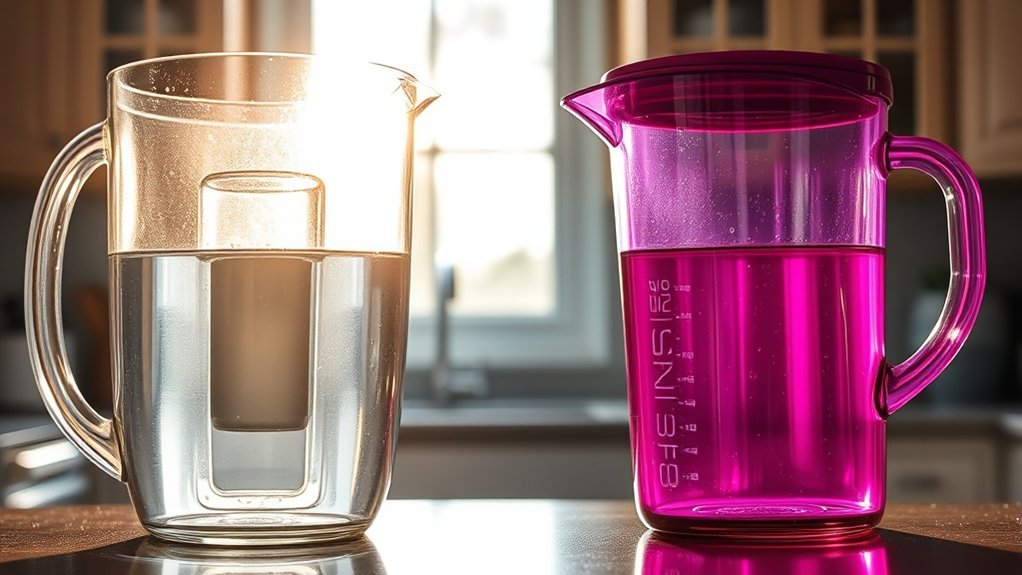
Choosing between glass and plastic water filter pitchers is less about which material filters water better and more about weight, break resistance, cleaning, price, and how the pitcher fits into your kitchen. The filter cartridge does the actual water treatment, so its certified contaminant-reduction claims matter far more than whether the outer jug is glass or plastic.
Quick Answer
Glass water filter pitchers resist scratches, stains, and odors well, while plastic pitchers are lighter, cheaper, and far less likely to shatter when dropped. Neither material filters water better by itself. For water quality, prioritize the cartridge’s independently certified contaminant-reduction claims, replacement cost, capacity, and service life.
Key Takeaways
Key Takeaways
- Pitcher material does not determine filtration performance. The filter media and its certified contaminant-reduction claims do.
- Glass resists scratching, staining, and odor absorption better, but plastic has a major advantage if the pitcher is dropped.
- Look beyond an NSF/ANSI number and verify the specific contaminant claim. Certification to one standard does not mean a filter removes everything covered by that standard.
- Many “glass” pitchers still use plastic lids, reservoirs, liners, handles, or filter housings, so glass does not automatically mean plastic-free.
- Filter replacement frequency and replacement-cartridge price usually matter more to long-term cost than the pitcher body.
- Before buying, check your local water-quality report or test private-well water so you know which contaminants, if any, you actually need to reduce.
Glass vs Plastic Water Filter Pitchers: Side-by-Side
| Factor | Glass | Plastic |
| Filtration | Depends on filter cartridge | Depends on filter cartridge |
| Drop resistance | Lower; can shatter | Higher |
| Scratch/stain resistance | Usually better | More likely to scratch or cloud over time |
| Weight | Heavier | Lighter |
| Typical upfront cost | Usually higher | Usually lower |
| Odor absorption | Very low | Varies by plastic and care |
| Best fit | Countertop use, appearance, scratch resistance | Families, frequent handling, fridge-door use, lower budgets |
The jug material does not decide what comes out of your water. The filter technology and its verified contaminant-reduction claims do.
| BRITA Glass Water Filter Jug with MAXTRA PRO Cartridge | Recycled-Glass Design | Capacity: 2.5L total / 1.5L filtered | Material: Borosilicate glass with bio-based plastic components | Filtration System: MAXTRA PRO multi-stage cartridge | VIEW LATEST PRICE | Read Our Analysis | |
| Aarke Purifier Glass Water Pitcher with Filter | Reusable Steel Cartridge | Capacity: 2.36L total / 1.18L filtered | Material: Glass, stainless steel, food-grade thermoplastic | Filtration System: Refillable stainless-steel cartridge with granules | VIEW LATEST PRICE | Read Our Analysis | |
| Waterdrop Glass Water Filter Pitcher with Filter | Fast Gravity Filtration | Capacity: 7 cups | Material: Glass body with plastic internal components | Filtration System: 5-stage filter; selected NSF/ANSI claims | VIEW LATEST PRICE | Read Our Analysis | |
| Waterdrop 22-Cup Rechargeable Water Filter Dispenser | Large Electric Dispenser | Capacity: 22 cups / 5.2L | Material: Glass | Filtration System: 5-stage electric filtration | VIEW LATEST PRICE | Read Our Analysis | |
| Waterdrop Large Glass Water Filter Pitcher | Certified Filter Claims | Capacity: 10 cups | Material: Glass body with plastic inner liner | Filtration System: Activated carbon and ion exchange | VIEW LATEST PRICE | Read Our Analysis | |
| Hydros 64 Ounce Water Filter Glass Pitcher | Legacy Fast-Flow Model | Capacity: 64 oz / 8 cups | Material: Borosilicate glass | Filtration System: Hydros Fast Flo carbon filter | VIEW LATEST PRICE | Read Our Analysis | |
| Lotus Vita ENYA Glass Water Filter Pitcher | Glass-and-Bamboo Design | Capacity: 1.4L filtered capacity | Material: Glass and bamboo with food-contact components | Filtration System: NATURA PLUS activated carbon and ion exchange | VIEW LATEST PRICE | Read Our Analysis |
More Details on Our Top Picks
-
BRITA Glass Water Filter Jug with MAXTRA PRO Cartridge
BRITA’s glass jug uses a 2.5L borosilicate-glass body with 1.5L of filtered-water capacity. According to the current BRITA Glass Jug specifications, the body contains 60% recycled glass from production surplus, while some other components use bio-based plastic. The MAXTRA PRO cartridge uses carbon and ion-exchange media to reduce chlorine-related taste and odor, limescale, and metals such as lead and copper where present. BRITA rates a cartridge for up to 150 litres. The Smart Light tracks filter replacement, and the UK product page says the jug components are dishwasher-safe up to 50°C except for the Smart Light.
- Capacity: 2.5L total / 1.5L filtered
- Material: Borosilicate glass with bio-based plastic components
- Filtration System: MAXTRA PRO multi-stage cartridge
- Filter Life: Up to 150L
- Dishwasher Safe: Yes, subject to manufacturer temperature guidance; remove Smart Light
- Environmental Feature: 60% recycled glass body
- Additional Feature: Smart Light filter-change indicator
- Important Detail: Glass construction does not mean the entire system is plastic-free
-
Aarke Purifier Glass Water Pitcher with Filter
The Aarke Purifier replaces the usual disposable plastic cartridge shell with a refillable stainless-steel cartridge. Filter granules developed with BWT go inside that reusable housing. Aarke specifies 2.36L total capacity, 1.18L filtered capacity, and a service life of up to 120L or four weeks per bag of granules. Pure granules are intended to reduce chlorine, limescale, lead, and copper. Aarke lists a filtration time of about three to five minutes per litre and says the system is dishwasher-safe at 60°C after removing the granules.
- Capacity: 2.36L total / 1.18L filtered
- Material: Glass, SUS304 stainless steel, food-grade thermoplastic and silicone
- Filtration System: Refillable stainless-steel cartridge with filter granules
- Filter Life: Up to 120L or four weeks
- Filtration Time: About 3–5 minutes per litre
- Dishwasher Safe: Yes; remove filter granules first
- Waste Reduction Feature: Reusable cartridge housing
- Additional Feature: Pure and Enriched granule options are available
-
Waterdrop Glass Water Filter Pitcher with Filter
This 7-cup Waterdrop glass pitcher uses multi-stage media including carbon materials and ion-exchange resin. Current specifications for the WD-PT-72 series identify certification against NSF/ANSI 42 for chlorine, taste and odor reduction; NSF/ANSI 53 for mercury reduction; and NSF/ANSI 372 for lead-content requirements. The filter is rated for about 100 gallons or two months, whichever comes first under the stated use conditions, and the listed flow rate is about 8.5 ounces per minute. The system is not designed to lower total dissolved solids simply because it uses multiple filtration stages.
- Capacity: 7 cups
- Material: Glass body with plastic internal components
- Filtration System: 5-stage filter media
- Certified Claims: NSF/ANSI 42 chlorine/taste/odor; NSF/ANSI 53 mercury; NSF/ANSI 372 lead-content requirements
- Filter Life: About 100 gallons or two months
- Flow Rate: About 8.5 oz per minute
- Dishwasher Safe: No; hand-wash according to product guidance
- TDS Reduction: No
-
Waterdrop 22-Cup Rechargeable Water Filter Dispenser
The Waterdrop ED12W is closer to a countertop dispenser than a traditional gravity pitcher. Its 5.2L, roughly 22-cup glass container pairs with an electric pump and a five-stage filter. Waterdrop rates the filter for 80 gallons or about three months and states that an 8-ounce serving can be dispensed in about 20 seconds. The company says third-party testing covers reduction of more than 70 substances, but those broader manufacturer-tested claims should not be confused with an independent certification for every listed contaminant.
- Capacity: 22 cups / 5.2L
- Material: Glass
- Filtration System: Electric 5-stage filtration
- Filter Life: 80 gallons or about three months
- Dispensing Speed: About 20 seconds for 8 oz, according to Waterdrop
- Power: Rechargeable / USB Type-C system
- Testing: Brand states third-party testing for 70+ contaminants
- Important Detail: Check the exact certified claim when a particular contaminant is your reason for buying
-
Waterdrop Large Glass Water Filter Pitcher
The 10-cup Waterdrop PT-09W uses a glass outer body but also includes a plastic inner liner, so it should not be treated as a completely plastic-free pitcher. Its filter combines activated-carbon and ion-exchange media. Current product specifications identify NSF/ANSI 42 certification for chlorine, taste and odor reduction, NSF/ANSI 53 certification for mercury reduction, and NSF/ANSI 372 compliance for lead-content requirements. The cartridge is rated for about 100 gallons or two months, depending on local water quality and use.
- Capacity: 10 cups
- Material: Glass body with plastic inner liner
- Filtration System: Activated carbon and ion exchange
- Certified Claims: NSF/ANSI 42 chlorine/taste/odor; NSF/ANSI 53 mercury; NSF/ANSI 372 lead-content requirements
- Filter Life: About 100 gallons or two months
- Dishwasher Safe: No
- Important Detail: Not completely plastic-free
- Best Use Case: Buyers wanting a larger gravity-fed glass pitcher with defined certification claims
-
Hydros 64 Ounce Water Filter Glass Pitcher
The 64-ounce Hydros glass pitcher is a legacy version that may still appear through retailer inventory. It uses the company’s Fast Flo coconut-shell carbon filter and was marketed around a roughly 60-second fill time and NSF/ANSI 42/Class I performance claims for aesthetic filtration. Hydros’s current glass lineup prominently features a smaller 40-ounce Glass Slim Pitcher, so the 64-ounce model should be viewed as an older option rather than the current flagship.
- Capacity: 64 oz / 8 cups
- Material: Borosilicate glass
- Filtration System: Hydros Fast Flo carbon filter
- Certification/Testing: Marketed with NSF/ANSI 42/Class I filtration claims
- Flow: Fast-flow design
- Filter Material: Coconut-shell activated carbon
- Environmental Feature: Hydros offers filter recycling through TerraCycle for its current lineup
- Availability: Legacy model; current manufacturer lineup has changed
-
Lotus Vita ENYA Glass Water Filter Pitcher
The current Lotus Vita ENYA pairs a glass carafe with a bamboo lid and the company’s NATURA PLUS filtration system. Lotus Vita specifies 1.4L of filtered-water capacity and a three-chamber system using activated carbon and ion exchangers. The manufacturer lists a filtration rate of about five minutes per litre and describes the food-contact components as BPA- and BPS-free. Those current manufacturer specifications are more useful than treating the marketplace “10-cup total” label as the amount of ready-to-pour filtered water.
- Capacity: 1.4L filtered capacity
- Material: Glass and bamboo with food-contact filter components
- Filtration System: NATURA PLUS three-chamber activated carbon and ion exchange
- Filtration Rate: About five minutes per litre
- BPA/BPS: Manufacturer states food-contact components are BPA- and BPS-free
- Design Feature: Bamboo lid
- Best Use Case: Small households wanting a glass-and-bamboo design
- Important Detail: Manufacturer capacity differs from some marketplace “10-cup total” wording
How to Choose the Right Water Filter Pitcher
Start with the water, not the pitcher. A beautiful glass jug with the wrong filter is less useful than a basic plastic pitcher with a certified cartridge that targets the contaminant you actually need to reduce.
- Check your water quality. If you use a U.S. community water system, review its annual Consumer Confidence Report. Private-well owners should arrange appropriate water testing because private wells are not regulated like community water systems.
- Identify the problem you want to solve. Chlorine taste, lead, PFAS, mercury, hardness, microbes, and total dissolved solids require different treatment approaches.
- Match the filter to that contaminant. Do not stop at a generic certification logo. Confirm the exact reduction claim for the model and cartridge.
- Compare replacement cost. Cartridge lifespan and price are recurring costs, while the pitcher itself may last for years.
- Check size and weight. A large glass pitcher can be heavy when full and may not fit a refrigerator door or shelf.
- Review cleaning instructions. Dishwasher-safe claims vary even among glass models, especially when lids, lights, silicone seals, bamboo, or electronics are involved.
Pro Tip: Search your water utility’s latest annual water-quality report before shopping. Knowing whether your concern is chlorine taste, lead, PFAS, hardness, or something else prevents you from paying for filtration features you do not need.
Factors to Consider: Glass vs Plastic Water Filter Pitchers

Material affects handling and maintenance, but not the basic contaminant-removal ability of a cartridge. The most useful comparison separates pitcher-body characteristics from filter performance.
Material Durability Comparison
Glass pitchers have an advantage in scratch, stain, and odor resistance. Borosilicate glass also handles normal temperature changes well when used according to the manufacturer’s directions. The trade-off is impact resistance: glass can chip or shatter if dropped or struck against a sink or countertop.
Plastic pitchers are much lighter and generally tolerate drops better. Over years of use, however, plastic surfaces can scratch, cloud, discolor, or retain odors depending on the material and how they are cleaned. For a household with children, frequent fridge-door handling, or limited counter space, impact resistance may matter more than long-term cosmetic clarity.
Does Glass Filter Water Better Than Plastic?
No. The pitcher body is only the container. Filtration depends on the cartridge, its media, flow design, service life, and verified contaminant-reduction claims. The CDC notes that common pitcher filters often use activated carbon primarily to improve taste and smell, although some models are certified for additional contaminant reductions.
That means a plastic pitcher with the right independently certified filter can outperform a glass pitcher whose cartridge is certified only for chlorine taste and odor.
Understanding NSF/ANSI Certification
The certification number is only the starting point. According to NSF, certification to a standard does not mean the product reduces every possible contaminant associated with that standard. Check the specific claim for the exact system and replacement cartridge.
- NSF/ANSI 42: commonly covers aesthetic effects such as chlorine, taste, odor, and certain particulates.
- NSF/ANSI 53: covers specified health-related contaminant-reduction claims, which can include substances such as lead or mercury depending on the certified product.
- NSF/ANSI 401: covers specified emerging contaminants or incidental compounds.
- NSF/ANSI/CAN 372: relates to lead-content requirements in product materials; it does not mean the filter removes lead from incoming water.
Note: “NSF certified,” “tested to NSF standards,” and “uses NSF-certified materials” are not interchangeable statements. Verify the exact contaminant claim and model in the certification information before relying on it for a specific water-quality concern.
When a Pitcher Filter Is Not Enough
A basic pitcher should not be treated as a universal water purifier. Some activated-carbon pitchers are mainly intended to improve chlorine taste and odor and are not designed to remove bacteria, viruses, nitrates, dissolved salts, or every PFAS compound.
If your local authority issues a boil-water advisory, follow the advisory rather than assuming a household pitcher makes microbiologically unsafe water safe. Private-well users should test their water and choose treatment based on the results. Some problems require reverse osmosis, disinfection, distillation, or another treatment technology instead of a standard pitcher.
Warning: Do not use an ordinary water-filter pitcher as a substitute for boiling or another treatment required during a boil-water advisory unless the specific device is certified and approved for that use. Follow instructions from your local water or public-health authority.
Are Glass Water Filter Pitchers Plastic-Free?
Not necessarily. “Glass pitcher” usually describes the main water container. The lid, reservoir, handle, liner, filter cartridge, seals, or dispensing parts may still contain plastic. BRITA, Aarke, and several Waterdrop glass products all use non-glass components somewhere in the system.
If reducing plastic contact is your goal, inspect the materials for every wetted component rather than relying on the word “glass” in the product name.
Environmental Impact Considerations
Both reusable glass and plastic pitchers can reduce reliance on single-use bottled water. Beyond that, there is no simple rule that one pitcher-body material always has the lower total environmental footprint.
Glass can contain recycled material and may stay clear and usable for a long time, but it is heavier to manufacture and ship. Plastic uses petroleum-derived material in many products but is light and resistant to breakage. Filter cartridges also create recurring material waste regardless of jug type.
For most households, the practical environmental priorities are to keep a reusable pitcher in service for as long as possible, avoid unnecessary bottled-water purchases, and use filter-recycling programs where available.
Maintenance and Cleaning Ease
Glass resists stains and odors well and can usually be cleaned with warm water, mild dish soap, and a soft sponge. Plastic should also be cleaned gently because abrasive scrubbers can scratch its surface.
Dishwasher compatibility is model-specific rather than material-specific. Electronic filter indicators, bamboo lids, silicone parts, filter cartridges, and some plastic reservoirs may need to be removed or hand-washed even when the glass body itself is dishwasher-safe.
Design, Weight, and Fridge Fit
Glass generally looks more like tableware, which appeals to buyers who leave the pitcher on a countertop or dining table. Transparency also makes it easy to spot residue or cloudiness.
Plastic wins for weight. A large pitcher already holds several pounds of water, so adding a heavy glass body can make one-handed pouring difficult. Before buying, measure your refrigerator shelf or door space and check the filled weight, not just the empty dimensions.
Cost-Effectiveness Analysis
Plastic pitchers usually have the lower upfront price, while premium glass systems can cost considerably more. The pitcher body, however, is only part of the real ownership cost.
Compare the replacement filter’s rated gallons or litres, replacement interval, and cartridge price. A less expensive pitcher with frequent costly replacements can cost more over several years than a pricier pitcher using longer-life filters.
Material and Food-Contact Safety
Glass itself does not contain BPA, but many glass pitchers still include plastic components. Likewise, many current plastic pitchers are specifically manufactured from BPA-free food-contact materials.
BPA-free status should not be confused with filtration performance. The FDA currently states that approved uses of BPA in food containers and packaging are considered safe based on its ongoing review. For a water filter, the more useful buying questions are whether its food-contact materials meet applicable requirements and whether its cartridge is certified for the contaminants you care about.
Note: Filter life varies dramatically by cartridge. Examples in this article range from four weeks or 120L for Aarke granules to about 100 gallons or two months for some Waterdrop gravity filters. Follow the service-life limit for the exact cartridge instead of using a generic two- or three-month rule.
Warning: Glass pitchers can chip or shatter if dropped or struck against a hard sink or countertop. A plastic pitcher may be the more practical choice for homes with young children, frequent handling, limited counter space, or anyone who has difficulty lifting a heavy filled jug.
Frequently Asked Questions
Are glass water filter pitchers heavier than plastic ones?
Yes. Glass pitchers usually weigh noticeably more, and the difference becomes more obvious once several cups of water are added. Plastic is often easier for children, older adults, and anyone who prefers one-handed pouring.
How long do filters in glass pitchers last compared to plastic?
Pitcher material does not determine filter life. The cartridge does. Depending on the product, replacement may be required after a certain number of gallons or litres, after a set period, or whichever limit comes first.
Can glass pitchers break easily during use?
They are normally sturdy during everyday pouring, but glass can chip or shatter if dropped or hit against a hard surface. Some models include silicone bumpers or protective components to reduce impact risk.
Are there BPA concerns with plastic water filter pitchers?
Many current pitchers are specifically made with BPA-free food-contact plastics. BPA-free status is a material specification, however, and does not tell you what contaminants the filter removes. Check both the product’s material information and its independent filtration certifications.
How do I clean a glass water filter pitcher effectively?
Remove the filter and any electronic parts, then wash the permitted components with warm water, mild dish soap, and a soft sponge. Check the manufacturer’s instructions before putting the pitcher in a dishwasher because lids, bamboo parts, indicators, seals, or reservoirs may require hand-washing.
Does a glass water filter pitcher filter better than plastic?
No. Glass and plastic are container materials. Filtration performance comes from the cartridge, filter media, flow design, and verified contaminant-reduction claims.
Are glass water filter pitchers completely plastic-free?
Usually not. Many glass pitchers still use plastic reservoirs, lids, handles, liners, filter housings, or other components. Review the full materials list if minimizing plastic contact is important to you.
Can I use a pitcher filter during a boil-water advisory?
Do not assume a standard pitcher makes microbiologically unsafe water safe. Follow the instructions issued by your local water or public-health authority, including boiling or using an approved alternative water source when directed.
Conclusion
Glass and plastic water filter pitchers each have clear strengths. Glass resists scratches, stains, and odors and often looks better on a table, while plastic is lighter, less expensive, and much more forgiving when dropped. Neither material has an inherent filtration advantage. For cleaner water, focus first on your water-quality needs, then choose a cartridge with verified claims for those contaminants and a replacement schedule you can realistically maintain.
Sources
- CDC — About Choosing Home Water Filters — explains filter types, activated carbon, and choosing treatment for specific substances.
- NSF — Standards for Water Treatment Systems — explains NSF/ANSI drinking-water standards and why contaminant-specific claims matter.
- U.S. EPA — Understanding Your Annual Water Quality Report — explains Consumer Confidence Reports for community water systems.
- BRITA — Glass Jug — verifies capacity, recycled-glass content, MAXTRA PRO specifications, cleaning guidance, and filter capacity.
- Aarke — Purifier — verifies materials, capacity, reusable cartridge design, filtration time, and four-week/120L service interval.
- Waterdrop — ED12W Glass Electric Water Filter Dispenser — verifies current ED12W filter life, dispensing speed, materials, and manufacturer testing claims.

