
Last Updated on July 25, 2026 by Daniel Globe
London’s best parks range from grand royal landscapes to wilder green spaces where the city can feel surprisingly far away. Hyde Park is ideal for a classic central-London visit, Richmond Park is the standout for deer and open landscapes, Regent’s Park excels for gardens and recreation, and Hampstead Heath and Greenwich Park offer some of the capital’s best views. Use this guide to choose the right park for your day, whether you want a picnic, family activities, wildlife, boating, history, or a quieter escape.
Quick Answer
The best parks in London depend on your plans. Choose Hyde Park for an iconic central location, Regent’s Park for gardens and recreation, Richmond Park for deer and open countryside, Greenwich Park or Hampstead Heath for skyline views, Battersea Park for families, and Holland Park for a smaller, peaceful garden escape.
Key Takeaways
- Hyde Park is a strong all-round choice for first-time visitors, with the Serpentine, Speakers’ Corner, lawns, monuments, and seasonal events.
- Richmond Park offers the wildest experience on this list, with ancient trees, free-roaming deer, Isabella Plantation, and long-distance views.
- Regent’s Park combines formal gardens, boating, playgrounds, tennis, sports facilities, and cultural attractions.
- Greenwich Park and Hampstead Heath are excellent choices when panoramic London views are a priority.
- Most parks are free to enter, but boating, swimming, sports facilities, attractions, and special events may charge or operate only on selected dates.
Disclosure: As an Amazon Associate I earn from qualifying purchases. Some links on this page are affiliate links, at no extra cost to you.
London Parks at a Glance
| Hyde Park | Best for: first visits, boating, history, central location, major events |
| Regent’s Park | Best for: gardens, roses, sports, boating, families |
| Richmond Park | Best for: deer, wildlife, cycling, long walks, countryside atmosphere |
| Greenwich Park | Best for: skyline views, Royal Observatory, gardens, Greenwich sightseeing |
| Hampstead Heath | Best for: wild landscapes, swimming, walking, Parliament Hill views |
| St James’s Park | Best for: royal landmarks, pelicans, a short central-London stroll |
| Victoria Park | Best for: East London, families, community activities, lakes and recreation |
| Battersea Park | Best for: families, Thames walks, playgrounds, gardens, riverside scenery |
| Holland Park | Best for: Kyoto Garden, woodland, quiet walks, summer culture |
How to Choose the Best London Park for Your Visit
For a first trip to London, Hyde Park or St James’s Park are easiest to combine with major central attractions. Choose Richmond Park or Hampstead Heath when you want more space and a less urban atmosphere. For formal planting, try Regent’s Park or Holland Park. Families have especially strong options at Regent’s Park, Victoria Park, Battersea Park, and Holland Park.
If views matter most, head to Greenwich Park’s hilltop viewpoints, Parliament Hill on Hampstead Heath, or King Henry’s Mound in Richmond Park. Activities such as boating, swimming, sports sessions, concerts, and festivals can be seasonal, so check the relevant park authority before travelling.
Note: Entry to London’s Royal Parks is free, but attractions and organised activities inside them can charge separately. Opening times, boating, swimming, sports bookings, and events also change by season.
Hyde Park
Hyde Park is one of London’s most iconic green spaces and an easy choice when you want a large park without leaving central London. Its lawns, paths, monuments, gardens, and Serpentine lake give you enough variety for anything from a quick walk to several relaxed hours outdoors.
The park has centuries of royal history. Henry VIII acquired the land in 1536 for hunting, and Charles I opened Hyde Park to the general public in 1637. Its later history includes the Great Exhibition of 1851 and the development of Speakers’ Corner as one of London’s best-known places for public speech and debate. You can read more in The Royal Parks’ history of Hyde Park.
Today, popular activities include walking, picnicking, tennis, seasonal swimming, and boating on the Serpentine. Speakers’ Corner is near Marble Arch, while monuments and memorials are spread across the wider park.
Hyde Park is particularly useful for visitors who want to combine greenery with nearby central-London sightseeing. Its scale makes it feel spacious, but it remains much easier to reach than London’s more distant nature reserves and deer parks.
Pro Tip: Hyde Park is large. Pick one or two priorities—such as the Serpentine, Speakers’ Corner, or the Rose Garden—rather than trying to cover every path in a short visit.
Regent’s Park
Regent’s Park combines formal gardens, lakes, sports facilities, playgrounds, and broad open lawns. It is one of the strongest choices when different members of your group want different things from the same park.
You can take a slow garden walk, hire a boat when seasonal boating is operating, book a sports court, cycle on designated routes, or stop for a picnic. London Zoo and Regent’s Park Open Air Theatre also sit within or beside the wider park landscape, although these ticketed attractions are separate from free park entry.
Scenic Gardens and Lakes
Queen Mary’s Gardens are the best-known horticultural feature. They contain London’s largest collection of roses, alongside ornamental planting, secluded benches, water features, and seasonal borders. The Royal Parks recommends early summer for some of the strongest rose displays.
The formal Avenue Gardens provide another contrast, with fountains, clipped planting, ornamental bowls, and colourful seasonal bedding. The park also includes St John’s Lodge Garden, a community wildlife garden, an allotment garden, and the newer Queen Elizabeth II Garden. See the current garden information from The Royal Parks.
| Queen Mary’s Gardens | London’s largest collection of roses plus ornamental planting and quiet seating areas |
| Boating Lake | Seasonal rowing boats and pedalos, with operating dates varying through the year |
| Avenue Gardens | Formal gardens with fountains, ornamental features, hedges, and seasonal flower displays |
| Community Wildlife Garden | Wildlife-friendly planting designed to support biodiversity |
| Queen Elizabeth II Garden | A newer two-acre garden created as a place for planting, biodiversity, and reflection |
Recreational Activities Available
Regent’s Park offers much more than decorative gardens. Its sports facilities include tennis, padel, football, cricket, rugby, netball, rounders, and other activities. Some courts and pitches require booking and payment.
Jogging is easy on the park’s broad paths, while cyclists should use routes where cycling is permitted. Seasonal boating operates on the main lake, and children have dedicated play areas and a separate boating pond.
For something slower, bring a picnic and combine the gardens with a lakeside walk. This mix of scenery and recreation makes Regent’s Park one of the easiest London parks to recommend to families or groups with mixed interests.
Richmond Park
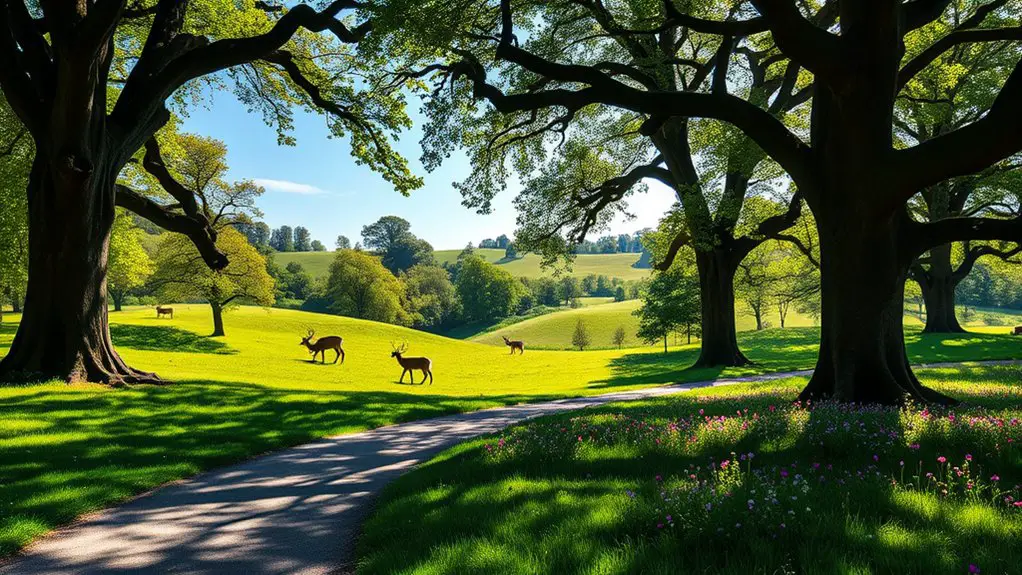
Richmond Park offers a much wilder experience than London’s formal central parks. Covering about 2,500 acres, it is London’s largest Royal Park and is known for ancient trees, broad grassland, woodland, ponds, and free-roaming red and fallow deer.
Its royal hunting history stretches back centuries. Charles I transformed the area into a Royal Park in the 17th century and enclosed it for deer. Today, the landscape remains one of London’s most important places for wildlife as well as walking and cycling.
One of the most famous viewpoints is King Henry’s Mound, where a protected vista looks east toward St Paul’s Cathedral. The Isabella Plantation provides a very different experience, with woodland paths, ponds, streams, rhododendrons, azaleas, and other ornamental planting.
Richmond Park is also excellent for long walks, picnics, and cycling, although its size means you should allow more time than you would for a small central park. The official Richmond Park visitor page is useful for current gate times, transport, wildlife notices, and seasonal restrictions.
Warning: Richmond Park’s deer are wild animals. The Royal Parks says to stay at least 50 metres away and never touch or feed them. Dogs must be kept on leads throughout Richmond Park during deer birthing season from May 1 through July 31, with extra caution also needed during the autumn rut.
Greenwich Park
Greenwich Park rises above the Thames and offers some of the best panoramic views in London. From the high ground near the Royal Observatory and General Wolfe statue, the view reaches across historic Greenwich toward Canary Wharf and the wider skyline.
The park has a history stretching back far beyond its present landscape. Archaeological remains include a Roman temple site and Anglo-Saxon burial mounds, while the land became closely associated with the monarchy during the 15th century.
The Royal Observatory is its most famous landmark. It played a central role in the development of Greenwich Mean Time and the Prime Meridian and forms part of Maritime Greenwich’s UNESCO World Heritage Site.
Elsewhere, the Flower Garden, Rose Garden, herbaceous border, historic tree avenues, playground, sports facilities, and seasonal boating give you plenty to explore. The restored landscape also includes the Grand Ascent, a series of grass terraces originally created in the 17th century.
Greenwich Park works especially well as part of a full Greenwich day because you can combine it with the National Maritime Museum, Cutty Sark, Queen’s House, Old Royal Naval College, and riverside without travelling across the city again. Check The Royal Parks’ Greenwich Park page for current opening and activity information.
Hampstead Heath
Hampstead Heath covers about 790 acres of grassland, woodland, ponds, sports areas, and more informal landscapes in north London. It feels less manicured than the Royal Parks and is a strong choice when you want a long walk without leaving the city.
Follow its winding paths through meadows and woodland or climb to Parliament Hill for one of London’s classic skyline views. The open slopes are popular for picnics, especially in good weather.
For a combination of wild scenery and a wide London skyline, Parliament Hill is one of the strongest viewpoints on this list.
The Heath is also famous for open-water swimming. However, swimming is allowed only at designated facilities, including the bathing ponds and Parliament Hill Lido. Opening schedules, bookable sessions, age rules, and admission charges vary by facility and season, so check the City of London swimming information before visiting.
Birdwatching, running, walking, seasonal concerts, and community events add to the Heath’s appeal. Unlike a formal garden, its main attraction is the feeling of space and changing natural scenery.
Warning: Do not swim in undesignated Hampstead Heath ponds. The City of London warns that non-swimming ponds are not lifeguarded or checked for underwater hazards.
St James’s Park
St James’s Park is smaller than Hyde Park or Richmond Park, but few London green spaces pack so many famous landmarks into such a compact area. Buckingham Palace, St James’s Palace, Horse Guards Parade, and the government district around Whitehall are all close by.
History and Heritage
The park is London’s oldest Royal Park. Henry VIII acquired the land in 1532, and later monarchs changed its landscape significantly.
Charles II commissioned a formal French-style redesign in the 17th century, including a long straight canal. The appearance visitors recognise today owes much to another major transformation in the 1820s by architect John Nash, who replaced the straight canal with a curving lake and introduced more natural-looking paths and scenery.
You can explore the full chronology on The Royal Parks’ St James’s Park history page.
Wildlife and Nature
The lake and its islands provide habitat for a variety of birds, but St James’s Park is especially famous for its pelicans. Pelicans were first introduced in 1664 after a gift from the Russian Ambassador and have remained a distinctive feature of the park ever since.
As you walk around the lake, you may also see waterfowl and other birds, squirrels, mature trees, and seasonal flower beds. Wildlife should be observed without feeding or disturbing it.
Visitor Amenities
St James’s Park is well suited to a shorter visit. Paths, benches, food and drink options, lawns, and central transport connections make it easy to include between nearby landmarks.
For one of the park’s best-known views, walk across or near Blue Bridge and look toward Buckingham Palace in one direction and Horse Guards and Whitehall in the other.
Victoria Park
Victoria Park is one of East London’s best-known green spaces, combining broad lawns, lakes, gardens, sports facilities, children’s areas, cafés, and a busy programme of community activities.
It is a particularly good choice for families. Playground facilities and seasonal activities give children more to do than simply walk around the park, while adults can use the paths and open spaces for jogging, cycling, sports, or a relaxed picnic.
Boating and pedalo activities do take place, but they should not be treated as a permanent walk-up rental service. Tower Hamlets schedules them on selected dates, particularly during school-holiday programmes. Check the current Tower Hamlets events programme before planning a trip specifically for boating.
Other highlights include the lakes, formal planting, cafés, sports areas, and large events held at different times of year. On busy event days, the atmosphere can be very different from a quiet weekday visit.
Battersea Park
Battersea Park combines a Thames-side location with landscaped gardens, open lawns, sports facilities, a lake, children’s attractions, and cultural features.
Battersea Park is one of the best choices on this list when you want both a traditional park and an easy riverside walk.
Wandsworth Council describes it as a 200-acre Victorian park built between 1854 and 1870. Its riverside promenade runs beside the Thames, while the interior includes a large lake, notable trees, ecological areas, sports facilities, playgrounds, the Pump House Gallery, and Battersea Park Children’s Zoo.
The Peace Pagoda is one of the park’s most recognisable landmarks and provides another reason to follow the riverside side of the park. Elsewhere, you can explore formal gardens, walk around the lake, use the playgrounds, or simply find a quieter stretch of lawn.
Facilities and events change, so use Wandsworth Council’s Battersea Park page for current opening, access, and facility information.
Holland Park
Holland Park offers a smaller and more intimate alternative to London’s huge royal landscapes. Spread across about 54 acres, it combines formal gardens, woodland, sports facilities, children’s play areas, and one of London’s best-known Japanese-style gardens.
The Kyoto Garden was donated by Kyoto’s Chamber of Commerce and created in connection with the 1992 Japan Festival in London. Waterfalls, carefully arranged planting, stone features, and a koi pond give this corner of the park a different character from the surrounding woodland.
The park also has sports facilities for tennis, football, netball, cricket practice, and golf practice, along with separate playground areas for younger and older children. Dogs are not permitted inside the Japanese Garden.
Culture is another major part of Holland Park. Opera Holland Park stages performances during its summer season in the park, while other concerts and events may also take place. Ticketed performances should be planned separately from an ordinary free park visit.
Keep an eye out for peafowl as you explore, but give all wildlife space rather than feeding or crowding it. For current rules, accessibility, facilities, and closing times, see the Royal Borough of Kensington and Chelsea’s Holland Park page.
Planning Your London Park Visit
Entry, Opening Times, and Seasonal Activities
The Royal Parks themselves are free to enter, and London’s council-managed parks on this list also generally provide free access. That does not mean every activity inside them is free. Swimming, boating, sports courts, zoos, theatres, special exhibitions, and ticketed events may charge separately.
Opening times vary. Some parks have pedestrian gates that close at night, while Richmond Park’s pedestrian gates are generally open around the clock. Gardens, sports centres, vehicle gates, and individual attractions can follow different schedules from the wider park.
Always check current information when your visit depends on a specific facility such as boating, swimming, a playground splash area, theatre performance, or guided walk.
Dogs, Wildlife, and Picnics
Dogs are welcome in many London park areas, but restrictions apply in certain gardens, wildlife zones, playgrounds, sports areas, and seasonal conservation zones. Richmond Park has particularly important rules because of its deer.
Ordinary picnics are possible in many parks, but barbecues, fires, large organised gatherings, and commercial activities may be restricted. Follow signs and the rules of the authority managing the park.
Best Time to Visit
Spring is excellent for blossom and fresh planting. Early summer is a strong time for Regent’s Park roses and longer evenings. Summer brings the widest range of concerts, boating, outdoor theatre, swimming, and family programmes, but also the biggest crowds.
Autumn works especially well in Richmond Park, Hampstead Heath, and Holland Park for changing foliage, although Richmond’s deer rut requires extra caution. Winter can be quieter and more atmospheric, but daylight hours and garden opening times are shorter.
Pro Tip: London weather changes quickly. A light waterproof layer and comfortable walking shoes are useful even when your park visit is only one part of a sightseeing day.
Frequently Asked Questions
Are dogs allowed in all London parks?
Dogs are allowed in many London park areas, but not everywhere. Individual gardens, wildlife areas, playgrounds, sports facilities, and conservation zones can have restrictions. Richmond Park also requires dogs to be on leads throughout the park from May 1 through July 31 during deer birthing season. Always check signs and the current rules for the park you are visiting.
Which London parks are best for children?
Regent’s Park, Victoria Park, Battersea Park, Hyde Park, Greenwich Park, and Holland Park all offer family-friendly features. Depending on the park, these can include playgrounds, boating, sports, seasonal activities, cafés, wildlife, and large lawns. Battersea Park also has a children’s zoo, which charges separately.
Are London parks free to enter?
Most major public parks in this guide are free to enter. However, attractions and activities inside them may charge. Examples include swimming, boat hire, sports courts, theatre performances, zoos, exhibitions, and some special events.
Can you have picnics in London’s parks?
Yes. Many London parks have large lawns and shaded areas that work well for ordinary picnics. Rules for barbecues, fires, alcohol, large groups, and organised events vary, so check the park authority’s rules before planning anything beyond a normal picnic.
Are guided tours available in London parks?
Yes. The Royal Parks and other organisations run guided walks covering history, wildlife, horticulture, and other themes. Tours are scheduled rather than continuously available, so check the current events calendar for the park you want to visit.
Which London parks have the best views?
Greenwich Park and Hampstead Heath are two of the strongest choices for broad skyline views. Richmond Park also has the historic protected view from King Henry’s Mound toward St Paul’s Cathedral. St James’s Park provides attractive shorter-range views framed by royal and government landmarks.
Can you swim in London parks?
Yes, but only at designated facilities. Hampstead Heath has bathing ponds and Parliament Hill Lido, while Hyde Park operates swimming at the Serpentine Lido seasonally. Opening dates, sessions, age requirements, prices, and booking arrangements can change, so check the official operator before travelling.
Conclusion
The best London park depends on the experience you want. Choose Hyde Park for a classic central-London day, Regent’s Park for gardens and recreation, or Richmond Park for wildlife and a more rural landscape. Greenwich Park and Hampstead Heath stand out for views, while Battersea Park and Victoria Park offer plenty for families. For something smaller and calmer, Holland Park’s gardens and woodland make an excellent alternative. Check current opening times and seasonal activities before you travel, then give yourself enough time to explore on foot rather than rushing from one highlight to the next.
Sources
- The Royal Parks — History of Hyde Park — royal hunting history, public access, the Serpentine, and Speakers’ Corner context.
- The Royal Parks — Gardens in The Regent’s Park — Queen Mary’s Gardens, Avenue Gardens, and other horticultural features.
- The Royal Parks — Deer in Richmond Park — deer population, wildlife safety, minimum viewing distance, and seasonal dog rules.
- City of London — Hampstead Heath Swimming Opening Times — designated swimming facilities and seasonal session information.
- Wandsworth Council — Battersea Park — park size, Victorian history, facilities, playgrounds, lake, and riverside setting.
- Royal Borough of Kensington and Chelsea — Holland Park — Kyoto Garden, playgrounds, sports facilities, access, history, and park rules.
