
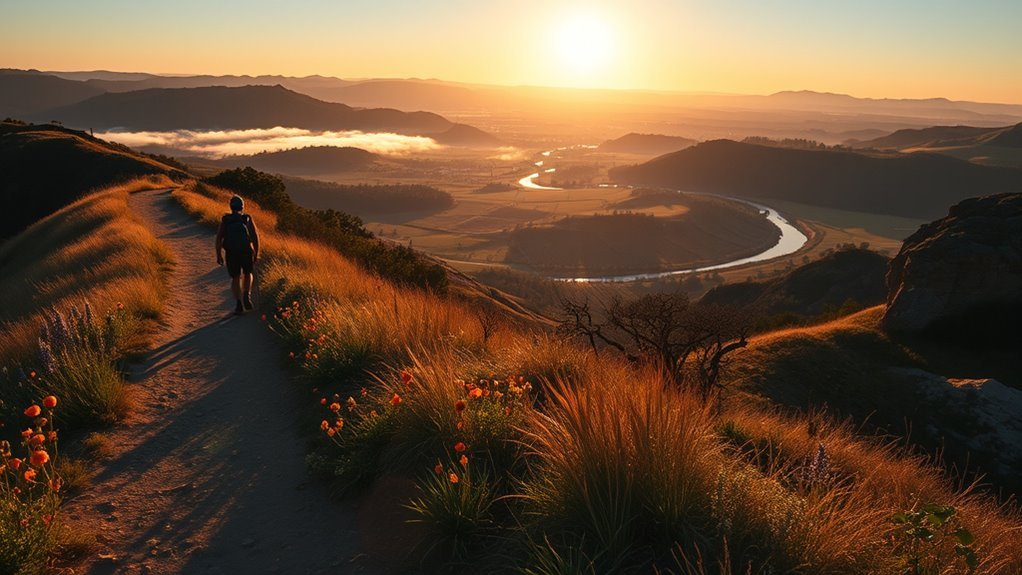
You’ll find hikes around Napa that surprise you with sweeping vineyard panoramas, cool redwood hush, and rugged old-mining scars. Stick to the trail and you’ll feel sun on your face, the smell of pine and fermenting grapes, and sudden vistas that make the climb worth it. I’ll point out which routes fit families, which demand stamina, and where those secret viewpoints hide—so you can pick the right trek for your day.
Robert Louis Stevenson State Park — Mount Saint Helena Trail

Tackle the Mount Saint Helena Trail and you’ll earn one of Napa Valley’s most expansive panoramas: this 10.2-mile roundtrip climb gains about 2,300 feet as it winds from mixed oak and fir forests into rocky ridgelines, where the air thins and the views open. You move through shade-scented groves, boots crunching on leaf litter, then break into sun where chaparral prickles at your calves and the wind strips your thoughts down to essentials. At the summit you’ll feel vastness—Pacific glints on the horizon, jagged Sierra silhouettes, even Mount Shasta on a clear day—each sight loosening whatever’s held you back. The trail’s well-marked turns keep you honest; the long switchbacks teach patience. Robert Louis Stevenson State Park sprawls with hidden spurs, so you can stretch the route or sit in a quiet canyon to breathe. This hike isn’t just exercise; it’s a deliberate unburdening, a chance to trade routines for raw, open sky.
Bothe-Napa Valley State Park — Redwood and Ritchey Canyon Trails

One of Napa Valley’s greenest refuges, Bothe-Napa Valley State Park spreads over 1,900 acres of redwood groves, mixed oak woodlands, and fern-filled ravines that invite you to slow down and look closely. You’ll wander over ten miles of trails where the air tastes like damp earth and cedar, and the Ritchey Canyon Trail follows a creek that sings against mossy boulders. Birdsong threads the canopy; woodpeckers drum like punctuation. Historic touches—the Bale Grist Mill remnants and Pioneer Cemetery—anchor the wildness to human stories, reminding you freedom often grows from knowing place.
One of Napa Valley’s greenest refuges, Bothe-Napa Valley State Park invites slow wandering through redwoods, creeks, and living history.
- Creekside serenity on Ritchey Canyon — ideal for gentle exploration and wildlife spotting.
- Towering redwoods — cool shade, soft needles underfoot, a breath-stealing sense of scale.
- Easy access and camping options — $10 per car lets you stay, picnic, and reclaim time.
Trails suit all levels, so you can push a bit or simply be present in this liberated green.
Linda Falls Trail — Howell Mountain Waterfall Hike

A short, verdant jaunt on Howell Mountain, the Linda Falls Trail leads you through towering redwoods and gnarled oaks to a dramatic double waterfall that drops about 50 feet into terraced pools—best seen after winter rains when the flow sings loudest. You walk a shady 3-mile loop in Angwin, feeling cool mist on your face and hearing water drum on stone. The path is easy to moderate, open to families and anyone craving a calm escape; spring swells the falls into a roaring hymn, winter keeps the pools full. Local hikers know to come early for quiet light through fern and bark, to breathe freed air and let the valley fall away. You’ll taste damp earth and pine resin, watch sunlight fractal through spray, and leave lighter, as if the creek carried some small weight downstream.
| Sound | Scent | Touch |
|---|---|---|
| Roar of falls | Pine and wet soil | Cool mist |
| Birdsong | Ferns | Smooth stones |
| Footsteps | Oak resin | Sun-warm log |
The Petrified Forest — Ancient Redwoods and Geologic Wonders

After you’ve rinsed the mist of Linda Falls from your face, head upslope to The Petrified Forest where ancient redwoods, turned to stone, stand like cathedral columns beneath a sun-splotched canopy. You’ll feel the hush of deep time as silica-slick trunks glitter in the light; these are some of the oldest petrified redwoods on Earth, frozen in volcanic memory. Trails are easy and well-kept—paid entry supports private stewardship—so you can roam freely with family or go solo to unburden your mind. Interpretive signs lay out petrification and eruption stories in plain language, turning geology into a kind of liberation: knowledge that loosens you from the hurried world.
- Walk accessible loops that cradle you among stone giants.
- Pause at signs to trace lava, ash, and mineral alchemy.
- Take quiet photos; the light and texture feel almost sacred.
This place rewards slow attention and a sense of renewal.
Oat Hill Mine Road and Palisades — Historic Mines and Rugged Views

Walk roughly 8 miles along Oat Hill Mine Road and you’ll move through sun-baked volcanic outcrops and shuttered mine entrances that whisper of Napa’s gold-rush past. You follow a one-way path of jagged basalt and old timbers; wind carries dust and the hollow echo of history as you climb. The Palisades pushes you further — a 10–12 mile, high-gain route that tests legs and rewards with vast vineyard panoramas and raw ridgeline exposure. Bring grit, water, layered clothes, and a hunger for wide skies. These trails aren’t tame; they demand attention and give you freedom in return: views that unmoor routine, volcanic textures underfoot, and iron-streaked mine faces that hint at past toil. You’ll meet solitude, rugged beauty, and routes that feel like choices toward liberation.
| Feature | Experience |
|---|---|
| Terrain | Volcanic rock, steep ridges |
| Distance | 8.3 miles (Oat Hill), 10–12 miles (Palisades) |
| Tip | Prep for rugged, variable conditions |
Frequently Asked Questions
Are Dogs Allowed on These Trails and Are Leashes Required?
Yes — dogs are allowed on many trails, and you’ll need to keep them leashed in most preserves. You’ll feel freedom in crisp air while guiding your pup; follow posted rules, pack water, and respect wildlife.
Which Trails Have Restrooms or Potable Water Available?
About 60% of these trailheads offer restrooms; only a few have potable water. You’ll find potable taps at Skyline Wilderness and Bothe-Napa, pit or vault toilets at Alston and Sugarloaf, so plan water-wise and pack freedom.
What Are the Best Months for Wildflower Displays Near Napa?
You’ll find peak wildflowers from late March through May, exploding in color on sun-warmed hills, fragrant breezes carrying pollen, vivid poppies and lupine swaying — go early, seek ridgelines and open meadows for the richest displays.
Are Any of These Trails Wheelchair or Stroller Accessible?
Some trails are accessible, but many aren’t—you’ll find paved, gently graded loops at a few parks that welcome wheelchairs or sturdy strollers. Feel the warm sun, smell grass, and savor freedom on those kinder paths.
Where Are the Nearest Parking Areas and Are Permits Required?
You’ll find parking at trailheads, park lots, and nearby street spots; some require day-use or regional park permits, others are free. Check signage, bring payment or printed permits, and expect crowded lots on sunny weekends.
Conclusion
You’ll feel Napa’s varied moods underfoot — the lung‑opening climb of Mount Saint Helena, the cool hush of redwood groves, and the splash of Linda Falls. Take in petrified trunks that recall forests older than you can imagine and scrubby mine roads that open to vineyard panoramas. Remember: over 130 miles of public trails weave Napa County, so you’ll always find a new ridge, fern‑fringed run, or golden sunset to make your boots sing.
