
Last Updated on July 25, 2026 by Daniel Globe
The best eSIM for London depends on how much data you need, whether you want to share a hotspot, and whether your trip stays in the UK or continues into Europe. Current options from Airalo, GigSky, Holafly, Saily, and Nomad cover different needs, from low-cost fixed-data packages to unlimited plans. The most important step is to check the exact network, high-speed allowance, hotspot rules, and activation policy before you buy.
Quick Answer
For most London visitors, compare Airalo or Saily for affordable fixed-data plans, GigSky or Nomad if access to multiple UK networks matters, and Holafly if you prefer an unlimited-data plan. Install your eSIM before departure, confirm your phone is unlocked, and check fair-use and hotspot limits before paying.
Key Takeaways
- There is no single best eSIM for every London traveler; compare price, data allowance, UK network access, hotspot rules, and trip length.
- Airalo currently offers inexpensive fixed-data UK packages on EE, while GigSky publishes access to Three, O2, and Vodafone for its UK service.
- “Unlimited” does not always mean unlimited full-speed data or unrestricted tethering, so read the fair-use terms before purchasing.
- Most travel eSIMs are installed on one device. Families normally need separate eSIMs or a phone that can share data by hotspot.
- Do not assume mobile data works throughout every London Underground tunnel. TfL’s 4G/5G rollout is still being completed during 2026.
Disclosure: As an Amazon Associate I earn from qualifying purchases. Some links on this page are affiliate links, at no extra cost to you.
Top Budget-Friendly eSIMs for London Travelers
For a short London trip, fixed-data plans are often the cheapest choice because you pay for a set allowance instead of an unlimited package you may never use. Prices change frequently, so treat the examples below as a snapshot checked on July 25, 2026 and confirm the final price at checkout.
| Provider | Current UK offering | Network / speed information | Best fit |
|---|---|---|---|
| Airalo | Examples include 1 GB for 7 days at $4 and 5 GB for 30 days at $13; unlimited packages are also offered. | The current UK plan page names EE. Some unlimited packages reduce speed after a daily high-speed allowance. | Travelers who want inexpensive fixed data and simple top-ups. |
| Saily | Examples include 1 GB for 7 days at $4.49 and 10 GB for 30 days at $18.99. | Advertises 3G/4G/LTE/5G depending on the local network and location. | Visitors who want predictable fixed-data pricing and app-based management. |
| GigSky | UK plans are advertised from $3.99, with fixed and unlimited options. | GigSky says its UK service can connect to Three, O2, and Vodafone with 4G/5G support. | Travelers who value multi-network access or generous hotspot support. |
| Holafly | Unlimited-data packages priced by trip duration. | Advertises 5G where available, plus 4G/LTE. Current UK plans allow up to 1 GB of hotspot sharing per day. | Heavy phone users who prefer not to track a fixed data balance. |
| Nomad | Fixed-data and unlimited UK packages are available. | Its UK page lists Three, O2, Vodafone, and EE, with 4G/5G availability depending on plan and location. | Travelers who want broad published network options for a UK-wide itinerary. |
Note: Travel-eSIM prices, network partners, throttling rules, and promotional offers can change without much notice. Recheck the exact package details immediately before purchase rather than choosing only by brand name.
High-Speed Data Providers and Network Reliability
London has extensive 4G and 5G service, but an eSIM provider does not create its own signal everywhere you travel. Your experience depends heavily on the underlying UK mobile network, congestion, your phone’s supported bands, building materials, and whether you are above or below ground.
Speed & Reliability
The UK now relies increasingly on 4G and 5G because its major operators have completed their 3G shutdowns. According to Ofcom’s Spring 2026 Connected Nations update, all major UK operators predict outdoor 4G coverage of at least 99% of premises, while 5G coverage continues to expand.
Ofcom reported in May 2026 that overall outdoor 5G coverage by individual UK operators ranged from 76% to 94%, although real-world performance still varies by location and network.
A 5G label alone should not decide your purchase. A strong 4G connection can outperform congested or weak 5G, and some travel eSIMs route traffic differently from a direct local carrier account. Look at the underlying network, high-speed allowance, and whether the plan can switch among several UK networks.
Coverage Extent
For a London-only trip, most major-network plans should provide broad above-ground coverage. If you are also traveling to Scotland, Wales, rural England, or Northern Ireland, network choice becomes more important.
Use Ofcom’s Map Your Mobile checker to compare EE, O2, Three, and Vodafone by postcode. Ofcom combines operator coverage predictions with performance information, making it more useful than assuming one network is automatically best everywhere.
Pro Tip: If your itinerary goes well beyond central London, favor a plan that publishes multiple UK partner networks or check your main destinations in Ofcom’s coverage map before buying.
Easy eSIM Activation and Setup
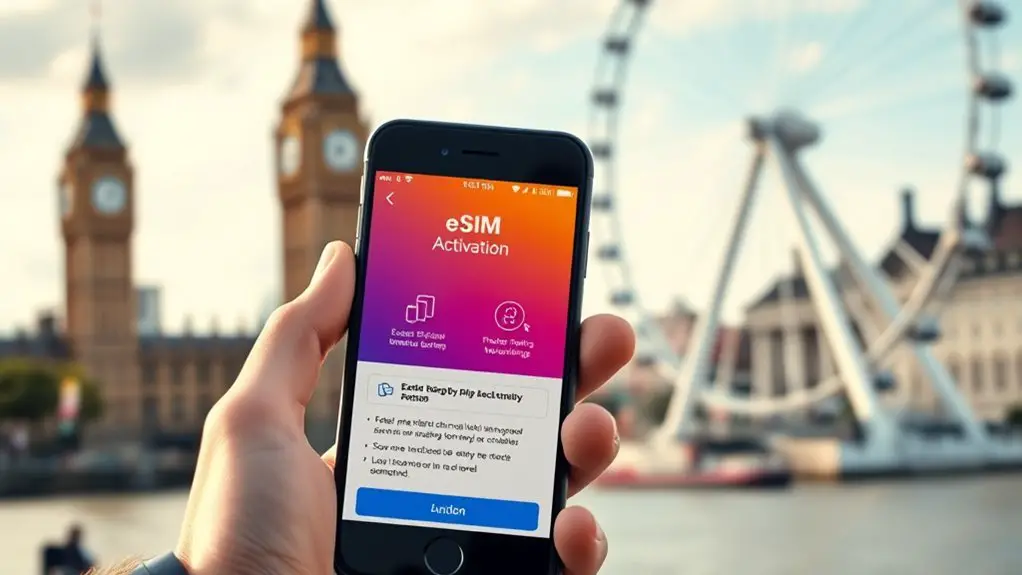
Most travel eSIMs can be installed before you leave home. Depending on the provider and phone, installation may use an app, QR code, carrier link, direct installation, or manual activation information.
- Confirm that your phone supports eSIM. Regional variants of the same phone can differ.
- Confirm that the phone is unlocked. An unlocked device is generally required when your travel eSIM uses a different carrier from your primary line.
- Buy the correct UK or Europe-plus-UK package. Do not assume every Europe plan automatically includes the United Kingdom.
- Install the eSIM while you have reliable internet. Apple notes that eSIM setup normally requires an internet connection.
- Check when validity begins. Some plans start when they first connect to a supported UK network; others have an activation deadline or different policy.
- On arrival, select the travel eSIM for cellular data. Enable data roaming for the travel eSIM if the provider requires it.
- Control your home line. Turn off data roaming on your primary SIM unless you intentionally want to use your home carrier abroad.
Apple’s international eSIM guidance explains that supported iPhones can keep a home line and a travel line available at the same time, although only one cellular-data network is used at once.
Warning: Installing an eSIM does not automatically disable roaming on your primary SIM. Check your data-line and roaming settings before using the phone abroad to reduce the risk of unexpected home-carrier charges.
Best eSIMs for Short-Stay Visitors
For a weekend or one-week London visit, buying far more data than you need can erase the savings of using a travel eSIM. Match the plan to how you actually use your phone.
| Provider | Why compare it for a short London stay |
|---|---|
| Airalo | Low-cost small data packages, including 1 GB and 3 GB options, plus straightforward app/QR installation. |
| Saily | Competitive fixed-data packages and automatic destination activation when correctly configured. |
| GigSky | Fixed and unlimited choices, multi-network UK access, and hotspot-friendly plans. |
| Holafly | Useful when you want an unlimited phone-data package priced by the number of travel days. |
| Nomad | Worth comparing when published access to several UK networks is more important than choosing the smallest possible package. |
For a very short visit, 1–5 GB may be enough when you mainly use maps, messaging, restaurant searches, ride-hailing, and occasional social media. Travelers who upload many photos, watch video, join video calls, or tether a laptop should consider a larger allowance or an unlimited package.
Family and Group eSIM Options in London
Travel eSIMs do not usually work like a traditional household mobile plan with one data pool automatically shared among several phone lines. Families normally have two practical choices: buy one eSIM for each person’s phone or use one phone as a hotspot.
Separate eSIMs for Each Family Member
Airalo’s current family guidance recommends purchasing individual eSIM plans for each traveler based on their needs. Holafly likewise asks customers to select one eSIM per person on its UK product page.
Separate plans usually work best when family members may split up during the day. Each person keeps independent maps, messages, ride-hailing, tickets, and emergency connectivity instead of depending on the group member carrying the hotspot phone.
Using One eSIM as a Group Hotspot
Hotspot sharing can save money when the group stays together, but the plan must permit tethering and provide enough data.
- Airalo: supports personal hotspot where the device and network allow it.
- GigSky: advertises unlimited hotspot sharing on its unlimited plans.
- Holafly UK: currently allows up to 1 GB of shared hotspot data per day.
- Saily: currently advertises unrestricted hotspot access on its UK product page.
Remember that hotspot use drains the host phone’s battery faster and every connected device consumes the same plan’s data.
Premium eSIM Features Worth Paying For
Higher-priced plans can make sense, but only when the extra feature solves a real travel problem. Do not pay a premium simply because a package uses words such as “premium,” “priority,” or “unlimited.”
| Feature | Why it can matter |
|---|---|
| Multiple UK partner networks | Gives the eSIM more than one potential network option when coverage varies by area. |
| Generous hotspot allowance | Important when sharing data with a laptop, tablet, child, or travel companion. |
| Calls, SMS, or a phone number | Useful when you need conventional calling, local SMS, reservations, or services that do not accept app-based calls. |
| 24/7 support | More valuable when you depend on the connection for work or arrive outside normal business hours. |
| Reusable installed eSIM | Some providers let you keep the same profile installed and buy another destination package later. |
Note: Hotspot sharing is not the same as installing one eSIM profile on several phones. An eSIM profile is normally tied to one active device. When a supported eSIM is transferred to a new phone, the old device’s service is typically deactivated.
Comparing Coverage and Network Reliability
The brand selling your travel eSIM and the UK network carrying the connection are not always the same company. Checking the local partner network can be more useful than comparing marketing claims about “fast” or “premium” data.
| Travel eSIM | Published UK network information |
|---|---|
| Airalo | Current UK package page identifies EE. |
| GigSky | Publishes Three, O2, and Vodafone for its UK service. |
| Nomad | Current UK page lists Three, O2, Vodafone, and EE. |
| Saily | Advertises connection through UK networks but does not prominently name a specific network on the current product summary. |
| Holafly | Advertises 5G where available plus 4G/LTE; verify the current network list in the package details before purchase. |
Coverage maps are still predictions. Buildings, basements, crowds, train routes, tunnels, and local network congestion can all change what you experience at street level.
London Underground and Transport Coverage
Do not confuse London’s fare zones with mobile-network coverage. An eSIM can work anywhere its partner network has service, regardless of whether you are in Zone 1 or Zone 6.
Transport for London is rolling out 4G and 5G through underground ticket halls, platforms, and tunnels. Coverage is already available on the whole Elizabeth line and on growing sections of several Underground lines, but TfL’s 2026 Business Plan says the wider project aims to reach all Tube lines by the end of 2026.
Wi-Fi is available at all Tube stations, which can provide a backup at stations where continuous tunnel coverage has not yet been completed.
Tips for Choosing the Right eSIM for Your Trip
Start with your itinerary rather than the provider’s marketing headline.
- Check device compatibility. Your exact phone model and regional version must support eSIM.
- Check carrier lock status. An unlocked phone is generally required to use a travel eSIM from another provider.
- Choose the coverage area. A UK-only plan is often enough for London; a regional Europe plan may be easier for a multi-country trip, but verify that the UK is explicitly listed.
- Estimate your data use. Maps and messaging consume far less data than video streaming, cloud backups, or laptop tethering.
- Check the local network. This matters more if you will leave London for rural areas.
- Read the “unlimited” terms. Look for daily high-speed limits, throttled speeds, and tethering restrictions.
- Check whether calls or SMS are included. Many travel eSIM packages remain data-only.
- Check activation timing. Know whether your validity starts at installation, first connection, or after a fixed activation deadline.
- Check top-up and refund rules. These can matter if your plans change or installation fails.
How Much Data Do You Need for a Week in London?
There is no universal amount, but these ranges are useful for planning:
| Usage style | Planning range for 7 days | Typical use |
|---|---|---|
| Light | 2–5 GB | Maps, messaging, email, restaurant searches, tickets, occasional photos. |
| Moderate | 5–10 GB | Frequent social media, photo uploads, music streaming, navigation, some short video. |
| Heavy | 10–20+ GB | Video streaming, video calls, large uploads, or regular hotspot use. |
These are planning estimates, not guarantees. Your phone’s built-in data-usage statistics are the best guide if you can check how much cellular data you normally consume in a week.
Data-Only eSIM vs. a UK Phone Number
A data-only travel eSIM is usually sufficient for WhatsApp, FaceTime, Signal, Telegram, email, maps, ride-hailing, and web browsing. You can often keep your normal SIM active for your existing phone number while using the travel eSIM for data.
If you specifically need a conventional UK mobile number with local calls and texts, consider a local carrier product instead. For example, Vodafone UK’s Pay As You Go Plus currently offers eSIM-compatible, no-contract packages with UK minutes and texts as well as data.
A local UK plan can be useful for a longer stay, but it may have different signup, payment, or activation requirements than a travel eSIM.
Avoiding Roaming Charges on Your Home SIM
Using a travel eSIM does not automatically protect you from every possible charge on your home line. Before departure:
- Turn off cellular-data roaming for your home SIM.
- Select the travel eSIM as your cellular-data line.
- Check whether “cellular data switching” could fall back to your primary line.
- Review your home carrier’s rules for calls, voicemail, and SMS abroad.
- If you want zero risk of home-line roaming, turn that line off entirely while abroad.
Troubleshooting an eSIM That Will Not Connect
If your London eSIM is installed but has no data:
- Confirm that the eSIM line is switched on.
- Make sure it is selected for cellular/mobile data.
- Enable data roaming for the travel eSIM if the provider requires it.
- Check the provider’s APN instructions.
- Toggle airplane mode on and off or restart the phone.
- Try automatic network selection first; if the provider permits manual selection, test another supported UK network.
- Confirm that the package has activated and has not expired.
- Check whether you have exhausted your high-speed or fixed-data allowance.
Warning: Do not delete an eSIM profile as a first troubleshooting step. Apple warns that deleting an eSIM can require contacting the carrier or provider to obtain a replacement before service can be restored.
Frequently Asked Questions
Can I use an eSIM in London with my existing phone plan?
Yes, on a compatible unlocked phone you can usually keep your home line and add a travel eSIM for London. Supported iPhones can run Dual SIM configurations, although only one cellular-data network is used at a time. Turn off data roaming on your home line unless you intentionally want to use it abroad.
Are eSIMs compatible with all smartphone models?
No. Many newer iPhone, Google Pixel, Samsung Galaxy, Motorola, and other phones support eSIM, but compatibility varies by exact model and region. Confirm that your phone has eSIM capability and is carrier-unlocked before purchasing a travel plan.
How much data do I need for a week in London?
A light user may be comfortable with roughly 2–5 GB for maps, messaging, email, and occasional social media. Moderate users can consider 5–10 GB, while frequent video, video calls, cloud uploads, or tethering can justify 10–20 GB or an unlimited package. Check your normal weekly phone usage for the best estimate.
Can I switch eSIMs during my trip if needed?
Usually, yes. Many modern phones can store multiple eSIM profiles and let you choose which line is active. Apple says supported iPhones can store eight or more eSIMs, with two active simultaneously on supported models. Android capabilities vary by device. Do not delete a travel profile until you are sure you no longer need it.
Do eSIMs work in all London transportation zones?
An eSIM is not limited by London’s fare zones; it works wherever its partner mobile network has service. Above-ground coverage is broad, but uninterrupted Underground coverage is not yet guaranteed through every tunnel. TfL is continuing its 4G/5G rollout during 2026, while Wi-Fi is available at all Tube stations.
Do I need a UK phone number while visiting London?
Not necessarily. A data-only eSIM is enough for maps, web access, WhatsApp, FaceTime, Signal, and most travel apps. A UK number becomes more useful when you need conventional local calls, SMS, or services that specifically require a UK mobile number. In that case, compare a local prepaid carrier eSIM as well as travel eSIMs.
Does “unlimited data” mean unlimited full-speed data?
Not always. Providers can apply fair-use policies, daily high-speed allowances, reduced speeds after heavy use, or separate hotspot limits. For example, GigSky publishes a daily high-speed allowance on its unlimited service, Holafly limits UK hotspot sharing to 1 GB per day, and some Airalo UK unlimited packages reduce speed after a stated daily threshold. Read the exact package terms before purchasing.
Conclusion
The best eSIM for London is the plan that matches your actual trip rather than the provider with the loudest “unlimited” or “5G” claim. Light users can save with a small fixed-data package, heavy users should compare high-speed and hotspot limits, and travelers leaving London should pay extra attention to the underlying UK networks. Install your eSIM while you have reliable internet, verify the activation policy, keep your home SIM’s roaming settings under control, and remember that Underground coverage is still expanding during 2026.
Sources
- Apple Support — Use eSIM while traveling internationally — backs up Dual SIM, unlocked-phone, travel-eSIM, and international setup guidance.
- Transport for London — Mobile phones and Wi-Fi underground — backs up current Tube mobile-coverage and station Wi-Fi information.
- Ofcom — Connected Nations Spring 2026 — backs up current UK 4G and 5G coverage data.
- Airalo — United Kingdom eSIM — backs up current UK package examples, network information, and plan availability.
- Holafly — United Kingdom eSIM — backs up unlimited-data, 5G/4G/LTE, and hotspot-sharing details.
- GigSky — Unlimited Data — backs up unlimited-plan, high-speed allowance, reusable-eSIM, and hotspot details.
