

Last Updated on July 24, 2026 by Caleb Warren
Drive Medical offers several types of mobility equipment, but the right choice depends on how much support you need, where you will use it, and whether you can safely lift, steer, brake, or transfer with the device. This guide compares six Drive Medical walkers, rollators, wheelchairs, and scooters using current manufacturer specifications rather than unsupported “doctor-recommended” rankings.
Quick Answer
The best Drive Medical mobility aid depends on your balance, endurance, upper-body strength, home layout, and transportation needs. A standard walker offers maximum walking support, a rollator adds wheels and a resting seat, a wheelchair supports seated mobility, and the ZooMe scooter provides powered travel but weighs 60 pounds.
Affiliate disclosure: This article contains Amazon affiliate links. If you make a qualifying purchase through one of these links, the site may earn a commission at no extra cost to you.
Medical and safety notice: This comparison is general information, not medical advice. Ask a doctor, physical therapist, or occupational therapist to help choose and fit a mobility aid if you have fallen, feel dizzy, cannot operate the brakes, have limited hand strength, or are unsure which level of support is safe.
Key Takeaways
- The basic two-button walker provides the most direct weight-bearing support but has no seat or hand brakes.
- The steel rollator has a 350 lb capacity, while both Nitro rollators have 300 lb capacities.
- The standard Nitro weighs 18 lb; the more cushioned Nitro DLX weighs 22 lb.
- The Blue Streak wheelchair weighs 41.25 lb, so caregivers should check whether they can lift it safely.
- The ZooMe scooter folds electronically, but it weighs 60 lb and requires airline confirmation before flying.
- Check the exact model number because dimensions, warranties, heights, and included parts can differ between variants.
Walker vs. Rollator vs. Wheelchair vs. Scooter
These products do not provide the same type of assistance. Start by matching the device category to the user’s functional needs:
- Standard walker: Best for someone who needs substantial support while walking and can lift or advance the frame safely. It does not provide a seat.
- Rollator: Best for someone who can walk and control hand brakes but needs wheels, storage, and a place to rest. A standard rollator is not designed to carry a seated person while moving.
- Manual wheelchair: Best for seated mobility when walking is limited or unsafe. The user must be able to self-propel, or a caregiver must be available to push and handle transfers.
- Mobility scooter: Best for a user who can sit upright, steer, operate a throttle, judge obstacles, and transfer safely. Scooters usually need more storage space and battery planning.
Pro Tip: Write down the user’s body weight, handle-height requirement, preferred seat height, doorway width, vehicle cargo opening, and maximum safe lifting weight before comparing models.
How We Evaluated These Products
This comparison uses published specifications from Drive Medical and the model numbers associated with the listed products. The products were compared by device type, capacity, product weight, folding method, seat dimensions, wheel size, storage, braking, and likely use environment. They were not physically tested for this article, and the rankings are practical use-case labels rather than medical endorsements.
Top Drive Medical Mobility Aids Compared
| Drive Medical Rollator Walker with Seat, Model 10257BL-1 | Best Value Rollator | Capacity: 350 lb | Product Weight: 18.5 lb | Folding: Standard folding frame | CHECK PRICE ON AMAZON | Read Our Analysis | |
| Drive Medical Nitro DLX Foldable Rollator Walker | Best Cushioned Rollator | Capacity: 300 lb | Product Weight: 22 lb | Folding: One-hand side-to-side | CHECK PRICE ON AMAZON | Read Our Analysis | |
| Drive Medical Two-Button Folding Walker with Wheels | Best Basic Walking Support | Capacity: 350 lb | Product Weight: About 7.5 lb | Folding: Two-button folding | CHECK PRICE ON AMAZON | Read Our Analysis | |
| Drive Medical Nitro Rollator with Seat, Black | Best Lightweight Rollator | Capacity: 300 lb | Product Weight: 18 lb | Folding: One-hand side-to-side | CHECK PRICE ON AMAZON | Read Our Analysis | |
| Drive ZooMe Auto-Flex Folding Travel Scooter Warranty Bundle | Best Powered Travel Option | Capacity: 300 lb | Product Weight: 60 lb | Folding: Electronic, 15 seconds or less | CHECK PRICE ON AMAZON | Read Our Analysis | |
| Drive Medical Blue Streak Wheelchair with 18-Inch Seat | Best Standard Wheelchair | Capacity: 300 lb | Product Weight: 41.25 lb | Folding: Folds to 12 inches wide | CHECK PRICE ON AMAZON | Read Our Analysis |
More Details on Our Top Picks
-
Drive Medical Rollator Walker with Seat, Model 10257BL-1
This steel rollator is a practical choice when you want a seat, hand brakes, storage, and a higher 350 lb capacity without moving to a powered device. Drive lists 7.5-inch casters for indoor and outdoor use, a 12-by-12-inch seat, a 21-inch seat-to-floor height, and an 18.5 lb product weight.
The under-seat pouch keeps belongings out of the way, while the removable padded backrest supports stationary rest periods. The loop-style hand brakes can slow the rollator or lock it before sitting.
The main trade-offs are its compact 12-inch seat and steel construction. Measure the user’s hip width and confirm that the 17.5-inch space between the arms is comfortable. See the official Drive Medical specifications before ordering because retailer descriptions may vary.
- Model:10257BL-1
- Weight Capacity:350 lb
- Product Weight:18.5 lb
- Frame Material:Steel
- Folding Mechanism:Standard folding frame
- Seat Size:12 by 12 inches
- Seat Height:21 inches
- Handle Height:30 to 34 inches
- Wheel Size:7.5-inch casters
- Storage:Under-seat pouch
-
Drive Medical Nitro DLX Foldable Rollator Walker
The Nitro DLX is the comfort-focused rollator in this group. Its cross-brace frame folds from side to side with one hand, and its 10-inch front casters provide easier rolling over thresholds and imperfect sidewalks than smaller wheels.
Drive lists a 300 lb capacity, 22 lb product weight, 18-by-10-inch seat, 20-inch seat height, and handle adjustment from 33.5 to 38.5 inches. The firm seat separates as the frame closes, and the removable zippered bag stays attached when the rollator is open or folded.
This version is four pounds heavier than the standard Nitro, so the added seat design may not suit someone who must frequently lift the rollator alone. Review the official Nitro DLX specifications and verify the exact color and model number in the retailer listing.
- Model:RTL10266CH-HS or color-equivalent DLX variant
- Weight Capacity:300 lb
- Product Weight:22 lb
- Frame Material:Aluminum
- Folding Mechanism:One-hand side-to-side folding
- Seat Size:18 by 10 inches
- Seat Height:20 inches
- Handle Height:33.5 to 38.5 inches
- Wheel Size:10-inch front casters
- Storage:Removable zippered bag
-
Drive Medical Two-Button Folding Walker with Wheels
This two-button aluminum walker is the simplest option in the comparison. It has two fixed front wheels and rear glide caps rather than four rolling wheels, a seat, or hand brakes. That design can provide more controlled support for someone who should not use a free-rolling rollator.
The adult model supports up to 350 lb and weighs about 7.5 lb. Each side folds independently, which can help when moving through narrow spaces. The handles adjust from approximately 32 to 39 inches, and the vinyl-contoured grips provide a broad hand surface.
Because it has no seat, storage, or braking system, it serves a different need from the rollators. A therapist should confirm the correct walking pattern and height after surgery, weakness, or a fall. See the manufacturer specifications for the model and available variants.
- Model:10210-1
- Weight Capacity:350 lb
- Product Weight:Approximately 7.5 lb
- Frame Material:Aluminum
- Folding Mechanism:Independent two-button folding
- Handle Height:Approximately 32 to 39 inches
- Wheel Size:5-inch front wheels
- Rear Contact:Glide caps
- Seat:None
- Hand Brakes:None
-
Drive Medical Nitro Rollator with Seat, Black
The standard Nitro combines a 300 lb capacity with an 18 lb aluminum frame. That makes it four pounds lighter than the Nitro DLX while retaining 10-inch front casters, a side-to-side folding frame, an adjustable backrest, and a removable storage bag.
Drive lists an 18-by-10-inch seat, a 20.5-inch seat height, and handles that adjust from 33.5 to 38.25 inches. Brake cables run inside the frame, reducing exposed cables that could catch on nearby objects.
This model folds manually using the seat handle. It does not have wireless key-fob folding. The large front casters improve rolling comfort, but the rollator is still intended for firm walking surfaces rather than deep gravel, loose sand, or steep terrain. Confirm the details on the official Nitro product page.
- Model:RTL10266BK
- Weight Capacity:300 lb
- Product Weight:18 lb
- Frame Material:Aluminum
- Folding Mechanism:Manual one-hand side-to-side folding
- Seat Size:18 by 10 inches
- Seat Height:20.5 inches
- Handle Height:33.5 to 38.25 inches
- Wheel Size:10-inch front casters
- Additional Feature:Brake cables routed inside frame
-
Drive ZooMe Auto-Flex Folding Travel Scooter Warranty Bundle
The ZooMe Auto-Flex is the only powered device in this comparison. It folds or unfolds electronically in 15 seconds or less using the included wireless key fob. Manual-release levers provide a backup folding method.
Drive lists a 300 lb capacity, 60 lb total product weight, 55 lb heaviest-piece weight, 4 mph top speed, and a maximum published range of 13 miles. Real-world range can fall with hills, cold weather, user weight, battery age, repeated starts, and soft surfaces.
The 1.6-inch ground clearance and compact wheels make it better suited to indoor floors, paved paths, terminals, and other firm surfaces than rough trails. Before buying it for car travel, confirm that the person loading it can safely manage 55 lb or has a lift or ramp.
The manufacturer describes its lithium battery as suitable for airline travel, but that does not guarantee acceptance on every flight. Contact the airline before travel, provide the battery specifications, and follow current FAA mobility-device battery guidance.
Drive lists a limited lifetime frame warranty, 24 months on electronics, and 12 months on batteries. A three-year protection plan advertised in an Amazon bundle is separate retailer or third-party coverage, so read its exclusions, administrator information, and claim process before purchase. Full manufacturer details appear on the official ZooMe Auto-Flex page.
- Model:FLEX-AUTO
- Weight Capacity:300 lb
- Product Weight:60 lb
- Heaviest Piece:55 lb
- Frame Material:Aluminum alloy
- Folding Mechanism:Electronic folding in 15 seconds or less
- Top Speed:4 mph
- Published Maximum Range:13 miles under specified conditions
- Ground Clearance:1.6 inches
- Battery:25.9V 10Ah lithium
-
Drive Medical Blue Streak Wheelchair with 18-Inch Seat
The Blue Streak is a standard folding manual wheelchair with an 18-by-16-inch seat, flip-back desk-length arms, push-to-lock wheel locks, and swing-away footrests. The arm design helps the chair move closer to some tables and desks.
Drive lists a 300 lb capacity, 41.25 lb product weight, 24-inch open width, and 12-inch folded width without riggings. Solid polyurethane tires reduce routine tire maintenance, while the nylon upholstery can be wiped clean.
The chair’s folded width helps with storage, but its 41.25 lb lifting weight may be difficult for some caregivers. Measure the user’s seated hip width, the narrowest doorway, and the vehicle opening before ordering. Footrests should be moved out of the way during transfers, and wheel locks should be engaged before the user sits or stands.
Review the official Blue Streak specifications to confirm the arm and leg-rest configuration included with the selected model.
- Model:BLS18FBD-SF
- Weight Capacity:300 lb
- Product Weight:41.25 lb
- Frame Material:Steel
- Seat Size:18 by 16 inches
- Open Width:24 inches
- Folded Width:12 inches without riggings
- Seat-to-Floor Height:19.5 inches
- Arm Style:Flip-back desk-length arms
- Footrests:Swing-away footrests
Factors to Consider When Choosing a Drive Medical Mobility Aid
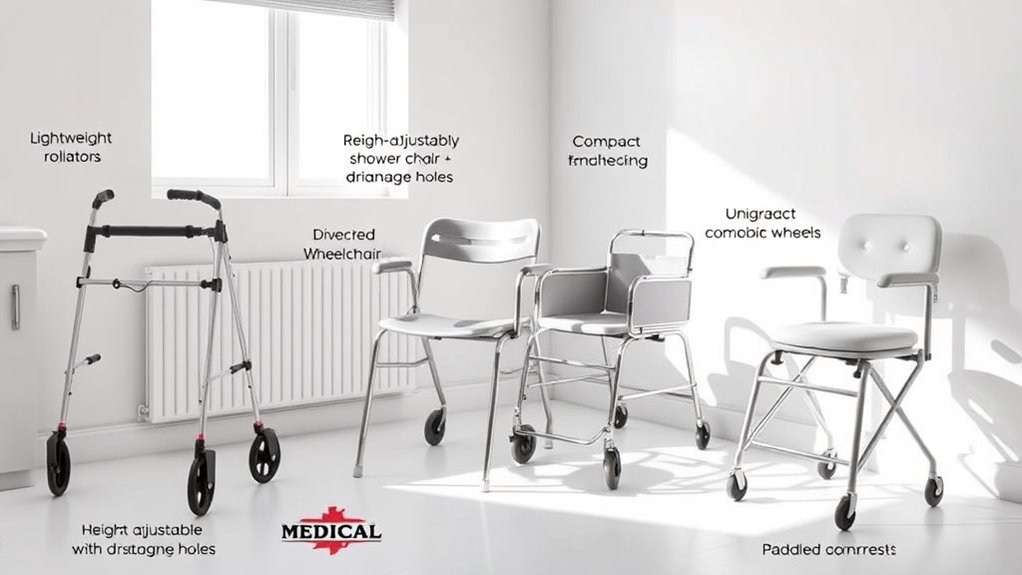
Brand name alone cannot tell you whether a mobility device is safe for a particular user. Match the device to the user’s balance, strength, walking ability, transfer skills, body measurements, home layout, transportation method, and expected environment.
Mobility Needs Assessment
Begin with the activity that is difficult or unsafe. Does the person need support while walking, a seat for occasional rest, full-time seated mobility, or powered transportation for longer distances?
A standard walker can provide more controlled walking support than a four-wheel rollator. A rollator requires enough balance, judgment, grip strength, and reaction time to steer and operate the brakes. A wheelchair requires safe transfers and either self-propulsion ability or caregiver assistance. A scooter requires steering, throttle control, obstacle awareness, and safe transfers on and off the seat.
The National Institute on Aging advises users to make sure a cane or walker is the correct size and notes that a physical or occupational therapist can help select and teach the safe use of an assistive device.
Weight Capacity Requirements
The published capacity must exceed the user’s total supported weight. Do not treat a 300 lb rating as suitable for a user who weighs exactly 300 lb while also carrying bags, oxygen equipment, or other items on the device.
Capacity alone does not confirm fit. A high-capacity product can still have a seat, arm spacing, handle range, or footrest position that is too small or too large. Never hang heavy bags from the handles because this can change the device’s balance.
Device Fit and Sizing
For a walker or rollator, the handles should generally allow the user to stand upright with a slight bend at the elbows. MedlinePlus advises adjusting walker handles around hip level and asking a provider or therapist for help when the walker is difficult to use.
For a seated device, measure the user’s hip width while seated and allow appropriate clearance without creating excessive side-to-side movement. Also compare seat depth, seat-to-floor height, back height, arm position, and footrest adjustment.
Note: Manufacturer handle ranges are not height recommendations for every user. Body proportions, posture, footwear, joint range, and walking pattern affect the correct setting.
Indoor Versus Outdoor Use
Smaller fixed wheels can be easier to control indoors, while larger rollator casters generally cross minor thresholds and sidewalk joints more smoothly. Wheel size does not make a device suitable for every outdoor surface.
Avoid loose gravel, deep grass, sand, steep slopes, wet floors, ice, and broken pavement unless the manufacturer specifically approves the surface and the user can maintain control. The ZooMe’s low ground clearance makes it a travel scooter for relatively smooth surfaces, not an off-road scooter.
Home and Vehicle Measurements
Measure the narrowest doorway, hallway turn, bathroom entrance, elevator opening, storage closet, vehicle cargo opening, and available floor space. Include the width of the user’s hands at the wheels when measuring for a self-propelled wheelchair.
Check both folded dimensions and lifting weight. A device can fit in a trunk yet still be too heavy for the user or caregiver to lift safely. Powered lifts, ramps, or a lighter model may be necessary.
Portability and Storage
A folding mechanism helps only when the user can operate it safely. Test whether the person can reach the release, keep fingers away from pinch points, control the folded frame, and prevent it from reopening during transport.
The two-button walker is the lightest product here. The standard Nitro is lighter than the Nitro DLX. The Blue Streak and ZooMe require substantially more lifting strength, even though both fold for storage.
Comfort and Adjustability
Comfort depends on more than padding. Check handle position, seat width, seat depth, back support, arm height, foot placement, posture, and how long the user expects to remain seated.
A rollator seat is intended for short stationary rest periods. Engage both parking brakes before sitting, place the device on a level surface, and do not have another person push the rollator while someone is seated unless the product is specifically designed and labeled as a rollator-transport-chair combination.
Safety Features Priority
Before each use, check that the frame opens fully, folding locks engage, handles are secure, wheels rotate without wobbling, brake cables are intact, wheel locks hold, upholstery is not torn, and footrests or accessories are attached correctly.
Warning: Stop using the device if a brake does not hold, a wheel is loose, the frame is bent, a fastener is missing, the battery housing is damaged, or the folding mechanism does not lock. Contact the retailer or a qualified mobility-equipment service provider before using it again.
Keep pathways well lit and remove loose rugs, cords, clutter, and other trip hazards. Wear supportive, nonslip footwear. Tell a healthcare provider about falls, new dizziness, weakness, vision changes, or medication side effects that may affect safe device use.
Maintenance and Replacement Parts
Clean the frame and upholstery according to the owner’s manual. Keep water away from scooter electronics and chargers. Inspect wheels, glides, brakes, fasteners, upholstery, battery connectors, and folding components on a regular schedule based on use.
Use parts approved for the exact model. Drive directs consumers to the original equipment provider for repairs and servicing and offers a provider locator when the original seller is unavailable. Do not drill, weld, or alter the frame because modifications can weaken it and affect warranty coverage.
Budget and Value
Compare the full cost rather than the purchase price alone. Possible expenses include delivery, assembly, fitting, cushions, baskets, replacement glides, tires, batteries, chargers, ramps, vehicle lifts, repairs, and protection plans.
Review the seller’s return policy before opening or assembling the product. Medical and mobility equipment may have special return restrictions. Keep the receipt, model number, serial number, packaging, owner’s manual, and warranty documents.
Insurance and Medicare
Medicare Part B may cover eligible walkers, wheelchairs, and scooters as durable medical equipment when the device is medically necessary and ordered for use in the home. Coverage is not automatic simply because a product has a medical-device description or an HCPCS code.
The prescriber and supplier generally must be enrolled in Medicare. Power scooters require a face-to-face examination and written order, and some powered mobility equipment may require prior authorization. Private insurance and Medicare Advantage rules can differ, so confirm coverage before buying through a retail marketplace.
Frequently Asked Questions
Does Drive Medical offer financing?
Drive Medical states that it does not sell directly to consumers. Financing, installment plans, and medical-credit options therefore depend on the authorized provider or retailer. Review the financing agreement’s interest, fees, return rules, and effect on warranty service before accepting it.
Are replacement parts available for older models?
Parts may be available, but availability depends on the exact model, serial number, age, and component. Check Drive Medical’s parts resources or contact the provider that sold the device. Do not substitute a similar-looking brake, wheel, charger, battery, or structural part without confirming compatibility.
How do I file a Drive Medical warranty claim?
Start with the retailer or medical-equipment provider that supplied the product. Keep the receipt, model number, serial number, photographs, and a description of the problem. Manufacturer coverage varies by product and component. A retailer protection plan has its own administrator and claim process.
Does insurance cover Drive Medical mobility devices?
Coverage may be available when the device meets the plan’s medical-necessity, documentation, home-use, prescriber, and supplier requirements. Medicare Part B can cover eligible walkers, wheelchairs, and scooters, but retail purchases made before approval may not be reimbursed. Ask the plan and enrolled supplier before ordering.
Where are Drive Medical products manufactured?
The country of origin can vary by product, component, and production run. Drive Medical lists several manufacturing facilities in the United States, but that does not establish the origin of every mobility product. Check the label, packaging, customs marking, or manufacturer documentation for the exact model.
Is a walker or rollator better?
A standard walker usually provides more controlled support and may be appropriate when balance or weight-bearing ability is limited. A rollator moves more easily and adds brakes, storage, and a seat, but the user must be able to steer and operate the brakes safely. A therapist can help determine the correct type.
How high should walker handles be?
Walker handles are commonly adjusted near hip or wrist-crease level so the user can stand upright with slightly bent elbows. This is only a starting point. A healthcare professional should check the setting when the user has unusual posture, joint limits, pain, weakness, or difficulty controlling the device.
Can the ZooMe Auto-Flex scooter travel on an airplane?
Its lithium battery may meet applicable mobility-device limits, but the passenger must still contact the airline in advance. The airline may request battery watt-hours, removal instructions, terminal protection, and advance check-in. Airline policies may be stricter than the general FAA allowance.
Sources
- Drive Medical product specifications — capacity, dimensions, product weight, wheels, seats, folding systems, warranties, and model information. Individual official product links also appear in the reviews.
- Medicare durable medical equipment coverage — general eligibility and provider-order requirements.
- Medicare walker coverage — walker and rollator coverage conditions.
- Medicare wheelchair and scooter coverage — examinations, written orders, suppliers, costs, and prior authorization.
- Federal Aviation Administration mobility-device guidance — lithium-battery limits and airline handling requirements.
- MedlinePlus walker instructions — walker adjustment, walking technique, and safety guidance.
Conclusion
The strongest choice is the device that matches the user’s actual mobility needs and physical environment. The two-button walker provides basic controlled support, the steel rollator raises capacity to 350 lb, the Nitro models balance portability with larger wheels, the Blue Streak supports seated mobility, and the ZooMe adds powered travel at the cost of greater weight and battery planning.
Compare the exact model number, fit, seat dimensions, handle range, lifting weight, braking system, warranty, and insurance requirements before buying. When falls, weakness, pain, poor balance, or uncertain transfers are involved, professional assessment is more valuable than any general product ranking.
