
Last Updated on July 25, 2026 by Daniel Globe
Trying dondurma is one of the most memorable food experiences in Istanbul, but there is more to Turkish ice cream than the famous cone tricks. The especially dense, stretchy style associated with Kahramanmaraş gets its texture from salep and careful production. Istanbul also has everything from neighborhood dondurmacıs to Maraş specialists, fruit-focused ice-cream shops, and dairy-free alternatives.
Quick Answer
Turkish dondurma can mean ice cream generally, while Maraş-style dondurma is the dense, elastic version famous for salep and dramatic serving tricks. In Istanbul, look beyond tourist carts and try established shops in Kadıköy, Moda, Kumkapı, or Beyoğlu. Traditional Maraş Dondurması is dairy-based, so check ingredients carefully if you have allergies or follow a vegan diet.
Key Takeaways
- Dondurma is the Turkish word for ice cream; registered Maraş Dondurması is a more specific regional product.
- Salep helps give Maraş-style ice cream its dense, elastic, slow-melting texture.
- The street-vendor performance is fun, but it does not by itself prove that the ice cream is authentic or high quality.
- Istanbul prices vary sharply by neighborhood and business, so check the displayed menu before ordering.
- Traditional Maraş Dondurması contains milk; cones, nuts, toppings, and cross-contact also matter for people with allergies or gluten restrictions.
Disclosure: As an Amazon Associate I earn from qualifying purchases. Some links on this page are affiliate links, at no extra cost to you.
What Is Dondurma? The Unique Characteristics of Turkish Ice Cream
Dondurma simply means ice cream in Turkish, so not every scoop sold in Turkey has the famous stretchy texture. The version most travelers have in mind is Maraş-style dondurma, associated with Kahramanmaraş in southeastern Turkey.
Türkiye’s official geographical-indication record goes a step further. Maraş Dondurması is a registered geographical indication, registration no. 344. The official product description identifies goat milk, salep, and sugar as its defining ingredients.
Salep is made from processed tubers of certain terrestrial orchids. Its hydrocolloids increase viscosity, which helps produce the thick, elastic body associated with Turkish-style ice cream. Food-science research has found that increasing salep concentration has a strong effect on an ice-cream mix’s viscosity.
Another important difference is air. Authentic Maraş Dondurması is characterized by relatively low volume expansion, rather than being whipped full of air. That helps explain why it feels heavier, denser, and more resistant than many conventional ice creams.
Maraş Dondurması was registered as a Turkish geographical indication on April 18, 2018, under registration no. 344.
Note: “Turkish ice cream,” “dondurma,” and “Maraş Dondurması” are not perfect synonyms. A shop may sell ordinary scoop ice cream, a Maraş-style recipe, or a product made to the registered Maraş specification.
The History of Dondurma: From Tradition to Modernity
Dondurma belongs to a long Turkish tradition of frozen and milk-based sweets, but its exact origin story should be treated with care.
The Turkish Ministry of Culture and Tourism records a traditional story connecting Maraş Dondurması with the Ottoman-era frozen dessert known as karsambaç. According to the legend, a salep seller known as Maraşlı Osman Ağa discovered that a mixture of salep, milk, and sugar had developed a thick, stretchy texture after being left in the snow.
That story is part of the dessert’s cultural heritage, but it is better understood as folklore than as a precisely documented invention date. What is certain is that Kahramanmaraş became strongly associated with the dense, elastic style now recognized as Maraş Dondurması.
Modern dondurma culture combines several traditions:
- Regional production: Salep and milk give Maraş-style dondurma its distinctive body.
- Dövme, or working the mixture: Traditional production emphasizes physical working and beating to create a cohesive texture.
- Street service: Some vendors use long metal paddles and playful cone tricks as entertainment.
- Modern shops: Today’s dondurmacıs offer everything from plain and pistachio ice cream to fruit flavors, sorbets, and plant-based frozen desserts.
Key Ingredients That Make Dondurma Special
The defining ingredients depend on which kind of dondurma you are buying. For registered Maraş Dondurması, the traditional specification centers on goat milk, salep, and sugar. Other Turkish ice creams can use cow’s milk, fruit, chocolate, nuts, mastic, or other flavorings.
Unique Texture Properties
The best-known Maraş-style texture is dense, elastic, slightly chewy, and slower to soften than ordinary high-overrun ice cream.
Four factors help explain it:
- Salep: Its natural hydrocolloids thicken the mixture and contribute to elasticity.
- Milk: Traditional registered Maraş Dondurması uses goat milk, although other Turkish ice creams may use different dairy bases.
- Low overrun: Less volume expansion keeps the finished ice cream relatively dense.
- Working and beating: The traditional dövme process helps build the firm, cohesive texture associated with the style.
Mastic, or sakız, is also used in some Turkish and eastern Mediterranean frozen desserts. However, it is not a required ingredient in the registered Maraş Dondurması specification. Think of mastic as an optional flavor or stylistic variation rather than the ingredient that defines every Turkish dondurma.
Flavor Varieties Offered
Istanbul dondurmacıs range from traditional specialists to modern ice-cream shops, so flavor lists change by season and business.
| Type | Examples You May See | What to Expect |
|---|---|---|
| Classic | Sade/plain, chocolate, pistachio | Good choices for comparing texture between shops |
| Turkish-inspired | Mastic, tahini, walnut, kaymak-style flavors | Nutty, aromatic, or rich flavors that vary by shop |
| Fruit | Black mulberry, sour cherry, fig, melon, raspberry | Availability often changes with the shop and season |
For your first taste, sade is especially useful because strong chocolate, fruit, or nut flavors do not hide the texture of the base.
The Art of Serving Dondurma: A Playful Experience
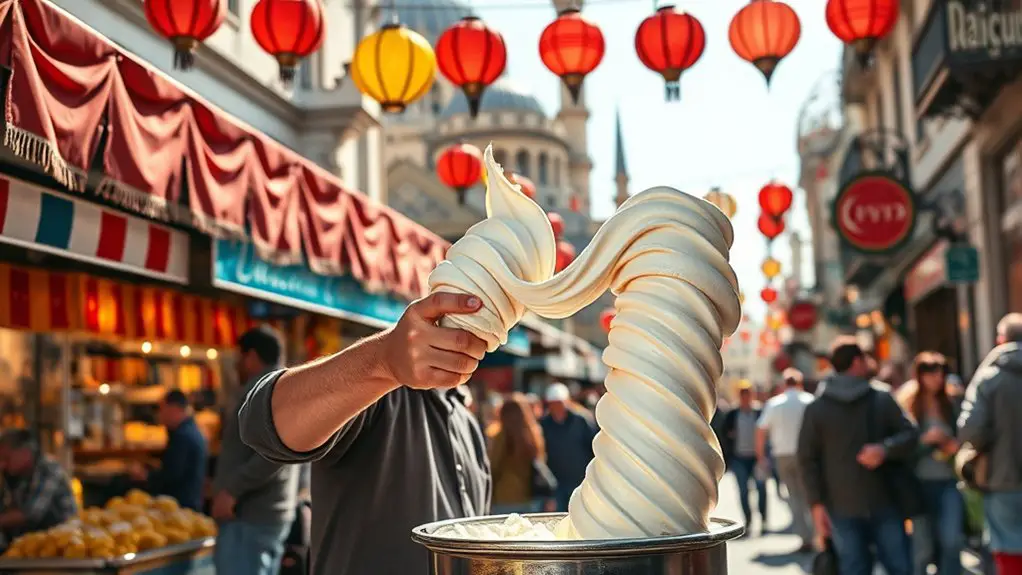
The theatrical street service is one of the reasons Turkish ice cream became internationally recognizable. Vendors may use a long-handled metal paddle to spin the cone, pull the ice cream away just as you reach for it, flip the cone, or briefly balance it above your head.
The dense consistency makes these tricks easier than they would be with very soft conventional ice cream. Still, the performance and the recipe are two different things: an entertaining vendor does not automatically mean that the product follows the traditional Maraş specification.
- Twisting the cone: The vendor rotates or swaps it before handing it over.
- Stretching the ice cream: A dense batch can cling to the long serving paddle.
- Playful misdirection: The customer may “receive” an empty cone several times before getting the real serving.
- Final handoff: Once the performance ends, you get the cone — usually with a smile and a photo opportunity.
Pro Tip: If you care more about flavor than the show, look for a busy neighborhood dondurmacı with clearly displayed prices and ask for a small taste of sade before choosing several flavors.
Top Places to Enjoy Dondurma in Istanbul
Istanbul has hundreds of ice-cream counters, so there is no single objectively “best” shop. A better strategy is to choose according to neighborhood and the style you want: classic scoop ice cream, fruit-forward varieties, Maraş-style texture, or a theatrical serving experience.
Established Dondurma Shops to Consider
- Dondurmacı Ali Usta, Moda: A long-established name on the Asian side with a broad flavor selection. It is a convenient stop while walking through Moda and Kadıköy.
- Yaşar Ustanın Sorbe ve Dondurması, Kadıköy: A neighborhood shop known for ice cream and fruit-focused sorbet varieties. It is a useful choice if your group wants both dairy and fruit options.
- Vardarlı Dondurma, Sahrayı Cedit: A neighborhood dondurmacı associated with dense Turkish-style ice cream and flavors such as mastic and tahini-walnut.
- Nurettin Usta Alpedo, Kumkapı: A small option in historic Fatih where the ice-cream service itself can be part of the fun.
- MADO, multiple Istanbul locations: A major Kahramanmaraş-rooted brand offering Maraş-style products as well as a large modern menu, including some vegan frozen desserts. Its central Beyoğlu locations are convenient for visitors around İstiklal Caddesi.
Hours, menus, branches, and prices can change. Check the current listing or the business’s own site on the day you visit rather than planning around an old blog post.
Unique Flavor Combinations
Modern Istanbul shops frequently move beyond plain, chocolate, and pistachio. Depending on the dondurmacı, you may encounter tahini, walnut, mastic, black mulberry, fig, sour cherry, melon, kaymak-inspired flavors, or rotating fruit sorbets.
Do not assume that every unusual flavor is traditional Maraş Dondurması. Often it is better understood simply as a creative Turkish ice cream or sorbet made by that particular shop.
How to Recognize Good Dondurma
A dramatic performance can be entertaining, but use the ice cream itself to judge quality.
- Start with plain: Sade makes it easier to judge the dairy flavor and texture.
- Look for density: Maraş-style ice cream should feel substantial rather than foamy.
- Check the ingredient information: A shop making strong claims about “authentic Maraş” should be able to explain what it serves.
- Watch the price board: Confirm whether pricing is per scoop, portion, cone, or weight before ordering.
- Do not confuse the show with certification: Cone tricks are entertainment, not proof of geographical-indication compliance.
Popular Flavors of Dondurma to Try
Flavor ranges vary enormously, but a few choices are particularly useful for travelers exploring Turkish ice cream:
- Sade (Plain): The best starting point for tasting the milk-and-salep base without another flavor dominating it.
- Antep Fıstıklı (Pistachio): A rich nut flavor that is common in Turkish dessert shops and pairs naturally with dense ice cream.
- Sakızlı (Mastic): Aromatic and resinous. It is a distinct flavor found at some shops, although mastic is not required in registered Maraş Dondurması.
- Chocolate: Familiar, easy to compare between stores, and especially good if you prefer a strong cocoa flavor.
- Fruit varieties: Black mulberry, sour cherry, fig, melon, and other fruits may appear depending on the producer and season.
Vegan and Dairy-Free Options for Dondurma Lovers
Traditional registered Maraş Dondurması is not vegan or dairy-free because goat milk is part of its defining recipe.
That does not mean vegan travelers have to skip frozen desserts in Istanbul. Some businesses now sell plant-based ice creams or fruit sorbets. MADO, for example, currently advertises vegan varieties including coconut-milk, black-mulberry, dark-chocolate, and raspberry options on its special ice-creams page.
Plant-based products should be described as vegan ice cream or frozen dessert rather than assumed to be traditional Maraş Dondurması. Recipes also change, so confirm the current ingredient list at the branch where you order.
Warning: If you have celiac disease or a serious milk, nut, soy, or other food allergy, do not judge safety from the flavor name alone. Ask about the ice cream, cone, toppings, shared scoops, and cross-contact before ordering.
Salep Sustainability and Why It Matters
Salep is culturally important, but its orchid source also creates a conservation issue. Collecting protected salep orchids from the wild is restricted in Türkiye, and food-purpose cultivation is controlled by agricultural authorities.
In 2026, Türkiye’s Ministry of Agriculture and Forestry announced the country’s first registered domestic salep cultivars, Balyumru and Bolyumru, as part of an effort to expand controlled cultivation and reduce pressure on wild orchid populations.
For travelers, the practical lesson is simple: enjoy dondurma from established producers rather than buying supposedly “wild” salep powder from questionable sources.
The Cultural Significance of Dondurma in Turkish Society
Dondurma is both everyday food and regional heritage. Neighborhood ice-cream shops fill up on warm evenings, families stop for a cone during a walk, and Maraş Dondurması has become closely associated with the identity of Kahramanmaraş.
The Turkish geographical-indication system formally recognizes that regional connection. At the same time, Istanbul has adapted the tradition in its own way: classic dondurmacıs, fruit-sorbet specialists, chains, cafés, and theatrical street vendors all coexist.
That mixture is part of what makes eating dondurma in Istanbul interesting. You can enjoy the tourist performance once, then compare it with a quieter neighborhood shop where the emphasis is almost entirely on the ice cream.
Tips for Enjoying Dondurma Like a Local
A few simple choices make ordering easier and help you avoid surprises.
- Ask the price first if it is not clearly displayed, especially around heavily visited areas.
- Try sade first when you want to judge the texture of a Maraş-style ice cream.
- Order a cup if needed: Kase means bowl or cup, while külah means cone.
- Say “bir top” when asking for one scoop at shops that price by the scoop.
- Try “fıstıklı” for pistachio and çikolatalı for chocolate.
- Enjoy the vendor routine when you are in the mood for it, but choose a conventional counter if you simply want your ice cream without the performance.
There is no universal “best time” to eat dondurma. Warm afternoons are refreshing, while evening walks through Moda, Kadıköy, Beyoğlu, or the waterfront districts create a livelier atmosphere.
How Much Does Dondurma Cost in Istanbul?
Istanbul ice-cream prices change too quickly for a permanent citywide price range to stay reliable. Prices differ by neighborhood, portion size, ingredients, and whether you are buying from a local counter, a tourist-zone cart, or a sit-down chain.
For a dated reference point, an Istanbul MADO online menu checked in July 2026 listed a 120 g plain dövme dondurma portion at 220 TL. That is only one current example, not a standard Istanbul price. Neighborhood shops can price their servings differently.
Pro Tip: Before a street vendor begins the cone performance, check the menu board or ask “Ne kadar?” — “How much?” This is especially useful in high-tourism areas where portion sizes and pricing may differ from neighborhood shops.
Frequently Asked Questions
Can I find gluten-free dondurma options in Istanbul?
Yes, some products are specifically sold as gluten-free. The traditional Maraş Dondurması specification itself uses goat milk, salep, and sugar rather than wheat, but that does not make every serving automatically safe for someone with celiac disease. Cones, toppings, recipes, and shared utensils can introduce gluten. Ask the individual shop about ingredients and cross-contact.
How much does dondurma typically cost in Istanbul?
There is no reliable citywide price because menus change quickly and portions differ. As one July 2026 reference, an Istanbul MADO online menu listed 120 g of plain dövme dondurma at 220 TL. Local neighborhood stores may charge differently, so check the current menu before ordering.
Are there seasonal flavors of dondurma available?
Yes. Some Istanbul shops rotate fruit ice creams and sorbets according to availability or season. Black mulberry, fig, melon, sour cherry, and other fruit flavors can appear at different times, but the selection depends on the shop rather than a fixed citywide seasonal calendar.
Is dondurma suitable for children?
Dondurma is commonly enjoyed by families, but ingredients still matter. Traditional Maraş Dondurması contains milk, while flavored varieties may contain pistachios or other nuts. Check for allergens, toppings, and cross-contact when a child has a food allergy or intolerance.
What is the best time to enjoy dondurma in Istanbul?
There is no single best time. A cone is refreshing during a warm afternoon, while evening is popular for combining dondurma with a walk through neighborhoods such as Moda, Kadıköy, or Beyoğlu. Check the shop’s current hours if you are traveling specifically to a particular dondurmacı.
Is all Turkish dondurma stretchy?
No. Dondurma is the general Turkish word for ice cream. The pronounced dense and elastic texture is especially associated with Maraş-style dondurma and its use of salep, low overrun, and traditional working methods.
Is mastic required in authentic Maraş Dondurması?
No. Mastic is used in some Turkish ice creams and is available as a distinctive flavor, but the registered Maraş Dondurması specification lists goat milk, salep, and sugar. Mastic is not one of its required defining ingredients.
Sources
- Turkish Patent and Trademark Office — Maraş Dondurması — geographical-indication registration, registration date, and product status.
- Republic of Türkiye Ministry of Culture and Tourism — Maraş Dondurması — ingredients, texture, regional characteristics, and traditional origin account.
- Journal of Food Engineering — The Effect of Salep Content on the Rheological Characteristics of a Typical Ice-Cream Mix — salep’s effect on viscosity and Turkish-style ice cream.
- Republic of Türkiye Ministry of Agriculture and Forestry — Registered Salep Cultivars — 2026 cultivation and conservation update.
- MADO — Special Ice Creams — current vegan, lactose-free, and gluten-free product information for specified varieties.
Conclusion
Dondurma is worth seeking out in Istanbul, but the best experience comes from knowing what you are ordering. Dondurma can mean any Turkish ice cream, while the famously elastic Maraş style has a much more specific tradition built around salep, dense texture, and careful working of the mixture.
Enjoy the street-vendor tricks if they appeal to you, but also make time for a neighborhood dondurmacı where the ice cream is the main event. Start with sade, try pistachio or a local fruit flavor next, check the posted price before ordering, and ask about ingredients when dietary restrictions matter. That way, the experience becomes more than a photo opportunity — you get a clearer taste of one of Turkey’s distinctive dessert traditions.
