

Last Updated on September 10, 2026 by Daniel Globe
Hiking poles, also called trekking poles, can add stability on rocky trails, steep slopes, mud, stream crossings, and other uneven ground. They can also shift some work to the upper body, especially on descents. But the benefits depend on terrain and technique, and travelers also need to understand current airport-security rules before packing poles for a flight.
Quick Answer
Hiking poles can improve stability and may reduce some lower-body loading, particularly on descents, but results vary by terrain and technique. For U.S. flights, TSA currently permits blunt-tipped poles in carry-on bags, while sharp-tipped poles must be checked. Airline baggage rules and international airport-security rules can still be stricter.
Key Takeaways
- Trekking poles can improve stability on uneven ground, but they do not eliminate the risk of slips or falls.
- Research suggests poles can reduce some knee-loading measures during downhill walking, but a universal 25% reduction is not supported.
- For general hiking, start with a pole length that creates about a 90-degree bend at your elbow.
- Stay on established trails, avoid striking vegetation, and consider rubber tips in sensitive areas.
- For U.S. airport security, blunt-tipped hiking poles may be carried on; sharp-tipped poles belong in checked baggage.
- Check both the security rules for every airport on your itinerary and the baggage rules of the airline operating your flight.
Disclosure: As an Amazon Associate I earn from qualifying purchases. Some links on this page are affiliate links, at no extra cost to you.
Benefits of Hiking Poles
One of the main reasons hikers use trekking poles is stability. Two poles create extra points of contact with the ground, which can be useful on loose rocks, roots, mud, snow, steep grades, and shallow stream crossings. That extra support can help you move more deliberately, but you still need suitable footwear and careful foot placement.
Poles can also redistribute some of the forces involved in walking. The effect is not the same on every trail. A small 1999 downhill-walking study found reductions of about 12% to 25% in several knee-loading measurements when participants used hiking poles. However, a later study of level walking found no reduction in knee joint compressive force.
The evidence suggests that trekking poles may reduce lower-body loading in some conditions, especially downhill, but a 25% reduction should not be treated as a guarantee for every hiker or every trail.
Poles also bring the arms and shoulders into the walking pattern. That can make hiking feel more balanced, especially with a backpack, but it does not automatically mean you will hike farther without getting tired. Research has found that pole use can increase physiological demand even when perceived effort does not rise to the same degree.
Note: Trekking poles are hiking equipment, not a substitute for a medical cane, walker, brace, or other prescribed mobility aid. Persistent joint pain, balance problems, or difficulty bearing weight should be discussed with a qualified health professional.
Can You Bring Hiking Poles on a Plane?
Yes, hiking poles can travel on an airplane, but whether they can stay in your cabin bag depends on the security authority, the pole tip, the airline’s baggage rules, and the airports on your itinerary.
Current U.S. TSA Rules
As of July 27, 2026, the Transportation Security Administration says blunt-tipped hiking poles are allowed in both carry-on and checked bags. Sharp-tipped hiking poles are not allowed in carry-on baggage.
TSA also states that items must be screened, the officer at the checkpoint makes the final decision, and travelers should check whether their airline accepts the poles as carry-on baggage.
Warning: Do not assume that every collapsible trekking pole qualifies for cabin baggage. A sharp carbide or metal tip can make the pole unsuitable for a U.S. carry-on even when the shaft folds small enough to fit inside your bag.
Airline Rules Are Separate From Security Rules
Passing airport security does not guarantee that an airline will accept a pole in the cabin. The collapsed pole still has to comply with the operating airline’s carry-on dimensions and baggage conditions. This matters most with long telescoping poles and on itineraries operated by more than one carrier.
Check the airline operating each flight rather than relying only on the company that sold the ticket.
International Rules Can Be Stricter
U.S. TSA rules do not apply at foreign security checkpoints. For example, current UK government airport-security guidance lists walking and hiking poles as prohibited in hand luggage but permitted in hold luggage.
For an international itinerary, check the rules at your departure airport, any airport where you must pass through security again, and your return airport. A pole accepted on the outbound trip may not qualify for cabin baggage on the return journey.
How to Pack Hiking Poles for Air Travel
- Collapse or fold the poles fully. Measure their packed length against the airline’s cabin-baggage limits.
- Protect the tips. Use the manufacturer’s tip protectors or a sturdy protective sleeve so the poles do not damage luggage or other belongings.
- Check sharp-tipped poles on U.S. departures. Do not rely on a carry-on when the pole has a sharp point.
- Secure loose sections. Lock telescoping sections and bundle folding sections so they cannot open inside the bag.
- Protect expensive poles. Place them inside the suitcase rather than leaving them exposed on the outside of checked baggage.
- Recheck the rules shortly before flying. Security and airline baggage policies can change.
Pro Tip: When air travel is a regular part of your hiking trips, consider packed length when buying poles. Folding poles often pack shorter than traditional telescoping models, although the exact dimensions vary by model.
Trail Regulations and Guidelines
Trail regulations vary by park, forest, preserve, and individual route. Check the land manager’s current rules, closures, permit requirements, and trail conditions before hiking rather than assuming that trekking poles are either prohibited or permitted everywhere.
Poles themselves are commonly recommended on difficult terrain. The National Park Service, for example, recommends or encourages trekking poles on some steep, rocky, snowy, or uneven routes. Local closures or resource-protection rules can still affect where hikers are allowed to travel.
The most important rule is to stay within the designated travel corridor when one exists. Avoid using your poles as a reason to step around mud, shortcut switchbacks, or move onto vegetation beside the trail. Those actions contribute to trail widening and erosion.
Environmental Impact of Hiking Poles

Trekking poles make repeated contact with the ground, so where you plant the tips matters. On durable rock, gravel, packed trail, snow, and similar surfaces, ordinary use generally creates less concern than repeatedly planting sharp tips in fragile vegetation or soft trail edges.
Leave No Trace recommends traveling on established trails and durable surfaces. When a trail is muddy, walking through the existing trail rather than around the edge helps prevent the path from becoming wider.
According to REI’s trekking-pole guidance, rubber tip protectors can also be useful in sensitive areas to reduce ground impact. Rubber walking tips are useful on asphalt and some hard surfaces as well.
The environmental footprint of the poles themselves also depends on material, manufacturing, durability, repairability, and how long you keep them. Aluminum poles are generally heavier but resistant to sudden breakage, while carbon-fiber poles can save weight but may fail differently under severe bending or impact. Choosing equipment that suits your use and lasts for years can be more useful than treating one material as automatically sustainable.
Note: Do not cut branches, damage live vegetation, or collect natural objects simply to make a walking stick. Leave No Trace guidance recommends leaving plants, rocks, and other natural objects where you find them.
Safety Considerations
| Safety Check | What to Do |
| General pole length | Start with about a 90-degree bend at the elbow while the tip rests near your foot. |
| Locks and joints | Check that each section is fully engaged and securely locked before putting weight on the pole. |
| Pole placement | Plant the tip on stable ground before transferring force through it, especially near loose rocks and stream crossings. |
| Other trail users | Keep poles close to your body when passing people and give horses extra room. |
Correct pole length helps prevent awkward posture. For general hiking, REI recommends a starting position in which your elbow forms about a 90-degree bend when the pole tip is on the ground near your foot.
For long climbs, shortening each adjustable pole by about 5 to 10 cm, or 2 to 4 inches, can improve leverage. On long descents, lengthening the poles by roughly the same amount can help you remain more upright. On a long traverse, the uphill pole can be shorter and the downhill pole longer.
Before each hike, inspect the pole shafts, locking mechanisms, wrist straps, baskets, and tips. A collapsing lock or damaged pole can create a hazard at the moment you expect it to support you.
Stay aware of your footing instead of looking only at the pole tips. Poles increase your points of contact, but they cannot make loose rock, wet roots, ice, or unstable streambeds safe.
Using Wrist Straps and Pole Tips
For ordinary trekking, place your hand up through the bottom of the wrist strap and then bring the hand down onto the grip. This allows the strap to support part of the load without requiring a constant tight grip.
Use baskets that match the terrain. Wider baskets help keep poles from sinking deeply into snow or soft ground. Carbide or steel tips provide traction on many natural surfaces, while rubber protectors are useful for transport, pavement, and situations where reducing tip impact is desirable.
Alternatives to Hiking Poles
Two trekking poles are not the only way to add support on a trail. A single purpose-built hiking staff can provide another point of contact and may be enough on flatter or less technical terrain. Unlike a pair of trekking poles, however, one staff does not provide symmetrical support on both sides.
Some hikers prefer to travel without poles and rely on footwear, balance, slower pacing, and careful route choice. On maintained routes, installed handrails or steps may provide support where available.
A large, immovable rock or sturdy tree trunk may occasionally provide brief support, but do not pull on fragile vegetation, rely on loose rocks, or move off the established trail merely to find something to hold. Avoid cutting or breaking branches to make a staff.
Etiquette for Using Hiking Poles
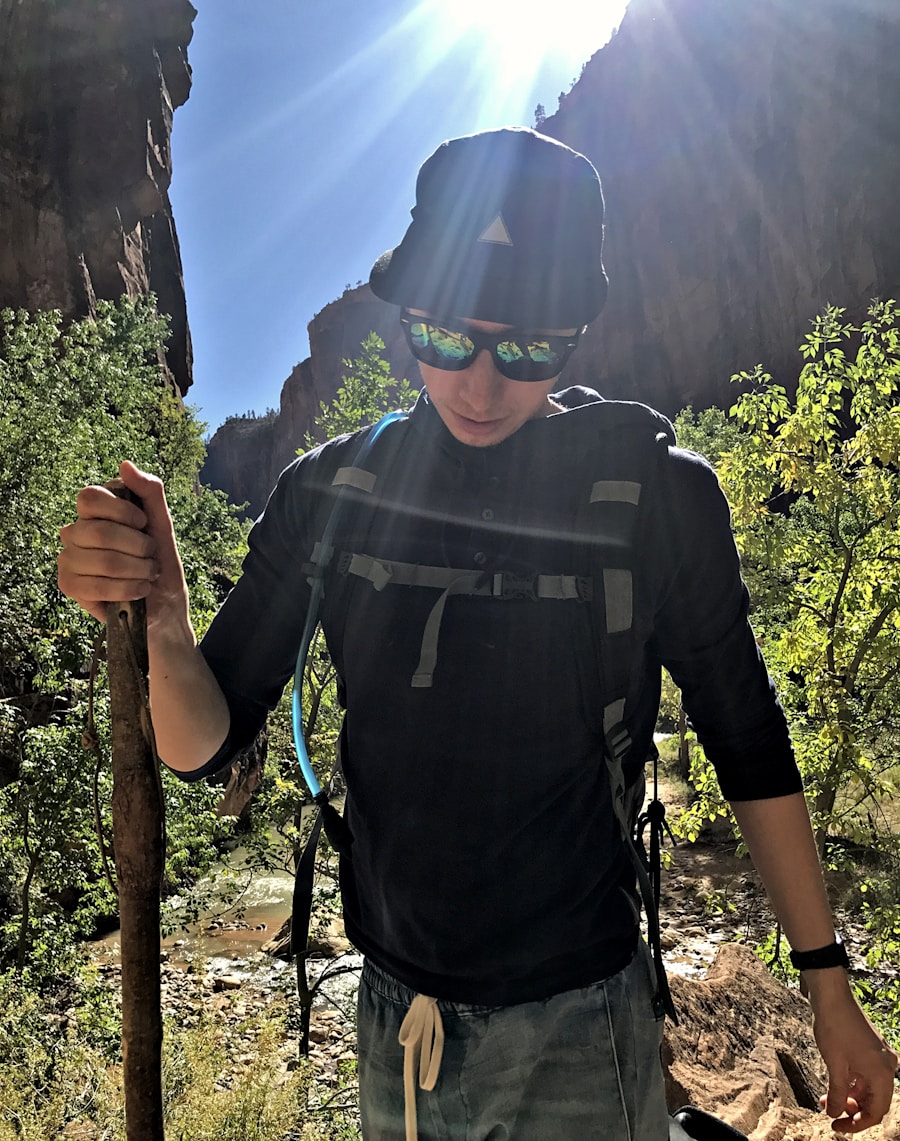
Good pole etiquette begins with controlling where the tips and handles go. On narrow trails, keep your poles close to your body when another person passes. Avoid swinging them sideways or planting a tip where another hiker is about to step.
When approaching someone from behind, announce yourself before passing. If you stop for a break, move to a safe durable area where permitted and keep your poles out of the travel path.
Take particular care around horses. National Park Service trail-etiquette guidance notes that horses may interpret equipment such as trekking poles as threatening. Yield to equestrians, remain calm, speak so the horse recognizes you as a person, and follow the rider’s instructions about where to stand or pass.
On narrow or crowded sections, carrying the poles together in one hand for a moment may be safer than continuing a wide arm swing.
Different Types of Hiking Poles
Telescoping trekking poles use two or three sliding shaft sections. They offer a broad adjustment range, which is useful when switching between level ground, climbs, descents, and traverses.
Folding poles break into several connected sections. Their main advantage is a short packed length, making them popular with trail runners, ultralight hikers, and travelers with limited luggage space.
Fixed-length poles eliminate adjustment mechanisms and can be simple and light, but they do not let you change length for terrain.
Hiking staffs are single poles rather than a matched pair. They are often best suited to moderate terrain where a hiker wants occasional balance support.
Poles designed for snow travel may use larger baskets to prevent deep sinking. Many trekking poles accept interchangeable baskets so one pair can be adapted to summer trails and snow.
Aluminum vs. Carbon Fiber
Aluminum shafts are generally durable and tend to bend before catastrophic failure under some types of overload. Carbon fiber can reduce weight and damp vibration well, but severe impact or bending can cause cracking or breakage. Neither material is automatically better for every hiker.
For rough backpacking or users who frequently wedge poles between rocks, durability may matter more than saving a few ounces. For long-distance hikers and trail runners, lower weight may be a higher priority.
Tips for Choosing and Using Hiking Poles
Start by deciding where you will use the poles. A casual day hiker, a winter snowshoer, an international traveler, and a long-distance backpacker may need very different features.
What to Look For
- Correct length: Make sure the adjustment range fits your height and allows a comfortable 90-degree elbow bend for general hiking.
- Secure locks: Lever-style or twist-style locks should remain tight throughout the hike and be easy for you to inspect and adjust.
- Comfortable grips: Cork, foam, and rubber each feel different with sweat, rain, gloves, and long days of use.
- Useful straps: Look for straps that can be adjusted without rubbing your wrists or hands.
- Appropriate baskets: Small trekking baskets work on ordinary trails; wider baskets are useful in snow or very soft ground.
- Replaceable tips: Replaceable components can extend the useful life of a pole.
- Packed length: Travelers should compare the collapsed or folded length with their luggage and airline restrictions.
- Weight versus durability: Choose based on your actual use instead of automatically buying the lightest model.
Basic Walking Technique
Walk naturally rather than forcing an exaggerated arm motion. A common rhythm is to plant the left pole with the right foot and the right pole with the left foot. This opposing pattern adds stability without making the poles dominate your stride.
On very steep terrain, planting both poles before a difficult step can add stability. Before relying on either pole, make sure the tip is planted securely and the shaft lock is holding.
On stream crossings, test the bottom before transferring weight. A pole tip can slide between rocks or sink unexpectedly into soft sediment, so never assume that a planted pole is secure until you feel the contact.
Pro Tip: Practice adjusting your poles, locks, straps, and folding mechanism at home. It is much easier to learn the system before you are standing on a steep trail in rain, wind, or cold weather.
Hiking poles are useful tools, not automatic protection against injury or fatigue. Used with sound technique, they can add stability, provide another way to manage demanding terrain, and make loaded or downhill hiking more comfortable for some people. Their benefits are greatest when pole length, placement, trail conditions, and individual comfort are considered together.
If you’re preparing for a spring hiking trip, waterproof footwear can help when trails are wet, compact binoculars can make wildlife viewing easier from a respectful distance, and portable power may be useful on longer trips. For more information about off-grid charging options, see this guide to the best solar chargers for backpacking.
Love travel? Join Our Facebook Community For More Tips.
Frequently Asked Questions
What are hiking poles?
Hiking poles, also called trekking poles, are lightweight poles normally used as a pair to add stability while hiking. Many models are adjustable or foldable and include wrist straps, interchangeable baskets, and carbide, steel, or rubber-covered tips.
Can you carry on hiking poles on a plane?
For flights departing through U.S. TSA checkpoints, blunt-tipped hiking poles are currently allowed in carry-on or checked baggage. Sharp-tipped hiking poles are not permitted in carry-on bags. The TSA officer makes the final checkpoint decision, and the airline must also accept the pole within its baggage rules.
Are there any regulations for carrying hiking poles on a plane?
Yes. Airport-security regulations determine whether a pole can pass through the passenger checkpoint, while the airline controls baggage dimensions, weight, and other acceptance rules. Regulations also vary by country. For example, current UK guidance requires walking and hiking poles to travel in hold luggage rather than hand luggage.
How should hiking poles be packed for air travel?
Collapse or fold the poles completely, protect the tips, secure loose sections, and place them inside a protective sleeve or your luggage. Sharp-tipped poles should be placed in checked baggage for U.S. departures. Expensive poles are best protected inside the suitcase instead of being strapped to the outside.
Can hiking poles be used as a carry-on item?
Possibly. In the United States, TSA permits blunt-tipped hiking poles through the checkpoint, but the packed poles must still meet the operating airline’s baggage requirements. Sharp-tipped poles cannot travel in U.S. carry-on baggage, and other countries may prohibit hiking poles from the cabin entirely.
Do rubber tip covers guarantee that hiking poles can go through TSA?
No. TSA distinguishes between blunt-tipped and sharp-tipped hiking poles but leaves the final checkpoint decision to the screening officer. Do not assume that placing a removable rubber cover over an otherwise sharp metal or carbide point guarantees carry-on acceptance. Checking the poles is the more conservative option when the underlying tip is sharp.
How long should trekking poles be?
For ordinary hiking, a good starting point is a pole length that leaves your elbow bent about 90 degrees with the tip on the ground beside your foot. For long climbs, shorten adjustable poles by roughly 5 to 10 cm. For long descents, lengthen them by about 5 to 10 cm and adjust further for comfort.
Sources
- Transportation Security Administration — Hiking Poles — U.S. carry-on and checked-baggage rules for blunt- and sharp-tipped hiking poles.
- GOV.UK — Hand Luggage Restrictions: Sports Equipment — UK hand- and hold-luggage rules for walking and hiking poles.
- REI Expert Advice — How to Use Trekking Poles — pole sizing, uphill/downhill adjustment, straps, baskets, tips, and walking technique.
- PubMed — Knee Joint Forces During Downhill Walking With Hiking Poles — evidence on knee-loading changes during downhill pole use.
- PubMed — Knee Joint Compression During Level Walking With Hiking Poles — evidence showing no reduction in knee compression during the tested level-walking conditions.
- Leave No Trace — The 7 Principles — guidance on durable surfaces, trail protection, natural objects, wildlife, and consideration of other visitors.

