
Last Updated on July 30, 2026 by Daniel Globe
Hilton is not owned by one hotelier, the Hilton family, or a private equity firm. The Hilton name and hotel system are controlled by Hilton Worldwide Holdings Inc., a publicly traded company. However, most buildings carrying a Hilton brand are owned by independent real-estate investors, developers, companies, or other third parties.
Quick Answer
Hilton Hotels is part of Hilton Worldwide Holdings Inc., which trades on the New York Stock Exchange under the ticker HLT. Public shareholders own the corporation. Hilton owns and licenses its hotel brands, but independent property owners own most Hilton-branded hotel buildings and operate them under franchise or management agreements.
Key Takeaways
- Hilton Worldwide Holdings Inc. controls the Hilton brands, reservation system, loyalty program, and hotel-management platform.
- Hilton Worldwide is publicly traded, so its shareholders collectively own the company; no disclosed shareholder owns a controlling majority.
- Most Hilton-branded buildings are owned by third parties rather than Hilton itself.
- As of June 30, 2026, Hilton reported 9,453 system properties: 8,525 franchised or licensed, 882 managed, and 46 in its ownership segment.
- The Hilton family, Blackstone, Park Hotels & Resorts, and Hilton Grand Vacations do not control Hilton Worldwide today.
Disclosure: As an Amazon Associate I earn from qualifying purchases. Some links on this page are affiliate links, at no extra cost to you.
Who Owns Hilton Hotels?
Hilton Worldwide Holdings Inc. is the parent company behind Hilton Hotels & Resorts and the broader Hilton portfolio. The corporation owns or controls the intellectual property, trademarks, reservation channels, Hilton Honors loyalty platform, operating systems, and contracts associated with its brands.
Hilton Worldwide Holdings Inc. is listed on the New York Stock Exchange under the ticker symbol HLT. Its shares are owned by public-market investors, including individuals, mutual funds, pension funds, investment advisers, company executives, and other institutions.
Note: The owner of the Hilton brand is not necessarily the owner of a specific Hilton hotel building. A property can have one real-estate owner, a separate franchisee, and another company responsible for daily management.
| Hilton brands and operating platform | Controlled by Hilton Worldwide Holdings Inc. and its subsidiaries. |
| Hilton Worldwide shares | Owned collectively by public shareholders who buy and hold HLT stock. |
| Most Hilton hotel buildings | Owned by independent developers, real-estate companies, investment funds, REITs, family businesses, or other third parties. |
| Hotel operations | Handled by a franchisee, Hilton under a management contract, or another approved management company, depending on the property. |
The Founder of Hilton Hotels
Conrad Nicholson Hilton was born on December 25, 1887, in San Antonio in what was then the New Mexico Territory. He developed early business experience while working in his father’s general store and later served in World War I.
In 1919, Hilton traveled to Cisco, Texas, intending to buy a bank. When that deal did not proceed, he bought the 40-room Mobley Hotel instead. The busy property rented rooms to oil workers in shifts, showing Hilton the earning potential of a well-run hotel.
The Mobley was Hilton’s first hotel purchase, but it was not originally named a Hilton. The first hotel formally carrying the Hilton name was the Dallas Hilton, which opened in 1925. Hilton designed the building with guest comfort in mind, placing elevators, laundry chutes, and other non-guest facilities along the west side to shield rooms from the intense afternoon sun.
Conrad Hilton’s approach combined property investment, standardized service, centralized systems, and a belief that hotels could offer dependable hospitality in many destinations. Those ideas helped shape the company that later became Hilton Worldwide.
The Growth and Expansion of Hilton
Hilton grew through a combination of hotel purchases, new construction, management agreements, franchising, brand development, and corporate transactions. Several dates in Hilton’s history help explain how the present ownership model developed:
- 1919: Conrad Hilton purchased the Mobley Hotel in Cisco, Texas.
- 1925: The Dallas Hilton became the first hotel formally carrying the Hilton name.
- 1943: Purchases in New York helped Hilton become the first coast-to-coast hotel group in the United States.
- 1946: Hilton Hotels Corporation was formed and soon entered the public stock market.
- 1947: The Roosevelt Hilton in New York became the first hotel identified by Hilton as installing televisions in guest rooms.
- 1949: Hilton International began with the opening of the Caribe Hilton in Puerto Rico, and Conrad Hilton acquired the original Waldorf Astoria in New York.
- 1954: Hilton purchased Statler Hotels for $111 million, then described as the largest real-estate transaction of its kind.
- 1959: The San Francisco Airport Hilton helped pioneer the modern airport-hotel concept.
- 2007: Affiliates of Blackstone acquired Hilton and took the company private.
- 2013: Hilton returned to the public markets, with HLT shares beginning to trade in December.
- 2017: Hilton separated much of its hotel real estate and timeshare business into Park Hotels & Resorts and Hilton Grand Vacations.
- 2018: Blackstone’s affiliated funds sold and distributed their remaining Hilton shares, ending their beneficial ownership position.
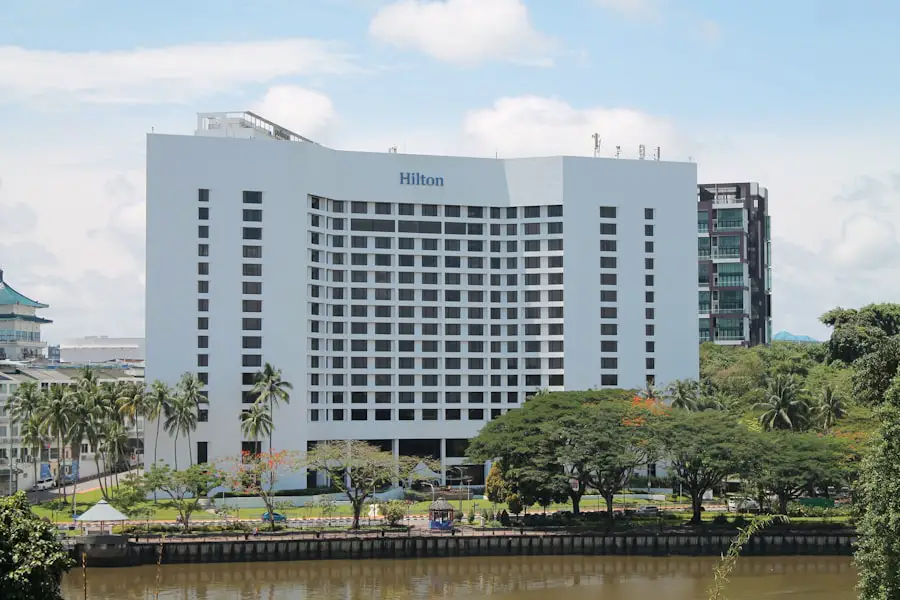
Hilton also expanded by adding brands designed for different types of guests and hotel owners. Its portfolio now ranges from luxury and full-service hotels to focused-service, extended-stay, lifestyle, collection, and economy brands. This broad portfolio allows owners to select a Hilton concept that matches a property’s market, size, location, and expected room rate.
The Current Ownership Structure of Hilton Worldwide
Hilton Worldwide Holdings Inc. is a public corporation rather than a family-owned hotel company. Anyone who owns HLT shares owns a small equity interest in the parent company. Shareholders elect directors, vote on designated corporate matters, and may receive dividends when Hilton’s board declares them.
No single investor disclosed in Hilton’s recent filings owned more than half of the company. This means Hilton does not have one controlling majority owner.
Major Reported Hilton Shareholders
Shareholder percentages are dated snapshots rather than permanent allocations. Investors can buy or sell shares, Hilton can repurchase shares, and investment firms can reorganize how holdings are reported.
| Reported holder | Reported ownership snapshot |
| BlackRock, Inc. | 8.4% in Hilton’s 2026 proxy, based on a Schedule 13G/A filed January 21, 2026. |
| Vanguard Capital Management | 7.49% as of March 31, 2026, according to its post-reorganization Schedule 13G filing. |
| Christopher J. Nassetta | 2.0% as of March 20, 2026, including qualifying shares, trusts, LLC holdings, and vested options described in Hilton’s proxy. |
Note: Vanguard reorganized how its business units report beneficial ownership in 2026. Older figures for “The Vanguard Group” should not be combined with newer figures reported separately by Vanguard Capital Management or other units.
Who Owns the Hilton-Branded Hotel Buildings?
Independent owners hold most of the real estate in Hilton’s system. Hilton’s asset-light model focuses mainly on brand licensing, reservations, loyalty services, technology, marketing, and hotel management rather than owning every building.
According to Hilton’s quarterly filing for June 30, 2026, its system was divided as follows:
| Operating relationship | Hilton system count on June 30, 2026 |
| Franchised or licensed | 8,525 properties, about 90.2% of the system. This total included timeshare properties and strategic partner hotels. |
| Managed for third-party owners | 882 properties, about 9.3% of the system. |
| Hilton ownership segment | 46 properties with 15,286 rooms, about 0.5% of the system by property count. |
| Total system | 9,453 properties containing 1,384,842 rooms. |
Only 46 of Hilton’s 9,453 system properties were included in its ownership segment on June 30, 2026. Most Hilton-branded hotels were franchised, licensed, or managed for third-party owners.
Franchised Hilton Hotels
At a franchised hotel, the property owner or franchisee receives permission to use a Hilton brand and participate in Hilton’s reservation, marketing, technology, quality-assurance, and loyalty systems. The franchisee pays fees and must follow the applicable brand standards.
Hilton states that it does not own, manage, or operate its franchised properties. The franchisee or its chosen management company handles daily operations and hotel employees.
Hilton-Managed Hotels
At a managed hotel, a third party normally owns the building while Hilton operates the property under a management contract. Hilton may provide the general manager, operating procedures, revenue management, staffing support, sales systems, and other services. The owner funds the property and pays management fees under the contract.
Hotels in Hilton’s Ownership Segment
Hilton also reports a small ownership segment that includes hotels it leases or holds through qualifying ownership interests. These properties represent only a small fraction of its worldwide system.
The Role of Hilton Shareholders
Hilton shareholders do not normally make daily hotel decisions. Their formal influence comes mainly through voting rights attached to their shares.
Shareholders can vote on matters such as director elections, executive-compensation proposals, auditor ratification, and qualifying shareholder proposals. Hilton’s board oversees corporate strategy and appoints senior leadership, while executives manage the company’s operations.
Large institutional investors may discuss governance, performance, risk, executive pay, capital allocation, or other issues with the company. However, owning shares in Hilton Worldwide is different from owning the land or building used by an individual Hilton-branded hotel.
The Influence of Major Investors
Investment managers such as BlackRock and Vanguard-related entities commonly hold shares on behalf of funds and investment clients. Their reported positions can give them meaningful voting power, but the underlying economic interests may be spread across many fund investors.
Institutional investors may vote on directors and other proposals, communicate with Hilton’s board or investor-relations team, and adjust their investment positions. Their influence is therefore primarily corporate and financial. It does not mean that these firms personally operate Hilton hotels or own every property carrying a Hilton sign.
Activist investors could seek changes if they accumulated a meaningful position, but the original article provided no evidence of a current activist campaign at Hilton. Predictions about restructuring or leadership changes should not be presented as fact without a specific filing or announcement.
The Management Team of Hilton Worldwide
Christopher J. Nassetta is Hilton’s president and chief executive officer. He has led the company since 2007 and is responsible for Hilton’s overall strategy, brand platform, growth, and relationships with hotel owners and shareholders.
Hilton’s wider management team includes executives responsible for finance, development, operations, brands, commercial services, human resources, technology, legal affairs, and regional business units. The board of directors provides oversight, while the executive team handles day-to-day corporate leadership.
At the property level, responsibility depends on the hotel’s contract. A Hilton-managed property may have Hilton-employed or Hilton-directed leadership, while a franchised property may be managed by the owner or an independent hotel-management company.
How Ownership Affects Hilton’s Operations
Hilton’s ownership model affects how the company earns money and how its hotels operate. Franchised properties generally pay royalty and program fees. Managed properties pay base management fees and may also pay incentive management fees based on performance.
This structure allows Hilton to expand without purchasing every hotel building. It also means the company depends on hotel owners to finance construction, renovations, furniture, staffing, maintenance, and many property-level expenses.
Hilton protects its brands through hotel-approval procedures, design reviews, property-improvement plans, operating standards, training, reservation systems, and quality inspections. A franchise can be terminated if an owner fails to pay required fees or repeatedly violates contractual brand standards.
Guests may therefore encounter differences between properties even when the hotels share the same Hilton brand. Building age, ownership budgets, local management, renovation cycles, staffing, and regional regulations can all affect the experience.
Hilton’s Branding and Marketing Strategy
Hilton’s portfolio contains 28 brands serving different price levels, trip purposes, and development needs. The company’s brands include luxury, lifestyle, full-service, focused-service, all-suites, extended-stay, collection, and economy offerings.
The Hilton Honors loyalty program connects those brands through one points system, member benefits, booking channels, and digital tools. The broader network can help participating hotel owners attract members who already recognize and use Hilton’s brands.
Hilton also supports properties through global advertising, sales, revenue-management tools, reservation technology, mobile check-in, Digital Key, training, and quality-assurance programs. Franchisees and managed-hotel owners pay fees that help fund many of these shared services.
Does the Hilton Family Still Own Hilton?
The Hilton family does not control Hilton Worldwide Holdings Inc. today. Conrad Hilton founded the hotel business, and later generations played important roles in its development, but the modern parent company is publicly owned.
Members of the Hilton family remain associated with the family’s history and philanthropy, including the separate Conrad N. Hilton Foundation. That charitable foundation is not the owner of Hilton Worldwide.
Does Blackstone Still Own Hilton?
No. Blackstone-affiliated funds acquired Hilton in 2007 and took it private. Hilton returned to the public market in 2013, after which Blackstone gradually reduced its position.
In May 2018, Hilton announced that Blackstone-affiliated selling shareholders would dispose of their remaining shares through sales, a Hilton repurchase, and distributions to their partners. The announcement stated that Blackstone and its affiliated funds would no longer beneficially own Hilton common stock after the transactions.
Blackstone executive Jonathan D. Gray serves as chairman of Hilton’s board, but his board role does not mean Blackstone currently owns or controls Hilton Worldwide.
Are Park Hotels & Resorts and Hilton Grand Vacations Part of Hilton?
Park Hotels & Resorts and Hilton Grand Vacations are separate publicly traded companies. Hilton completed their spin-offs in January 2017, creating three independent companies:
- Hilton Worldwide Holdings Inc.: The hotel-brand, franchise, licensing, and management company trading as HLT.
- Park Hotels & Resorts Inc.: A lodging real-estate company trading as PK that owns hotel properties, including some carrying Hilton brands.
- Hilton Grand Vacations Inc.: A timeshare company trading as HGV that uses Hilton-related branding under a long-term licensing relationship.
Hilton stated that it retained no ownership interest in Park or HGV at the time of the spin-offs, although commercial agreements continued between the companies.
How to Find the Owner of a Specific Hilton Hotel
A Hilton sign alone usually does not reveal the building’s legal owner. To investigate a particular property:
- Identify the exact property name and street address. Similar Hilton brands may have several hotels in the same city.
- Search the local property-assessor or land-record database. The recorded owner may be a hotel-specific limited liability company.
- Check the state or national business registry. Search the legal entity to identify its registered address, managers, or parent company where publicly available.
- Review public-company filings. If a hotel is owned by a listed REIT or hospitality company, its annual report may name the property.
- Ask the property directly. The hotel may be able to identify its ownership or management company, although front-desk employees may not have that information.
Pro Tip: Search separately for the property owner, franchisee, and management company. One LLC may own the building while a different hospitality company employs the staff and operates the hotel.
The Future of Hilton’s Ownership Model
Hilton’s present model is heavily weighted toward franchise, licensing, and management agreements. This approach allows the company to grow its brand network while property owners supply most of the real-estate investment.
Future percentages will change as hotels open, close, convert brands, change owners, or move between franchise and management arrangements. Hilton may also buy, lease, sell, or restructure individual property interests when management believes doing so supports the company’s strategy.
Changes in shareholder ownership are also normal for a public company. Large investment managers can move above or below reporting thresholds, and Hilton’s share-repurchase activity can change each investor’s percentage even when that investor does not trade.
Claims that Hilton will adopt a specific new ownership model, merge with another company, or enter a particular joint venture should be treated as speculation unless Hilton confirms the development through an official announcement or SEC filing.
Hilton’s Global Presence and Impact
Hilton currently describes itself as a global hospitality company with 28 brands, more than 9,400 properties, nearly 1.4 million rooms, and a presence in 144 countries and territories. Its June 30, 2026 SEC filing reported an exact system total of 9,453 properties and 1,384,842 rooms.
The network supports hotel owners, employees, suppliers, and tourism businesses in many markets. The economic and community impact of an individual property depends partly on who owns it, who manages it, how it purchases goods and services, and how it works with local organizations.
Hilton also promotes environmental and community programs through its Travel with Purpose strategy. Because most properties are owned by third parties, progress across the network requires cooperation among Hilton, hotel owners, franchisees, management companies, employees, suppliers, and guests.
If you are planning a Hilton stay, practical packing choices can also make the trip easier. Review this guide to the best travel toothbrushes, or visit TakeTravelInfo for more travel tips and recommendations.
Frequently Asked Questions
Who owns Hilton Hotels?
Hilton Hotels & Resorts is part of Hilton Worldwide Holdings Inc. Public shareholders collectively own the parent company, which trades on the New York Stock Exchange under the ticker HLT.
Does the Hilton family still own Hilton?
The Hilton family does not control Hilton Worldwide Holdings Inc. today. The company is publicly owned, although the family remains connected to the Hilton legacy and the separate Conrad N. Hilton Foundation.
Does Blackstone own Hilton?
No. Blackstone-affiliated funds took Hilton private in 2007 but disposed of their remaining Hilton shares in 2018 after Hilton returned to the public market.
Who owns individual Hilton hotel buildings?
Most Hilton-branded buildings are owned by independent hotel companies, developers, investment groups, REITs, or property-specific LLCs. Hilton may franchise the brand or manage the hotel for that owner.
How many hotels does Hilton actually own?
Hilton reported 46 properties in its ownership segment on June 30, 2026. Its total system contained 9,453 properties, meaning the great majority were franchised, licensed, or managed for third-party owners.
Is Hilton a franchise?
Hilton uses franchising extensively, but it is not exclusively a franchise company. Its system also includes hotels managed for third-party owners, licensed properties, strategic partner hotels, timeshare properties, and a small ownership segment.
Are Hilton Grand Vacations and Park Hotels owned by Hilton?
No. Park Hotels & Resorts and Hilton Grand Vacations became independent publicly traded companies through Hilton’s January 2017 spin-offs. They continue to have commercial relationships with Hilton.
Who is the CEO of Hilton?
Christopher J. Nassetta is the president and chief executive officer of Hilton Worldwide Holdings Inc. He has led Hilton since 2007.
Sources
- Hilton Q2 2026 Form 10-Q — current property totals, room totals, and franchised, managed, and ownership-segment counts.
- Hilton 2026 Proxy Statement — disclosed major shareholders, executive ownership, voting, and corporate governance.
- Hilton 2025 Form 10-K — business model, franchise agreements, brand standards, management contracts, and ownership structure.
- The Story of Hilton — official company timeline and historical milestones.
- Hilton Company Management — current executive leadership and CEO information.
- Hilton’s 2017 Spin-off Announcement — separation of Hilton, Park Hotels & Resorts, and Hilton Grand Vacations.
