
Last Updated on September 10, 2026 by Daniel Globe
Hiking with a partner can make a day on the trail safer, easier to manage, and more enjoyable. Good teamwork means more than simply walking beside another person. Partners need to communicate, match the route to the abilities of the group, share responsibilities, watch for changing conditions, and know what they will do if something goes wrong.
Quick Answer
Hiking with a partner gives you another person to help with navigation, notice hazards, share appropriate group tasks, provide encouragement, and respond during an emergency. The biggest benefits come when partners plan together, stay together, match the pace to the slower hiker, carry essential gear, and agree on what to do if they become separated.
Key Takeaways
- Hiking with a partner can add useful support, but it does not replace good planning, proper gear, or sound judgment.
- Agree on the route, pace, turnaround time, regroup points, and emergency plan before starting.
- Stay together and use the slower hiker’s comfortable pace to help keep the group from spreading out.
- Share appropriate group tasks, but make sure each hiker has essential food, water, clothing, and emergency supplies.
- Open communication, mutual respect, and shared decisions can strengthen trust and make difficult situations easier to manage.
Disclosure: As an Amazon Associate I earn from qualifying purchases. Some links on this page are affiliate links, at no extra cost to you.
Why Teamwork Matters on an Outdoor Adventure
Outdoor conditions can change quickly. A trail may become harder than expected, weather may deteriorate, someone may develop a blister or injury, or the group may reach a junction that is not obvious on the map. A partner gives you another set of eyes and another person with whom to assess the situation.
Each hiker may also bring different strengths. One person may be comfortable reading a map while another is better at noticing weather changes, organizing gear, preparing food, or treating minor injuries. Used well, those different skills can make a team more adaptable.
Teamwork also affects morale. A difficult climb or a long return to the trailhead can feel more manageable when hikers encourage one another and make decisions together. Shared challenges can deepen trust and turn an ordinary hike into a memorable experience.
Communication and Coordination on the Trail
Effective teamwork starts before anyone takes the first step. Hiking partners should talk openly about what they expect from the trip rather than assuming they have the same goal.
Agree on the Plan Before You Start
Discuss the route, total distance, elevation gain, expected weather, trail difficulty, approximate pace, breaks, and a turnaround time. Everyone should understand whether the goal is a relaxed nature walk, a fast workout, a summit attempt, photography, or something else.
The National Park Service Hike Smart guidance recommends choosing a trail that everyone in the group can complete safely and leaving a trip plan with a trusted person who is not joining the hike.
Preventing Misunderstandings
Simple, direct communication helps prevent small problems from growing. Tell your partner when you need water, food, a clothing change, a slower pace, or a short break. Speak up early if you notice pain, dizziness, unusual fatigue, worsening weather, navigation uncertainty, or another concern.
Non-verbal cues also matter. A partner who has become unusually quiet, starts stumbling, falls far behind, or repeatedly stops may need help even if they have not asked for it.
Coordination and Task Distribution
A well-coordinated team can divide appropriate tasks according to experience and preference. One member might check the map while another watches the weather. At camp, one person may organize shelter while another prepares a meal or filters water.
Sharing responsibilities reduces the chance that one person becomes overloaded. It also gives less-experienced hikers opportunities to practice useful outdoor skills under the guidance of someone more experienced.
Use Regroup Points
Partners should not disappear around corners or through trail junctions without knowing where the other person is. Agree to regroup at intersections, creek crossings, major obstacles, viewpoints, or any place where the route could become confusing.
The National Park Service advises hiking groups to stay together and specifically recommends letting the slowest hiker help set the group’s pace.
Pro Tip: Before leaving the trailhead, agree on three things: where you will regroup, what time you will turn around, and what each person should do if you become separated. A two-minute conversation can prevent a great deal of confusion later.
Sharing Responsibilities and Skills
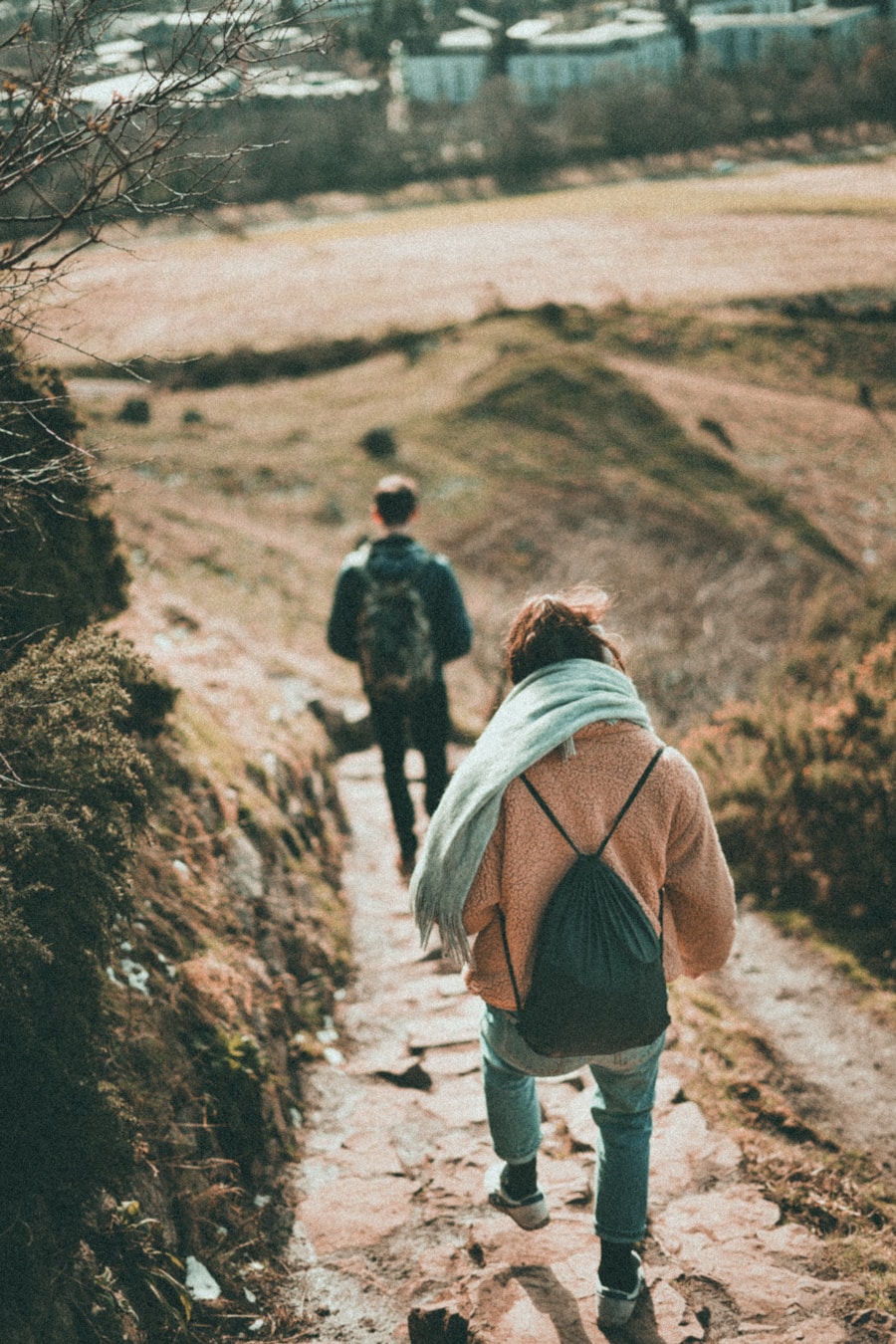
Sharing responsibilities gives each person a meaningful role. During a camping trip, one hiker might organize meals while another sets up the tent. On a day hike, one person may monitor navigation while the other keeps track of time and changing conditions.
That does not mean one person should carry every critical item for the pair. Equipment such as a shelter or cooking system may sometimes be divided between hikers, but each person should still have enough basic equipment to cope with an unexpected delay or brief separation.
The National Park Service Ten Essentials cover navigation, sun protection, insulation, illumination, first aid, fire, repair tools, food, hydration, and emergency shelter. The exact equipment required will vary with the route, season, weather, duration, and remoteness.
Note: Sharing group gear can reduce duplicated weight, but do not make one backpack the only source of essentials for everyone. Each hiker should have personal water, food, necessary medications, weather protection, and other critical items appropriate to the trip.
Skill sharing is another major benefit of hiking with a partner. A novice hiker can learn navigation, campsite selection, pacing, or outdoor cooking from someone with more experience. A partner with first-aid training can also teach useful preparedness skills.
The exchange should work both ways. Even an experienced hiker may learn something from a newer partner who brings knowledge of local plants, photography, technology, fitness, weather, or another specialty. Over time, this creates a stronger and more capable team.
Overcoming Trail Challenges Together
| Trail Challenge | Team Response |
| Different hiking speeds | Slow the group to a sustainable pace, keep the slower hiker from being isolated, and regroup regularly. |
| Unexpected bad weather | Pause, assess conditions together, add appropriate layers or rain protection, and use the agreed turnaround or alternate plan when needed. |
| Navigation uncertainty | Stop rather than continuing blindly, compare navigation information, identify the last known location, and make a deliberate decision before moving. |
| Injury or illness | Stop the activity, assess the person’s condition, provide care within your training, keep the person protected from the environment, and seek emergency help when necessary. |
| Disagreement about continuing | Put safety ahead of the summit or destination. Discuss the concern calmly and choose an option that keeps the group together and within everyone’s abilities. |
The outdoors can test both physical endurance and judgment. When a storm interrupts a hike, for example, the group may need to decide whether to turn around, wait in a safer location, or use an alternate route that was identified beforehand.
A partner can help with the decision by noticing details you may have missed and by providing emotional support when stress makes clear thinking more difficult. The goal is not to push one another through every obstacle. Good teamwork also means knowing when to stop.
Warning: Do not let “safety in numbers” create false confidence. A group can still become lost, injured, dehydrated, hypothermic, or trapped by dangerous conditions. Do not continue simply because several people are present, and do not depend on a mobile phone having service in remote terrain.
Successfully managing a difficult situation can build confidence and resilience. A hard ascent, river crossing, or unexpected route change becomes a shared experience from which the group can learn. Afterward, discussing what worked and what did not can improve future trips.
Building Trust and Camaraderie
Trust grows when hiking partners consistently look out for one another. A person who checks whether everyone has enough water, waits at a junction, offers help with a heavy pack, or speaks honestly about a problem shows that the team’s well-being matters more than reaching a destination quickly.
That trust also makes communication easier. A hiker is more likely to admit that a knee hurts, that the pace is too fast, or that a steep section feels unsafe when the group has created an atmosphere where concerns are taken seriously.
Camaraderie often develops through shared experiences. Difficult trails, changing weather, camp meals, scenic viewpoints, and the satisfaction of reaching a goal together give partners stories to remember. These experiences can deepen existing friendships and create strong new connections.
Safety in Numbers: The Benefits of Hiking With a Partner
A Partner Adds Another Layer of Support
One clear benefit of hiking with a partner is that another person is present to notice a problem and provide assistance. If one hiker slips, becomes ill, develops heat-related symptoms, or has trouble continuing, the other person can help assess the situation and seek assistance when appropriate.
The National Park Service advises hikers in many parks to travel with another person and keep the hiking party together. However, this should be treated as an additional layer of protection rather than a guarantee of safety.
Immediate Support During an Emergency
A hiking partner may be able to provide basic first aid, keep an injured person warm, identify the group’s location, communicate with emergency services, or seek help when doing so is safe and necessary.
Preparation matters before the emergency happens. The American Red Cross hiking first-aid guidance recommends tailoring a first-aid kit to factors such as the number of people, terrain, climate, remoteness, trip duration, and individual medical needs. First-aid knowledge is just as important as carrying supplies.
Collaborative Vigilance
Partners can watch for hazards such as loose footing, difficult stream crossings, wildlife, heat stress, rapidly changing weather, or a missed junction. A second person may notice something the first person overlooked.
At the same time, everyone should remain personally responsible for awareness and preparation. Do not assume that another person is tracking the route, carrying all emergency equipment, or watching every hazard unless those responsibilities have been discussed.
A strong hiking team does not move at the speed of its fastest member. It stays together, communicates early, and makes decisions that everyone in the group can safely manage.
Hiking Partner Checklist Before You Leave
A short planning conversation can make teamwork much easier once you are on the trail.
- Choose an appropriate route: Match distance, terrain, elevation, and technical difficulty to the least-experienced or least-conditioned member of the group.
- Check current conditions: Review weather, trail alerts, closures, fire restrictions, water availability, and other local hazards.
- Agree on the goal: Decide whether the priority is distance, a summit, sightseeing, photography, exercise, or simply enjoying time outside.
- Set a turnaround time: Decide when you will turn back even if the destination has not been reached.
- Discuss pace: Plan to use a sustainable pace that keeps the group together.
- Choose regroup points: Stop at trail junctions, crossings, and other locations where separating could cause confusion.
- Review emergency communication: Know whether cell coverage is likely and consider an appropriate backup communication device for remote trips.
- Leave a trip plan: Tell a trusted person where you are going, who is with you, your route, and when you expect to return.
- Review critical medical information: Partners should know about information that could matter in an emergency, such as serious allergies or where necessary medication is carried.
- Check essential equipment: Make sure both hikers have appropriate food, water, navigation, clothing, lighting, first-aid supplies, and other gear required by the conditions.
The National Park Service Trip Planning Guide recommends preparing for emergencies, staying together when traveling as a group, and using the buddy system if someone must leave the group.
What to Do If You Get Separated From Your Hiking Partner
Even careful groups can become separated. One person may stop without telling the other, miss a junction, move ahead too quickly, or lose sight of the group in poor visibility. Planning for this possibility is much easier than improvising after it happens.
- Prevent separation first. Stay within practical communication distance and wait at junctions or confusing sections.
- Use your prearranged plan. Follow the meeting-point or separation procedure you agreed on before the hike.
- Avoid wandering without a plan. If you are genuinely lost and cannot confidently determine your location, unnecessary movement can make it harder for others to find you.
- Use navigation tools carefully. Check your map, compass, GPS, landmarks, and last known position before deciding to move.
- Signal when appropriate. A whistle can carry farther than a voice and uses less energy.
- Get emergency help when necessary. If a person is missing and the circumstances create a genuine safety concern, contact park staff, 911, or the appropriate local emergency service when communication is available.
Current NPS trip-planning guidance warns that separation can lead to becoming lost or injured and recommends using the buddy system if someone must leave the group.
Managing Different Hiking Paces and Goals
Different speeds are one of the most common sources of tension between hiking partners. A faster person may become frustrated by frequent stops, while the slower person may feel pressured to push beyond a comfortable pace.
The safest answer is usually not to make the slower person chase the faster person. Instead, choose a pace that the group can maintain together. On longer hikes, the faster hiker can carry an appropriate share of group equipment or simply accept that a partnership changes the pace of the day.
Goals can differ too. One person may want to reach a summit while another is satisfied with a viewpoint halfway up. Discuss those expectations before the trip and agree that safety concerns can override the original destination.
When a disagreement develops on the trail, stop and discuss the actual risk rather than arguing about who is tougher or more experienced. Weather, remaining daylight, water, fatigue, injury, terrain, and the return distance are more useful decision factors than pride.
Group Size, Trail Etiquette, and Leave No Trace
Teamwork also includes reducing the group’s effect on other visitors and the environment. Larger groups can occupy more trail space, create more noise, and have a greater impact around campsites and rest areas.
Leave No Trace guidance on planning ahead recommends learning local regulations, preparing for hazards and weather, and visiting in small groups or dividing larger parties when appropriate.
Stay on established or durable surfaces where required, respect posted group-size limits, keep noise reasonable, yield according to local trail rules, and avoid blocking the trail when the group stops.
Good trail teamwork should benefit your own party without making the experience worse for everyone around you.
Celebrating Success as a Team
Celebrating an achievement is an important part of a shared adventure. Reaching a summit, completing a difficult route, making it back before an approaching storm, or simply finishing a first hike together can be worth acknowledging.
A celebration does not need to be elaborate. Take a photo at a viewpoint, share a favorite trail snack, enjoy a meal after the hike, or talk about the best part of the day.
Those moments reinforce the feeling that the achievement belonged to the team. They can also build motivation for future trips because each person remembers what the group accomplished together.
The Long-Term Impact of Teamwork on Outdoor Adventures
Teamwork can influence far more than one outing. Partners who learn how to communicate, make conservative decisions, divide responsibilities, and solve problems together often become more efficient on later trips because they understand one another’s strengths and limitations.
The lessons can also carry into everyday life. Listening, adapting plans, admitting when something is wrong, staying calm under pressure, and supporting another person are useful skills on and off the trail.
Most importantly, hiking together can turn an individual pursuit into a shared experience. The best partnerships are not built by pushing everyone toward the same destination at any cost. They are built through communication, preparation, mutual respect, and the willingness to put the well-being of the group ahead of a summit or mileage goal.
Note: The same planning mindset can help when a trip involves unfamiliar rules or complications beyond the trail. For example, travelers with prior legal issues may need to research entry requirements well before departure. Our guide to traveling to Europe with a DUI covers those travel-specific considerations.
Frequently Asked Questions
What are the benefits of hiking with a partner?
A hiking partner can provide companionship, encouragement, another set of eyes for navigation and hazards, help with appropriate shared tasks, and assistance when an injury or other problem occurs. These benefits are strongest when both people stay together and prepare properly.
How can hiking with a partner enhance safety?
A partner may notice hazards, navigation mistakes, illness, fatigue, or changing conditions that you miss. They may also be able to provide first aid or seek help during an emergency. Hiking with someone does not eliminate risk, so both people still need appropriate skills, equipment, and an emergency plan.
What are some tips for effective communication while hiking with a partner?
Discuss the route, pace, turnaround time, breaks, regroup points, and emergency plan before leaving. On the trail, tell your partner early when you are tired, hurt, uncertain about the route, low on water, uncomfortable with the terrain, or concerned about weather.
How can hiking with a partner provide motivation?
Partners can encourage each other during difficult climbs, long distances, or uncomfortable weather and can make training and trip planning feel more social. Encouragement should never become pressure to continue when someone feels unsafe, injured, or unable to proceed comfortably.
What are some potential challenges of hiking with a partner?
Common problems include different hiking speeds, fitness levels, risk tolerance, trail preferences, break schedules, and goals. Partners can reduce conflict by discussing expectations beforehand and agreeing that the group will adjust when conditions or someone’s well-being require it.
How can hiking with a partner create a sense of connection?
Sharing effort, solving problems, experiencing scenic places, and supporting one another can strengthen relationships. The conversations and memories created on a hike may also give partners a stronger reason to plan future outdoor adventures together.
Who should set the pace when hiking in a group?
Use a pace that keeps the group together rather than making slower hikers continually catch up. National Park Service guidance recommends letting the slowest hiker help set the pace and keeping the hiking party together.
What should hiking partners do if they get separated?
Follow the separation plan established before the hike. Check your last known location and navigation tools, avoid wandering without a clear reason, use agreed meeting points or signaling methods, and contact emergency services or park staff when a missing partner creates a genuine safety concern.
Should hiking partners share all their gear?
Some group equipment can be divided to reduce duplicate weight, but each person should retain essential personal items appropriate to the trip. Do not put all water, food, medications, weather protection, illumination, or other critical supplies in one person’s pack.
Sources
- National Park Service — Hike Smart — group pacing, staying together, trip planning, weather preparation, and emergency communication.
- National Park Service — Trip Planning Guide — staying together, buddy-system guidance, emergency planning, and trip plans.
- National Park Service — Ten Essentials — basic equipment categories for hiking and unexpected emergencies.
- Leave No Trace — Plan Ahead and Prepare — responsible trip preparation, group size, regulations, weather, and minimizing outdoor impact.
- American Red Cross — Hiking & Backpacking First Aid Kit — first-aid preparedness for different group sizes, terrain, remoteness, and trip conditions.

