
Last Updated on September 11, 2026 by Daniel Globe
The .30-06 Springfield can handle deer, elk, target shooting, and many other sporting uses, but it does not have one fixed effective range. Your real limit depends on the exact ammunition, rifle, zero, weather, shooting position, target, and your ability to place a shot under field conditions. Factory charts are useful starting points, but you must confirm the results with your own rifle.
Quick Answer
A practical .30-06 effective range is usually much shorter than the distance the bullet can travel. With a 200-yard zero, representative 150- and 180-grain factory loads drop about 22 to 24 inches at 400 yards. Your hunting limit ends where accurate shot placement, safe conditions, and reliable bullet performance can no longer be confirmed.
Key Takeaways
- The .30-06 does not have one universal effective range for deer, elk, or target shooting.
- Bullet weight alone does not determine range. Muzzle velocity, ballistic coefficient, construction, and atmospheric conditions also matter.
- Current factory examples show about 22 to 24 inches of drop at 400 yards and about 45 to 48 inches at 500 yards with a 200-yard zero.
- Energy figures such as 1,000 or 1,500 ft-lbs are rough reference points, not universal guarantees of an ethical result.
- Confirm your final zero and actual trajectory at the range before relying on a manufacturer’s chart in the field.
Warning: A rifle bullet can travel far beyond your intended target. Fire only at an approved range or in a lawful location with a safe backstop. Positively identify the target, check the complete line of fire, and know what is in front of and beyond it.
Disclosure: As an Amazon Associate I earn from qualifying purchases. Some links on this page are affiliate links, at no extra cost to you.
What Is the .30-06 Effective Range?
The term effective range can mean several different things. Separating those meanings prevents misleading answers.
- Maximum projectile range: The total distance a bullet may travel before it reaches the ground. This is much farther than a responsible hunting shot.
- Mechanical accuracy range: The distance at which a rifle, optic, ammunition, and rest can produce an acceptable group.
- Target-shooting range: The distance at which a trained shooter can make repeatable hits on a defined target.
- Terminal-performance range: The distance at which the bullet still has the impact velocity and construction needed to expand or penetrate as designed.
- Personal hunting range: The farthest distance at which you can reliably place a shot in the vital area from realistic field positions under current conditions.
The final definition is the one that matters most when hunting. Hunter-education guidance recommends practicing on an approximately 8-inch target and limiting shots to the range at which you can hit it consistently from the positions you expect to use.
The cartridge may remain capable at a distance where the shooter, conditions, or bullet performance no longer support a responsible shot.
Factors That Change Effective Range
Your practical distance can change even when the cartridge name stays the same. Important variables include:
- The exact bullet and factory load
- Bullet weight and ballistic coefficient
- Bullet construction and required impact velocity
- Actual muzzle velocity from your barrel
- Scope height and zero distance
- Temperature, altitude, air pressure, and shooting angle
- Wind speed and direction
- Range-estimation error
- The steadiness of your shooting position
- The size, angle, and movement of the target
Federal’s published ballistics tables warn that calculated trajectories represent nominal performance under stated test conditions. Actual results can change with the firearm, ammunition, sights, altitude, and weather. That is why a catalog chart should guide your range work rather than replace it.
How Bullet Weight Changes .30-06 Distance
Bullet weight affects recoil, muzzle velocity, retained energy, penetration, and trajectory, but weight does not act alone. A lighter bullet normally starts faster. A heavier bullet may have greater sectional density and can retain more energy, but it may also begin slower and show more drop.
The bullet’s ballistic coefficient is equally important. It describes how well the projectile resists aerodynamic drag. A high-BC 165- or 175-grain bullet may retain velocity better than a lower-BC 180-grain bullet, while a streamlined 150-grain bullet may shoot flatter than a heavier design over normal hunting distances.
Representative 150- and 180-Grain Factory Data
The following examples come from the 2025 Winchester centerfire-rifle ballistics table. Both use Copper Impact bullets and a 200-yard long-range zero. The figures are factory estimates, not guaranteed results from every rifle.
| Measurement | 150-Grain Copper Impact | 180-Grain Copper Impact |
|---|---|---|
| Muzzle velocity | 2,920 fps | 2,725 fps |
| Velocity at 400 yards | 2,031 fps | 2,010 fps |
| Energy at 400 yards | 1,373 ft-lbs | 1,615 ft-lbs |
| Trajectory at 400 yards | -21.9 inches | -23.9 inches |
| Trajectory at 500 yards | -44.8 inches | -48.1 inches |
This comparison shows why “heavier bullets go farther” is too simple. The 150-grain example shoots slightly flatter, while the 180-grain bullet carries substantially more energy at 400 yards. A different bullet shape or factory load could change the comparison again.
Choosing a Bullet Weight
- 125 to 150 grains: Often chosen when a flatter short- to medium-range trajectory or lighter recoil is useful. The bullet must still be designed for the intended game.
- 150 to 165 grains: Common general-purpose choices for deer-sized game and mixed hunting use.
- 165 to 180 grains: Often selected for larger game because many designs provide useful sectional density, penetration, and retained energy.
- 200 to 220 grains: Specialized loads that may offer deep penetration but normally produce more recoil and a more curved trajectory.
Note: A bullet’s construction matters as much as its weight. Match bullets, full-metal-jacket bullets, varmint bullets, and controlled-expansion hunting bullets of the same weight can behave very differently after impact.
.30-06 Hunting Range for Deer and Elk
The .30-06 has enough flexibility for both deer and elk when paired with a suitable hunting bullet, but the cartridge name does not establish an ethical distance.
Deer Hunting Range
For deer, choose an expanding bullet that the ammunition manufacturer recommends for deer-sized game. Then establish the farthest distance at which you can repeatedly hit an approximately 8-inch target from kneeling, sitting, prone, or supported field positions.
A bench group alone does not prove field capability. Your hunting limit may be much shorter when wind, cold, uneven ground, excitement, low light, or an unstable rest affect the shot.
Elk Hunting Range
Elk are larger and demand careful bullet selection and precise placement. Many hunters choose 165- or 180-grain controlled-expansion bullets, but the bullet maker’s intended-use guidance and impact-velocity requirements matter more than weight alone.
A commonly repeated rule suggests retaining about 1,500 ft-lbs for elk, but that number is not a universal law or guarantee. Bullet construction, impact velocity, penetration, shot angle, and placement determine whether the load can perform properly.
The Winchester examples above show why blanket claims fail. Its listed 150-grain load falls below 1,500 ft-lbs at 400 yards, while the 180-grain version remains above it. Other 150- or 180-grain loads can produce different results.
Personal Hunting Range Checklist
Before taking a longer shot, confirm all of the following:
- You have positively identified the legal game animal.
- The shooting angle exposes an appropriate vital area.
- The animal is still rather than running.
- You know the distance rather than estimating it loosely.
- You have a stable field rest.
- You know your load’s actual point of impact at that distance.
- The bullet remains within its intended impact-performance range.
- You can account for the current wind.
- The complete line of fire and backstop are safe.
- You have repeatedly demonstrated the required accuracy in practice.
When any item is uncertain, move closer or do not take the shot.
Can a .30-06 Be Used for Self-Defense?
A .30-06 rifle can be used lawfully in some defensive circumstances, but a typical hunting rifle is generally a poor choice for home defense. It is long, loud, powerful, and capable of penetrating walls and continuing beyond the intended area.
There is no credible universal “60 ft-lbs” or “260 ft-lbs” threshold that predicts whether a person will be stopped. Defensive outcomes cannot be reduced to one energy number, and long-range ballistic capability does not make a firearm more suitable for protecting a home.
Anyone keeping a firearm for protection should understand local law, obtain qualified training, plan for safe access, and prevent children or other unauthorized people from reaching it. Project ChildSafe provides secure-storage guidance and firearm safety resources.
.30-06 Bullet Drop at 400 Yards
With a 200-yard zero, many common .30-06 hunting loads are approximately 20 to 25 inches below the line of sight at 400 yards. The current Winchester examples above measure about 21.9 inches low for the 150-grain load and 23.9 inches low for the 180-grain load.
At 500 yards, those same examples are about 44.8 and 48.1 inches low. This is far more than the 6- or 7-inch figures sometimes repeated in inaccurate trajectory summaries.
What Changes Bullet Drop?
- Zero distance: A 200-yard zero produces less apparent drop at 300 to 500 yards than a 100-yard zero.
- Muzzle velocity: A faster bullet normally reaches the target sooner, giving gravity less time to act.
- Ballistic coefficient: A streamlined bullet loses velocity more slowly.
- Sight height: The distance between the optic and bore changes the calculated path relative to the line of sight.
- Atmosphere: Altitude, temperature, pressure, and humidity affect air density and drag.
- Shooting angle: A steep uphill or downhill shot requires a different correction than a level shot.
Wind should be treated as a separate correction. Gravity produces vertical drop, while a crosswind mainly moves the bullet horizontally. At longer distances, even a small error in wind speed or direction can move the impact outside the vital area.
100-Yard Versus 200-Yard Zero
A 100-yard zero is simple to confirm and works well for woods, short fields, and ranges where longer targets are unavailable. It normally requires more elevation correction at 300 to 500 yards.
A 200-yard zero is common for open-country hunting because it reduces the required holdover at medium distance. However, the bullet may strike above the line of sight between 100 and 200 yards, so you must confirm the complete trajectory before hunting.
Pro Tip: Print or record a trajectory card for the exact ammunition lot you use, then replace the predicted figures with impacts measured from your own rifle.
How to Zero a .30-06 for Longer Shots
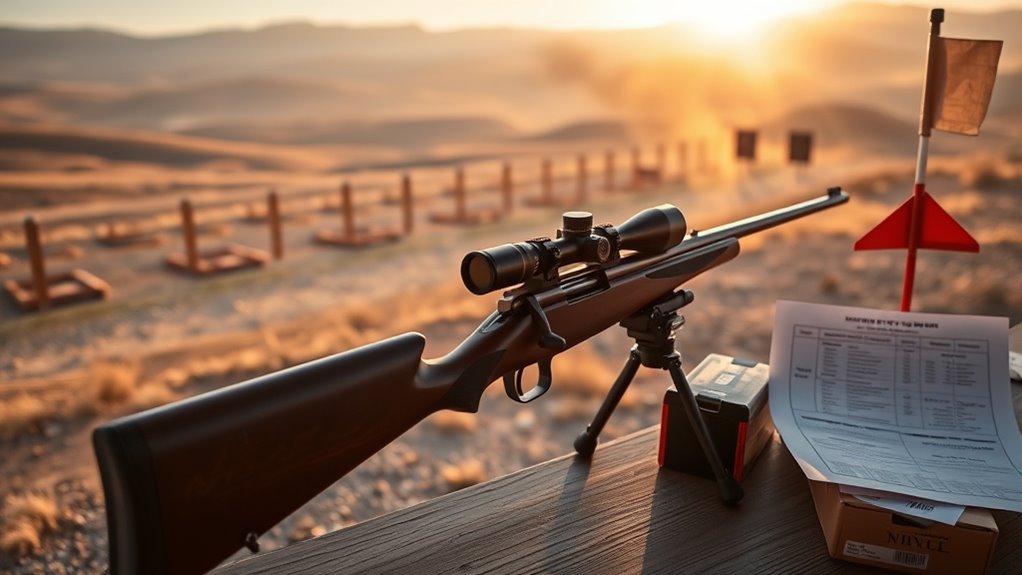
A reliable zero begins with a safe range, correctly mounted optic, stable rest, and the exact ammunition you plan to use. A close target can help you get on paper, but the final zero must be confirmed at the selected distance.
At a Glance
| Time Required | About 45 to 90 minutes for initial sight-in and confirmation |
| Difficulty | Moderate; basic rifle and scope familiarity required |
| Tools Needed | Eye and ear protection, stable rest, targets, correct ammunition, scope manual, and binoculars or a spotting scope |
| Cost | Varies with range fees and the amount of ammunition required |
1. Inspect the Rifle and Ammunition
Confirm that the barrel marking matches the ammunition. Check that the scope base and rings are secure according to the manufacturer’s instructions. Do not continue if the rifle, mount, optic, or ammunition appears damaged.
2. Set Up at a Safe Range
Wear eye and ear protection. Use a stable bench or rest, a clear target, and an approved backstop. Keep the muzzle pointed in a safe direction and keep your finger outside the trigger guard until you are ready to fire.
3. Get on Paper at Close Range
Start at about 25 yards if needed. This is a preliminary check, not the final zero. Fire a careful group and adjust the optic until the group is close enough to the aiming point to move the target farther away safely.
4. Confirm at 100 Yards
Move to 100 yards and fire a three-shot group from a stable rest. Measure the center of the group rather than adjusting from one shot. Follow the optic maker’s directions to move the point of impact.
The Winchester sight-in guide recommends starting close, making measured adjustments, and then confirming performance at the intended zero distance and beyond.
5. Establish the Final Zero
For a 100-yard zero, center the group at 100 yards. For a 200-yard zero, use the ammunition maker’s predicted 100-yard offset only as a starting point, then confirm the rifle at a true 200 yards.
Do not assume that being a certain number of inches high at 100 yards automatically creates a perfect 200-yard zero. Scope height, velocity, bullet design, and rifle differences can change the result.
6. Confirm at Longer Distances
After establishing the zero, fire at 300 yards and any farther distance you may use. Record the actual elevation and wind corrections. If you cannot keep every careful shot within your chosen target area, that distance is beyond your current personal limit.
7. Record Your Results
Write down the ammunition brand, product name, bullet weight, lot number, zero distance, temperature, altitude, group size, and measured impacts. Recheck the zero after changing ammunition, removing the optic, striking the rifle, or making major equipment changes.
Frequently Asked Questions
How Far Can a .30-06 Shoot Accurately?
There is no single accuracy limit. A suitable rifle and target load may produce repeatable hits at long range, but hunting range is normally much shorter. Your practical limit is the farthest distance at which you can consistently hit the required target from realistic field positions while maintaining safe conditions and suitable bullet performance.
Why Have Military Snipers Used .308 or 7.62 NATO Instead of .30-06?
Military cartridge selection involves ammunition standardization, logistics, rifle size, recoil, magazine design, weapon reliability, and mission needs. The .308 is not universally flatter than the .30-06. Modern military precision rifles also use several other cartridges. The current U.S. Army MK22, for example, supports 7.62 mm, .300 Norma Magnum, and .338 Norma Magnum configurations.
What Range Should I Zero My .30-06?
A 100-yard zero is simple and practical for shorter hunting distances. A 200-yard zero can reduce holdover at medium range and is often useful in open country. Choose the zero that matches your normal conditions, then confirm the actual trajectory at 100, 200, 300, and any farther distance you may use.
How Far Does a .30-06 Bullet Drop at 500 Yards?
It depends on the load and zero. In Winchester’s 2025 table, its 150-grain Copper Impact load is about 44.8 inches low at 500 yards with a 200-yard zero, while the 180-grain version is about 48.1 inches low. Your rifle may produce different results, so confirm the trajectory at the range.
Is a .30-06 Suitable for Elk at 400 Yards?
Some .30-06 hunting loads may retain suitable velocity and energy at 400 yards, while others may not. The answer also depends on bullet construction, shot angle, wind, range certainty, and your field accuracy. Do not treat cartridge name or energy alone as permission to take the shot.
Does a Heavier .30-06 Bullet Always Have a Longer Effective Range?
No. A heavier bullet may retain more energy and penetrate deeply, but it often starts slower and may drop more. Ballistic coefficient, bullet shape, muzzle velocity, construction, and the required terminal performance determine the useful range together.
Conclusion
The .30-06 remains a versatile hunting and target cartridge, but its effective range cannot be reduced to one number. A current factory example shows roughly 22 to 24 inches of drop at 400 yards with a 200-yard zero, yet another load may differ. Choose ammunition designed for the intended use, verify its real trajectory, practice from field positions, and keep every shot within your proven accuracy and safety limits.
Sources
- Winchester 2025 Centerfire Rifle Ballistics — 150- and 180-grain .30-06 velocity, energy, and trajectory examples.
- Federal Premium Rifle Ballistics — load variation, test conditions, trajectory, velocity, and energy data.
- Winchester: Step-by-Step Instructions to Sight in Your Rifle — safe preliminary and final sight-in process.
- Hunter-ed: Know Your Accuracy Limits — field-practice and personal effective-range guidance.
- NSSF Project ChildSafe — secure firearm storage and safety education.
- U.S. Army MK22 Precision Sniper Rifle — current multi-caliber military precision-rifle context.
