
Last Updated on August 29, 2026 by Caleb Warren
Disclosure: As an Amazon Associate, we earn from qualifying purchases. If you click a link on this page and make a purchase, we may receive a small commission at no extra cost to you.
Giving a paper airplane real power and smartphone control sounds simple, but the experience depends on stability, range, battery life, and how easy the aircraft is to recover after a rough landing. The POWERUP 4.0 Paper Airplane Kit combines a lightweight twin-motor flight module with Bluetooth phone control, automatic stabilization, and aerobatic flight modes. It is especially appealing if you enjoy paper airplanes, RC flying, hands-on STEM activities, or experimenting with different airframe designs. Its main tradeoffs are a learning curve, a roughly 10-minute battery runtime, and the need for plenty of open flying space.
Quick Verdict
Rating: 8/10, Recommended with caveats
Best For: Paper-airplane fans, hobby pilots, tinkerers, families, and STEM activities
Bottom Line: POWERUP 4.0 turns lightweight paper and compatible model aircraft into controllable powered planes with useful stabilization and app-based flight tools. It is rewarding once you learn the launch and control technique, but you need a large outdoor area and should expect short flying sessions between charges.
| Specification | Detail |
|---|---|
| Brand | POWERUP |
| Model | POWERUP 4.0 |
| Product Type | Smartphone-controlled paper airplane propulsion and flight-control kit |
| Module Weight | 19 g |
| Maximum Advertised Speed | Up to 20 mph |
| Advertised Control Range | Up to 230 ft on the current Amazon listing |
| Flight Time | Up to about 10 minutes per full charge |
| Charging Time | Approximately 25–30 minutes |
| Connectivity | Bluetooth |
| Phone Compatibility | POWERUP 4.0 app for iOS and Android |
| Flight Assistance | Onboard flight computer, autopilot assistance, gyro/accelerometer stabilization, and launch assist |
| Motors | Two high-speed motors |
| Compatible Airframes | Paper airplanes and compatible lightweight foam or balsa designs within manufacturer limits |
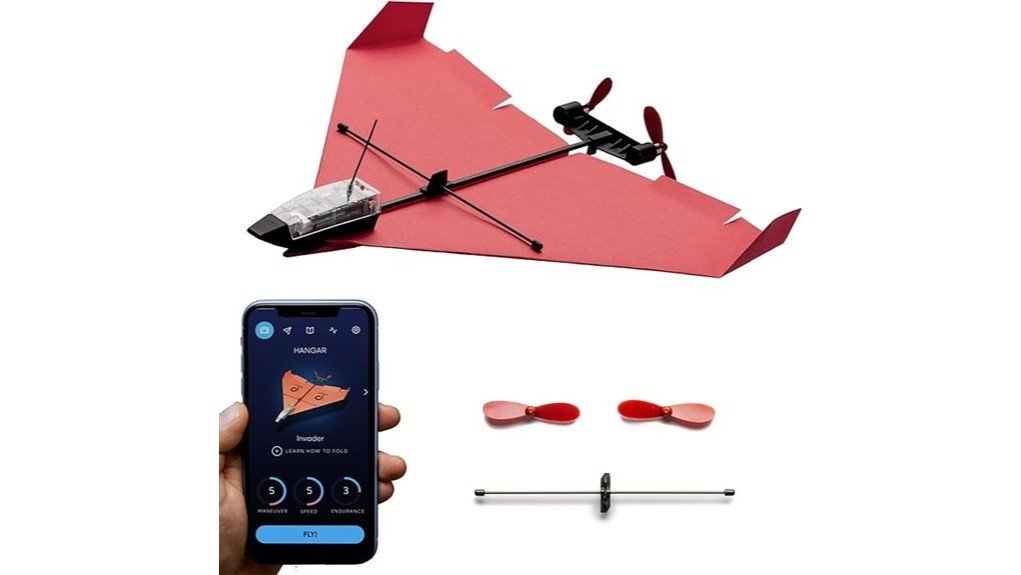
| Included Accessories | Twin-motor Bluetooth module, 4 paper templates, Micro USB charging cable, crossbar, spare propeller set, trim card, and user guide |
| Warranty | Manufacturer states 12 months for the product and 6 months for the battery |
| Best Use | Outdoor recreational flying, paper-plane experimentation, hobby use, and STEM activities |
What Is the POWERUP 4.0?
The POWERUP 4.0 is a motorized flight module that attaches to a paper airplane or another compatible lightweight airframe. Instead of simply throwing your paper plane and watching it glide, you use a smartphone to control thrust and direction while the onboard electronics help stabilize the aircraft.
The module weighs only 19 grams and uses two high-speed motors. POWERUP also equips it with an onboard flight computer, autopilot assistance, gyro and accelerometer sensing, and smartphone flight analytics. The result is closer to a small RC aircraft experiment than a traditional disposable paper airplane.
Our assessment is based on current Amazon and manufacturer specifications plus published hands-on testing. It should be treated as an editorial buying assessment rather than a claim that our team independently laboratory-tested this exact unit.
Who Should Buy It?
Best For
- You enjoy paper airplanes and want more control than a normal hand launch provides.
- You want a hands-on way to explore aerodynamics, wing design, thrust, drag, and stability.
- You enjoy RC aircraft but like the low-cost experimentation possible with replaceable paper airframes.
Skip If
- You only have a small yard, crowded park, or indoor room available for flying.
- You want long continuous RC sessions without stopping to recharge.
- You prefer a ready-to-fly aircraft that requires little folding, trimming, or experimentation.
Before You Buy: POWERUP 4.0 can travel quickly and has an advertised range of up to 230 feet, so a small backyard is not ideal. Use a large, clear flying area away from roads, people, trees, power lines, animals, and other obstacles.
Unboxing, Build Quality, and Included Parts
The standard POWERUP 4.0 kit includes the twin-motor Bluetooth module, four paper airplane templates, a Micro USB charging cable, crossbar, spare propeller set, trim card, and user guide. That gives you the core parts needed to begin experimenting without purchasing a separate transmitter.
The flight unit is designed to survive the sort of rough landings that naturally happen while learning. POWERUP describes carbon-fiber construction and reinforced components, while the availability of replacement parts makes minor damage less likely to end your use of the entire system.
The paper portion is naturally less durable than the powered module. A hard landing can wrinkle or tear a paper airframe even when the electronics remain usable, but you can fold another compatible plane instead of replacing an entire RC aircraft.
Flight Performance, Stability, and Tricks
The POWERUP 4.0 is advertised to reach speeds of up to 20 mph, which is quick for such a lightweight aircraft. The current Amazon listing gives it a control range of up to 230 feet. Real range can be lower because Bluetooth performance depends on your phone, interference, surroundings, and aircraft orientation.
Its onboard flight computer, launch assist, and gyro-based stabilization are designed to make flight more manageable than simply attaching motors to paper. These systems can reduce sudden instability and help you correct imperfect launches, although they do not remove the need to learn how your particular plane design behaves.
Acro Mode adds loops, barrel rolls, and hammerhead-style maneuvers. These tricks make the system more interesting after you have mastered basic straight flight and turns, but they also require more space and more precise control.
Pro Tip: Learn basic level flight before experimenting with Acro Mode. A well-folded, properly trimmed plane in a large open field gives you more room to understand how throttle, turns, and airframe design affect the flight path.
Battery Life and Charging
POWERUP rates the 4.0 for up to about 10 minutes of flight time from a full charge. A full recharge takes roughly 25 to 30 minutes through the supplied Micro USB charging cable.
Ten minutes sounds brief compared with many electronic toys, but an individual paper-plane flight may last much less than the entire battery cycle. You will often spend part of the session retrieving the aircraft, checking the paper airframe, adjusting trim, and preparing another launch.
Heavy throttle use can consume the available battery more quickly. If long uninterrupted RC sessions are your priority, the recharge cycle is one of the POWERUP 4.0’s more important limitations.
Connectivity and App Features
The POWERUP 4.0 connects to your smartphone over Bluetooth and uses the POWERUP app for iOS or Android. Instead of carrying a dedicated RC transmitter, you use your phone to control the plane.
| Feature | What It Does |
|---|---|
| Flight Log | Helps you record and review your flights. |
| Flight Analytics | Displays flight information such as heading, thrust, and turn data. |
| Leaderboard | Lets you compare flight performance with other users. |
| Folding Guidance | Provides access to different paper-airplane designs. |
| Acro Mode | Supports advanced maneuvers such as loops and barrel rolls. |
The app is one reason POWERUP 4.0 has more educational value than a basic motorized paper plane. You can change an airframe, repeat the flight, and use the recorded information to understand how your changes affected performance.
Setup Tips Before Your First Flight
A good first flight starts before you launch. Give yourself time to charge the module fully, install the POWERUP app, pair the aircraft, and fold a straightforward paper-plane design before experimenting with unusual wing shapes.
- Start with a proven template. Learn the controls before testing extreme paper-plane designs.
- Check symmetry. Uneven wings or folds can make the aircraft pull strongly to one side.
- Inspect the motor unit. Make sure the module, crossbar, and propellers are correctly positioned before launch.
- Use a large field. The plane can cover distance quickly, particularly at higher throttle.
- Begin with basic turns. Save Acro Mode for after you can launch, climb, turn, and recover consistently.
- Keep your phone ready. Launching with one hand while operating a touchscreen with the other takes practice.
How It Performs in Real Use
For a Beginner Flying Session
The stabilization and launch-assist features give beginners more help than a basic powered paper airplane, but there is still a learning curve. Your fold quality, launch technique, trim, wind, and throttle control all affect the outcome. Expect the first few flights to be part of the learning process.
For Aerobatics
Once you are comfortable with normal turns, Acro Mode gives the POWERUP 4.0 considerably more replay value. Loops and barrel rolls let you move beyond straight-line flying, although these maneuvers should be attempted only where you have enough open space to recover from mistakes.
For STEM Experiments
This is one of the kit’s strongest uses. You can alter wing shapes, folds, weight distribution, or compatible lightweight airframes and compare how each design handles lift, drag, thrust, gravity, stability, and turns. That makes the aircraft useful for supervised classroom projects as well as family experimentation.
For Travel and Portable Hobbies
The powered module itself is extremely light, and paper airframes can be folded almost anywhere. That makes the system easier to pack than a large RC airplane. You still need a suitable open destination for flying, and the paper aircraft should be protected from crushing while stored.
Educational Benefits and STEM Learning
The POWERUP 4.0 is more than a powered toy because its behavior changes when you change the aircraft around it. Different wing configurations give you a practical way to observe basic aerodynamic principles instead of only reading about them.
You can use experiments to explore:
- Lift: How wing shape and airspeed help keep the aircraft in the air.
- Drag: How different shapes resist movement through the air.
- Thrust: How the twin motors move the aircraft forward.
- Gravity: How weight and balance influence climbing and gliding.
- Stability: How wing symmetry, trim, and the onboard electronics affect the flight path.
POWERUP also promotes the platform for educational use, and its flight-log capability makes repeated experiments more useful. You can modify one factor, fly again, and compare the result instead of relying only on memory.
Safety and Responsible Flying
The POWERUP 4.0 uses fast-spinning propellers and can reach up to 20 mph, so you should treat it as a powered RC aircraft rather than an ordinary paper toy. Keep fingers, hair, loose clothing, and other objects away from the propellers while the motors are active.
Fly away from people, animals, traffic, buildings, overhead wires, and restricted airspace. Younger users should follow the current manufacturer’s age guidance and use the product with appropriate adult supervision.
The stabilization system can help in imperfect or breezy conditions, but this does not mean the electronics are waterproof. Avoid rain, standing water, and wet grass when moisture could reach the flight module. Follow the supplied manual and any local rules that apply to powered model aircraft in your area.
Pros and Cons
Pros
- Very light 19 g flight module.
- Smartphone control works with supported iOS and Android devices.
- Autopilot assistance and gyro stabilization help manage flight.
- Acro Mode adds loops, barrel rolls, and more advanced flying.
- Paper-airframe experimentation gives it genuine STEM and hobby value.
Cons
- The roughly 10-minute battery runtime requires regular charging breaks.
- You need a large open area because the aircraft can travel quickly and cover significant distance.
- Good results still require practice with folding, trimming, launching, and touchscreen control.
Is It Worth the Price?
The POWERUP 4.0 sits closer to a specialized hobby and STEM product than a basic paper-airplane toy. You are paying for the reusable motor module, Bluetooth control, stabilization electronics, app features, replacement-part ecosystem, and ability to experiment with many inexpensive airframes.
It offers stronger value if you enjoy testing designs instead of flying the same ready-made aircraft every time. The reusable electronics can move from one suitable airframe to another, which gives the system more long-term experimentation potential than a single fixed paper plane.
It is less compelling if your priority is maximum flight time or effortless ready-to-fly operation. Buyers who want long RC sessions with minimal setup may prefer a conventional rechargeable RC airplane.
How It Compares to Alternatives
The POWERUP 2.0 is the simpler same-brand concept if you want a more basic powered paper-airplane experience. Buyers interested in the 4.0 electronics but a different aircraft format can also compare POWERUP’s 4.0 F-22, balsa, and other compatible kits.
The standard POWERUP 4.0 reviewed here makes the most sense when your priority is flexibility. Its main appeal is being able to take the same smartphone-controlled propulsion system and experiment with different paper and lightweight aircraft designs.
Frequently Asked Questions
What types of aircraft can you use with POWERUP 4.0?
It is designed primarily for paper airplanes, but POWERUP also states that the 4.0 can support compatible lightweight foam and balsa models within its weight limits. Start with one of the supplied paper templates until you understand how the module handles.
How long does POWERUP 4.0 fly on one charge?
The advertised flight time is up to about 10 minutes per full charge. Actual runtime can vary with throttle use, aircraft design, weather, and how aggressively you fly.
How long does the POWERUP 4.0 take to charge?
A full charge takes approximately 25 to 30 minutes under the manufacturer’s specifications. The standard kit includes a Micro USB charging cable.
How far and how fast can POWERUP 4.0 fly?
The current Amazon listing advertises speeds up to 20 mph and a control range up to 230 feet. Real-world range can be shorter because Bluetooth interference, your smartphone, wind, and surrounding obstacles affect the connection and flight path.
Can you fly POWERUP 4.0 in wind or rain?
Its stabilization system is intended to help deal with imperfect or breezy conditions, but that is not the same as verified waterproofing. Avoid rain and wet conditions, and use calmer weather while learning.
Are replacement parts available?
Yes. POWERUP currently lists replacement and spare-part accessories for the 4.0 platform. That is useful because propellers and other small components may eventually need replacement after repeated flying and crashes.
Is POWERUP 4.0 good for beginners?
It has beginner-friendly technology such as stabilization and launch assistance, but you should still expect some practice. Folding quality, trimming, launch technique, touchscreen control, and available flying space all affect your results.
The Bottom Line
The POWERUP 4.0 is a strong choice if you want to combine paper-airplane experimentation with smartphone-controlled RC flight and hands-on aerodynamics. Its lightweight motor module, stabilization system, Acro Mode, flight analytics, and reusable design give you plenty to explore after you master the basics.
You should skip it if you lack a large safe flying area or expect long continuous flight times. For hobbyists, families, tinkerers, and STEM-focused users who enjoy experimenting, the POWERUP 4.0 earns our 8/10, Recommended with caveats verdict.
