
Last Updated on August 29, 2026 by Caleb Warren
Disclosure: As an Amazon Associate, we earn from qualifying purchases. If you click a link on this page and make a purchase, we may receive a small commission at no extra cost to you.
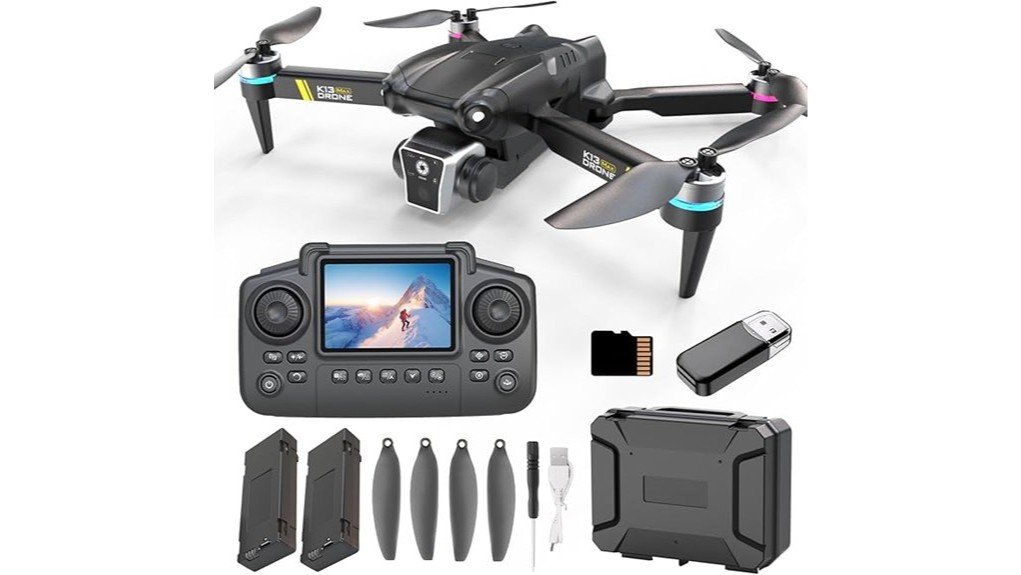
Learning to fly a camera drone can become frustrating when the controls feel complicated, the aircraft drifts easily, or you have to depend on a phone for every basic function. The Weavixol K13 MAX Drone aims to make those first flights easier with a screen-equipped controller, brushless motors, altitude hold, one-key takeoff and landing, and a lightweight 220-gram design. Its 1080p camera and two-battery bundle add useful flexibility for casual practice and aerial snapshots, but you should not expect GPS-level navigation or stabilized cinematic footage. This review explains what the K13 MAX does well, where its limits matter, and whether it fits the way you plan to fly.
Quick Verdict
Rating: 7/10, Recommended with caveats
Best For: First-time pilots who want simple controls, a built-in controller screen, and a compact practice drone.
Bottom Line: The K13 MAX gives you brushless motors, altitude hold, a listed 1080p camera, two batteries, and convenient beginner controls in a lightweight package. Its main tradeoff is that you should not treat it like a GPS camera drone with automatic return-to-home or advanced camera stabilization.
Key Specifications
| Specification | Detail |
|---|---|
| Brand | Weavixol |
| Model | K13 MAX |
| Product Type | Foldable beginner camera quadcopter |
| Listed Weight | 220 g / 7.8 oz |
| Listed Dimensions | 9.05 x 7.08 x 2.56 inches |
| Material | Plastic |
| Video Resolution | Listed as 1080p |
| Still Resolution | 8.84 MP listed effective resolution |
| Video / Image Formats | MP4 / JPEG |
| Motors | Brushless |
| Flight Batteries | Two rechargeable 1800 mAh lithium-ion batteries |
| Advertised Flight Time | About 12 to 15 minutes per battery depending on conditions and listing version |
| Listed Maximum Range | Up to 328 ft |
| Connectivity | Radio control plus Wi-Fi video connectivity |
| Controller | Remote controller with built-in display |
| Beginner Features | Altitude hold, one-key takeoff and landing, headless-mode-style beginner assistance, and trim controls |
| Included Basics | Drone, controller, batteries, propeller accessories, and USB charging cable; confirm the current package before ordering |
| Best Use | Beginner practice, casual aerial photos, and short recreational flights |
What Is the Weavixol K13 MAX Drone?
The K13 MAX is a lightweight, foldable camera quadcopter aimed mainly at beginners. At a listed 220 grams, it is easy to carry and less intimidating to handle than many larger camera drones. Its controller includes a built-in display, so you can access a camera view without making a phone the center of every basic flight.
The main attraction is the combination of brushless motors, altitude hold, one-key takeoff and landing, a 1080p-listed camera, and two 1800 mAh batteries. Those features give you a practical starter setup for learning throttle, direction, hovering, framing, and landing.
This is still an entry-level aircraft. No verified mechanical gimbal, advanced image stabilization, GPS navigation, or GPS-based automatic return-to-home was confirmed for this specific Weavixol listing. You should therefore keep expectations focused on practice and casual recording rather than long-range or cinematic flying.
Before You Buy: Do not choose the K13 MAX because you expect GPS-guided return-to-home or advanced obstacle sensing. Keep the drone close, maintain visual contact, and treat its listed 328-foot range as a technical maximum rather than a beginner flying target.
Who Should Buy It?
Best For
- First-time pilots who want one-key takeoff, altitude hold, and straightforward controls.
- Casual users who prefer a controller with its own display instead of relying entirely on a phone.
- Travelers or hobbyists who want a lightweight foldable drone for short practice sessions and basic aerial images.
Skip If
- You need GPS navigation, dependable automatic return-to-home, or long-distance flying.
- You expect stabilized 4K footage suitable for serious video production.
- You regularly fly in windy, wet, or demanding outdoor conditions.
Design and Build Quality
The K13 MAX uses a foldable plastic body and has a listed weight of 220 grams. That light construction helps with portability, especially when you want a drone that can fit into a small travel kit instead of requiring a large dedicated case.
Brushless motors are another useful feature at this level. Compared with simple brushed-motor toy drones, brushless designs are generally better suited to repeated use and smoother power delivery. You should still inspect the propellers and arms before each flight because a lightweight drone can be affected by minor propeller damage or misalignment.
The compact body also creates a tradeoff. A 220-gram aircraft has less mass to resist sudden wind changes than a larger drone, so calm conditions give you a much better learning environment.
Camera Capabilities
The K13 MAX is listed with 1080p video capture and an 8.84 MP effective still-photo resolution. Its camera is suitable for learning how aerial framing works, recording short clips, and taking casual photos from viewpoints you cannot reach from the ground.
The listing also identifies JPEG for still images and MP4 for video, both of which are easy to view and share on common devices. The wide viewing angle can help you fit more scenery into a frame while practicing basic composition.
You should keep the camera expectations realistic. There is no verified mechanical gimbal or comparable advanced stabilization system for this exact configuration. Movement, wind, quick turns, and vibration can therefore be more visible in footage than they would be with a higher-end stabilized camera drone.
Pro Tip: For cleaner-looking video, fly during calm weather, use slow stick movements, pause briefly before changing direction, and avoid rapid yaw turns while recording.
Flight Performance and Beginner Features
The K13 MAX focuses on controls that reduce the workload during your first few flights. Altitude hold helps the aircraft maintain a more consistent height after you settle the throttle, while one-key takeoff and landing removes some of the coordination needed during two of the most stressful parts of a beginner flight.
Brushless motors provide the thrust, and trim or calibration controls help you correct unwanted drift. These aids can make practice easier, but they do not turn the drone into a fully autonomous aircraft. Wind, poor calibration, damaged propellers, and signal conditions can still change how it behaves.
For your first flights, staying well inside the listed 328-foot maximum range is a smarter approach. Learning orientation is much easier when you can clearly see which direction the drone is facing.
Battery Life
The package is listed with two rechargeable 1800 mAh flight batteries. Available seller information for this version points to roughly 12 to 15 minutes of advertised flight time per battery, with actual results depending on wind, speed, maneuvering, recording, battery condition, and temperature.
That means the two batteries may give you roughly 24 to 30 minutes of combined practice under favorable conditions, but not 30 minutes of uninterrupted flight on a single battery. You need to land and change batteries between sessions.
A precise charging time for this exact ASIN was not consistently confirmed. Use the supplied charging equipment and follow the current manual or charging indicator rather than relying on the original article’s unsupported 5 to 6 hour estimate.
Control and Connectivity
One of the K13 MAX’s most useful beginner features is its remote controller with a built-in display. A screen on the controller reduces the amount of phone setup required for basic camera viewing and gives you a more self-contained flight experience.
The product is also listed with Wi-Fi connectivity. Some K13 MAX versions use a Wi-Fi connection for additional video or phone-based functions, so you should follow the instructions supplied with your exact package rather than assuming every similarly named K13 MAX operates identically.
For reliable control, perform the required pairing and calibration steps before takeoff. If the video feed disconnects, prioritize maintaining visual control of the aircraft rather than continuing to fly based only on the screen.
How It Performs in Real Use
For First-Time Practice
In an open, calm area, altitude hold and one-key takeoff can reduce the number of controls you have to manage at once. Start low and close, then practice hovering, gentle turns, forward movement, and landing before trying longer routes.
For Casual Aerial Photos
The 1080p-listed camera gives you enough resolution for recreational clips and social sharing. The lack of verified gimbal stabilization means the best results usually come from slow, deliberate movements rather than aggressive turns or fast flying.
For Parks and Open Outdoor Areas
The light 220-gram build is easy to carry to an appropriate flying location. Wind is the more important concern. If branches, grass, or flags are moving strongly, waiting for calmer conditions can make the aircraft easier to control.
For Travel and Storage
The folding design and lightweight body make the K13 MAX convenient for packing. Protect the propellers from bending during transport, keep batteries away from loose metal objects, and check the rules that apply to batteries and drones before airline travel.
Setup Tips Before Your First Flight
- Charge the flight batteries fully using the supplied charging equipment and follow the manual’s indicator instructions.
- Inspect every propeller for cracks, looseness, or bending before takeoff.
- Perform level calibration on a flat surface if the instructions call for it.
- Choose a large open area away from people, trees, traffic, power lines, and other obstacles.
- Begin in calm weather because a lightweight drone can drift more noticeably in wind.
- Keep the first flights short and close while you learn the controls and battery behavior.
- Land before the battery becomes critically low instead of using every last moment of advertised flight time.
Compatibility and Safety
No water-resistance rating was verified for the K13 MAX, so keep it dry and avoid flying in rain, wet snow, or conditions where moisture can enter the electronics. Do not touch moving propellers, and keep other people clear during takeoff and landing.
The listed 220-gram weight makes the drone relatively light, but weight alone does not remove your responsibility to follow local airspace and flight rules. Check the rules for the location where you plan to fly and maintain visual awareness of the drone throughout the flight.
You should also avoid treating a basic return-style control on similar K13 variants as equivalent to GPS return-to-home. For this specific Weavixol configuration, a verified GPS navigation system was not confirmed.
Pros and Cons
Pros
- Lightweight 220-gram listed design is easy to carry.
- Built-in controller display reduces reliance on a phone for basic viewing.
- Brushless motors are a useful feature for an entry-level practice drone.
- Altitude hold and one-key takeoff/landing make early flights easier to manage.
- Two included 1800 mAh batteries extend your total practice session.
Cons
- No verified GPS-based return-to-home for this configuration.
- No verified mechanical gimbal or advanced camera stabilization.
- Light construction makes calm weather especially important for beginners.
Is It Worth the Price?
The K13 MAX fits the entry-level, budget-oriented side of the camera-drone market by feature set. Its strongest value comes from combining a controller screen, brushless motors, beginner flight aids, a listed 1080p camera, and two batteries in one lightweight package.
It is worth considering if your main goal is to learn basic drone control without immediately investing in a more advanced GPS camera system. The second battery is particularly useful because it gives you another practice session after the first battery is depleted.
The value becomes less convincing if you mainly want polished aerial video, dependable GPS-assisted return, long transmission distances, or autonomous tracking. Those needs justify looking at a more advanced class of drone.
How It Compares to Alternatives
If you want a substantial step up in navigation and camera capability, the Potensic ATOM SE is worth comparing. It adds GPS-assisted return-to-home, electronic image stabilization, 4K recording, and much longer listed transmission capability, making it a better fit for buyers who prioritize serious outdoor camera use.
The DJI Neo is another lightweight option to compare if automated capture and a more developed flight ecosystem matter to you. The K13 MAX makes more sense when your priority is a simpler, lower-level practice drone with a screen controller and conventional stick flying rather than advanced positioning and automated shooting features.
Frequently Asked Questions
How long does the K13 MAX fly on one battery?
Available seller information for the relevant K13 MAX version advertises roughly 12 to 15 minutes per battery. Actual flight time can be shorter because wind, aggressive maneuvers, recording, temperature, and battery condition all affect runtime.
Do the two batteries provide 30 minutes of continuous flight?
No. The two batteries can extend your combined flying session, but you must land and replace the battery between flights. Treat any 24 to 30 minute figure as combined advertised runtime under favorable conditions, not one uninterrupted flight.
How long does a K13 MAX battery take to charge?
A reliable charging time for this exact Weavixol ASIN was not consistently confirmed. Use the supplied USB charging equipment and follow the charging indicator and instructions included with your current package rather than relying on the previous 5 to 6 hour claim.
Does the K13 MAX have GPS return-to-home?
A verified GPS navigation or GPS-based automatic return-to-home system was not confirmed for this Weavixol K13 MAX configuration. Keep the aircraft close and maintain visual contact instead of depending on an automatic recovery feature.
Do you need a phone to fly the K13 MAX?
The supplied remote is listed with a built-in display, which reduces the need to depend on a phone for the basic camera view and flight controls. Wi-Fi connectivity is also listed, and phone-related functions can vary between K13 MAX packages, so follow the manual included with your exact version.
Can the K13 MAX fly in light rain?
You should not fly it in rain. No water-resistance rating was verified, and moisture can damage the motors, camera, battery connections, or other electronics.
Is the 1080p camera good enough for serious aerial photography?
It is better suited to practice, casual clips, and recreational photos. The camera is listed at 1080p with 8.84 MP effective still resolution, but no verified mechanical gimbal or advanced stabilization was confirmed for this configuration.
What should you check before ordering replacement parts or relying on a warranty?
Check the current Amazon listing and seller information first. A specific manufacturer warranty period and guaranteed long-term replacement-parts availability were not reliably verified for this exact ASIN, so those details should be confirmed before purchase.
The Bottom Line
The Weavixol K13 MAX is best for a beginner who wants a lightweight practice drone with brushless motors, simple flight aids, two batteries, and a controller with its own display. Skip it if GPS return-to-home, advanced obstacle sensing, or stabilized high-resolution video is a priority, because its strongest qualities are accessibility and basic flight practice rather than advanced aerial photography.
Ready to Buy?
Check the latest price, package contents, and current product details before you decide.
