

Last Updated on September 11, 2026 by Daniel Globe
Working legally in Puerto Rico requires a clear understanding of United States immigration law and local territorial labor regulations. Because Puerto Rico is an unincorporated territory of the United States, federal immigration laws apply fully across the island. U.S. citizens and Lawful Permanent Residents do not need a visa or work permit to work in Puerto Rico, but all foreign nationals must obtain valid employment authorization—such as an employer-sponsored work visa (H-1B, L-1, H-2B, TN, or E-2) or an Employment Authorization Document (EAD)—before performing any work.
Quick Answer
Foreign nationals need U.S. federal work authorization to work legally in Puerto Rico. Most workers secure an employer-sponsored nonimmigrant visa (such as an H-1B, L-1, or H-2B filed via Form I-129 with USCIS) or an Employment Authorization Document (Form I-765). U.S. citizens and green card holders can work in Puerto Rico without a work permit.
Key Takeaways
- Federal Jurisdiction: U.S. federal immigration law governs all work authorization in Puerto Rico; local permits do not replace federal visas.
- U.S. Citizens Exempt: U.S. citizens and permanent residents only complete standard Form I-9 verification and require no special work visa.
- Employer Sponsorship: Foreign temporary workers generally require sponsorship through USCIS Form I-129, supported by Department of Labor wage certifications.
- Territorial Compliance: Sponsoring employers must register with the Puerto Rico Department of Labor and Human Resources (DTRH) and adhere to local statutory wage and benefit laws.
- Local Wage Floor: Puerto Rico’s statutory minimum wage is $10.50 per hour under Act No. 47-2021.
At a Glance
| Time Required | 2 to 7 months (15 calendar days with USCIS Premium Processing) |
| Difficulty | Moderate to High (requires employer sponsorship, labor certs, and consular processing) |
| Key Agencies | USCIS, U.S. Department of Labor (USDOL), PR Department of Labor (DTRH), PR Treasury (Hacienda) |
| Typical Government Fees | $460–$1,080 base petition + $300–$600 Asylum fee + $205 consular MRV fee |
Disclosure: As an Amazon Associate I earn from qualifying purchases. Some links on this page are affiliate links, at no extra cost to you.
Who Needs a Work Permit in Puerto Rico?
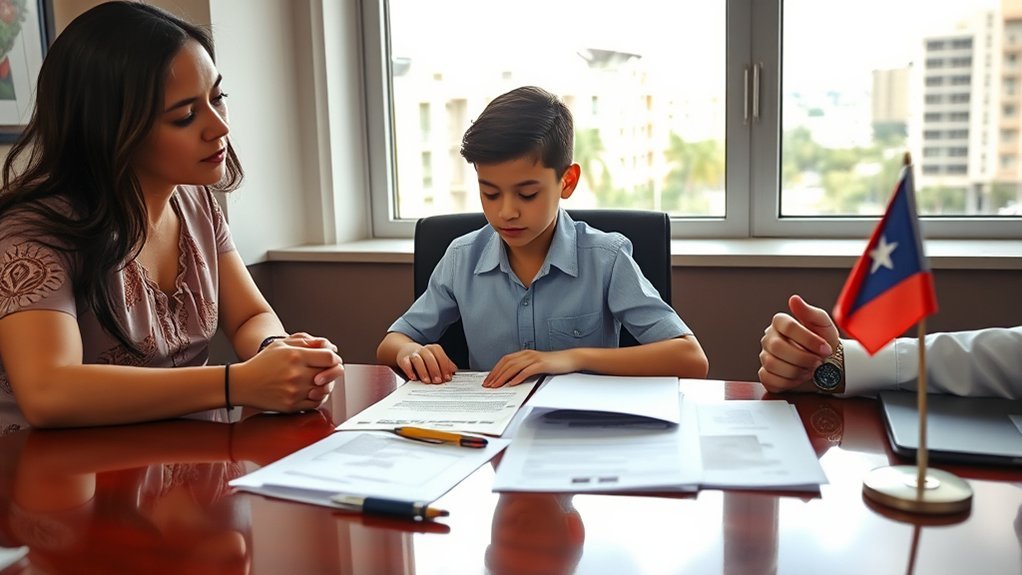
Any non-U.S. citizen who does not hold permanent resident status (a Green Card) must obtain lawful federal work authorization before beginning employment in Puerto Rico. Because Puerto Rico operates under U.S. federal sovereignty, local municipal or territorial permits cannot bypass federal immigration requirements. Sponsoring employers must comply with both U.S. Citizenship and Immigration Services (USCIS) mandates and the registration guidelines set by the Puerto Rico Department of Labor and Human Resources (Departamento del Trabajo y Recursos Humanos, or DTRH).
The specific authorization pathway depends entirely on your nationality, career field, and job tenure:
- Temporary Non-Agricultural Workers: Eligible foreign nationals hired for seasonal hospitality, disaster recovery, or construction roles generally enter under the H-2B Visa.
- Specialty & Professional Hires: Candidates in specialized fields such as software engineering, biotechnology, or finance require an H-1B Visa, TN Status (for Canadian and Mexican professionals under USMCA), or an L-1 Visa for intracompany transfers.
- Independent Status Holders: Individuals residing in Puerto Rico under eligible adjustment categories, Temporary Protected Status (TPS), or specific student/exchange programs must obtain a physical Employment Authorization Document (EAD) via Form I-765.
Note: U.S. citizens born in the 50 states, Washington D.C., or any U.S. territory do not need a passport, visa, or work permit to work in Puerto Rico. They complete the standard federal Form I-9 Employment Eligibility Verification using a state driver’s license, Social Security card, or U.S. passport.
Which Puerto Rico Visa Type Fits Your Job?
Selecting the correct visa category ensures statutory compliance, avoids processing delays, and preserves legal status. Work visas are categorized by occupation type, educational requirements, and foreign treaties.
- H-1B Specialty Occupations: Geared toward professional roles that require a minimum of a bachelor’s degree or equivalent in a specialized field (e.g., engineering, medical research, IT architecture, accounting).
- L-1 Intracompany Transfers: Permits multinational companies with offices in Puerto Rico to transfer managers and executives (L-1A) or employees with specialized organizational knowledge (L-1B) from foreign affiliates.
- H-2B Temporary Non-Agricultural: Common in Puerto Rico’s tourism, hospitality, and infrastructure rebuilding sectors. The employer must demonstrate that there are not enough U.S. workers capable of performing the temporary work.
- TN Professional Visas: Available to qualified Mexican and Canadian citizens entering pre-approved professional categories under the United States-Mexico-Canada Agreement (USMCA).
- E-1 / E-2 Treaty Traders and Investors: Applicable to foreign nationals from treaty countries who are directing substantial commercial trade or investing significant capital into a Puerto Rico enterprise.
- Employment Authorization Document (Form I-765): An open work permit issued to individuals with pending green card petitions, DACA, TPS, or as eligible dependents of primary visa holders (such as L-2 or select H-4 spouses).
“Every foreign national working in Puerto Rico must match their specific job duties, education, and nationality to a recognized federal immigration classification before their employer files a petition.”
Should You Sponsor or Hire a Contractor?
Companies operating in Puerto Rico must evaluate whether to sponsor a foreign worker directly or engage an independent foreign contractor. The choice carries distinct legal, tax, and operational ramifications under both Puerto Rico and federal statutes.
| Criteria | Direct Employee Sponsorship | Independent Contractor |
|---|---|---|
| Visa Requirement | Employer files Form I-129 and pays associated USCIS fees. | Worker must independently possess self-directed work authorization (e.g., E-2, EAD). |
| Employer Control | High: Controls schedule, tools, methods, and worksite location. | Low: Directs project scope only; contractor controls execution. |
| Tax & Payroll | Withholds PR income tax (Hacienda), FICA, unemployment, and disability. | Issues Puerto Rico Form 480.6A/B; contractor manages own tax liability. |
| Statutory Benefits | Mandatory Christmas Bonus (Act 148), vacation, sick leave, and CFSE coverage. | Exempt from statutory employment benefits and paid leave rules. |
Warning: Misclassifying an employee as an independent contractor to avoid visa sponsorship or statutory benefits violates Puerto Rico Department of Labor (DTRH) regulations and the federal Fair Labor Standards Act (FLSA), exposing businesses to severe back-tax assessments and legal penalties.
How Do You Apply for a Puerto Rico Work Permit?

Applying for a Puerto Rico work permit requires completing sequential steps across territorial and federal agencies. Missing a step or failing to file accurate documentation can trigger a Request for Evidence (RFE) or outright petition denial.
- Obtain a Bona Fide Written Job Offer: The Puerto Rico employer must issue a formal offer defining job duties, physical worksite address, compensation, and the expected employment duration.
- Acquire Department of Labor Certification: For specialty visas (H-1B), the employer must file a Labor Condition Application (LCA, Form ETA-9035) with the U.S. Department of Labor certifying prevailing wage compliance. For H-2B roles, temporary labor certification (Form ETA-9142B) is mandatory.
- Submit the Petition to USCIS: The employer files Form I-129 (Petition for a Nonimmigrant Worker) along with certified labor forms, supporting employer credentials, and statutory filing fees.
- Attend Consular Processing / Visa Interview: Once USCIS approves Form I-129 (issuing Form I-797 Notice of Action), foreign candidates residing abroad must complete Form DS-160 online, pay the $205 MRV visa fee, and attend an interview at a U.S. Embassy or Consulate.
- Complete Port of Entry and I-9 Onboarding: Upon arrival in Puerto Rico, U.S. Customs and Border Protection (CBP) issues an electronic Form I-94 showing lawful admission. The employer then verifies identity and work eligibility via Form I-9.
Pro Tip: Employers facing urgent project start dates can utilize Form I-907 Premium Processing. For eligible I-129 petitions (such as H-1B or L-1), USCIS guarantees an adjudication decision within 15 calendar days for a $2,805 fee ($1,685 for H-2B petitions).
What Do Puerto Rico Work Permits Cost?
Filing fees and compliance expenses vary significantly depending on the visa category, petitioner size, and processing speed. Under federal regulations, employers must cover core sponsorship and petition costs for employee work visas.
Filing Fees and Charges
The primary nonimmigrant petition filing fees set by USCIS and the Department of State include:
- H-1B Specialty Worker: $780 Form I-129 base filing fee ($460 for small employers with 25 or fewer full-time employees and registered nonprofits) plus a mandatory $600 Asylum Program Fee ($300 for small businesses/nonprofits), $500 Fraud Prevention Fee, and statutory ACWIA training fees ($750 to $1,500).
- L-1 Intracompany Transfer: $1,385 base filing fee ($695 for small businesses/nonprofits) plus $600 Asylum Program Fee ($300 small/nonprofit) and $500 Fraud Detection Fee.
- H-2B Temporary Non-Agricultural: $1,080 base filing fee ($540 for small businesses/nonprofits) plus $600 Asylum Program Fee and $150 Fraud Prevention Fee.
- Employment Authorization Document (Form I-765): $520 for standard paper filing ($470 for online submission).
- Consular MRV Application Fee: $205 per candidate for petition-based nonimmigrant categories (H, L, O, P, Q, R) paid to the Department of State.
Extra Compliance Expenses
Beyond standard USCIS forms, businesses must budget for supplemental administrative and legal charges:
- Legal and Immigration Attorney Fees: Ranging from $2,000 to $6,000 depending on case complexity and petition type.
- Puerto Rico Labor Registration (DTRH): Territorial filing and compliance record-keeping.
- State Insurance Fund (CFSE): Mandatory workers’ compensation insurance premiums required under Puerto Rico territorial law.
- Document Translation and Credential Evaluation: Certified Spanish-to-English translations and academic equivalency evaluations for foreign degrees, typically costing $150 to $400.
What Employer Rules Apply in Puerto Rico?
Hiring foreign talent in Puerto Rico requires strict adherence to both U.S. federal employment standards and local labor laws governed by the DTRH and the Puerto Rico Internal Revenue Code.
Employer Registration Rules
Before extending offers to foreign workers or submitting federal petitions, an employer must complete local registrations:
- Register with the Puerto Rico Department of State (Departamento de Estado) to conduct business locally.
- Obtain a Merchant’s Registration Certificate (Certificado de Registro de Comerciante) through the Puerto Rico Department of Treasury (SURI – Hacienda).
- Enroll with the Puerto Rico Department of Labor and Human Resources (DTRH) for unemployment insurance and disability tax accounts.
- Secure a policy with the State Insurance Fund Corporation (Corporación del Fondo del Seguro del Estado – CFSE) for mandatory workers’ compensation.
Compliance And Wage Obligations
Employers sponsoring workers in Puerto Rico must maintain continuous statutory compliance across all employment practices:
- Prevailing Wage Mandates: Employers filing H-1B or H-2B petitions must pay at least the local prevailing wage determined by the U.S. Department of Labor for the specific occupational code and geographic area in Puerto Rico.
- Statutory Minimum Wage: Employers must pay at least $10.50 per hour, the statutory minimum wage in Puerto Rico under Act No. 47-2021.
- Mandatory Christmas Bonus (Aguinaldo Navideño): Under Puerto Rico Act No. 148, employers must pay an annual statutory Christmas bonus to eligible employees who satisfy statutory hours-worked thresholds.
- Vacation and Sick Leave: Non-exempt employees accrue statutory paid leave according to monthly hours worked under the Puerto Rico Labor Transformation and Flexibility Act (Act No. 4-2017).
- Local Income Tax Withholding: Employers must withhold Puerto Rico income tax in accordance with the Puerto Rico Internal Revenue Code and remit payments directly to Hacienda.
Frequently Asked Questions
Do U.S. citizens need a work permit to work in Puerto Rico?
No. U.S. citizens and Lawful Permanent Residents (green card holders) do not need a work permit or visa to work in Puerto Rico. They are authorized to work upon completing a standard Form I-9 verification with acceptable identity documents.
How do you get a work permit for Puerto Rico?
Foreign nationals must obtain a bona fide job offer from an employer registered in Puerto Rico. The employer then files an immigration petition (such as Form I-129 for an H-1B or H-2B visa) with USCIS. Once approved, the worker completes consular visa processing or receives an Employment Authorization Document (EAD).
What is the legal minimum wage in Puerto Rico?
The statutory minimum wage in Puerto Rico is $10.50 per hour under Act No. 47-2021. Sponsoring employers must also ensure that specialized foreign hires receive the prevailing wage determined by the U.S. Department of Labor.
Can I work remotely from Puerto Rico for a mainland U.S. company?
U.S. citizens can work remotely from Puerto Rico without immigration restrictions. However, foreign nationals must hold valid U.S. work authorization that permits remote employment. Employers must also comply with Puerto Rico tax withholdings through Hacienda once an employee establishes tax residency on the island.
Conclusion
Working legally in Puerto Rico requires aligning federal immigration pathways with local labor regulations. Foreign professionals and employers must ensure every petition is supported by certified wage determinations, accurate USCIS filings, and territorial registrations with the DTRH and Hacienda. By following the statutory steps, budgeting for filing fees, and respecting Puerto Rico’s employment standards, businesses and international candidates can establish a lawful, compliant, and productive working relationship.
Sources
- U.S. Citizenship and Immigration Services (USCIS) — Overview of nonimmigrant temporary worker classifications and Form I-129 guidelines.
- U.S. Department of Labor (USDOL) Foreign Labor Certification — Prevailing wage determinations and Labor Condition Application (LCA) rules.
- Departamento del Trabajo y Recursos Humanos de Puerto Rico (DTRH) — Puerto Rico labor standards, minimum wage regulations (Act 47-2021), and mandatory benefits.
- Departamento de Hacienda de Puerto Rico — Territorial employer tax withholding, SURI merchant registration, and payroll tax compliance.
