
Last Updated on July 25, 2026 by Daniel Globe
The easiest way to travel from London to Brighton is usually by direct train, especially for a day trip. Frequent services leave several central London stations and can reach Brighton in about an hour. Coach travel is often worth checking when price matters more than speed, while driving, cycling, and carpooling suit more specific needs.
Quick Answer
For most visitors, a direct train is the simplest way to get from London to Brighton. Trains leave London Victoria, London Bridge, and London St Pancras, with the fastest journeys taking about an hour. Coaches are generally slower but can cost less, while driving gives you flexibility but adds traffic and parking concerns.
Key Takeaways
- Train: Usually the fastest and easiest option, with direct services from London Victoria, London Bridge, and St Pancras.
- Coach: Often worth comparing for budget travel, but allow roughly two hours or more depending on traffic and stops.
- Driving: The normal direct route follows the A23/M23/A23 corridor; check London road-user charges and Brighton parking before leaving.
- Cycling: London to Brighton is a serious long-distance ride of roughly 50-plus miles, not a casual city-bike trip.
- Carpooling: Can split driving costs, but availability varies and the journey remains subject to normal road traffic.
Disclosure: As an Amazon Associate I earn from qualifying purchases. Some links on this page are affiliate links, at no extra cost to you.
London to Brighton Transport Options Compared
| Option | Typical Planning Time | Best For | Main Drawback |
|---|---|---|---|
| Train | About 1 hour on the fastest direct services | Speed, day trips, central-to-central travel | Peak fares and busy services |
| Coach | Roughly 2 hours or more | Budget-focused travelers | Traffic can extend the trip |
| Car | Highly traffic-dependent | Groups, luggage, flexible stops | Congestion and Brighton parking |
| Cycle | A substantial part of the day for most riders | Experienced or prepared cyclists | Distance, hills, traffic, and return logistics |
| Carpool | Similar to driving | Splitting road-travel costs | Ride availability varies |
Taking the Train From London to Brighton
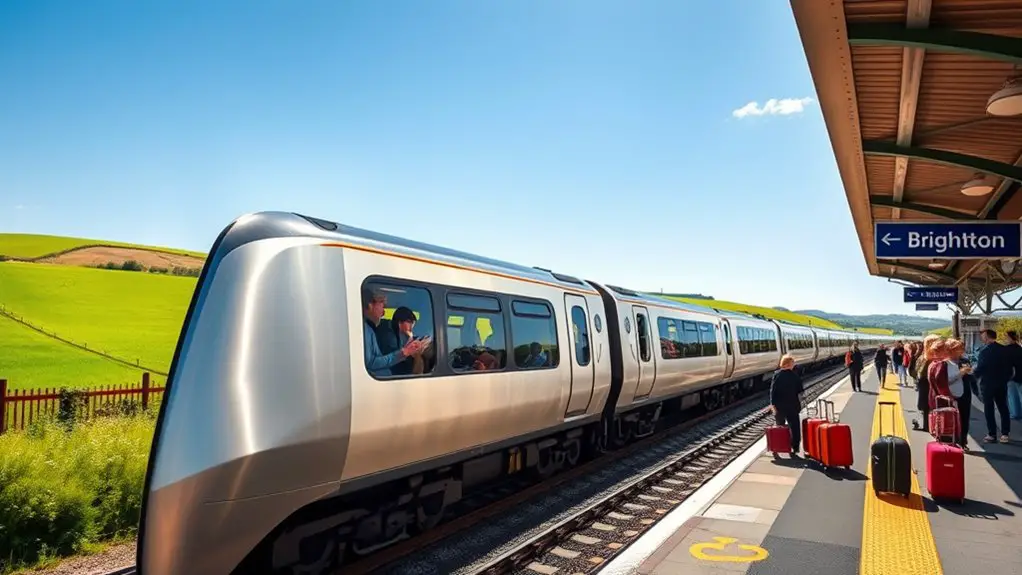
For most travelers, the train from London to Brighton offers the best balance of speed, convenience, and location. According to National Rail, direct trains serve Brighton from London Victoria, London Bridge, and London St Pancras.
The fastest direct journeys take about an hour. Exact times vary by station, day, engineering work, and stopping pattern, so check the live journey planner before setting out rather than relying on a fixed timetable.
The fastest direct London-to-Brighton rail journeys take about an hour, making the train the strongest choice for most day trips.
Which London Station Should You Use?
London Victoria is convenient for Westminster, Belgravia, and much of west-central London. London Bridge works well for the City, South Bank, and southeast London, while St Pancras can be useful if you are starting in north-central London or connecting from another train.
Choose the departure station based on where you are staying rather than crossing London simply to save a few minutes on the rail journey.
Train Tickets and Saving Money
Rail fares depend on your travel time, ticket type, route, and any discount you qualify for. Advance tickets may offer savings when available, while Off-Peak tickets can be useful when your schedule fits their restrictions. Anytime tickets provide more flexibility but can cost more.
Railcards and GroupSave may reduce eligible fares, so compare the full set of options before paying. Remember that ticket restrictions vary by journey; the cheapest ticket is not necessarily valid on every train.
Pro Tip: Check fares from Victoria, London Bridge, and St Pancras. The closest departure station to you may save more time than choosing the train with the absolute shortest scheduled journey.
Seat reservations are not normally offered on Southern or Thameslink commuter-style services to Brighton, so on a busy train you choose from the seats available when you board.
Brighton railway station is close to the city center. From there, you can continue toward The Lanes, the Royal Pavilion, and the seafront on foot or use a local bus if you prefer.
Traveling by Bus or Coach Services
A coach is a useful alternative when you care more about price than getting to Brighton as quickly as possible. National Express operates London-to-Brighton services from Victoria Coach Station, with Brighton Coach Station near the seafront.
Ticket Booking Options
You can book coach tickets online or through the operator’s app. Available fare types can include different levels of flexibility, so check the amendment and cancellation conditions before choosing solely by price.
Booking ahead can also give you a wider choice of departure times. If you are traveling on a busy weekend, during summer, or around a major Brighton event, reserving earlier reduces the risk that your preferred service sells out.
Journey Duration Insights
Coach journeys are normally slower than direct trains. National Express currently advertises a fastest London Victoria-to-Brighton Coach Station journey of a little over two hours, while other departures can take longer because of stops and road conditions.
Do not rely on a generic morning, midday, or evening duration. Check the timetable for the exact service you plan to use, and leave extra time if you have a reservation or event in Brighton shortly after arrival.
Comfort and Amenities
National Express coaches generally provide features such as reclining seats, onboard toilets, Wi-Fi, and charging facilities. Exact equipment can vary, so treat these as travel conveniences rather than guarantees for every individual vehicle.
Bring your own water or snack if you expect to need one during the journey rather than assuming food will be sold onboard.
Coach luggage rules also differ from rail rules. National Express has defined allowances for hold luggage and hand luggage, so check its current conditions before traveling with large suitcases, sports equipment, or extra bags.
Driving Your Own Vehicle to Brighton
Driving gives you the most freedom over departure time, luggage, and stops, but it also exposes you to London traffic and Brighton parking costs. It is often most attractive for a group, a family carrying a lot of gear, or travelers staying outside central Brighton.
Route Options Overview
The normal direct driving corridor between London and Brighton uses the A23 and M23, returning to the A23 as you approach Brighton. Your exact route through London depends on your starting point, so use live navigation rather than adding a scenic detour by default.
The motorway and A23 corridor itself should not be confused with London’s road-user charging schemes. Depending on where you begin your journey and your vehicle, you may have to account for the central London Congestion Charge or the Ultra Low Emission Zone. Check your vehicle and route on Transport for London’s official road-charging service before leaving.
Note: London charging rules relate to the roads and zones you use before leaving the capital. They are not a toll for traveling on the M23 or A23 to Brighton.
Parking in Brighton
Parking is one of the main reasons many day-trippers choose the train instead of driving. Brighton & Hove City Council operates or lists several central and seafront options, including The Lanes, Regency Square, Trafalgar Street, London Road, and Black Rock.
Use the official Brighton & Hove car-park information to check current opening details, height restrictions, accessible bays, and charges before your visit.
| Parking Type | Best Use |
|---|---|
| Central car parks | The Lanes, shopping, attractions, and city-center visits |
| Seafront parking | Direct beach access, with seasonal demand and pricing to consider |
| On-street paid parking | Shorter stays where signs permit |
| Accessible bays | Travelers who qualify; rules and charges differ by facility |
Always read the signs where you park. Brighton has controlled parking zones, and restrictions vary by street and time.
Traffic and Timing
There is no single reliable “quiet” period that guarantees a quick London-to-Brighton drive. Congestion can be affected by the London rush, incidents on the M23/A23, summer beach traffic, roadworks, football matches, concerts, Pride, and other large events.
Before leaving:
- Check live traffic conditions for the A23 and M23.
- Check planned roadworks and major Brighton events.
- Choose your parking location before reaching central Brighton.
- Allow extra time on sunny weekends and event days.
Cycling From London to Brighton
Cycling from London to Brighton can be a memorable challenge, but it should be treated as a long-distance ride rather than a casual transport alternative.
For perspective, the British Heart Foundation’s established London to Brighton Bike Ride covers about 54 miles from Clapham Common to Brighton seafront. The event uses special traffic arrangements, so do not assume an independent ride on another date will have the same closed or managed roads.
Plan a route that matches your experience, fitness, and comfort in traffic. Expect hills as you approach the South Downs and make sure your bike is mechanically sound before setting out.
Warning: Do not copy an organised-event route and assume the roads will be closed to normal traffic. On an independent ride, plan for ordinary road conditions, junctions, weather, hills, and other traffic.
Carry enough water, food, a charged phone, basic puncture-repair equipment, and weather-appropriate clothing. Follow the Highway Code rules for cyclists. A correctly fitted helmet is strongly recommended, and legally required lights and reflectors must be used when riding at night.
If you do not own a suitable bike, only use a rental after confirming that the company allows a long intercity journey and that you have an approved way to return the bicycle. Ordinary city bike-share schemes are not designed for a one-way ride from London to Brighton.
Think about the return journey before you leave London. Non-folding bicycles can be restricted on busy Southern services and during large cycling events, so check the operator’s current cycle policy before assuming you can simply take your bike home on the next train.
Using Ride-Sharing and Carpool Options
Carpooling can be a useful alternative when a suitable driver is already traveling between London and Brighton. Instead of paying the full cost of running a separate car, passengers and drivers can share eligible journey costs.
Availability is the main limitation. A carpool may be available on one date and unavailable on another, so do not build a time-critical trip around it until your ride is confirmed.
For a smoother trip:
- Use an established platform with profiles, ratings, and clear booking information.
- Check the exact pickup and drop-off points before booking.
- Confirm luggage space if you have a suitcase or large bag.
- Keep your phone charged and share your plans with someone you trust when traveling with a driver you have not met before.
Carpooling can reduce your personal share of the travel cost and make use of seats that would otherwise be empty. It does not, however, avoid congestion: the car still uses the same road network as other drivers.
Combining Multiple Transportation Modes
Combining transport can work well, but only when each mode solves a real part of the journey. Because direct trains and coaches already reach central Brighton, switching from an intercity train to an intercity coach normally adds time rather than saving it.
More useful combinations include:
- Train + walking: A simple choice if your destination is in central Brighton or near the seafront.
- Train + local bus: Useful for destinations farther from Brighton station.
- Coach + walking or local bus: Practical after arriving near the seafront.
- Car + parking + walking: Avoids repeatedly moving the car around congested central streets.
- Train + bicycle: Possible when operator cycle restrictions allow it.
The best combination is usually the one with the fewest unnecessary transfers.
Tips for a Smooth and Cost-Effective Journey
A little preparation can make the London-to-Brighton trip cheaper and less stressful.
- Compare the train and coach before booking. Train is normally quicker, but coach fares may be attractive when your schedule is flexible.
- Check ticket restrictions. A cheaper Off-Peak or Advance rail ticket may limit which services you can use.
- Use any discount you qualify for. Railcards and group discounts can reduce eligible train fares.
- Check disruption on the day. Engineering work can change Brighton Main Line services, especially at weekends.
- Plan Brighton parking before driving. Searching for a space after reaching the center wastes time and can increase costs.
- Know your luggage rules. Rail and coach operators use different allowances.
For rail travel, National Rail generally allows passengers to carry up to three pieces of luggage without an extra charge, provided the luggage can be carried and stored safely. Large or unusual items can be subject to additional operator restrictions.
Note: Timetables, fares, roadworks, parking charges, and service restrictions can change. Recheck your chosen operator and any official travel alerts shortly before departure.
Frequently Asked Questions
Are there any special discounts for frequent travelers?
Yes. Regular rail travelers can compare season or flexible ticket products, while eligible passengers may save with a Railcard. Groups should also check GroupSave where it is available. The best product depends on how often you travel, the time of day, and whether you need flexibility.
What are the best times to avoid crowds?
Weekday commuter periods are normally busier than the middle of the day, while sunny weekends and major Brighton events can also produce heavy demand. Instead of relying on a fixed “quiet” hour, check live train information and event schedules before traveling.
Can I bring large luggage on public transport?
Usually, but the rules differ by operator. National Rail generally permits up to three pieces of luggage at no extra charge if you can carry and store them safely. Coaches use defined hold- and hand-luggage allowances. Never block aisles, doors, or wheelchair spaces.
Is there accessible transportation for disabled travelers?
Yes. Rail passengers can use National Rail Passenger Assist. Assistance can be requested in advance, and staff will also provide turn-up-and-go support where possible. National Express also provides accessibility support and recommends discussing wheelchair or mobility requirements before travel so it can check the vehicle and stops.
What are the safety tips for traveling alone?
Plan your route before leaving, keep your phone charged, keep valuables secure, and let someone know your travel plans when appropriate. When using a carpool with someone you have not met, use an established booking platform, confirm the driver and pickup details, and avoid moving the arrangement to an unverified channel unnecessarily.
What is the fastest way to get from London to Brighton?
A direct train is normally the fastest practical option. The quickest scheduled rail journeys take about an hour, with direct services available from London Victoria, London Bridge, and London St Pancras.
Can I take my bicycle back to London on the train?
Often, but restrictions apply to non-folding bikes on busy services and special restrictions may be introduced during major cycling events. Folding bikes are easier to carry. Check the train operator’s current bicycle policy before beginning your ride.
Conclusion
For most London-to-Brighton trips, the direct train is the easiest choice: it is fast, frequent, and takes you straight into central Brighton without worrying about traffic or parking. A coach can make sense when you are prioritizing price, while a car gives groups and travelers with luggage more flexibility.
Cycling is a rewarding option for prepared riders, but the distance and hills make it a real long-distance journey. Carpooling can also work when a suitable ride is available. Whichever option you choose, check live schedules, traffic, restrictions, and parking shortly before departure so your plans reflect the conditions on the day.
Sources
- National Rail — Visit Brighton by Train — direct London rail connections and journey guidance.
- National Rail — Passenger Assist — rail accessibility and assistance arrangements.
- National Express — London to Brighton — current coach journey information and booking guidance.
- Brighton & Hove City Council — Car Parks — official Brighton parking locations and current information.
- Transport for London — Pay to Drive in London — Congestion Charge, ULEZ, and other London road-user charging information.
- GOV.UK — Highway Code Rules for Cyclists — cycling safety and legal requirements.
