
Last Updated on July 24, 2026 by Ethan Caldwell
A solo road trip can give you more control over your schedule, stops, and pace, but it also makes you responsible for every driving, navigation, safety, and budget decision. A good plan should help you avoid fatigue, find essential services, handle weak cell coverage, and respond calmly when weather, traffic, or vehicle trouble changes your route.
Quick Answer
Plan a solo road trip by choosing a route with regular fuel, food, lodging, and safe stopping options. Set a driving limit based on your alertness, check weather and closures, download offline maps, share your itinerary, inspect your vehicle, and carry enough money and emergency supplies for delays or breakdowns.
Key Takeaways
- Choose roads with dependable services, but verify cell coverage, closures, weather, and fuel availability before leaving.
- Plan a break about every two hours or 100 miles, and stop sooner whenever your attention begins to fade.
- Download offline maps and keep a paper map or written route because live navigation can fail in remote areas.
- Calculate fuel correctly and include lodging, food, tolls, parking, activities, and an emergency reserve in your budget.
- Share your route and check-in schedule with a trusted person who knows what to do if you miss a check-in.
At a Glance
| Time Required | About 2 to 4 hours for initial planning, plus a final check before departure |
| Difficulty | Easy to moderate, depending on distance, weather, and route remoteness |
| Tools Needed | Navigation app, offline map, weather and road-condition sources, budget notes, and an emergency contact plan |
| Cost | Planning can be free; fuel, lodging, food, tolls, parking, and activity costs vary by route |
Disclosure: As an Amazon Associate I earn from qualifying purchases. Some links on this page are affiliate links, at no extra cost to you.
Choose a Safe Solo Road Trip Route
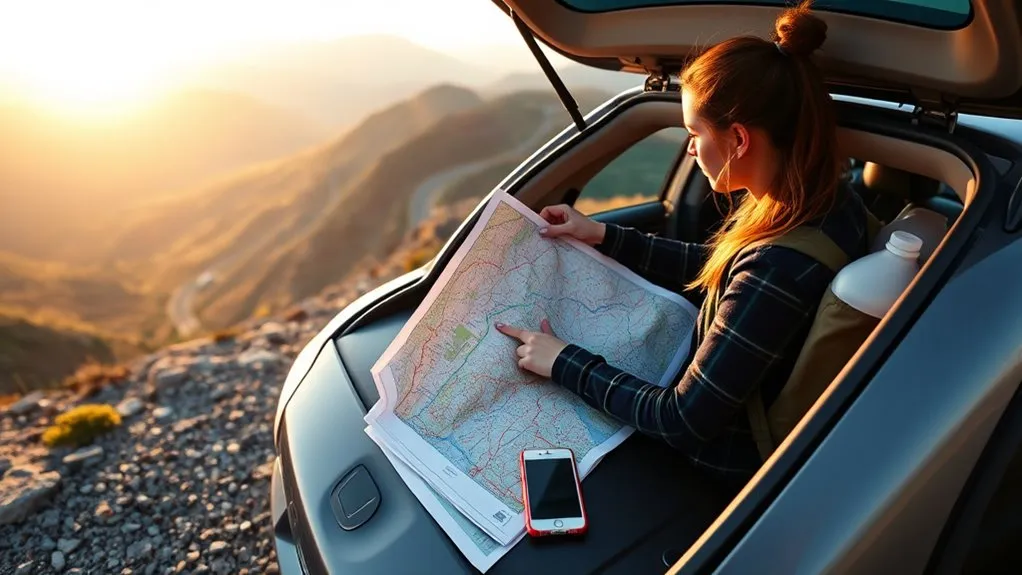
Start with a route that matches your driving experience, vehicle, schedule, and comfort level. Major highways and well-used regional roads often make fuel, food, lodging, restrooms, and roadside assistance easier to find. However, traffic volume alone does not make a road safe.
Review each part of your route for:
- Fuel or charging locations
- Rest areas and safe daytime stopping places
- Hotels or campgrounds with recent reviews
- Construction, closures, and seasonal road restrictions
- Mountain passes, unpaved roads, ferries, or toll roads
- Expected weather and visibility
- Cell coverage and offline-navigation needs
Scenic byways and national parks can be excellent solo destinations, but do not assume they have reliable cell service or nearby assistance. The National Park Service says cellular coverage varies among parks and may also change within the same park. Check the official page for each park, including current alerts, road conditions, operating hours, entry requirements, and available services.
Note: A route shown by a navigation app may be technically passable but still unsuitable for your vehicle, weather, experience, or comfort. Follow official closures and posted signs even when an app suggests continuing.
Create a Day-by-Day Solo Road Trip Itinerary
Break a multi-day journey into individual driving days instead of treating it as one long route. For each day, record:
- Your starting location and planned departure time.
- Your overnight destination and lodging address.
- Estimated driving time and distance.
- Fuel, meal, restroom, and sightseeing stops.
- A backup fuel stop and backup lodging option.
- Your expected arrival and check-in time.
- Any roads, parks, or attractions with limited operating hours.
Add extra time for meals, traffic, construction, weather, parking, and missed turns. A schedule with no buffer can pressure you to speed, skip breaks, or continue driving when tired.
Send the itinerary to a trusted contact before departure. Include your vehicle description, license plate, lodging locations, planned route, and the times you expect to check in. Agree on what that person should do if you miss a check-in and cannot be reached.
Set a Safe Daily Driving Limit
There is no single number of driving hours that is safe for every traveler. Your limit depends on how well you slept, when you are driving, your health, medication, weather, traffic, and the difficulty of the road.
Begin with a conservative daily plan, especially on your first solo trip. The CDC advises taking a break about every two hours or 100 miles during a long drive. Stop earlier when you need fuel, food, a restroom, movement, or time to reset your attention.
NHTSA reports that 644 people died in drowsy-driving-related crashes in 2024. Fatigue is a safety risk, not a test of determination.
Drowsy-driving crashes are especially associated with the period between midnight and 6 a.m. and with the late-afternoon dip in alertness. Plan to drive during the hours when you normally feel most awake, and avoid starting a trip after a short night of sleep.
Warning: Pull over in a safe, legal place if you begin yawning repeatedly, missing signs, drifting within your lane, hitting rumble strips, struggling to remember recent miles, or having trouble keeping your eyes open. Music, cold air, and an open window do not make a sleepy driver safe.
If you become sleepy, stop at a designated rest area, service plaza, hotel, or another safe public location. NHTSA advises that a short nap and caffeine may provide temporary help, but neither replaces adequate sleep. Do not continue until you are alert enough to drive safely.
Plan Stops, Weather Checks, and Drive Time
Use your primary navigation app to estimate distance and driving time, then add stops before departure. Roadtrippers can help build a route and find attractions, campgrounds, lodging, and other places along the way. Its Autopilot feature can generate suggestions, but you should still verify every stop and route.
iExit is designed for interstate travel and can show upcoming fuel, food, lodging, rest areas, and charging locations. It is most useful as a stopping tool, not as a replacement for official closure or emergency information.
Before leaving each morning, check:
- The weather forecast for your starting point, route, and destination
- State DOT websites or local 511 services
- Traffic incidents and construction
- Wildfire, flooding, snow, wind, or visibility alerts
- National park or public-land alerts
- Your fuel level and distance to the next dependable station
The Federal Highway Administration explains that 511 services can provide current traveler information through participating state and local systems. Features differ by location, so check the relevant state’s service before your trip.
Pro Tip: Save the addresses and phone numbers for your hotel, roadside-assistance provider, insurance company, and emergency contact. Do not depend only on app bookmarks that may be unavailable without data service.
Never type, search, or change a route while driving. Pull into a safe parking area before using your phone, or use voice guidance only when it does not distract you.
Download Offline Maps and Navigation Backups
Download the map area covering your entire route before departure. Google Maps supports offline driving navigation in many areas, but offline mode does not provide live traffic information or alternative routes. Some countries and regions also limit map downloads.
Keep at least one backup:
- A paper road atlas or printed route
- Written directions to your lodging
- A second navigation app with downloaded maps
- A vehicle GPS that does not depend on your phone
- A satellite communication device for genuinely remote travel
Charge your phone before each driving day and carry a vehicle charger and power bank. Keep essential information available outside your phone in case the device is lost, damaged, overheated, or out of power.
Budget for Fuel, Lodging, Food, and Delays
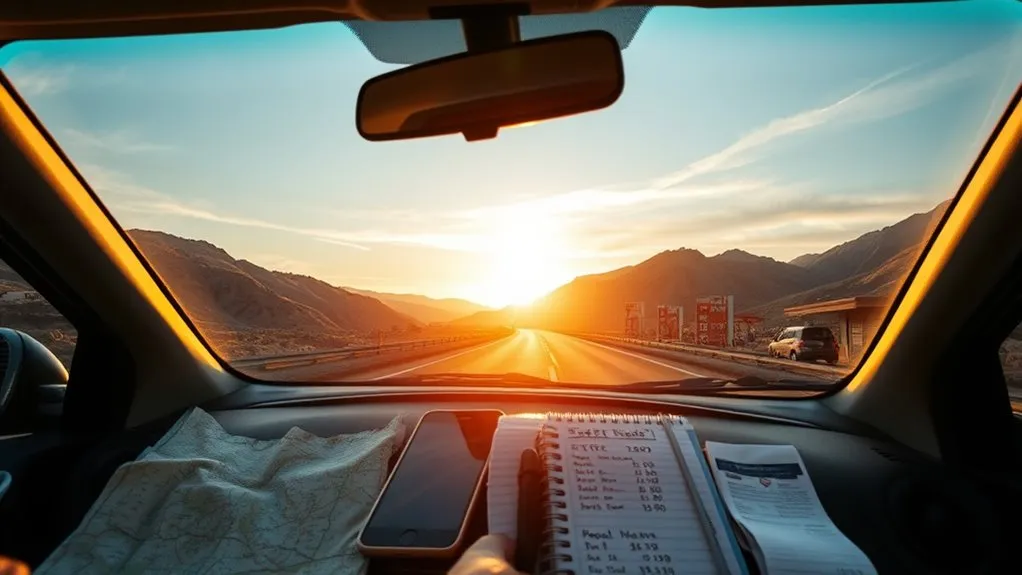
Build your budget before booking nonrefundable stays. Include more than the basic price of fuel and a hotel room.
Calculate Your Fuel Cost
Use this formula for a gasoline vehicle:
Estimated fuel cost = total trip miles ÷ vehicle mpg × average price per gallon
For example, a 900-mile trip in a vehicle that averages 30 mpg requires about 30 gallons. At $3.50 per gallon, the estimated fuel cost is $105.
Use your vehicle’s real-world fuel economy when possible. Mountain roads, high speeds, idling, roof cargo, towing, cold weather, and heavy loads may reduce efficiency. Fuel-price apps can help you compare nearby stations, but no app can guarantee a fixed saving.
Compare the Full Lodging Cost
Compare the final amount rather than the advertised nightly rate. Check:
- Taxes and service fees
- Parking or resort fees
- Cleaning fees
- Deposit or card-hold requirements
- Cancellation and late-arrival policies
- Breakfast or kitchen access
- Distance from your main route
A cheaper room far from the highway may cost more after extra fuel, parking, and driving time are added.
Include Every Major Expense
- Fuel or charging
- Lodging or campground fees
- Meals, snacks, and drinking water
- Tolls, ferries, parking, and entrance fees
- Attractions and activities
- Laundry and personal supplies
- Roadside assistance or minor repairs
- An emergency reserve
A practical reserve is a percentage of your expected trip cost rather than one fixed amount. Setting aside roughly 10% to 20% can help cover a changed hotel, an extra driving day, higher fuel costs, or a minor repair. Increase the reserve for remote, winter, or multi-week travel.
Prepare Your Vehicle Before the Trip
Inspect your vehicle several days before departure so you have time to correct a problem. Follow the maintenance schedule in your owner’s manual and consider a professional inspection if the vehicle is overdue for service or has recently shown a warning light, vibration, leak, unusual sound, or starting problem.
The National Highway Traffic Safety Administration recommends checking key vehicle systems before a long trip. Your check should include:
- Tire pressure when the tires are cold
- Tire tread, sidewalls, and spare tire
- Engine oil and applicable vehicle fluids
- Coolant and visible leaks
- Battery and charging system
- Headlights, brake lights, signals, and flashers
- Windshield wipers and washer fluid
- Belts and hoses
- Brakes and unusual noises
- Open safety recalls
Use the pressure printed on the vehicle’s door placard or in its owner’s manual, not the maximum pressure molded into the tire sidewall.
Pack a Roadside Emergency Kit
Carry supplies that match the route, climate, season, and distance from services. A useful basic kit includes:
- Charged phone, vehicle charger, and power bank
- First aid kit and required medication
- Flashlight and spare batteries
- Reflective warning triangles, flares, or another visible warning device
- Jumper cables or a charged jump starter
- Tire pressure gauge
- Spare tire, jack, and the correct wheel tools
- Work gloves and basic tools
- Drinking water and nonperishable food
- Emergency blanket and weather-appropriate clothing
- Paper maps
- Insurance, registration, and roadside-assistance information
Add extra water, sun protection, and heat supplies for desert travel. Add warm clothing, an ice scraper, traction aid, and other winter equipment when snow or freezing temperatures are possible.
Choose Safe Lodging and Parking
Read recent reviews and examine the property’s location before booking. Look for a staffed front desk, well-lit parking, working exterior locks, and a clear late-arrival procedure.
When you arrive:
- Park in a visible, well-lit area when possible.
- Remove valuables from sight before leaving the vehicle.
- Keep your room number private.
- Use the room’s deadbolt or secondary lock.
- Confirm emergency exits after entering your room.
- Do not announce publicly that you are traveling alone.
- Move to another property or public place when the location feels unsafe.
Tell your trusted contact that you arrived, but avoid posting your exact location publicly in real time.
Stay Safe During a Solo Road Trip
Keep safety part of your daily routine rather than treating it as a one-time checklist. Before driving, confirm that you are rested, the route is open, the weather is manageable, and you have enough fuel to reach a dependable station.
During the drive:
- Wear your seat belt and obey posted limits.
- Keep doors locked when stopped in unfamiliar areas.
- Use designated pullouts instead of stopping in a travel lane.
- Avoid isolated stops after dark when a safer public option is available.
- Do not leave your keys, wallet, phone, or identification unattended.
- Never tell a stranger your full route or overnight location.
- Leave an area when a person or situation makes you uncomfortable.
Your trusted contact should know when each driving day begins and ends. A simple message at departure, during a planned stop, and after checking in can provide useful backup without making the trip feel restrictive.
What to Do If Something Goes Wrong
If Your Vehicle Breaks Down
- Move as far from active traffic as safely possible.
- Turn on the hazard lights.
- Call 911 when there is an immediate danger, injury, fire, or unsafe road position.
- Contact roadside assistance when the location is secure.
- Remain with the vehicle when leaving it would expose you to traffic, extreme weather, or an unfamiliar remote area.
- Share your location with your trusted contact.
- Accept help only when you can verify the responder or service provider.
If You Lose Cell Service
Continue using your downloaded map or paper directions. Do not take an unplanned remote shortcut while searching for a signal. Return to the last known safe location when the road, weather, or navigation becomes uncertain.
If Weather or a Closure Blocks the Route
Follow official instructions and turn around when directed. Do not drive around gates, barricades, floodwater, wildfire closures, or warning signs. Use your backup lodging plan when continuing would require rushing, driving after dark, or entering unsafe conditions.
If You Feel Unsafe
Drive to a police station, fire station, staffed hotel, busy fuel station, hospital, or another well-lit public place. Call emergency services when you believe you are being followed or threatened. Do not drive directly to an isolated hotel, campsite, or home address while someone is following you.
Frequently Asked Questions
What is the 3-3-3 rule for road trips?
The 3-3-3 rule is an informal guideline commonly used by RV travelers. The usual version means driving no more than 300 miles in one day, arriving at the campsite by 3 p.m., and staying for at least three nights. Variations exist, and it is not an official traffic-safety rule. Solo drivers can use its general idea by choosing shorter driving days and arriving before dark.
How many hours should you drive alone each day?
There is no universal safe number. Plan a conservative limit based on your sleep, normal schedule, health, medication, road difficulty, traffic, and weather. Take a break about every two hours or 100 miles, and end the driving day immediately when you cannot remain fully alert.
Is there an AI tool for making a road-trip itinerary?
Yes. Roadtrippers offers an AI-powered Autopilot feature that can suggest a route and stops. General AI assistants can also help organize ideas. Treat every generated plan as a draft, then verify roads, closures, opening hours, fuel, lodging, weather, and park information through official sources. TripIt is useful for organizing confirmations but is not a substitute for route planning.
What information should you share with an emergency contact?
Share your route, planned stops, lodging addresses, expected arrival times, vehicle description, license plate, and roadside-assistance details. Set specific check-in times and agree on how long the person should wait before contacting authorities or your lodging when you cannot be reached.
Can you rely on your phone during a solo road trip?
No. Phones can lose service, power, or access to live traffic data. Download maps before leaving, carry a charger and power bank, and keep a paper map or written route. Remote travelers may also need a satellite communication device.
Conclusion
A safe solo road trip starts with a realistic route, a rested driver, and a plan that still works when the weather changes or cell service disappears. Verify official road conditions, set conservative driving limits, prepare your vehicle, download navigation backups, and share your itinerary with someone you trust. Leave enough time and money to change plans instead of forcing yourself to continue under unsafe conditions. Good preparation gives you more room to enjoy the drive without ignoring the risks.
Sources
- National Highway Traffic Safety Administration: Drowsy Driving — fatigue risks, high-risk driving periods, warning signs, and temporary countermeasures
- National Highway Traffic Safety Administration: Summer Driving Tips — vehicle inspections, route checks, emergency kits, and long-distance driving preparation
- National Park Service Trip Planning Guide — trip plans, emergency preparation, current conditions, and navigation backups
- National Park Service: Cellular and Internet Access — limitations and variation in park cell coverage
- Federal Highway Administration: 511 Traveler Information — official state and local traveler-information services
- Google Maps Help: Offline Maps — downloading maps and the limits of offline navigation
