
Last Updated on August 26, 2026 by Ethan Caldwell
If you are trying to work out how long Moses’ journey took, the first step is to separate several different parts of the Exodus story. The Bible gives useful calendar markers for the journey from Egypt to Mount Sinai, an 11-day travel reference from Sinai to Kadesh-barnea, and a much longer 40-year wilderness period. It does not, however, provide a verified 700-kilometer route or a complete day-by-day schedule.
Quick Answer
The Bible places Israel’s departure from Egypt on the 15th day of the first month, the Wilderness of Sin on the 15th day of the second month, and arrival at Sinai in the third month. That points to roughly six to seven weeks from Egypt to Sinai, but Scripture does not give an exact modern distance or a 47-day itinerary.
Key Takeaways
- The Bible gives calendar markers for the Exodus but no verified total distance in kilometers.
- Israel reached the Wilderness of Sin one month after leaving Egypt and reached the Sinai wilderness in the third month.
- The exact location of the sea crossing remains disputed; Nuweiba is one proposal, not a proven site.
- Deuteronomy’s famous 11-day journey is from Horeb/Sinai to Kadesh-barnea, not from Egypt all the way to Canaan.
- The 40 years were connected to Israel’s rebellion and judgment after the spies explored Canaan, not to the physical distance of the route.
Disclosure: As an Amazon Associate I earn from qualifying purchases. Some links on this page are affiliate links, at no extra cost to you.
How Long Was the Exodus Route?
The Bible gives a clearer answer about time than it does about total distance. Numbers 33:3–15 says the Israelites left Rameses on the 15th day of the first month. Their early itinerary then passed through Succoth, Etham, the area near Pi-hahiroth and Migdol, the sea crossing, Marah, Elim, the Wilderness of Sin, Dophkah, Alush, Rephidim, and finally the Wilderness of Sinai.
Exodus 16:1 supplies another firm date: the people reached the Wilderness of Sin on the 15th day of the second month, one month after their departure. Exodus 19:1–3 then places their arrival in the Wilderness of Sinai in the third month.
Those markers suggest roughly six to seven weeks from Egypt to the Sinai region, depending on how the ancient calendar wording is interpreted. What the text does not provide is a verified total such as 700 kilometers, a 500-kilometer first leg, or a precise 47-day travel schedule. Modern distances depend heavily on where scholars place the ancient sites and the sea crossing.
Note: Biblical chronology and modern route mapping are different things. Scripture gives several dates and a sequence of camps, but many ancient locations cannot be identified with enough certainty to calculate a single authoritative kilometer total.
Why Did God Choose a Longer Route?
The biblical explanation is explicit. Exodus 13:17–18 says God did not lead the Israelites by the road through Philistine territory even though that route was shorter. The reason given is that the people might face war, lose heart, and decide to return to Egypt.
Instead, Israel was led toward the wilderness and the sea. In the narrative, this longer path becomes more than a geographical detour. It creates the setting in which Israel experiences deliverance at the sea, receives food and water in the wilderness, confronts enemies, and eventually enters into covenant at Sinai.
From a theological perspective, the wilderness becomes a place of formation. Israel is no longer simply escaping Egypt; the people are learning how to live as a community dependent on God. That theme continues through Exodus, Numbers, and Deuteronomy.
The shorter road was not necessarily the route the biblical narrative considered safest for a newly freed people facing the danger of war.
Where Were the Main Stops on the Way to Sinai?
The safest way to trace the route is to follow the names preserved in Exodus and Numbers 33 rather than assigning unsupported modern dates to each camp.
Key Stops Along Route
| Stop | What the Biblical Account Says |
|---|---|
| Rameses | Departure point on the 15th day of the first month. |
| Succoth | First camp listed after Rameses. |
| Etham | Camp on the edge of the wilderness. |
| Pi-hahiroth / Migdol | Area where Israel camped before the sea crossing; Baal-zephon is also named. |
| Marah | Reached after three days in the wilderness following the crossing. |
| Elim | An oasis associated with twelve springs and seventy palm trees. |
| Wilderness of Sin | Reached on the 15th day of the second month; manna is introduced in Exodus 16. |
| Dophkah and Alush | Intermediate camps listed in Numbers 33. |
| Rephidim | Associated with water from the rock and the Amalekite attack. |
| Wilderness of Sinai | Israel camped before the mountain in the third month. |
Camp Sites And Events
The camps matter because Exodus connects geography with major events. After the sea crossing, Israel traveled three days into the wilderness before reaching Marah, where the water was bitter. The people then reached Elim, described as having twelve springs and seventy palm trees. These details appear in Exodus 15:22–27.
In the Wilderness of Sin, the people complained about food and received manna. At Rephidim, they lacked water and later faced an Amalekite attack. Exodus 17 records Joshua leading Israel’s fighters while Moses, Aaron, and Hur were on the hill above the battle.
Unlike the original reconstructed timeline, Exodus does not say the Amalekites attacked on “Day 42.” The event belongs late in the Egypt-to-Sinai sequence because Rephidim is the final major camp listed before Sinai.
Sinai Approach Landmarks
Marah, Elim, the Wilderness of Sin, Dophkah, Alush, and Rephidim provide the main named landmarks approaching Sinai. Their exact modern coordinates remain debated, so identifying every biblical stop with a modern location would go beyond what the evidence can establish.
Arrival at Sinai is much firmer chronologically than geographically. Exodus 19 says Israel entered the Wilderness of Sinai in the third month, camped before the mountain, and Moses then went up to God. The text therefore supports an arrival sequence but does not independently establish a modern “Day 48” for Moses’ ascent or for receiving the Ten Commandments.
Where Did the Red Sea Crossing Happen?
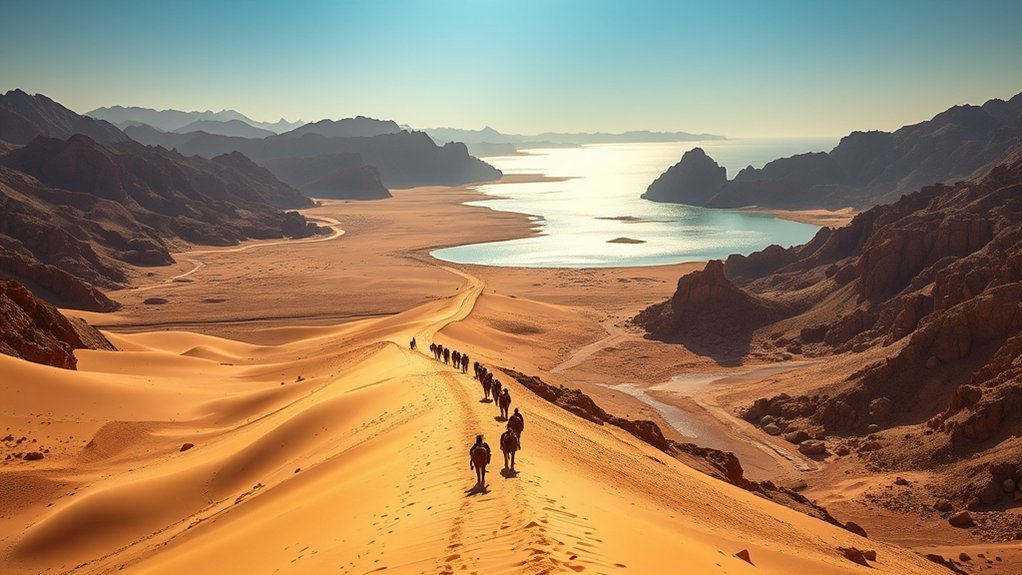
No proposed modern location for the Exodus sea crossing has been proved beyond serious dispute. Exodus 14:1–4 places Israel near Pi-hahiroth, between Migdol and the sea and opposite Baal-zephon, but scholars do not agree on the modern identification of all three names.
Another issue is the Hebrew name yam sûp. Many English Bibles traditionally render it “Red Sea,” while “Sea of Reeds” is another common translation. Because both the ancient landscape and several place names are uncertain, scholars have proposed crossing areas near Egypt’s northeastern frontier, lake or marsh systems farther north, the Gulf of Suez, and—among some modern proponents—the Gulf of Aqaba.
Academic research published by Oxford University Press treats the location of the Re(e)d Sea as an unresolved geographical question and discusses evidence connected with Egypt’s eastern frontier and North Sinai. That is a much safer description than claiming that one beach has been archaeologically confirmed.
Possible Crossing Sites
| Proposal | Why It Is Considered | Main Limitation |
|---|---|---|
| Northeastern Egypt / lake or Reed Sea region | Fits scholarly attempts to connect the biblical place names with Egypt’s eastern frontier and the meaning “Sea of Reeds.” | Ancient waterways and landscapes have changed, and individual sites remain debated. |
| Gulf of Suez | Has a long history in Exodus-route reconstructions and connects Egypt with the Sinai Peninsula. | The exact biblical place names still cannot be matched conclusively. |
| Nuweiba / Gulf of Aqaba | Its broad coastal setting and nearby mountains have attracted modern route theories. | It requires disputed route and Sinai identifications and lacks conclusive archaeological evidence tying the beach to Exodus 14. |
Route Distance Estimates
Modern distance calculations can illustrate how dramatically different route theories affect the journey, but they cannot establish which theory is correct. A route through Egypt’s northeastern frontier produces a very different mileage total from one that sends Israel deep into the Sinai Peninsula and across the Gulf of Aqaba.
This is why figures such as “337 kilometers from Rameses to Nuweiba” should not be used as proof that Nuweiba must be the crossing site. The calculation already assumes that both the starting location and proposed crossing location have been correctly identified.
The same caution applies to ancient travel speed. Exodus describes families, children, livestock, camps, shortages, route changes, and periods of waiting. A modern walking-speed calculation cannot simply be multiplied by a map distance to recreate the biblical itinerary.
Evidence For Nuweiba
Nuweiba Beach is a recognizable modern location on the Gulf of Aqaba and is frequently promoted in one reconstruction of the Exodus route. Supporters point to its open beach, surrounding terrain, and the theory that Mount Sinai should be located east of the Gulf of Aqaba.
Those observations make Nuweiba a location that can be discussed, but they do not amount to archaeological confirmation. Claims that coral formations are Egyptian chariot wheels, that inscriptions conclusively mark the crossing, or that archaeology has established Nuweiba as the Exodus site have not produced a scholarly consensus.
A balanced article should therefore describe Nuweiba as one disputed modern proposal. The biblical narrative itself gives Pi-hahiroth, Migdol, Baal-zephon, and the sea as the relevant geographical clues.
How Fast Could the Israelites Travel?
The Bible does not give an average number of kilometers per day for the Israelites. Any precise walking rate would be speculative because the group described in Exodus included families, livestock, possessions, organized camps, and periods when they did not travel at all.
Terrain and access to water would also matter. Exodus describes three days without finding water after the sea crossing, a stay at Elim, complaints about food in the Wilderness of Sin, and another water crisis at Rephidim. Those events make a simple constant-speed model unrealistic.
Pharaoh’s army could presumably move differently from a migrating population, but Exodus does not tell us that the Egyptians traveled 400 kilometers in seven days or averaged 57 kilometers per day. It simply says Pharaoh pursued Israel and eventually overtook them while they were camped by the sea.
The most defensible conclusion is therefore that Israel’s pace varied from stage to stage. The biblical calendar markers are more reliable for estimating elapsed time than modern guesses about average walking speed.
Why Did the Wilderness Journey Last 40 Years?
The 40-year wilderness period was not caused by Israel needing 40 years to physically cover the distance between Egypt and Canaan. The decisive explanation comes later in the narrative, after the spies explored Canaan.
In Numbers 14:26–35, Israel refuses to trust God and enter the land. The judgment is expressed as forty years in the wilderness, corresponding to the forty days during which the spies explored Canaan. The adult generation associated with the rebellion would die in the wilderness, with Joshua and Caleb specifically excepted in the passage.
Deuteronomy adds another useful chronological detail. Deuteronomy 2:14 says 38 years passed from the departure from Kadesh-barnea until Israel crossed the Zered Valley and the previous generation of fighting men had passed away.
Deuteronomy 8 also interprets the wilderness years as a period of testing and formation. Thus the biblical story gives both a judgment dimension and a spiritual-formative dimension to the long wilderness period.
What Does the Bible’s 11-Day Journey Actually Mean?
The statement in Deuteronomy 1:2–3 is often misunderstood. It says that it normally takes 11 days to travel from Horeb to Kadesh-barnea by the Mount Seir road. Horeb is another biblical name associated with the Sinai mountain region.
That verse does not say that the entire journey from Egypt to the Promised Land should have taken 11 days. Israel had already traveled from Egypt to Sinai before beginning the later journey northward toward Kadesh-barnea.
Deuteronomy’s “11 days” describes Horeb-to-Kadesh-barnea—not Egypt-to-Canaan and not the entire 40-year Exodus story.
This distinction resolves much of the apparent contradiction between a journey measured in days and a wilderness story measured in decades. The 40 years reflect what happened after Israel reached the border region and rebelled, rather than the minimum time physically needed to walk there.
Frequently Asked Questions
How Long Did It Take Moses to Travel From Egypt to Sinai?
The biblical calendar suggests roughly six to seven weeks. Israel left on the 15th day of the first month, reached the Wilderness of Sin on the 15th day of the second month, and arrived in the Wilderness of Sinai in the third month. The Bible does not provide a modern kilometer total or an exact 47-day timetable.
How Long Was It Supposed to Take to Get to the Promised Land?
The Bible does not give a single minimum travel time from Egypt to the Promised Land. Deuteronomy 1:2 gives an 11-day journey from Horeb, or Sinai, to Kadesh-barnea. That figure should not be applied to the entire journey from Egypt to Canaan.
How Long Would It Take to Travel From Egypt to Canaan?
There is no reliable biblical number for a hypothetical direct walk from Egypt to Canaan. The answer depends on the chosen starting point, destination, ancient road, group size, terrain, stops, and security conditions. Estimates such as 10–15 days should therefore not be presented as a biblical fact.
How Long Should the Journey to Canaan Have Taken?
Deuteronomy says the route from Horeb to Kadesh-barnea normally took 11 days. Israel’s 40-year period cannot therefore be explained by distance alone. Numbers 14 connects the long wilderness period with rebellion after the exploration of Canaan.
Where Did Moses Cross the Red Sea?
The exact location is unknown. Exodus names Pi-hahiroth, Migdol, Baal-zephon, and the sea, but those clues have not produced a universally accepted modern site. Proposed areas include waters near Egypt’s northeastern frontier, the Gulf of Suez, and the Gulf of Aqaba.
Is Nuweiba Beach Proven to Be the Red Sea Crossing Site?
No. Nuweiba is one modern proposal for a Gulf of Aqaba crossing, but archaeology has not established it as the Exodus crossing site. Its identification depends on other disputed assumptions about the Exodus route and the location of Mount Sinai.
Conclusion
So, how long should Moses’ route have taken? There is no single biblical number for the entire journey from Egypt to Canaan. The clearest chronology shows that Israel traveled from Egypt to the Sinai wilderness in roughly six to seven weeks, while Deuteronomy later describes the route from Horeb to Kadesh-barnea as an 11-day journey.
The famous 40 years therefore cannot be explained by walking distance. Numbers connects that period with Israel’s rebellion after the spies explored Canaan, while Deuteronomy records a 38-year span from Kadesh-barnea to the Zered Valley. The biblical story is ultimately about a journey interrupted and extended by events, decisions, judgment, and formation—not a route that physically required four decades to walk.
Sources
- Numbers 33:3–15 — Bible Gateway — departure date and the sequence of camps from Rameses to Sinai.
- Exodus 13:17–18; 16:1; 19:1–3 — Bible Gateway — reason for the wilderness route and the main Egypt-to-Sinai calendar markers.
- Numbers 14:26–35 and Deuteronomy 2:14 — Bible Gateway — the 40-year judgment and the 38-year Kadesh-to-Zered period.
- Deuteronomy 1:2–3 — Bible Gateway — the 11-day journey from Horeb to Kadesh-barnea.
- Oxford Academic — The Location of the Re(e)d Sea — scholarly discussion of the crossing location and the identification of the Sea of Reeds.
- Oxford Academic — The Geography of the Exodus: Ramesses to the Sea — research on Exodus geography, ancient place names, and route reconstruction.

