
Last Updated on July 25, 2026 by Daniel Globe
The word horn can describe several very different things: an animal structure, a brass musical instrument, a vehicle warning device, or an object historically made from animal horn. Each developed for a different purpose, yet all share connections to sound, signaling, defense, display, or symbolism. Understanding those differences makes the many uses of horns much easier to appreciate.
Quick Answer
Horns serve very different roles depending on the context. Musical horns shape sound through vibrating lips and long tubing; vehicle horns give audible warnings; animal horns help with defense, competition, and display; and horn imagery has carried cultural meanings ranging from abundance to supernatural power.
Key Takeaways
- A musical horn, vehicle horn, and animal horn are different structures that happen to share the same name.
- True animal horns generally have a bony core covered by a keratin sheath, while antlers are made of bone and are normally shed and regrown.
- Vehicle horns are warning devices, but equipment and horn-use laws vary by vehicle type and jurisdiction.
- Horns have appeared in mythology, signaling traditions, containers, drinking vessels, musical instruments, and decorative arts.
- Modern horn design combines established materials and manufacturing with electronic systems, computer-aided design, specialty composites, and limited 3D-printing applications.
Disclosure: As an Amazon Associate I earn from qualifying purchases. Some links on this page are affiliate links, at no extra cost to you.
What Does “Horn” Mean?
Horn is an unusually broad word. In zoology, it can refer to a hard structure growing from an animal’s head. In music, a horn is a brass instrument descended in part from early signaling and hunting horns. On a vehicle, the horn is an audible warning device. Historically, actual animal horn was also shaped into containers, drinking vessels, handles, combs, buttons, and signaling instruments.
These meanings are related historically because hollow animal horns were among the natural objects people could blow through to create a loud signal. Over time, purpose-built metal musical and signaling horns developed far beyond those natural forms.
The Role of Horns in Music
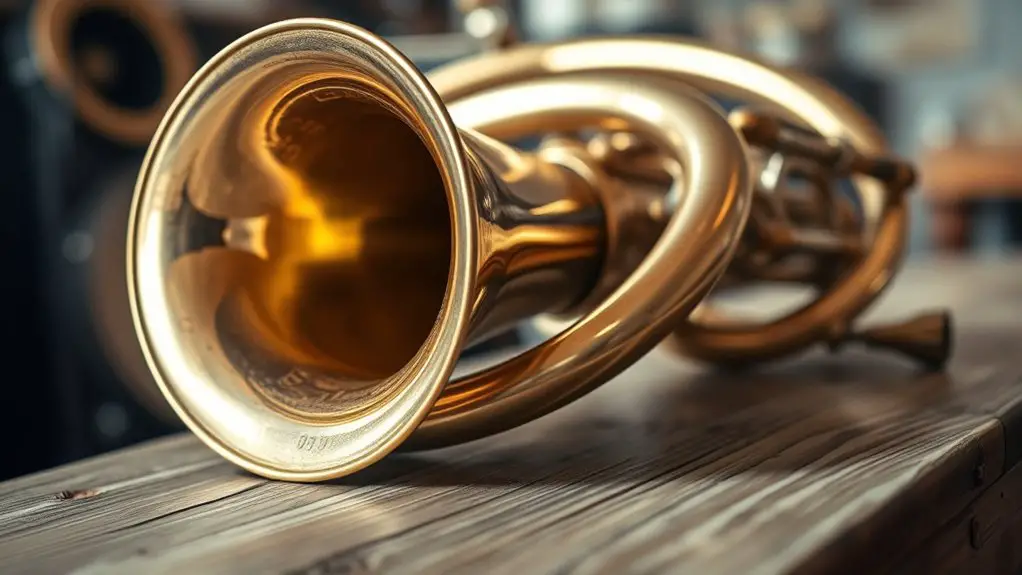
The orchestral horn is a brass instrument with long coiled tubing, a mouthpiece, valves, and a wide bell. Sound begins when the player’s lips vibrate against the mouthpiece. The air column inside the instrument then resonates, producing the horn’s characteristic tone.
According to Yamaha’s Musical Instrument Guide, the horn’s soft, resonant timbre allows it to blend effectively with both brass and woodwind instruments. Players also place the right hand inside the bell, which influences tone, pitch, and playing technique.
Natural Horns and Modern Valved Horns
Earlier European horns were much simpler than modern instruments. Natural horns consisted mainly of a mouthpiece, long tubing, and a bell. With no modern valve system, players relied heavily on the natural harmonic series and hand technique to obtain different notes.
Modern instruments use valves to redirect air through different lengths of tubing. Common designs include F horns, B♭ horns, and F/B♭ double horns. A double horn lets the player switch between two sets of tubing, combining useful characteristics of both instrument lengths.
Note: “French horn” remains common in everyday speech, but many musicians and instrument makers simply use the name “horn.”
Why Horns Matter in an Ensemble
Horns can sound warm and restrained or powerful and brilliant. That range makes them useful for lyrical melodies, harmonic support, fanfares, dramatic climaxes, and transitions between instrumental colors.
In orchestral music, the horn often blends with woodwinds while also supplying the strength expected from the brass section. Horns are also heard in concert bands, chamber music, jazz-related ensembles, popular arrangements, and film scores.
In jazz and other improvisational music, brass instruments give performers room to shape articulation, dynamics, phrasing, and tone in highly individual ways. In film music, horn sections are frequently used when composers want warmth, grandeur, suspense, or dramatic weight.
Automotive Horns: A Safety Essential
An automotive horn is primarily a warning device. It gives a driver a fast way to alert another road user when visual communication may not be enough. Appropriate uses can include warning a driver who is moving into an occupied lane, drawing attention to an immediate hazard, or alerting someone who has not noticed an approaching vehicle.
The horn supplements safe driving; it does not replace observation, braking, speed control, mirrors, turn signals, or other collision-avoidance measures.
How an Electric Car Horn Works
Many vehicle horns use an electromagnetic mechanism. As described in HELLA’s technical horn information, electrical current creates a magnetic field that moves an armature connected to a steel diaphragm. Repeated movement makes the diaphragm vibrate and creates the audible warning tone.
Vehicles can use different horn designs, including:
- Electromechanical horns: use a vibrating diaphragm driven by an electromagnetic mechanism.
- Electronic horns: use electronic control to generate or regulate the warning sound.
- Compressed-air horns: use pressurized air and are especially familiar on large trucks and other heavy vehicles.
Vehicle Horn Laws and Responsible Use
Horn requirements are not identical everywhere. Rules can differ by country, state, vehicle class, and type of horn.
For example, 49 CFR 393.81 requires covered U.S. buses, trucks, truck-tractors, and certain other commercial vehicles to have a horn capable of providing an adequate and reliable warning signal. That federal rule does not create a universal decibel specification for every passenger vehicle or every jurisdiction.
Warning: Vehicle-horn equipment and use laws vary by location. A horn should be used as a safety warning when appropriate, not as a substitute for safe driving or simply to express anger.
Animal Horns: Anatomy, Evolution, and Function
Animal horns have evolved in many forms, but not every structure casually called a “horn” is anatomically the same. Understanding the differences between true horns, antlers, pronghorn horns, and rhinoceros horns prevents a common source of confusion.
Horns vs. Antlers
The National Park Service explains that horns in animals such as bighorn sheep and bison are two-part structures: an internal bony core is covered by an outer keratinous sheath. These horns are generally retained and continue growing rather than being shed each year.
Antlers are different. They are made of bone, occur in members of the deer family, and are normally shed and regrown on a seasonal cycle.
| Structure | Typical Composition | Normally Shed? |
| True horn | Bony core with keratin sheath | No |
| Antler | Bone | Yes, seasonally in most species |
| Pronghorn horn | Bony core with keratinous sheath | Outer sheath is normally shed annually |
| Rhinoceros horn | Predominantly keratin rather than a typical bovid-style bony core and sheath | No annual shedding cycle |
A deer antler is not simply another kind of horn: antlers are bone and are normally shed, while typical true horns combine a bony core with a keratin sheath.
The Unusual Pronghorn
Pronghorns are a notable exception to the usual pattern. Their horns grow over permanent bony cores, but the outer keratin sheaths are shed and regrown. Male horns are also characteristically pronged. That combination makes the pronghorn different from both deer antlers and the permanent horns of animals such as bison and sheep.
Rhinoceros Horns Are Different
Rhinoceros horns do not have the same bony-core-and-sheath construction as typical bovid horns. They consist largely of keratin, the structural protein also found in hair and fingernails.
The U.S. Fish & Wildlife Service states that rhino horn has no proven medicinal efficacy and that demand for supposed medicinal and ornamental uses has contributed to poaching and illegal trafficking.
Warning: Claims that rhinoceros horn or other animal-horn products provide proven medical benefits should not be treated as established science. Wildlife products may also be restricted or illegal to buy, sell, import, or export.
Why Animals Have Horns
Horns can contribute to several biological functions, depending on the species. Common roles include:
- Competition: males of some species use horns in contests over dominance or access to mates.
- Defense: horns may help an animal confront predators or rivals.
- Display: horn size and shape can influence visual signaling within a species.
- Social interaction: horn-based contests can help establish rank without every encounter becoming a fight to the death.
A ram’s horns, for example, are functional structures used in contests between males. Natural selection can therefore influence horn size, shape, and durability when those traits affect survival or reproductive success.
Horns in Cultural Symbolism
Horns have carried many cultural meanings, but there is no single symbolism shared by every society. Their meaning depends on the animal, deity, object, period, and tradition being represented.
Power, Divinity, and Wild Nature
Horned figures appear frequently in ancient and later art. In Greek tradition, for example, Pan was commonly represented with goat-like features, including horns. Such imagery tied the god visually to herding, animals, and the untamed landscape rather than establishing a universal rule that horns always represent one particular idea.
The Cornucopia and Abundance
One of the clearest horn symbols is the cornucopia, or “horn of plenty.” In the Greek myth involving Hercules and the river god Achelous, a broken horn becomes associated with abundance. The Smithsonian American Art Museum describes this mythic horn as nature’s cornucopia or horn of plenty.
The image later became a familiar artistic symbol of harvest, prosperity, food, and abundance.
Horn as a Practical Material
Animal horn has also had practical uses. Before modern plastics became common, craftspeople could heat, cut, polish, and shape horn into useful or decorative objects. Depending on place and period, these included spoons, combs, handles, drinking vessels, containers, ornaments, and signaling devices.
Historical use should be distinguished from modern wildlife trade. Today, the legality and conservation impact of animal-horn products depend on the species and jurisdiction.
Innovations in Horn Design
Horn design continues to evolve, although modern innovation looks different in musical instruments and vehicles.
Modern Musical Horn Design
Conventional orchestral horns are still commonly built from metals such as brass and nickel silver. Makers refine bell geometry, tubing layout, valve construction, bore dimensions, detachable-bell systems, and ergonomic features to alter response and playing feel.
Computer-aided design and modern manufacturing can make experimentation and repeatability easier. 3D printing is also useful in some workshops for prototypes, tooling, replacement parts, experimental components, and limited specialty applications. It is more accurate to describe this as an additional design tool than as a wholesale replacement for traditional horn manufacturing.
Composite components such as carbon-fiber bells also exist in specialist markets. Their lower mass may appeal to some players, but material choice affects feel and acoustical behavior, so claims that one material universally improves sound should be treated cautiously.
Modern Vehicle Horns
Vehicle-horn development includes compact electronic controls, improved corrosion protection, weather-resistant housings, long-life diaphragm designs, and systems adapted for different vehicle voltages and applications.
Heavy vehicles may also use compressed-air horns, while passenger vehicles commonly rely on electrically powered warning horns. Whatever the technology, the purpose remains straightforward: produce a clearly recognizable warning when the driver needs to call attention to a hazard.
Pro Tip: When comparing claims about a “new” horn technology, separate prototype capability from widespread adoption. A material or process can be technically impressive without replacing established designs across an entire industry.
Frequently Asked Questions
What are the different types of horns used in animal species?
True horns, such as those of bison and sheep, normally have a bony core covered by a keratin sheath. Deer and their relatives grow antlers, which are bone rather than true horns and are normally shed seasonally. Pronghorns have permanent bony cores but shed their outer horn sheaths annually. Rhinoceros horns are largely keratin and lack the typical bovid-style bony core.
How are horns used in sports and competitions?
Audible horns or air horns can be used to attract attention, mark a start or finish, announce time periods, or communicate with participants and spectators. Their exact role depends on the sport and event rules. In many competitions, electronic timing, whistles, starting devices, flags, or other signals are used alongside or instead of horns.
Can horns be used as tools in some cultures?
Yes. Historically, natural horn has been shaped into signaling instruments, drinking vessels, containers, spoons, handles, combs, and decorative objects. Its toughness and ability to be cut, polished, and shaped made it useful before modern plastics and other manufactured materials became widely available.
Are there any health benefits associated with horn products?
Animal-horn products should not be assumed to provide proven medical or nutritional benefits. In particular, the U.S. Fish & Wildlife Service reports no proven medicinal efficacy for rhinoceros horn. Claims about powdered horn or similar wildlife products should be evaluated critically, and buyers must also consider conservation and wildlife-trade laws.
How are horn replicas made for educational purposes?
Educational replicas can be made from resin, plastic, plaster, silicone-molded casting materials, or 3D-printed polymers. A mold may be taken from an authorized specimen or a digital model may be created from measurements or scanning. Replicas allow students and museum visitors to study shape and structure without repeatedly handling fragile or protected biological material.
What is the difference between a horn and an antler?
A typical true horn has a bony core covered by a keratin sheath and is usually retained rather than shed each year. An antler is made of bone and is normally shed and regrown seasonally. Pronghorns are unusual because their permanent bony cores remain while the outer horn sheaths are shed.
Do all vehicle horns have the same legal sound limit?
No. Horn equipment standards and horn-use rules vary by jurisdiction and vehicle class. For example, U.S. federal rules for certain commercial vehicles require an adequate and reliable warning signal but do not create one universal horn decibel limit for every vehicle. Local requirements should be checked where the vehicle is operated.
Conclusion
Horns connect biology, music, transportation, craft, and culture, but the similarities largely end with the name and their historical links to signaling and natural horn material. A modern orchestral horn shapes an air column to create music, a vehicle horn provides an audible warning, and animal horns are anatomical structures shaped by evolution.
The distinctions matter. True horns are not the same as antlers, rhinoceros horn has no proven medicinal value, vehicle-horn laws are not universal, and newer manufacturing methods have supplemented rather than simply replaced traditional horn design. Looking at each type on its own terms reveals a much richer story of sound, survival, communication, craftsmanship, and symbolism.
Sources
- Yamaha — Musical Instrument Guide: Horn — horn construction, playing technique, sound, and instrument types.
- HELLA — Super Tone Horn Technical Information — operation of an electromechanical vehicle horn.
- Electronic Code of Federal Regulations — 49 CFR 393.81 — U.S. federal horn requirement for covered commercial vehicles.
- National Park Service — Horns versus Antlers — anatomical differences among true horns, antlers, and pronghorn structures.
- U.S. Fish & Wildlife Service — Rhino Horn and Illegal Wildlife Trade — rhino-horn composition, medicinal claims, and conservation concerns.
- Smithsonian American Art Museum — Achelous and Hercules — the cornucopia or “horn of plenty” in classical mythology and symbolism.
