
Last Updated on July 25, 2026 by Daniel Globe
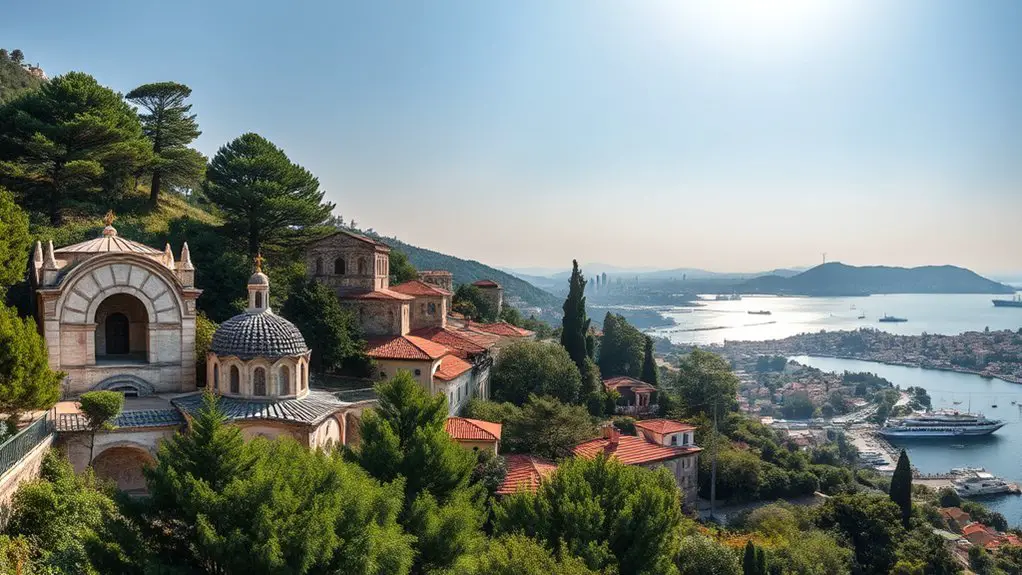
Heybeliada, the second-largest of Istanbul’s Princes’ Islands, carries layers of history that are easy to miss behind its pine-covered hills and waterfront houses. Known historically as Halki, the island is tied to Byzantine monastic life, Ottoman naval education, 19th-century resort culture, Republican-era institutions, and the continuing story of the Halki Theological School.
Quick Answer
Heybeliada’s history stretches from Byzantine-era monasteries to Ottoman and Republican institutions. Its modern character took shape in the 19th century as regular sea transport encouraged summer settlement, while the naval school and Halki Theological School made the island an important educational center. Much of the architecture visitors see today is later than the Byzantine period.
Key Takeaways
- Heybeliada was historically known as Halki, a name associated in local history with the Greek word for copper.
- The island has genuine Byzantine monastic roots, but many surviving buildings were rebuilt or substantially altered in later centuries.
- Heybeliada’s major Ottoman naval connection is its 19th-century naval school, not a documented 15th-century island shipyard.
- Improved ferry transportation helped turn Heybeliada into a fashionable 19th-century summer resort.
- The Halki Theological School opened in 1844, was rebuilt after the 1894 earthquake, and stopped teaching in 1971.
- As of July 2026, extensive renovation of the seminary is underway while discussions continue over its possible reopening.
Disclosure: As an Amazon Associate I earn from qualifying purchases. Some links on this page are affiliate links, at no extra cost to you.
Byzantine Roots and the Name Halki
Before it became known in Turkish as Heybeliada, the island was widely called Halki. Adalar Municipality’s history of the island connects the name with the Greek word halkos, meaning copper, and with ancient mining around Çam Limanı.
The island’s strongest documented connection to the Byzantine period is religious rather than residential. Monasteries and churches formed an important part of island life, and the Monastery of the Holy Trinity on today’s Ümit Tepesi has roots in the Byzantine era. The exact date of its original foundation is uncertain.
That distinction matters. Visitors should not assume that every old-looking church, monastery, or mansion on Heybeliada is a surviving Byzantine building. Much of the architectural fabric visible today comes from Ottoman and later periods, while several religious institutions occupy sites whose histories stretch much further back.
Heybeliada preserves continuity with the Byzantine world mainly through its religious sites and traditions, even though many of the standing buildings were reconstructed centuries later.
The Latin Period After 1204
The Fourth Crusade captured Constantinople in 1204 and created the Latin Empire, disrupting Byzantine control across the region. The Princes’ Islands were inevitably affected by the political changes surrounding the capital.
However, the evidence does not justify describing Heybeliada as covered with surviving “Crusader-era fortifications.” Island-specific architectural claims from this period should be treated cautiously unless tied to a documented archaeological site.
Byzantine rule in Constantinople was restored in 1261. Heybeliada’s monasteries remained the clearest link between the island and the medieval religious world surrounding the imperial capital.
Ottoman Rule and the Rise of Naval Education
Under Ottoman rule, Heybeliada remained closely connected to the maritime life of Istanbul. Adalar Municipality cites the 17th-century traveler Evliya Çelebi as recording officials on the island and noting that island revenues were associated with the office of the Kaptan Paşa, the Ottoman grand admiral.
Heybeliada’s best-documented naval importance, however, developed much later through naval education.
According to the official history of the Turkish Naval Academy, part of the Ottoman naval school was temporarily transferred to Heybeliada while new facilities were being prepared in Istanbul. The school returned to Kasımpaşa in 1838 and was later moved back to Heybeliada, where naval education became one of the island’s defining institutions.
The Heybeliada campus eventually included classrooms, accommodation, a hospital, a pharmacy, printing facilities, and a library. The institution went through several reorganizations during the late Ottoman and Republican periods.
Note: Heybeliada’s naval heritage is real and important, but it should not be confused with an unsupported claim that the Ottomans established a major shipyard on the island in the 15th century.
A 19th-Century Summer Resort
Heybeliada changed dramatically during the 19th century. Until then, the Princes’ Islands were relatively quiet communities compared with the expanding Ottoman capital.
A peer-reviewed study of Heybeliada’s 19th-century social and economic history notes that the Princes’ Islands became some of Istanbul’s most popular summer resorts as transportation improved from the middle of the century.
Regular sea connections made seasonal life on the islands practical for more Istanbul residents. Heybeliada’s shoreline settlement expanded, while villas, wooden houses, religious buildings, schools, gardens, and leisure spaces helped create the island character still associated with the Princes’ Islands today.
The summer-resort period was not simply a playground for a vague “elite.” Heybeliada developed as a socially and culturally mixed island community connected to Istanbul’s Muslim and non-Muslim populations, educational institutions, trades, fishing, and seasonal visitors.
Its surviving residential heritage is especially important. Many late Ottoman houses use the timber construction traditions once common throughout Istanbul. Registered houses on Heybeliada have consequently become a subject of architectural documentation and preservation research.
Halki Theological School: From 1844 to 1971
One institution towers over discussions of Heybeliada’s cultural history: the Halki Theological School, also called the Theological School of Halki or Heybeliada Seminary.
The school stands within the Monastery of the Holy Trinity on Ümit Tepesi. According to the Ecumenical Patriarchate’s official history, the monastery has Byzantine origins, while the theological school began operating in its modern institutional form in 1844.
The original school facilities were largely destroyed in the major Istanbul earthquake of 1894, although the church survived. Architect Periklis Fotiadis designed the replacement complex, which was inaugurated in 1896. This is why describing the standing school simply as “Byzantine architecture” is misleading: its religious roots are much older than its principal surviving educational buildings.
The seminary trained Orthodox clergy and church leaders for more than a century. It stopped providing theological instruction in 1971 following changes affecting private higher education in Türkiye.
Republican-Era Change, the Sanatorium, and Island Life
The early 20th century brought war, migration, demographic change, and new public institutions. Rather than following a simple story in which fashionable residents abandoned Heybeliada for “more exotic” destinations, the island passed through several periods of disruption and renewal.
Adalar Municipality notes that the island became quieter during the period surrounding the Turkish War of Independence and population movements of the era, then began gaining vitality again during the 1950s.
One important Republican-era institution was the Heybeliada Sanatorium, founded in 1924 and described by the municipality as Türkiye’s first sanatorium. Its presence linked the island’s pine-covered environment and sea air with an important chapter in the history of tuberculosis treatment in the country.
Heybeliada also became associated with prominent writers, public figures, schools, and cultural institutions. These layers make its history broader than a simple sequence of Byzantine, Ottoman, and tourist eras.
Modern-Day Heybeliada: Preserving the Past
Modern Heybeliada contains historic religious sites, military and educational buildings, wooden residences, public institutions, and recreation areas. Preservation is an ongoing process rather than a completed restoration program.
The island’s registered residential architecture has been studied as a distinct body of cultural heritage, and some historic structures are carefully maintained while others face the familiar problems of age, weather, fire risk, structural deterioration, changing ownership, and costly restoration.
| Historic Site | Key Date | Why It Matters |
| Holy Trinity Monastery and Halki Theological School | School opened 1844; current main complex 1896 | Combines Byzantine monastic origins with one of the most important institutions in modern Orthodox educational history. |
| Historic Naval School complex | 19th-century Heybeliada phase | Represents the island’s major role in Ottoman and later Turkish naval education. |
| Heybeliada Sanatorium | 1924 | An important landmark in the history of modern public health and tuberculosis treatment in Türkiye. |
| Late Ottoman wooden houses | Mainly 19th to early 20th century | Preserve part of the residential character that developed as Heybeliada became a major Istanbul summer resort. |
Halki Seminary Restoration and Reopening Discussions in 2026
Heybeliada’s most important current heritage development concerns the Halki Theological School.
As of July 2026, extensive renovation of the historic complex is underway. On July 9, 2026, Ecumenical Patriarch Bartholomew visited the school to inspect the work, according to an official Ecumenical Patriarchate update.
The Patriarchate has also confirmed ongoing discussions involving Turkish education authorities over the prospect of reopening the seminary. At the time of this update, however, the school should not be described as having already resumed theological teaching.
Note: The seminary’s status is developing quickly. Claims that it has formally reopened should be checked against the latest official announcement before publication or travel.
Experiencing Heybeliada’s Historic Landscape
The island’s history is best understood by seeing its different layers together rather than searching for a single “old town.” Around the settlement near the ferry pier are late Ottoman and Republican-era houses and civic buildings. Higher ground leads toward religious and educational sites, while Çam Limanı and Değirmenburnu preserve the island’s long relationship with recreation, woodland, and the sea.
Heybeliada remains largely defined by walking routes and low-impact local transportation rather than ordinary urban car traffic. That slower pace makes it possible to notice details such as wooden façades, garden walls, religious compounds, school buildings, and changes in the shoreline settlement.
Pro Tip: For a history-focused visit, allow enough time to explore beyond the ferry pier. Check access conditions for religious, military, and institutional properties before assuming that historic buildings are open to the public.
Frequently Asked Questions
What is the best way to get to Heybeliada from Istanbul?
Ferry is the standard way to reach Heybeliada. Şehir Hatları operates Princes’ Islands services from mainland Istanbul, with routes that can include Kabataş, Kadıköy, Beşiktaş, Bostancı, Maltepe, and other piers depending on the timetable. Check the official Şehir Hatları timetable before traveling. Fares change periodically, so use the official fare page rather than relying on an old fixed ticket price.
Are there any remaining Byzantine structures on Heybeliada?
Heybeliada has religious sites with Byzantine-era origins, especially the Holy Trinity monastic tradition, but many buildings standing today are later constructions or reconstructions. The Halki Theological School, for example, opened in 1844 and its present principal complex was inaugurated in 1896 after the earlier buildings were damaged by the 1894 earthquake. It is more accurate to speak of Byzantine religious continuity than to label every historic structure Byzantine architecture.
Can I stay overnight on Heybeliada?
Yes. Heybeliada has hotels, small guesthouses, and other overnight accommodation. Staying overnight offers a different experience from a day trip because the island becomes noticeably quieter after the busiest ferry traffic and daytime visitors leave. Availability is more limited than in central Istanbul, so booking ahead is sensible during summer weekends and holidays.
Are there beaches on Heybeliada?
Yes. Heybeliada has several coastal recreation and swimming areas. Değirmenburnu is identified by Adalar Municipality as a beach and picnic area, while Çam Limanı is one of the island’s best-known bays and recreation areas. Beach operators, fees, facilities, and access conditions can change seasonally, so check current local information before planning a swimming day.
Is Heybeliada a popular tourist destination?
Yes. Heybeliada is one of the main inhabited Princes’ Islands and attracts visitors for its historic buildings, pine-covered landscape, waterfront, walking routes, religious heritage, and quieter atmosphere compared with central Istanbul. Its strongest historic attractions include the Halki Theological School area, naval heritage, old residential streets, and the island’s bays and recreation areas.
Why was Heybeliada historically called Halki?
Halki was the island’s long-used Greek name. Local historical accounts connect it with halkos, the Greek word for copper, and with ancient mineral extraction around Çam Limanı. The Turkish name Heybeliada is commonly associated with the island’s shape, which was thought to resemble a saddlebag, or heybe.
Is the Halki Theological School open in 2026?
As of July 2026, the historic complex is undergoing major renovation and discussions about reopening the theological school are active. However, it should not yet be described as having fully resumed its pre-1971 educational role unless a newer official announcement confirms that classes have restarted.
Conclusion
Heybeliada’s history is richer than a simple progression from Byzantine island to Ottoman resort. Its Byzantine monastic roots, Ottoman naval-school tradition, 19th-century summer culture, Republican-era sanatorium, wooden residential heritage, and Halki Theological School all tell different parts of the same story.
The island is especially valuable because those layers remain visible within a compact landscape. A monastery with Byzantine origins can share the island’s story with an 1896 seminary complex, Ottoman-era naval institutions, early Republican public-health history, and residential streets shaped by Istanbul’s rise as a modern metropolis.
That story is still developing. The continuing restoration of the Halki Theological School and discussions surrounding its future give Heybeliada’s cultural heritage present-day significance as well as historical importance.
Sources
- Adalar Municipality — Heybeliada and Adalar Municipality Tourism Guide — island history, landmarks, bays, recreation areas, and local historical context.
- Ecumenical Patriarchate — Theological School of Halki — Byzantine monastic origins, the 1844 school opening, 1894 earthquake, 1896 reconstruction, and 1971 closure.
- Ecumenical Patriarchate — July 2026 Halki renovation update — current restoration work at the seminary.
- Turkish National Defence University, Naval Academy — History — documented development of naval education on Heybeliada.
- Journal of Turkology — The Social and Economic Structure of Heybeliada in the First Half of the 19th Century — social history and the growth of the Princes’ Islands as summer resorts.
- Şehir Hatları — Princes’ Islands Timetable and official fare tariffs — current ferry routes and pricing information.

