
Last Updated on July 25, 2026 by Daniel Globe
Büyükada’s history stretches from Byzantine exile and monastic life to Ottoman rule, a late 19th-century resort boom, and the multicultural island visitors see today. The largest of Istanbul’s Princes’ Islands was shaped not by one empire or community, but by centuries of religious foundations, summer residents, merchants, writers, political exiles, and changing transport links. Its historic mansions and monuments remain important, although preservation is still an ongoing challenge rather than a completed success story.
Quick Answer
Büyükada developed from a Byzantine place of monasteries, retreat, and imperial exile into a late Ottoman summer resort. Ferry connections helped fuel its 19th-century growth, while Greek, Armenian, Jewish, Levantine, Muslim, and foreign residents shaped its architecture. Today, protected historic districts, surviving mansions, religious sites, and museums preserve parts of that layered history.
Key Takeaways
- Büyükada and the other Princes’ Islands were used during the Byzantine period for religious retreat, imperial visits, and the exile of politically inconvenient members of elite society.
- Many sites have Byzantine roots, but much of the architecture visible today is later; it is misleading to describe the island as full of intact Byzantine palaces and churches.
- Büyükada’s major resort boom came centuries after the Ottoman conquest, accelerating during the 19th century as ferry connections improved access from Istanbul.
- The island’s famous villas and religious landmarks reflect a multicultural late Ottoman society rather than one single architectural tradition.
- Horse-drawn tourist carriages stopped operating in 2020. Walking, cycling, and authorized electric public transport now play the main roles in getting around the island.
Disclosure: As an Amazon Associate I earn from qualifying purchases. Some links on this page are affiliate links, at no extra cost to you.
Byzantine Roots and Imperial Exile
As you explore the history of Büyükada, the largest of Istanbul’s Princes’ Islands, its Byzantine past is one of the first layers to understand. According to the Adalar District Governorate’s history of the islands, the archipelago served at different times as a place of religious retreat, imperial summer use, and exile for important Byzantine figures.
The association with exile is one reason the archipelago became known in Western languages as the Princes’ Islands. Imperial family members, nobles, clergy, and political rivals who fell out of favor could be sent away from Constantinople while remaining relatively close to the capital.
Monasteries became especially important to Büyükada’s Byzantine identity. However, it is important to distinguish a Byzantine site from a building that has survived unchanged since Byzantine times. Fires, earthquakes, rebuilding, abandonment, and later construction altered many religious complexes over the centuries.
For example, Ayios Nikolaos Monastery stands in an area associated with the Byzantine settlement of Karya. Adalar Municipality describes the monastery itself as a 14th-century work whose history also includes fires, raids, earthquakes, and later alterations. It should therefore not be presented simply as an intact 12th-century Byzantine monastery.
Aya Yorgi, or the Monastery of St. George Koudounas, also has deep historical associations. Local and official histories connect its monastic tradition to the Byzantine period, while documentary references to monasteries on the islands survive from the Middle Ages. The buildings visitors encounter today, however, reflect rebuilding and development over later centuries rather than one untouched Byzantine structure.
Büyükada’s Byzantine legacy is best understood through its history of exile, monasteries, archaeological traces, and long-lived sacred sites—not through claims that its modern streets are filled with intact Byzantine palaces.
Ottoman Rule and the Rise of a Summer Resort
The islands passed into Ottoman control during the conquest of Constantinople. The Adalar District Governorate dates their conquest to April 17, 1453.
That political change did not instantly transform Büyükada into the fashionable summer resort associated with the late Ottoman period. For much of the Ottoman era, the island remained relatively modest compared with the dense capital across the water.
The resort culture developed gradually. Official district history notes that summer use revived toward the end of the 18th century, while settlement and seasonal life expanded much more dramatically in the 19th century.
Rather than being the product of a single Ottoman building style, Büyükada’s resort identity grew from a cosmopolitan mix of wooden villas, religious buildings, hotels, gardens, entertainment venues, and public spaces.
Improved transportation was one of the biggest forces behind that change. Adalar Municipality’s Büyükada history notes that the island’s population increased after ferry service began connecting the islands more closely with Istanbul. Regular maritime transport made a seasonal home on Büyükada practical for people who still had business and social ties in the city.
By the second half of the 19th century, Büyükada was becoming one of Istanbul’s best-known summer destinations. Its sea air, wooded hills, waterfront setting, and easier access attracted increasingly affluent seasonal residents and visitors.
A Hub for Wealthy Turks and Foreigners
During the late 19th and early 20th centuries, Büyükada’s popularity as a summer resort continued to grow. Its residents and seasonal visitors included Ottoman officials, wealthy Muslim families, Greeks, Armenians, Jews, Levantines, Europeans, and other communities connected with Istanbul’s commercial and cultural life.
As you walk through the island’s older residential districts, the grand wooden and masonry houses are among the clearest reminders of that period. Bay windows, verandas, towers, decorative woodwork, large gardens, and a mix of European and Ottoman-era influences give the streetscape a character unlike central Istanbul.
It is more accurate to describe these mansions as products of a cosmopolitan late Ottoman resort culture than as one uniform Ottoman architectural style. Different owners, architects, craftsmen, religious communities, and international fashions all contributed to Büyükada’s built environment.
Religious buildings tell the same multicultural story. Greek Orthodox churches and monasteries stand alongside Armenian and Catholic institutions, a synagogue, and mosques. One important late Ottoman landmark is Hamidiye Mosque, commissioned during the reign of Sultan Abdülhamid II and opened for worship in 1895.
Many historic houses remain private residences, while others have found new uses as hotels, cultural venues, or public buildings. Preservation is uneven, however. Some structures have been carefully maintained or restored, while others have suffered from neglect, fire, weather, redevelopment pressure, or structural decay.
Landmarks That Explain Büyükada’s History
Aya Yorgi Monastery
Located on Yücetepe, Büyükada’s highest hill, Aya Yorgi is one of the island’s best-known religious destinations. Its importance comes from the long history of the sacred site and its continuing role in religious life, not from the idea that the present church is an untouched Byzantine building.
Ayios Nikolaos Monastery
On the eastern side of the island, Ayios Nikolaos connects today’s Büyükada with the Byzantine settlement traditionally known as Karya. The site experienced destruction, earthquakes, and rebuilding over many centuries, making it a useful example of how historical layers overlap on the island.
Hamidiye Mosque
Opened in 1895, Hamidiye Mosque reflects the growth of Büyükada’s Muslim population during the late Ottoman period. Its decorated interior and architectural details make it one of the island’s most significant Ottoman religious buildings.
The Büyükada Greek Orphanage
Another striking landmark is the enormous wooden Greek Orphanage on İsa Tepesi. According to Adalar Municipality, the building was constructed in 1898 by a French company with the intention of operating it as a hotel. After that plan failed to receive the required approval, the building was acquired and adapted for use as an orphanage.
The structure later became one of Büyükada’s most important endangered heritage sites. Its condition is a reminder that the island’s architectural heritage has not simply been “restored to grandeur”; major conservation challenges remain.
Republic-Era Büyükada and Leon Trotsky
Büyükada’s history did not end with the Ottoman Empire. Social and demographic changes affected the island during the early Turkish Republic, while its reputation as a retreat continued to attract officials, writers, artists, and other prominent residents.
One of its most internationally famous residents was Leon Trotsky. After his expulsion from the Soviet Union, Trotsky lived on Büyükada from 1929 to 1933. Istanbul’s official visitor platform recounts his years on the island and his work there during exile.
Trotsky’s Büyükada residence is historically significant, but it should not be treated as a normal museum stop: the historic property has deteriorated and access conditions can differ from those of public attractions. His time on the island nevertheless added another chapter to Büyükada’s much older association with political exile.
Preservation and Revitalization Efforts
While Büyükada’s mansions and tree-lined streets can create the impression of a place frozen in time, the island’s heritage has faced decades of pressure. Historic wooden buildings are particularly vulnerable to fire, neglect, redevelopment, weather, and expensive maintenance.
Rather than relying on an unverified list of recent restoration projects, Büyükada’s conservation history is better understood through documented legal protections and planning decisions.
| Year | Verified Milestone | Why It Matters |
|---|---|---|
| 1973–1979 | A series of heritage-board decisions identified the islands as natural and historic areas requiring protection. | These decisions established an important legal foundation for conserving the archipelago’s landscape and built heritage. |
| 1984 | Büyükada, Heybeliada, Burgazada, Kınalıada, and Sedefadası were designated together as an integrated protected-site ensemble. | Protection began to treat the islands’ natural and cultural character as an interconnected whole. |
| 2020 | Istanbul Metropolitan Municipality stopped phaeton operations following the glanders crisis and moved island transportation toward electric vehicles. | The change ended the horse-drawn carriage era that had long been associated with Büyükada tourism. |
| 2021 | The Marmara Sea and Islands were designated a Special Environmental Protection Area. | Modern conservation policy increasingly addresses natural heritage and environmental pressures alongside historic buildings. |
| 2024–2026 | Conservation planning, transportation management, environmental projects, and heritage debates have continued through municipal and national authorities. | Büyükada remains a living community whose preservation needs must be balanced with tourism, housing, transport, and environmental protection. |
These measures have strengthened protection, but they have not eliminated the island’s conservation problems. Some historic structures remain endangered, and planning decisions continue to evolve.
Note: Büyükada and the Princes’ Islands are sometimes described online as being on UNESCO’s World Heritage Tentative List. As of July 2026, the official UNESCO Tentative List for Türkiye does not contain Büyükada, Adalar, or the Princes’ Islands as a listed property. Heritage advocates have discussed potential nomination efforts, but that is not the same as official Tentative List status.
Modern-Day Büyükada: A Historic Island Still Evolving
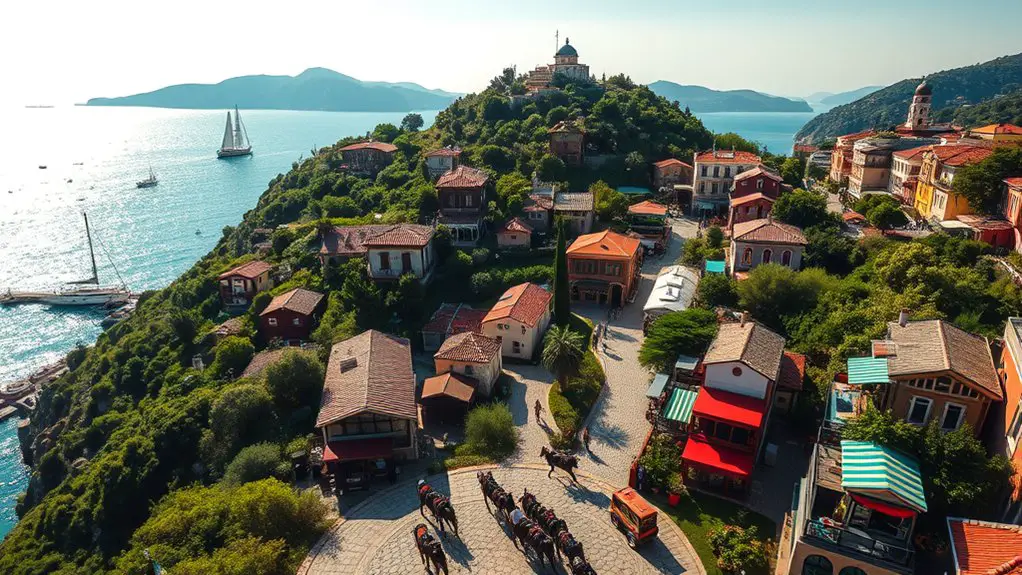
Today, Büyükada remains both a residential community and one of Istanbul’s most popular island destinations. Its historic character survives in religious monuments, wooden villas, gardens, waterfront buildings, and neighborhoods developed during the late Ottoman and early Republican periods.
You can still spend time by the coast, visit beaches, cycle, walk through residential streets, and follow routes toward the island’s hilltop religious sites. Calling every beach “pristine,” however, is unnecessary; conditions, services, and crowds vary by location and season.
Restaurants around the island serve seafood and Turkish dishes, while the historic center around the ferry pier provides the liveliest concentration of cafes, shops, and public activity.
One experience you can no longer book is the traditional tourist horse-drawn carriage ride. Istanbul Metropolitan Municipality records show that phaeton operations were stopped in 2020 and island transport was reorganized around electric vehicles. Walking and cycling remain popular ways to experience Büyükada at a slower pace.
For a deeper look at the island’s past, the Museum of the Princes’ Islands on Büyükada is especially useful. Opened in 2010, it presents the history, literature, communities, and cultural life of the archipelago.
Büyükada therefore works best not as a perfectly preserved relic, but as a living historic landscape. Byzantine memories, late Ottoman resort culture, Republican-era stories, religious traditions, tourism, and conservation debates all remain visible in different ways.
Frequently Asked Questions
Are there still Byzantine-era structures on Büyükada?
Büyükada has sites with strong Byzantine-era connections, especially former monastic locations, but visitors should not expect a collection of intact Byzantine palaces and castle walls. Many early structures disappeared, survive only as archaeological traces, or were rebuilt in later centuries. Ayios Nikolaos occupies an area connected with Byzantine Karya, while Aya Yorgi has a long monastic tradition but later visible construction.
Can I rent a horse-drawn carriage on Büyükada?
No. The traditional phaeton system was stopped in 2020. Visitors now explore Büyükada mainly on foot, by bicycle, or with authorized electric public transportation and island taxi services.
Are there museums on Büyükada showcasing its history?
Yes. The Museum of the Princes’ Islands, or Adalar Müzesi, opened on Büyükada in 2010. Its exhibitions cover the islands’ communities, natural environment, architecture, literature, daily life, and historical development.
Can I stay overnight on Büyükada or only visit for the day?
You can stay overnight. Büyükada has hotels, historic accommodation properties, and guesthouses in addition to being a popular day-trip destination. Staying overnight also lets you experience the island after much of the daytime ferry traffic has left.
Are there restrictions on swimming at Büyükada’s beaches?
Swimming is available at several beaches and coastal facilities, but access rules, opening periods, lifeguard coverage, and services vary. Follow posted beach rules and local warnings, and check sea and weather conditions before entering the water.
Why are they called the Princes’ Islands?
The name reflects the archipelago’s long association with Byzantine princes, imperial relatives, nobles, and other prominent figures who were sent to the islands in exile or retreat. Büyükada became one of the best-known islands connected with this history.
When did Büyükada become a fashionable summer resort?
Although the islands had been used for retreat much earlier, Büyükada’s major resort growth took place during the 19th century. Better ferry connections made regular travel from Istanbul easier, encouraging seasonal settlement, hotels, entertainment venues, and construction of elaborate summer houses.
Is Büyükada on the UNESCO World Heritage Tentative List?
No. As of July 2026, neither Büyükada nor the Princes’ Islands appears as a property on Türkiye’s official UNESCO World Heritage Tentative List. There have been heritage campaigns and discussions about future recognition, but those efforts should not be confused with formal Tentative List status.
Sources
- Adalar District Governorate — History of the Princes’ Islands — Byzantine exile, imperial use, Ottoman conquest, and development of the islands as summer destinations.
- Adalar Municipality — Büyükada — island geography, population history, ferry-driven growth, and major historic sites.
- Adalar Municipality — Ayios Nikolaos Monastery — the Karya site, monastery chronology, earthquakes, fires, and rebuilding.
- Istanbul Metropolitan Municipality — Adalar Conservation Planning — protected-site decisions, conservation plans, 2020 phaeton decision, and 2021 environmental protection status.
- UNESCO World Heritage Centre — Türkiye Tentative List — current official UNESCO Tentative List status.
- Europa Nostra — Prinkipo Greek Orphanage Conservation Report — condition, heritage significance, and continuing preservation challenges of the orphanage complex.
Conclusion
Büyükada’s history is more complex than a simple progression from Byzantine exile to an Ottoman vacation spot. Its identity grew from Byzantine monastic traditions, centuries of political change, late Ottoman ferry connections, multicultural communities, elaborate summer houses, religious institutions, and Republic-era figures such as Leon Trotsky. The island’s surviving architecture makes those layers visible, but preservation remains an active challenge. Understanding that mix of survival, rebuilding, loss, and adaptation makes Büyükada far more interesting than the romantic postcard version alone.
