

Last Updated on July 31, 2026 by Daniel Globe
Disclosure: As an Amazon Associate, we earn from qualifying purchases. If you click a link on this page and make a purchase, we may receive a small commission at no extra cost to you.
A beginner GPS drone should be easy to control, portable enough to carry, and reliable enough to return when the signal or battery drops. The Tercaso HK88 combines a 2K camera, GPS-assisted return, brushless motors, app controls, and two batteries in a foldable package. Its feature list is strong for casual practice and basic aerial photography, but the listing has an important weight discrepancy and does not include a mechanical camera gimbal. This review helps you decide where the HK88 fits and which claims you should confirm before ordering.
Quick Verdict
Rating: 7.5/10, recommended with caveats
Best For: Beginners who want GPS return, simple app flight modes, and a 2K FPV camera without moving to a premium drone.
Bottom Line: The HK88 offers a useful mix of beginner controls, brushless motors, and two-battery flight time. The limited listed control range, lack of a true gimbal, and conflicting weight data make it better for casual flying than serious aerial filmmaking.
| Specification | Detail |
|---|---|
| Brand | Tercaso |
| Model | HK88 |
| Product type | Foldable GPS FPV quadcopter |
| Camera | 2K video, 2.07 MP effective still resolution, CMOS sensor |
| Camera angle | 110-degree wide-angle lens with 90-degree adjustment |
| Video link | 5 GHz FPV transmission to a compatible phone |
| Flight motors | Brushless motors |
| Positioning | GPS, altitude hold, and optical flow |
| Flight modes | Follow Me, circle flight, waypoint path, Headless Mode, gesture shooting, one-key takeoff and landing |
| Battery | Two 2,000 mAh lithium-ion batteries |
| Claimed flight time | Up to 40 minutes combined across both batteries |
| Listed maximum range | 30 meters |
| Controls | Included remote control and smartphone app |
| Storage | Phone or compatible SD card |
| Material and color | Gray plastic |
| Amazon item dimensions | 8.3 x 7.8 x 2.8 inches |
| Weight note | Marketing copy says under 250 g, while Amazon item details also show 1.28 lb. Confirm the aircraft weight for the current package. |
| Included accessories | Remote, two batteries, and carrying bag |
| Recommended minimum age | 15 years, according to the listing |
What Is the Tercaso HK88 GPS Drone?
The Tercaso HK88 is a foldable camera drone aimed at beginners and casual hobby pilots. It pairs a 2K camera with GPS positioning, optical-flow support, altitude hold, brushless motors, and app-based intelligent flight modes. You can fly it with the included controller while using a compatible phone for live FPV video and app functions.
The main selling point is breadth rather than professional image quality. You get GPS return, Follow Me, circle flight, waypoint paths, gesture shooting, Headless Mode, and one-key takeoff and landing in one package. The camera has a wide 110-degree field of view and can tilt through 90 degrees, but the listing describes shock absorption rather than a mechanical two-axis or three-axis gimbal.
Who Should Buy It?
Best For
- New pilots who want GPS return and one-key controls as a safety net.
- Casual travelers who value a foldable design, carrying bag, and two batteries.
- Hobby users who want basic 2K aerial clips, FPV viewing, and automated flight modes.
Skip If
- You need stabilized cinematic footage from a true mechanical gimbal.
- You need long-range control beyond the listed 30-meter maximum.
- You need confirmed sub-250 g aircraft weight or documented Remote ID support.
Before You Buy: Do not rely only on the “under 250 g” marketing line. Amazon also lists an item weight of 1.28 lb, so confirm the aircraft’s actual takeoff weight and the rules that apply to your intended recreational or non-recreational flight.
Products Worth Considering

【2K HD Camera & 5G Real-time Transmission 】The 2K drone is equipped with a 90° electrically adjustable camera, enabling effortless adjustment of the camera angle for enhanced perspectives. Built-in shock absorption and 5GHz FPV transmission ensures smooth and stable videos. HD photos and videos can be saved directly to your phone through the app, making it easy to view and share your happy moments on social media.
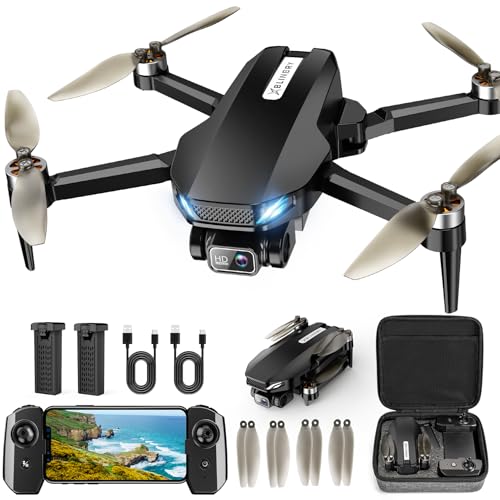
【2K HD Camera & 5G Real-time Transmission 】The 2K drone is equipped with a 90° electrically adjustable camera, enabling effortless adjustment of the camera angle for enhanced perspectives. Built-in shock absorption and 5GHz FPV transmission ensures smooth and stable videos. HD photos and videos can be saved directly to your phone through the app, making it easy to view and share your happy moments on social media.

【Under 0.55lb Mid-sized Drone, No FAA Registration】Designed with a unique material composition, the N11 PRO is a remarkably valuable mid-sized GPS drone (not mini ones). Its weight is kept under 0.55lb, eliminating the need for FAA registration. This drone provides a perfect solution for hassle-free flying in the States without FAA, making it ideal for capturing stunning footage on the go.
Design, Build, and Portability
The HK88 uses a foldable gray plastic body and comes with a carrying bag. Amazon lists item dimensions of 8.3 x 7.8 x 2.8 inches, though it does not clearly label whether those measurements reflect the folded aircraft, unfolded aircraft, or packaged item. The compact layout should be easier to carry than a fixed-arm drone, but you should check the current listing images and package details before choosing a case or backpack compartment.
Brushless motors are a meaningful upgrade over the small brushed motors found on many entry-level toy drones. They usually run more smoothly, create less motor noise, and need less routine replacement. They do not make the aircraft windproof, so you should still avoid gusty conditions, especially while learning.
Camera and Video Quality
The camera records up to 2K video and uses a 2.07 MP CMOS sensor. Its 110-degree wide-angle view helps you fit landscapes, buildings, and groups into the frame, while the 90-degree adjustable angle lets you point the camera forward or downward before or during a flight, depending on the control setup.
Video can be viewed through a 5 GHz FPV connection and saved to your phone or a compatible SD card. The listing also mentions built-in shock absorption, which may reduce small vibrations. It is not the same as a powered gimbal, so turns, wind, and abrupt stick inputs can still tilt or shake the frame.
Pro Tip: Use slow control inputs and fly in calm air when recording. Smooth acceleration and wide, gentle turns will do more for usable footage than relying on digital or passive stabilization alone.
Flight Stability and Control
GPS positioning supports outdoor return functions and location-based modes. Altitude hold helps the drone maintain height, while optical flow can improve low-altitude positioning when the downward sensor has enough light and surface detail. These aids reduce workload, but they do not replace active piloting or a clear view of the aircraft.
The HK88 offers two speed settings, Headless Mode, one-key takeoff and landing, Follow Me, circle flight, and app-drawn waypoint paths. Headless Mode can simplify directional control for beginners, although learning the drone’s true nose orientation will make you a safer pilot as your skills improve.
Auto return can activate after a low-battery warning, signal loss, or a manual command. Treat it as a backup, not a guarantee. GPS accuracy, takeoff-point recording, obstacles, wind, battery state, and the selected return behavior can affect where the aircraft lands.
Battery Life, Range, and App Controls
The package includes two 2,000 mAh lithium-ion batteries. Tercaso claims up to 40 minutes of total flight time when both batteries are used, which works out to roughly 20 minutes per battery under ideal conditions. Wind, speed, recording, temperature, battery age, and return-to-home reserve can reduce practical airtime.
Amazon’s specification table lists a maximum range of 30 meters. That is suitable for close practice, backyard-scale flying where legal, and nearby framing, but it is much shorter than the range offered by higher-tier camera drones. Keep the aircraft within visual line of sight and do not use the live phone view as your only reference.
The smartphone app supports live video, flight-path drawing, gesture shooting, flight-track records, and selected automated modes. App reliability depends on phone compatibility, permissions, wireless interference, and the version available when you install it. Check the manual’s QR code or official app name rather than downloading a similarly named third-party app.
Safety Features and User Guidance
The HK88 includes overcurrent protection, an emergency-stop command, low-battery return, signal-loss return, and flight-track recording. These features can help reduce risk, but an emergency stop may cause the drone to drop rather than land. Use it only when stopping the motors is safer than allowing continued flight.
For U.S. recreational flying, the FAA requires you to pass TRUST and follow recreational operating rules. A drone under 250 g may avoid registration only when it is flown exclusively under the recreational exception. All drones flown under Part 107 must be registered regardless of weight, and registered drones generally must meet Remote ID requirements unless an exception applies.
Check local airspace, temporary flight restrictions, property rules, privacy laws, and park restrictions before takeoff. Keep people, pets, trees, power lines, roads, and moving vehicles out of your flight path. Younger pilots should use close adult supervision even though the listing markets the drone to both adults and kids.
How It Performs in Real Use
For First Flights
One-key takeoff, altitude hold, Headless Mode, and two speed settings make the HK88 approachable for first-time pilots. Start in the slower mode and practice hovering, nose-in orientation, square patterns, and controlled landings before trying automated paths.
For Casual Aerial Photos
The 2K camera and wide lens are suitable for social posts, vacation overviews, and basic landscape clips in good daylight. Results will be less polished than footage from a stabilized 4K drone, especially during turns or in wind.
For Travel
The folding body, carrying bag, and dual-battery setup are convenient for day trips. Airline and destination rules vary, so protect battery terminals, carry lithium batteries in your cabin baggage when required, and check local drone restrictions before you travel.
For Indoor Practice
The manufacturer suggests windless indoor practice for beginners, with conservative height and distance limits. Use a large, uncluttered room only, keep propellers away from people and fragile objects, and confirm that GPS-dependent modes are disabled or behaving as the manual describes indoors.
Setup Tips Before First Use
- Read the HK88 manual fully. Confirm the correct app, controller pairing steps, battery charging procedure, and return-to-home behavior.
- Inspect every propeller. Replace cracked, bent, loose, or incorrectly mounted blades before takeoff.
- Calibrate as directed. Complete compass or gyro calibration in an open area away from vehicles, steel structures, magnets, and strong electrical sources.
- Wait for a reliable GPS lock outdoors. Verify that the home point has been recorded before flying farther away.
- Test controls at low altitude. Check yaw, pitch, roll, hover, landing, and return direction before starting an automated mode.
- Land with reserve power. Do not plan a flight around the full advertised battery time. Leave enough charge for wind, navigation errors, and a controlled landing.
Pros and Cons
Pros
- 2K camera with a 110-degree lens and 90-degree angle adjustment.
- GPS return, altitude hold, and optical flow support beginner control.
- Brushless motors should provide smoother, quieter operation than basic brushed designs.
- Two 2,000 mAh batteries provide a claimed 40 minutes of combined flight time.
- Foldable body, carrying bag, remote, app controls, and several automated modes are included.
Cons
- The listing’s under-250 g claim conflicts with its 1.28 lb item-weight specification.
- The listed 30-meter maximum range limits larger outdoor shots.
- Shock absorption cannot match the stabilization of a mechanical gimbal.
Is It Worth the Price?
The HK88 fits the budget-to-mid-range beginner category based on its feature set. You get GPS functions, brushless motors, dual batteries, a carrying bag, and a 2K FPV camera, which is a useful package when your priority is learning and casual recording rather than professional production.
It offers the most value to a first-time buyer who will stay close, fly in calm conditions, and use the automated modes as training aids. It is not the best fit when you need long-distance transmission, a verified sub-250 g platform, polished gimbal-stabilized footage, or a clearly documented Remote ID system.
Products Worth Considering

【Lightweight 249g, No FAA Registration Required】This lightweight drone weighs under 249g/8.7 ounces, allowing adults to fly without the need for FAA registration, making it the ideal choice for hassle-free flights and easy portability

【2K HD Camera & 5G Real-Time Transmission】 Capture crisp 2K high-resolution photos and videos with smooth 5G Wi-Fi transmission for a stable, real-time viewing experience by using Scrubuz drones. Thanks to the 90° electric adjustable camera with 110° wide-angle lens, allowing you to achieve more vast landscapes, which can be saved to the Micro SD card not exceed 64GB or directly on your mobile device.
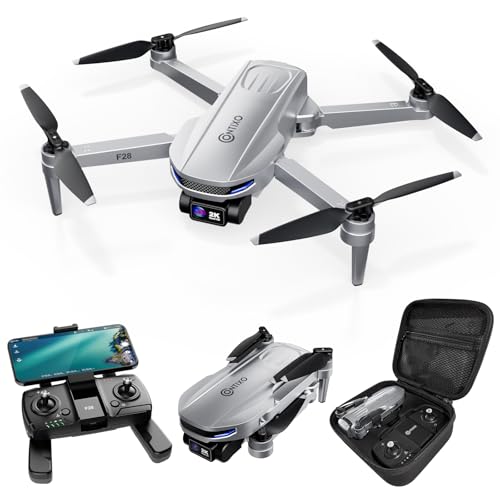
Exceptional HD Camera & FPV Drone - The F28 camera drone is equipped with a 2K Full HD Camera, offering a FOV of 85° and adjustable angles ranging from 0° to 90°, ensuring that your video drones capture better aerial photos and videos from a bird-eye perspective.
How It Compares to Alternatives
The Holy Stone HS360S is worth comparing when you want a better-known beginner brand, a published 249 g aircraft weight, and a much longer advertised control range. The DJI Mini 4K costs more but adds a three-axis gimbal, 4K recording, and a mature flight ecosystem that is better suited to smooth travel video.
The Tercaso HK88 makes more sense when you want a lower-cost practice drone with GPS return, two batteries, and several app modes, and you can accept its shorter listed range and less advanced camera stabilization.
Products Worth Considering

【Drone with Camera】Equipped with GPS drone FPV camera and a 90° electrically adjustable lensy, this drone for adults capture stunning aerial photos and videos from virtually any angle. Whether you're flying over forests, beaches, mountains, or cityscapes, it delivers breathtaking views and immersive experiences—helping creators preserve unforgettable moments and bring their vision to life.

𝟒𝐊 𝐂𝐚𝐦𝐞𝐫𝐚 𝐟𝐨𝐫 𝐒𝐡𝐚𝐫𝐩, 𝐃𝐞𝐭𝐚𝐢𝐥𝐞𝐝 𝐒𝐡𝐨𝐭𝐬: Capture crisp photos and clear 4K video for trips, family moments, and everyday outdoor filming. The 110° wide-angle lens helps you fit more scenery into every frame.

【Drone with Camera】Equipped with GPS drone FPV HD camera and a 90° electrically adjustable lensy, this drone for adults capture stunning aerial photos and videos from virtually any angle. Whether you're flying over forests, beaches, mountains, or cityscapes, it delivers breathtaking views and immersive experiences—helping creators preserve unforgettable moments and bring their vision to life.
Frequently Asked Questions
How long does the Tercaso HK88 fly?
The listing claims up to 40 minutes across two 2,000 mAh batteries, or roughly 20 minutes per battery under ideal conditions. Plan for less time when flying in wind, recording video, using faster modes, or keeping a safe landing reserve.
Does the HK88 require FAA registration?
The answer depends on the aircraft’s actual weight and how you fly it. The listing says under 250 g but also shows 1.28 lb in item details, so verify the current aircraft weight. In the United States, all Part 107 drones require registration, while sub-250 g drones flown only under the recreational exception may be exempt.
Does it have a mechanical gimbal?
The listing mentions shock-absorbing technology and a 90-degree adjustable camera, but it does not identify a mechanical gimbal. Expect basic vibration control rather than the level, smooth footage produced by a two-axis or three-axis gimbal.
What is the remote-control range?
Amazon’s technical details list a maximum range of 30 meters. Obstacles, wireless interference, phone performance, and local conditions can reduce the usable distance, so keep the drone close and within visual line of sight.
Can you fly the HK88 indoors?
The manufacturer recommends calm indoor practice for beginners, but you need a large, clear space and close control. GPS may not work indoors, so read the manual’s guidance for optical flow, altitude hold, and return functions before takeoff.
Can it save photos and videos to an SD card?
The listing says recordings can be stored on a compatible SD card or phone. Confirm the supported card type and capacity in the manual because the Amazon page does not clearly state those limits.
What happens if the signal or battery gets low?
The HK88 is designed to return near its recorded takeoff point after signal loss, low battery, or a manual return command. You should still confirm GPS lock and the home point before flying because obstacles, wind, and weak positioning can affect the return path.
Who should skip this drone?
Skip it when you need cinematic stabilization, long-range transmission, confirmed Remote ID capability, or a verified takeoff weight for regulatory planning. It is better suited to supervised beginner practice and close-range casual footage.
The Bottom Line
The Tercaso HK88 is a reasonable starter drone for close-range practice, basic 2K footage, and learning GPS-assisted flight modes. Buy it for the brushless motors, dual batteries, and beginner controls, but skip it when you need a true gimbal, long range, or fully consistent weight and compliance details.
Ready to Buy?
Check the latest price, package contents, aircraft weight, and product details before you decide.
