
Last Updated on July 27, 2026 by Daniel Globe
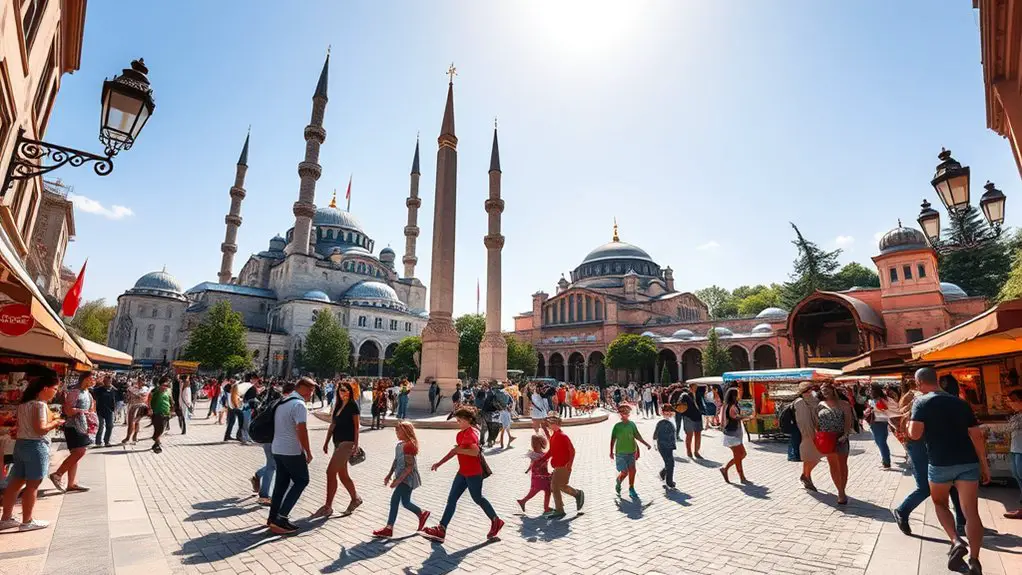
Sultanahmet packs more family-worthy sights into a single walkable district than almost anywhere else in Istanbul. From soaring domes to underground cisterns and a lush historic park where kids can run off their energy, this old-city neighborhood blends living history with genuine kid appeal. Here is how to navigate the sights, manage your budget with 2026 ticket updates, and fit it all into a seamless 1-day itinerary with your family.
Quick Answer
The must-see family stops in Sultanahmet are the Hagia Sophia, Blue Mosque, Topkapi Palace, Basilica Cistern, Istanbul Archaeological Museums, the Hippodrome, and Gülhane Park. All sit within a 10-minute walk of each other, allowing families to explore the entire district in a single well-paced 6- to 8-hour day.
Key Takeaways
- Walkable Proximity: All main historical attractions sit within 10–15 minutes of each other, making public transit unnecessary once you arrive.
- 2026 Ticket Rules: Foreign tourists pay €25 for Hagia Sophia’s upper gallery, 2,750 TL for Topkapi Palace with Harem, 1,950 TL for the Basilica Cistern (daytime), and €15 for the Archaeological Museums.
- Free Attractions: The Blue Mosque, the Hippodrome, and Gülhane Park are completely free to enter.
- Kids’ Free Entry Cutoffs: Age limits for free admission vary: under 8 at Hagia Sophia, under 7 at Basilica Cistern, under 6 at Topkapi Palace, and 12 and under at the Archaeological Museums (valid passport required).
- Pacing & Breaks: Balance indoor tile and mosaic viewing with outdoor playtime at Gülhane Park and snack stops for Turkish ice cream (Dondurma) and Simit.
At a Glance: Sultanahmet with Kids
| Time Needed | A full day (6–8 hours) to cover major sights at a comfortable family pace |
| Getting There | T1 Tram line to Sultanahmet Station — main sights sit within 100–500 meters |
| Free Attractions | Blue Mosque, Hippodrome (Sultanahmet Square), Gülhane Park |
| Paid Entry (2026 Rates) | Hagia Sophia (€25), Topkapi Palace (2,750 TL), Basilica Cistern (1,950 TL daytime), Archaeological Museums (€15) |
Disclosure: As an Amazon Associate I earn from qualifying purchases. Some links on this page are affiliate links, at no extra cost to you.
The Hagia Sophia: A Journey Through History
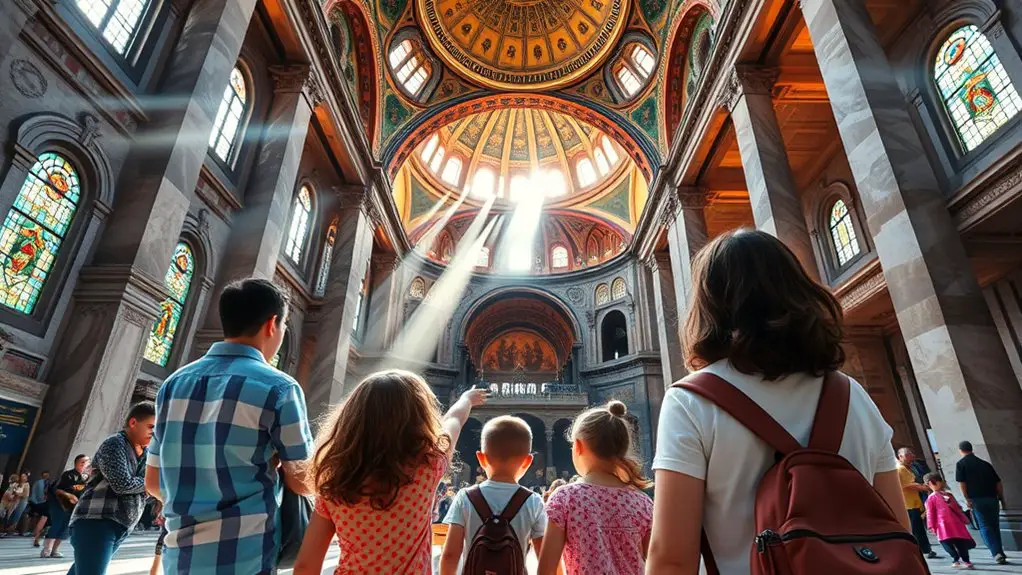
Step inside the Hagia Sophia and you are standing in a building that has served as a Byzantine cathedral, an Ottoman mosque, a museum, and now an active mosque again. Commissioned by Byzantine Emperor Justinian I and completed in 537 AD by Anthemius of Tralles and Isidore of Miletus, its soaring 31-meter dome was one of the most daring engineering feats of late antiquity.
The vast central hall features massive arches that create an ethereal atmosphere as natural sunlight filters through golden glass mosaics. As you explore, children can spot where Christian symbols and Islamic calligraphy exist side by side — a physical record of Istanbul’s shifting empires.
Note: Foreign visitors pay a €25 entrance fee to access Hagia Sophia’s upper gallery, which includes a downloadable QR-code AR audio guide. This gallery offers the best views of the famous Byzantine mosaics (including the Deësis mosaic) and the marble interiors. Children under 8 enter free with valid passport verification. The ground floor is reserved exclusively for Muslim prayer services.
Warning: Hagia Sophia closes to tourist visits on Fridays between 12:00 PM and 2:30 PM for congregational Friday prayers. Plan your visit for early morning (09:00 AM) to avoid long security queues and prayer closures.
The Blue Mosque: A Stunning Architectural Marvel
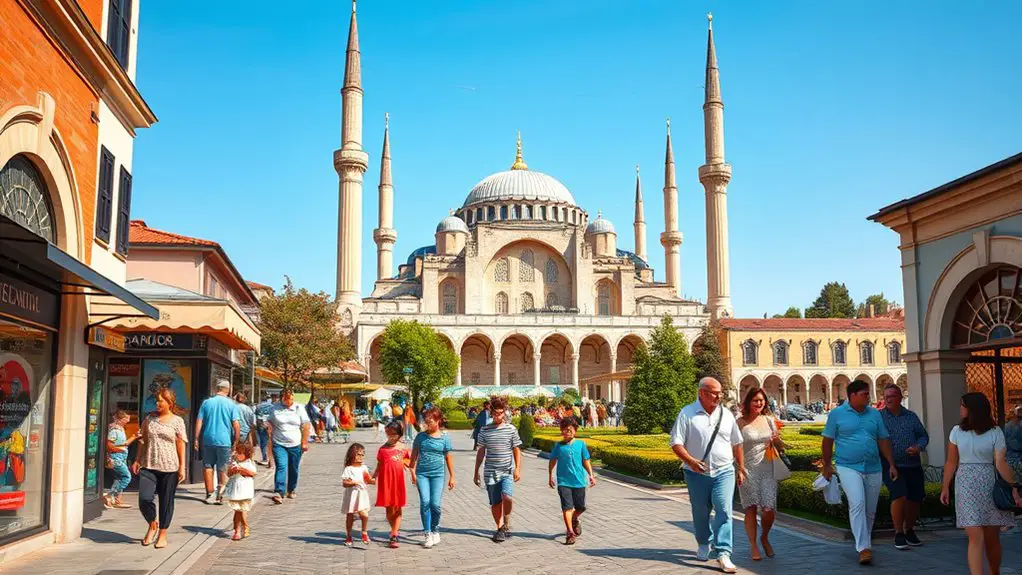
Directly across Sultanahmet Square from the Hagia Sophia, the Blue Mosque (Sultan Ahmed Mosque) showcases the peak of 17th-century classical Ottoman architecture. With its cascading central domes and unique six minarets, it forms an iconic anchor of Istanbul’s skyline.
Admission is free for all visitors because the mosque remains an active house of worship. However, tourists must plan around the five daily prayer times and observe modest dress guidelines.
Architectural Design Features
Inside, the prayer hall is illuminated by over 200 stained-glass windows and decorated with more than 20,000 handmade İznik ceramic tiles featuring floral tulip, carnation, and cypress patterns. The massive dome rests on four giant pillars (“elephant feet”), distributing structural weight outwards to create an open, column-free interior that feels expansive for visitors of all ages.
Historical Significance
Commissioned by Sultan Ahmed I and constructed between 1609 and 1617 by architect Sedefkâr Mehmed Ağa (a direct student of the legendary Mimar Sinan), the mosque was intentionally built directly opposite Hagia Sophia to demonstrate Ottoman architectural mastery alongside Byzantine heritage.
Visitor Experience Tips
To keep young visitors engaged, turn your walkthrough into an architectural scavenger hunt: challenge kids to spot different tile patterns or count the six minarets from the central courtyard. All visitors must remove their shoes before entering (plastic carrying bags are provided). Women must cover their hair, and both men and women must cover their shoulders and knees. Wraps and headcovers are provided free near the entrance if needed.
Pro Tip: Visit the Blue Mosque and Hagia Sophia back-to-back — they sit only 110 meters apart across Sultanahmet Square, making it easy to cover both landmarks without extra walking.
Topkapi Palace: Explore the Royal Residence
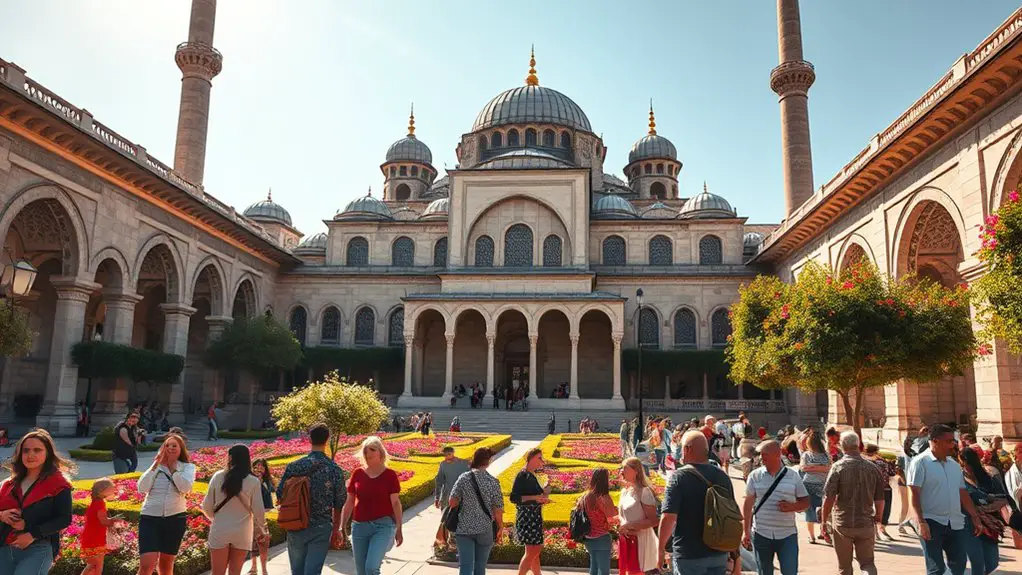
Topkapi Palace served as the administrative heart of the Ottoman Empire and the primary residence of its sultans for nearly 400 years. Spanning four vast courtyards overlooking the Bosphorus, this sprawling imperial complex requires at least 2 to 3 hours to explore thoroughly with children.
Highlights inside the complex include the Imperial Treasury — home to the 86-carat Spoonmaker’s Diamond and gold ceremonial daggers — and the Imperial Harem, where the sultan’s family resided in beautifully tiled suites. The Fourth Courtyard offers wide stone terraces with sweeping views across the Bosphorus Strait and Golden Horn, providing space for kids to catch their breath.
“Topkapi Palace’s combined ticket (2,750 TL) includes access to the Main Palace grounds, the Harem quarters, and the historic Hagia Irene church inside the First Courtyard. Children aged 6 and under enter free with passport verification.”
Basilica Cistern: An Underground Wonderland
Located just a two-minute walk from Hagia Sophia, the Basilica Cistern (Yerebatan Sarnıcı) offers an atmospheric, cool, and slightly mysterious underground adventure that is almost always a highlight for children.
Built during the 6th century under Emperor Justinian I, this subterranean reservoir stored up to 80,000 cubic meters of water supplied via aqueducts for the Great Palace of Constantinople. Today, soft artistic lighting illuminates 336 marble columns rising from the shallow water. Raised wooden boardwalks allow families to walk through the subterranean forest of stone.
In the far northwest corner, don’t miss the two famous Medusa head column bases — one carved upside down and the other positioned sideways. Scholars believe they were reused from earlier Roman buildings to maximize structural support.
Note: Standard daytime admission for foreign visitors is 1,950 TL (09:00 AM – 6:30 PM). A separate “Night Shift” ticket experience runs from 7:30 PM to 10:00 PM for 3,000 TL. Children under 7 enter free with ID. Note that entry requires descending a steep 52-step stone staircase; strollers are impractical here, so a baby carrier is recommended for infants and toddlers.
Gülhane Park: A Green Escape in the City
Directly adjacent to Topkapi Palace, Gülhane Park is the oldest public park in Istanbul and the ultimate midday reset spot for families sightseeing in Sultanahmet.
Lush Greenery and Relaxation
Once the outer royal gardens of the Ottoman court, Gülhane Park features wide brick promenades shaded by centuries-old plane trees, manicured rose gardens, and open grassy lawns. It is completely free to enter and provides a quiet break from the crowded pavement of Sultanahmet Square.
Play Areas for Kids
The park includes a modern children’s playground equipped with swings, climbing towers, and slides, along with plenty of shaded wooden benches for parents. Street vendors line the main paths selling fresh Turkish tea, roasted chestnuts, and sesame-crusted Simit rings.
Istanbul Archaeological Museums: A Treasure of Artifacts
Tucked inside the outer gardens of Topkapi Palace near Gülhane Park, the Istanbul Archaeological Museums house over one million artifacts spanning Mediterranean, Anatolian, and Near Eastern civilizations. The complex consists of three main buildings: the Main Archaeological Museum, the Ancient Orient Museum, and the Tiled Kiosk Museum.
- The Alexander Sarcophagus: A exquisitely carved 4th-century BC marble sarcophagus depicting relief scenes of Alexander the Great in battle.
- The Troy Collection: Gold artifacts, weapons, and pottery recovered during excavations at the legendary site of ancient Troy.
- Treaty of Kadesh Tablet: The oldest surviving written peace treaty in human history (1259 BC), signed between the Egyptian and Hittite Empires.
- Interactive Children’s Displays: Reconstructed historical models and scale ships that bring ancient history to life for young visitors.
Admission for foreign adults is €15, while children aged 12 and under enter free. It is also fully included on the official Museum Pass Istanbul.
The Hippodrome: A Historic Gathering Place
Stretching along the western side of the Blue Mosque, the Hippodrome (now Sultanahmet Square / Sultanahmet Meydanı) was the sporting and social hub of Byzantine Constantinople, famous for intense chariot races and public rallies.
Today, it is a wide pedestrian square containing three ancient monuments along its central spine:
- The Obelisk of Theodosius: An ancient Egyptian granite obelisk originally carved for Pharaoh Thutmose III in 1450 BC and re-erected in Constantinople in 390 AD.
- The Serpent Column: A bronze victory monument brought from the Temple of Apollo at Delphi, dedicated in 479 BC after the Battle of Plataea.
- The Walled Obelisk: A 32-meter stone tower dating back to the 10th century, once covered in gilded bronze plates.
Because the square is completely pedestrianized, open, and free to visit 24/7, it serves as a great low-stress spot for kids to run while parents admire the monuments.
1-Day Sultanahmet Family Itinerary
To avoid burnout and long queues with children, follow this battle-tested chronological plan for exploring Sultanahmet in one day:
- 08:30 AM – Beat the Lines at Hagia Sophia: Arrive early at Hagia Sophia’s upper gallery entrance to clear security before tour buses arrive.
- 10:00 AM – Cross over to the Blue Mosque: Walk 110 meters across the square to enter the Blue Mosque courtyard before morning prayer closing times.
- 11:15 AM – Explore Topkapi Palace & Harem: Walk past the Imperial Gate into Topkapi Palace. Focus on the Harem quarters, Treasury, and Bosphorus viewing terraces.
- 01:30 PM – Picnic Lunch & Playground at Gülhane Park: Exit Topkapi into Gülhane Park. Grab street snacks (Simit, grilled corn, or Dondurma) and let the kids play at the playground.
- 03:00 PM – Descend into the Basilica Cistern: Head underground into the cool Basilica Cistern to search for the Medusa heads.
- 04:00 PM – Walk the Hippodrome Monuments: Stroll through Sultanahmet Square to view the Obelisk of Theodosius and the Serpent Column.
- 05:00 PM – Optional Cultural Stop or Museum Visit: Visit the Istanbul Archaeological Museums if energy permits, or relax at a rooftop cafe with views of the Marmara Sea.
Is the Museum Pass Istanbul Worth It for Families?
The official Museum Pass Istanbul (valid for 5 days) costs roughly 105 Euros per adult. However, because recent policy changes separated several major monuments, it is vital to check which Sultanahmet sites accept the pass before buying:
| Attraction | Standard Foreign Adult Ticket | Accepted on Museum Pass? |
|---|---|---|
| Topkapi Palace + Harem | 2,750 TL (~€54) | YES |
| Archaeological Museums | €15 | YES |
| Hagia Sophia (Upper Gallery) | €25 | NO |
| Basilica Cistern | 1,950 TL (~€40) | NO |
Verdict: For a single day in Sultanahmet, buying individual entry tickets is usually cheaper than purchasing adult Museum Passes — especially since children receive free entry at most sites with proof of age.
Family Survival Logistics: Cobblestones, Bathrooms, and Treats
- Strollers vs. Carriers: Sultanahmet Square and Gülhane Park are smooth and stroller-friendly. However, ancient cobblestones inside Topkapi Palace, stairs inside Hagia Sophia’s upper gallery, and the 52 stone steps into Basilica Cistern make a lightweight stroller or structured baby carrier essential.
- Public Restrooms: Clean, coin-operated public restrooms are located near the Sultanahmet Tram Stop, inside the second courtyard of Topkapi Palace, and within Gülhane Park. Keep 10 to 20 TL in small cash/coins handy for entry fees.
- Kid-Friendly Snacks & Treats: Vendors sell fresh sesame Simit rings and roasted corn throughout the square. For entertainment, stop at a traditional Maraş Dondurma cart where ice cream vendors perform tricks with long metal paddles before handing kids their cones.
Frequently Asked Questions
Are there family discounts or combo tickets available in Sultanahmet?
While there is no single bundled municipal ticket covering all private and public sites, children receive significant age-based exemptions: under 8 enter free at Hagia Sophia, under 7 at Basilica Cistern, under 6 at Topkapi Palace, and 12 and under at the Archaeological Museums. Always carry original passports or clear digital copies to verify child ages at ticket booths.
What are the best times to visit Sultanahmet with children?
Spring (April to June) and autumn (September to November) offer mild temperatures ideal for walking. Arrive at Sultanahmet Square by 08:30 AM on weekdays to beat tour bus crowds and mid-day summer heat.
Are strollers allowed inside major Sultanahmet attractions?
Strollers work well at ground-level sites like the Blue Mosque courtyard, Hippodrome, and Gülhane Park. However, they are unsuited for the steep stone stairs at the Basilica Cistern and the narrow upper walkways of Hagia Sophia. A compact baby carrier is recommended for toddlers.
Is it easy to find family-friendly meals near the attractions?
Yes. The pedestrian streets surrounding Sultanahmet Square feature dozens of traditional Turkish restaurants serving kid-friendly items such as grilled meat patties (Köfte), flatbread pizzas (Pide), and rice pilaf, alongside quick street food stands.
Are guided tours recommended for families visiting Sultanahmet?
Yes. Skip-the-line small-group or private family tours are highly beneficial for major sites like Topkapi Palace and Hagia Sophia, as they allow families to bypass hour-long general admission lines and keep children engaged through interactive storytelling.
Conclusion
Sultanahmet packs an extraordinary range of family-friendly experiences into a compact, walkable old-city district. By pairing morning architectural masterpieces like the Hagia Sophia and Blue Mosque with afternoon subterranean exploration at the Basilica Cistern and outdoor play in Gülhane Park, families can experience 1,500 years of history at an enjoyable, stress-free pace.
Sources
- Smarthistory — The Blue Mosque (Sultan Ahmet Camii) — Architectural construction history and design context.
- Britannica — Blue Mosque — Structural dimensions, minaret details, and Ottoman heritage.
- Hagia Sophia Official Visitor Information — Upper gallery entry rules, AR audio guides, and tourist visitor guidelines.
- Topkapi Palace Official Ticket Portal — Combined ticket prices, Harem access, and operating hours.
- Basilica Cistern Visitor Guide — Daytime and Night Shift entrance fees and accessibility.
- The Istanbul Insider — Main Tourist Entrance Fees — Verified ticket pricing and child exemption policies.
