
Last Updated on August 29, 2026 by Caleb Warren
Disclosure: As an Amazon Associate, we earn from qualifying purchases. If you click a link on this page and make a purchase, we may receive a small commission at no extra cost to you.
A compact camera drone is most useful when it is easy to carry without giving up the flight and imaging features you actually need. The DJI Mini 4 Pro combines a sub-249 g standard takeoff weight with a 1/1.3-inch camera sensor, omnidirectional obstacle sensing, and DJI’s O4 transmission system. Its biggest strengths are portability, strong video options, and useful flight-assistance features, while its 34-minute standard-battery figure is a controlled-test maximum rather than the flight time you should expect every time. This review explains what those specifications mean in real use and who will get the most value from the Mini 4 Pro.
Quick Verdict
Rating: 9/10, Recommended with caveats
Best For: Travelers, content creators, and recreational pilots who want advanced camera and sensing features in a compact drone.
Bottom Line: The Mini 4 Pro delivers an unusually complete camera and flight-assistance package for a drone weighing under 249 g with the standard battery. Its main tradeoffs are limited real-world endurance compared with the advertised maximum, sensitivity to rain, and transmission figures that depend heavily on local rules and conditions.
| Specification | Detail |
|---|---|
| Brand | DJI |
| Model | Mini 4 Pro |
| Product type | Foldable camera drone |
| Standard takeoff weight | Under 249 g |
| Folded dimensions | 148 × 94 × 64 mm without propellers |
| Camera sensor | 1/1.3-inch CMOS, 48 MP effective pixels |
| Lens | 24 mm equivalent, f/1.7 aperture |
| Video | Up to 4K/100fps; 4K/60fps HDR supported |
| Gimbal | 3-axis mechanical stabilization |
| Standard battery flight time | Up to 34 minutes under DJI test conditions |
| Battery Plus flight time | Up to 45 minutes under DJI test conditions; aircraft exceeds 249 g |
| Video transmission | DJI O4, up to 20 km under FCC test conditions |
| Navigation | GPS + Galileo + BeiDou |
| Obstacle sensing | Omnidirectional binocular vision with bottom 3D infrared sensing |
| Wind resistance | Up to 10.7 m/s |
| Internal storage | 2 GB, with microSD support for additional storage |
| Water protection | Not waterproof |
What Is the DJI Mini 4 Pro?
The DJI Mini 4 Pro is a foldable camera drone built around the idea of keeping the aircraft small while retaining many features normally associated with larger consumer drones. With the standard Intelligent Flight Battery, propellers, and a microSD card installed, DJI lists its takeoff weight at under 249 g.
The camera uses a 1/1.3-inch CMOS sensor with 48 MP effective pixels, an f/1.7 lens, and a three-axis mechanical gimbal. You can record 4K video at several frame rates, including 4K/60fps HDR and 4K/100fps slow-motion recording. DNG photo capture and 10-bit D-Log M or HLG video modes also give more room for editing than a basic entry-level drone.
The other major selling point is flight assistance. Omnidirectional sensing, Advanced Return-to-Home, ActiveTrack 360°, Waypoint Flight, and Cruise Control are designed to reduce workload and give you more ways to plan or automate shots.
Who Should Buy It?
Best For
- Travelers who want a capable drone that folds into a small bag.
- Creators who need 4K video, vertical shooting, RAW photos, and advanced color modes.
- Pilots who value omnidirectional sensing, tracking, waypoint, and return-home features.
Skip If
- You regularly need to fly in rain or wet weather.
- You need a larger dual-camera platform with a dedicated telephoto perspective.
- You expect the advertised maximum flight time or transmission distance in normal conditions.
Before You Buy: The 20 km transmission figure is an FCC maximum measured in an unobstructed environment without interference. It is not a promise that you can or should fly 20 km away. Local aviation rules, visual-line-of-sight requirements, signal interference, obstacles, and battery reserve can limit practical distance. The Battery Plus also increases the aircraft weight above 249 g.
Design and Portability
The Mini 4 Pro measures 148 × 94 × 64 mm when folded without propellers, so it takes up little space compared with larger camera drones. That size makes it easier to pack beside a camera, charger, or other travel equipment.
Its standard takeoff weight of under 249 g can also simplify ownership in some regions, but weight alone does not exempt every pilot from registration, training, operating, or airspace rules. Regulations depend on where you fly and how the drone is used.
If you install the Intelligent Flight Battery Plus, the aircraft exceeds 249 g. That battery can increase the theoretical flight time, but you should consider the regulatory and portability consequences before choosing it.
Flight Performance and Battery Life
DJI rates the standard Intelligent Flight Battery for a maximum flight time of 34 minutes. The Battery Plus raises that laboratory maximum to 45 minutes. These tests are performed under controlled conditions, so your usable time will normally be lower after allowing for wind, maneuvering, recording, temperature, obstacle avoidance, and the battery reserve needed to return safely.
The drone’s maximum horizontal speed reaches 16 m/s in Sport mode under DJI’s test conditions, while maximum wind-speed resistance is listed at 10.7 m/s. The low aircraft weight is useful for travel, but you should still pay close attention to wind speed and direction, particularly when the return trip will be against the wind.
O4 video transmission is another major upgrade. Under the FCC standard, DJI lists a maximum transmission distance of 20 km in an unobstructed, interference-free environment. The CE maximum is 10 km. Buildings, trees, competing wireless signals, terrain, antenna orientation, and local transmission standards can reduce the usable distance substantially.
Pro Tip: Plan your flight around the return journey, not the advertised maximum battery figure. Check wind direction before takeoff, establish a safe Return-to-Home altitude, confirm the home point, and leave enough battery reserve for unexpected headwinds or route changes.
Camera and Imaging Performance
The Mini 4 Pro uses a 1/1.3-inch CMOS sensor with 48 MP effective pixels. Its 24 mm equivalent lens has an f/1.7 aperture, which helps the camera collect more light than a slower lens and gives you a wide perspective suited to landscapes, architecture, and travel footage.
Video options are one of the drone’s strongest features. It supports 4K recording up to 100fps for slow motion, while 4K/60fps HDR is available for normal high-frame-rate footage. HLG and 10-bit D-Log M modes are useful if you plan to color-correct or grade footage later rather than relying only on footage straight from the camera.
The three-axis mechanical gimbal stabilizes tilt, roll, and pan movement. It can also rotate for vertical shooting, which is useful when you want footage formatted for mobile-first social platforms without cropping a horizontal frame afterward.
Low-Light Shooting
DJI provides a dedicated Night video mode and an f/1.7 lens, so the Mini 4 Pro is more capable after sunset than basic mini drones. You can also adjust shutter speed, ISO, and white balance manually in the DJI Fly app.
That does not make it equal to a larger-sensor camera in very dark conditions. More importantly, the vision sensing system requires adequate lighting and visible surface patterns to operate effectively. You should not assume that obstacle sensing will perform the same way in darkness as it does during daylight.
Safety, Sensing, and Navigation
The Mini 4 Pro uses an omnidirectional binocular vision system supplemented by a downward 3D infrared sensor. It can detect obstacles ahead, behind, to the sides, above, and below when operating conditions are suitable.
| Feature | What It Does | Buyer Benefit |
|---|---|---|
| Omnidirectional sensing | Uses vision sensors around the aircraft | Adds awareness when flying near obstacles |
| Advanced RTH | Plans a return path toward the recorded home point | Helps reduce workload during return flights |
| GPS + Galileo + BeiDou | Provides satellite positioning | Supports positioning and navigation |
| Waypoint Flight | Lets you create planned flight routes | Useful for repeatable movements and planned shots |
Obstacle sensing is an aid, not a substitute for pilot attention. DJI specifies that the vision system performs best when surfaces have clear patterns and there is adequate light. Thin branches, wires, transparent surfaces, low-contrast objects, darkness, or fast movement can still create problems.
Controls and User Experience
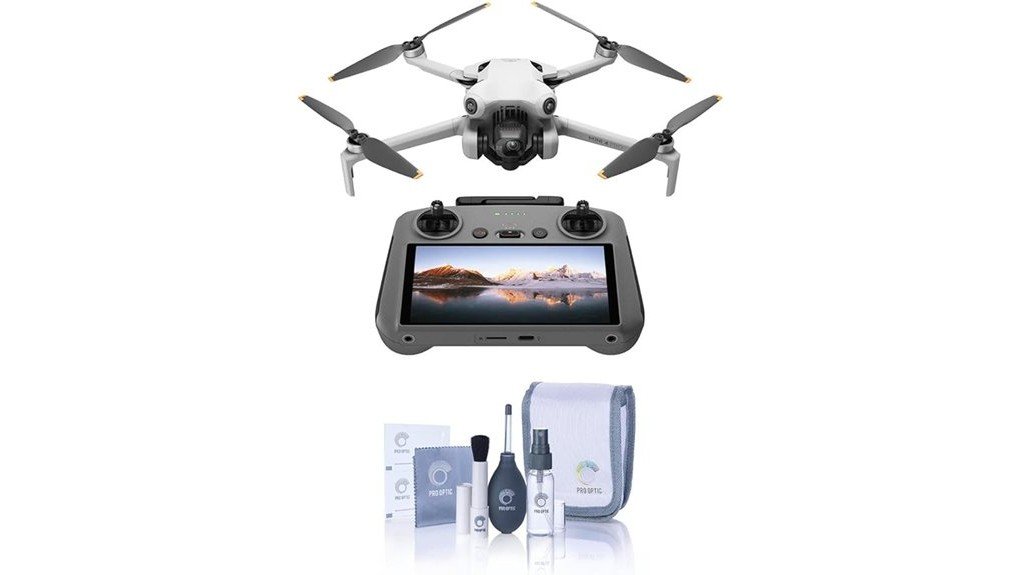
The Amazon listing reviewed here is the DJI Mini 4 Pro with DJI RC 2. The RC 2 has DJI Fly installed, so you do not need to use your phone as the controller display. Initial activation still requires an internet connection, after which the aircraft and controller are paired through DJI Fly.
For newer pilots, features such as automated return, obstacle sensing, and assisted shooting modes can reduce some of the workload involved in positioning the aircraft and framing shots. Experienced users can make use of manual camera controls, D-Log M, RAW photos, waypoints, Cruise Control, and ActiveTrack 360°.
The Mini 4 Pro also includes 2 GB of internal storage. That is useful as emergency storage if you forget a card, but it is not enough for a serious day of 4K recording. A compatible high-speed microSD card is the more practical option for regular video work.
How It Performs in Real Use
For Travel
The folded size and under-249 g standard configuration are the main advantages when you are trying to keep camera equipment compact. It is easier to fit into a small camera bag than larger DJI aircraft, while still giving you advanced tracking, RAW capture, and high-resolution video.
For Landscape and Travel Video
The wide 24 mm equivalent view works well for coastlines, mountains, buildings, and establishing shots. The rotating gimbal also gives you native vertical footage without sacrificing as much resolution through later cropping.
For Tracking a Moving Subject
ActiveTrack 360° can automate subject-following movements and reduce the amount of manual stick input required for certain shots. Omnidirectional sensing is valuable during these automated movements, but you should still choose an open environment and remain ready to take control.
For Windy Locations
DJI specifies wind resistance up to 10.7 m/s, but a lightweight drone will still use more energy fighting wind. A strong tailwind on the outbound leg can become a battery-draining headwind on the return, so distance should be shortened as conditions become less favorable.
Setup Tips Before Your First Flight
- Charge and activate the battery first. DJI ships batteries in hibernation mode for transportation, so charging is part of the initial activation process.
- Confirm your home point. Wait for reliable satellite positioning before flying farther away.
- Set a sensible Return-to-Home altitude. Choose an altitude appropriate for nearby trees, buildings, and other obstacles.
- Use a suitable microSD card. The 2 GB internal storage is limited, particularly for 4K video.
- Inspect the aircraft. Check propellers, battery installation, lens, gimbal movement, weather, and airspace before takeoff.
- Learn the control modes in an open area. Obstacle sensing is helpful, but developing basic manual control remains important.
Weather, Safety, and Regulations
The DJI Mini 4 Pro is not waterproof. DJI advises avoiding contact with water. If rain begins during a flight, return and land as soon as possible, then allow the aircraft to dry completely before using it again.
Do not treat the under-249 g weight as a universal exemption from aviation rules. Registration, training, Remote ID, visual-line-of-sight, altitude, airspace, commercial-use, and location restrictions vary by country and type of operation. Check the rules that apply where you plan to fly.
Battery choice matters too. DJI states that the Intelligent Flight Battery Plus increases the aircraft weight above 249 g. Accessories can also change takeoff weight and flight behavior, so confirm your configuration before assuming a particular regulatory category applies.
Pros and Cons
Pros
- Under 249 g with the standard flight battery.
- 1/1.3-inch 48 MP camera with 4K/60fps HDR and 4K slow motion.
- Omnidirectional obstacle sensing adds useful flight assistance.
- O4 transmission provides a strong communication system for open-area flying.
- ActiveTrack 360°, Waypoint Flight, Cruise Control, RAW photos, and vertical shooting add creative flexibility.
Cons
- The 34-minute flight figure is a controlled-test maximum, so practical flight sessions will be shorter.
- The drone is not waterproof and should not be flown in rain.
- The Battery Plus extends flight time but increases the aircraft weight above 249 g.
Is It Worth the Price?
The Mini 4 Pro sits toward the premium end of the compact consumer-drone category. Its value comes from combining a lightweight folding design with camera features, intelligent flight modes, O4 transmission, and sensing hardware that would be difficult to match with a basic budget drone.
You will get the most value if you intend to use features such as 4K HDR, vertical shooting, ActiveTrack 360°, waypoints, RAW capture, or omnidirectional sensing rather than simply flying for recreation. A cheaper model can make more sense if your main goal is casual daytime flying and basic aerial video.
The largest value limitation is that its small size still brings small-drone compromises. You are buying portability first, so a larger aircraft can offer advantages in camera flexibility, wind handling, or endurance depending on the model.
How It Compares to Alternatives
The DJI Mini 3 Pro is worth comparing if you want another sub-249 g DJI option and can accept an older O3 transmission system with a 12 km FCC maximum and forward, backward, and downward obstacle sensing rather than the Mini 4 Pro’s omnidirectional system. The Mini 4 Pro is the stronger choice when sensing coverage, O4 transmission, and its newer intelligent flight functions matter to you.
If camera versatility matters more than minimum weight, the DJI Air 3S moves into a different class. It weighs about 724 g and uses a dual-camera system with a 1-inch wide-angle camera and a 70 mm equivalent medium-tele camera. The Mini 4 Pro makes more sense when compactness and the under-249 g standard configuration are higher priorities.
Frequently Asked Questions
Is the DJI Mini 4 Pro really under 249 g?
Yes. DJI specifies a standard takeoff weight below 249 g with the Intelligent Flight Battery, propellers, and a microSD card. Using the Intelligent Flight Battery Plus increases the aircraft weight above 249 g, so check your exact configuration and local rules.
How long does the DJI Mini 4 Pro actually fly?
DJI rates the standard battery for up to 34 minutes and the Battery Plus for up to 45 minutes under controlled test conditions. Real flights are normally shorter because wind, maneuvering, temperature, recording, and the battery reserve needed for a safe return all consume usable time.
Can the DJI Mini 4 Pro really transmit video for 20 km?
The 20 km figure is DJI’s maximum under FCC rules in an unobstructed environment without interference. DJI lists lower maximums under other regional standards, and real-world buildings, trees, wireless interference, terrain, battery limits, and aviation rules can shorten usable distance considerably.
Can you fly the DJI Mini 4 Pro in light rain?
No. DJI states that the Mini 4 Pro is not waterproof and recommends avoiding contact with water. If rain starts while you are flying, return and land as soon as practical and let the aircraft dry completely before using it again.
Does the DJI Mini 4 Pro have built-in storage?
Yes. The aircraft includes 2 GB of internal storage. That can help when a memory card is unavailable, but a compatible microSD card is far more practical for regular 4K recording.
Does obstacle sensing work in low light?
The vision system needs suitable lighting and surfaces with visible patterns for reliable operation. Low light, thin objects, transparent surfaces, or low-contrast obstacles can reduce sensing performance, so you should not rely on obstacle avoidance as your only safety measure.
How does the DJI Mini 4 Pro perform for low-light video?
Its 1/1.3-inch sensor, f/1.7 lens, manual camera controls, and Night video mode give you useful tools for dusk and nighttime shooting. You should still expect more noise and less detail as light drops, and the sensing system may also become less effective.
Is the DJI Mini 4 Pro suitable for beginners?
It can be a good first serious camera drone because DJI RC 2, GPS positioning, Return-to-Home, and obstacle sensing reduce some of the workload. You still need to learn manual control, understand the limitations of the sensors, watch battery and weather conditions, and follow local flight regulations.
The Bottom Line
The DJI Mini 4 Pro is an excellent fit when you want a highly portable camera drone without giving up 4K HDR recording, omnidirectional sensing, advanced tracking, waypoints, or a strong O4 transmission system. You should skip it if rain resistance, a larger dual-camera system, or longer practical endurance matters more than compact size.
Its biggest advantage is how many useful camera and flight features fit into the under-249 g standard configuration. Its main limitation is that headline figures such as 34 minutes of flight time and 20 km transmission describe maximum test conditions, so sensible real-world planning remains essential.
Ready to Buy?
Check the latest price, seller information, package contents, and product details before you decide.
