
Last Updated on July 27, 2026 by Daniel Globe
Tbilisi mixes centuries-old churches and balcony-lined lanes with contemporary architecture, hillside viewpoints, markets, museums, and one of Georgia’s most distinctive food cultures. The best way to experience the capital is to spend at least two or three days combining Old Tbilisi with its sulfur baths, major landmarks, museums, local food, and panoramic viewpoints.
Quick Answer
The best things to do in Tbilisi include wandering Old Tbilisi and Abanotubani, soaking in a sulfur bath, taking in the views near Narikala, crossing the Bridge of Peace, visiting the Georgian National Museum and Sameba Cathedral, browsing Dry Bridge Market, exploring the Botanical Garden, and riding the funicular to Mtatsminda Park.
Key Takeaways
- Allow at least two full days for Tbilisi; three days gives you time to slow down, enjoy a sulfur bath, and explore beyond the Old Town.
- Old Tbilisi, Abanotubani, Narikala, the Bridge of Peace, Sameba Cathedral, and the Georgian National Museum are among the essential first-time sights.
- Narikala is undergoing rehabilitation in 2026, so access to parts of the fortress can change even though the surrounding ridge remains one of the city’s signature viewpoints.
- Tbilisi is hilly. Comfortable shoes make a major difference around Old Tbilisi, Narikala, Mtatsminda, and the Botanical Garden.
- Public transport is inexpensive, while walking is often the easiest way to connect attractions in the historic center.
- Make time for Georgian food, not just landmarks: khinkali, khachapuri, lobio, badrijani nigvzit, churchkhela, and regional wines are part of the Tbilisi experience.
Disclosure: As an Amazon Associate I earn from qualifying purchases. Some links on this page are affiliate links, at no extra cost to you.
Explore Old Tbilisi and Abanotubani
Old Tbilisi is the historic heart of Georgia’s capital. Its steep lanes, cobblestones, carved wooden balconies, courtyards, churches, cafes, galleries, and small shops reveal the many cultures that have shaped the city over the centuries.
The neighborhood is best explored on foot without rushing. Streets around Kote Apkhazi, Erekle II Street, Meidani, Abanotubani, and the lower slopes beneath Narikala place many of Tbilisi’s most recognizable sights within a relatively compact area.
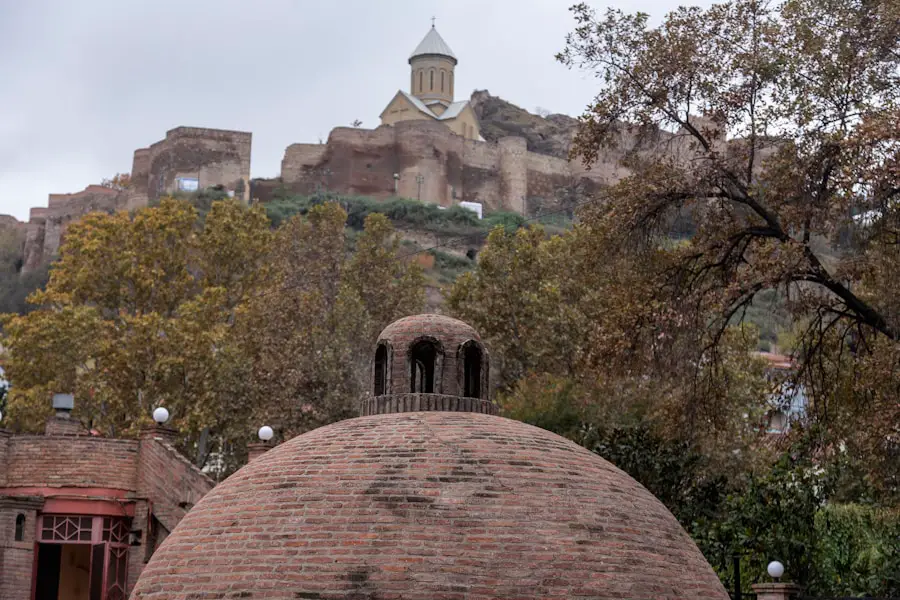
The sulfur-bath district of Abanotubani is especially distinctive. Brick domes rise only slightly above street level because the bathhouses are built around the city’s naturally heated springs. Bathing has long been part of Tbilisi’s social culture, and the springs are closely connected with the traditional story of the city’s founding. Georgia Travel’s sulfur-bath guide provides more background on the district and its history.
See Anchiskhati Basilica
Anchiskhati Basilica on Ioane Shavteli Street is regarded as Tbilisi’s oldest surviving church. The basilica dates to the 6th century and offers a striking contrast to the newer buildings surrounding it. Its relatively simple exterior makes it easy to walk past, but it is one of the most historically important religious structures in the capital.
Note: Tbilisi’s churches are active places of worship, not only tourist attractions. Dress respectfully, keep voices low, avoid interrupting services, and follow any photography rules posted at the entrance.
Experience Tbilisi’s Sulfur Baths
A sulfur bath is one of the experiences most closely associated with Tbilisi. Most historic bathhouses are concentrated in Abanotubani, where their low brick domes and steaming water form one of the city’s signature scenes.
Bathhouses vary considerably. Some offer traditional shared bathing areas, while others have private rooms with individual pools. Many also offer a traditional exfoliating scrub known as a kisa. Prices, room standards, and booking policies vary, so it is worth comparing options before choosing one.
The bathhouses are more than spa facilities. For generations they have also served as gathering places, reflecting the social history of a city whose name itself is associated with warmth and hot springs.
Warning: Sulfur-bath pools can be very hot. Stay hydrated, do not remain in hot water if you feel dizzy or unwell, and follow the bathhouse staff’s instructions.
The Narikala Fortress and Mother of Georgia
Narikala dominates the hillside above Old Tbilisi and the Mtkvari River. The earliest fortifications here reach back to roughly the 4th century, and the site was altered repeatedly as different powers controlled Tbilisi.
Inside the fortress area is St. Nicholas Church. The medieval predecessor dated to the 13th century but was almost completely destroyed after the site was used for ammunition storage. The present church was completed in 1997 over surviving historical foundations and walls. More historical detail is available from the official Georgia Travel Narikala guide.
2026 Access Note: Narikala remains part of an ongoing rehabilitation program in Tbilisi. Access to the fortress interior or individual sections can therefore change. The viewpoints and surrounding ridge are still worth including in an Old Town walk, but do not assume every wall, stairway, or courtyard will be accessible.
The easiest ascent for many visitors is the Rike–Narikala ropeway from Rike Park. As of July 2026, the Tbilisi Transport Company tariff lists the Rike–Narikala ropeway at 2.5 GEL one way.
Near the upper station, follow the ridge toward Kartlis Deda, or Mother of Georgia. The monumental figure overlooks Tbilisi with a sword in one hand and a bowl of wine in the other, traditionally symbolizing defense against enemies and hospitality toward friends.
Pro Tip: Use the cable car for the uphill journey and explore the ridge on foot. Even when fortress access is restricted, the upper area gives you broad views over Old Tbilisi, the Mtkvari River, Sameba Cathedral, and the newer parts of the city.
The Peace Bridge
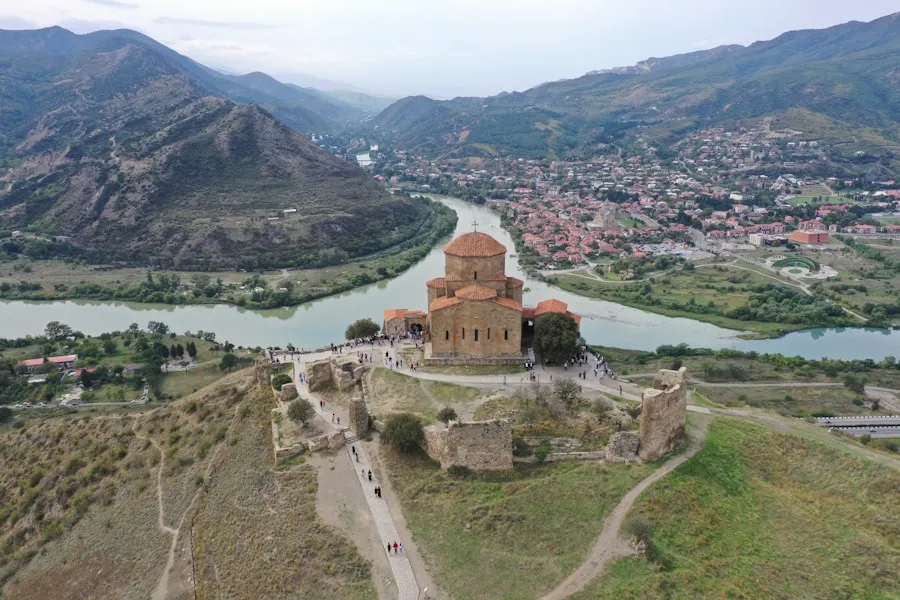
Photo note: the existing image above shows Jvari Monastery near Mtskheta, a popular day trip from Tbilisi, rather than the Bridge of Peace.
The Bridge of Peace is one of Tbilisi’s best-known modern landmarks. Opened in 2010, the pedestrian bridge crosses the Mtkvari River between the historic center and Rike Park.
Italian architect Michele De Lucchi designed the bridge’s distinctive glass-and-steel canopy. Its contemporary form deliberately stands out from the older buildings lining the river and has become part of Tbilisi’s visual identity. The bridge is particularly striking after dark when its lighting system illuminates the curved canopy.
Walking across also gives you an easy connection between Rike Park and the Old Town, with views toward the Narikala hillside and surrounding historic neighborhoods. The official Georgia Travel Bridge of Peace page provides additional architectural and historical information.
The Georgian National Museum
The Georgian National Museum is one of the best places in Tbilisi to understand Georgia beyond its churches and architecture. Its collections span archaeology, ethnography, numismatics, religious art, fine art, natural history, and material from many periods of Georgian history.
Georgian National Museum at a Glance
| Founded | 2004 |
| Official Network | 10 museums, the National Gallery, 4 house museums, and 2 research centers |
| Ancient Highlights | Dmanisi hominin remains and Stone Age material dating to about 1.8 million years ago |
| Other Collection Highlights | Archaeology, ethnography, Christian art, numismatics, and ancient Colchian gold and silver |
One of the network’s most significant archaeological stories comes from Dmanisi in southern Georgia. Hominin remains and Stone Age discoveries from the site date to about 1.8 million years ago and changed scientific understanding of early human movement beyond Africa.
The museum also preserves finely worked gold and silver from ancient Colchis, religious art, archaeological discoveries, coins, ethnographic objects, and works by Georgian and European artists. Temporary exhibitions mean the exact displays available during a visit can change. See the Georgian National Museum for official institutional information.
July 2026 Travel Update: Major rehabilitation of Rustaveli Avenue began on July 23, 2026, with vehicle restrictions and temporary changes to a number of bus and minibus routes. If you are visiting museums along the Rustaveli corridor during the works, allow extra travel time and rely on the latest municipal routing information.
The Holy Trinity Cathedral of Tbilisi
The Holy Trinity Cathedral, commonly called Sameba, is one of Tbilisi’s most recognizable buildings. Construction began in 1996 and was completed in 2004. The cathedral sits on Elia Hill, where its dome and golden cross can be seen from much of central Tbilisi.
The complex combines features of traditional Georgian church architecture on a monumental scale. According to Georgia Travel, it reaches 86.1 meters including the cross and brings together nine individual churches in its above-ground and underground sections.
Inside, stone, marble, icons, paintings, and religious decoration create a much quieter atmosphere than the busy avenues outside. The surrounding grounds also provide attractive city views.
Sameba remains an active center of Georgian Orthodox worship, so visitors should dress and behave accordingly, particularly during services and religious celebrations.
Mtatsminda Park
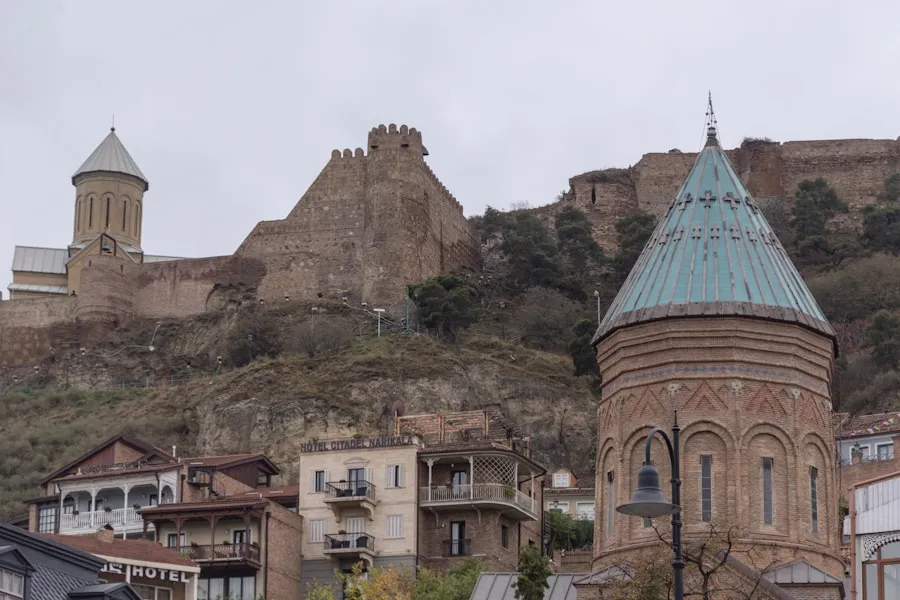
Photo note: the existing photograph above shows Narikala Fortress and Old Tbilisi rather than Mtatsminda Park.
Mtatsminda Park sits high above central Tbilisi and combines panoramic views with amusement rides, restaurants, walking areas, and family attractions. It is a useful change of pace after a day spent exploring dense historic neighborhoods.
Attractions and Activities
The park includes a Ferris wheel, amusement rides, quieter green spaces, fountains, picnic areas, walking routes, and family attractions. Conditions and ride availability can vary with weather, so not every attraction is guaranteed to operate at all times.
One of the most enjoyable ways to reach the top is the historic Tbilisi Funicular. Opened in 1905, the railway climbs from its lower station on Chonkadze Street toward Mtatsminda. Georgia Travel describes the route as roughly 501 meters long and taking only a few minutes.
Dining with a View
Restaurants and cafes near the upper funicular station make Mtatsminda a good choice for a meal with a city view. The large Tbilisi TV Tower is an unmistakable skyline landmark nearby, but the easiest visitor viewpoints are the terraces, paths, rides, and open areas around Mtatsminda Park rather than the tower itself.
A Magical Experience
Late afternoon and early evening are especially attractive times to visit. You can watch daylight fade across Tbilisi before the streets, Sameba Cathedral, Bridge of Peace, and other landmarks begin to illuminate below.
Mtatsminda also connects with walking routes toward other hills and recreational areas. Visitors who prefer a quieter experience can simply walk the park and enjoy the views without using the amusement rides.
The Dry Bridge Market
The Dry Bridge Market is one of Tbilisi’s most distinctive places to browse for vintage objects, art, old household items, coins, books, jewelry, Soviet-era memorabilia, and handmade pieces.
The bridge’s name can be confusing. It does not currently cross the main Mtkvari channel. A former branch of the river once passed beneath the bridge, but the waterway was redirected, leaving the bridge “dry.” The market that developed around it has existed in its present form since around the 1950s.
Vendors spread their goods across tables, cloths, and improvised stalls, while artists commonly display paintings and other work in the adjoining park. According to Georgia Travel, the market operates daily, although the number of sellers and the atmosphere can vary with weather and season.
Browsing is part of the appeal, even if you do not plan to buy anything. Take time to look closely and ask sellers about objects that catch your attention. Polite bargaining is common, but not every item is necessarily negotiable.
The Tbilisi Botanical Garden
The National Botanical Garden of Georgia occupies a green valley directly behind the Old Town and Narikala ridge. It is one of the easiest places to escape traffic and dense urban streets without traveling far from central Tbilisi.
The garden’s history reaches back centuries, and it has operated formally as a botanical garden since the 19th century. Its paths pass collections of native and international plants, wooded slopes, bridges, streams, and the Tsavkisistskali Waterfall.
The Tbilisi Botanical Garden covers roughly 128 hectares and contains more than 3,500 plant species, according to Georgia’s official tourism information.
Some paths are steep, so sturdy shoes are more useful than sandals if you want to explore beyond the main entrance. A wooden bridge dating to 1898 overlooks one of the garden’s best-known waterfall areas.
The garden suffered significant storm and snow damage in early 2026, which led to temporary access restrictions while safety work was carried out. Because individual entrances and paths can be affected by maintenance, use the current visitor information available through the official Botanical Garden tourism page when planning your route.
Taste Georgian Food in Tbilisi
Food should be treated as one of Tbilisi’s major attractions rather than an afterthought. Georgian cuisine is built around bread, cheese, herbs, walnuts, beans, vegetables, grilled meats, dumplings, and a long winemaking tradition.
Start with khinkali, Georgian dumplings that are traditionally eaten by hand. Khachapuri is a broad family of cheese-filled breads with regional variations. Other worthwhile dishes include lobio (seasoned beans), badrijani nigvzit (eggplant with walnut filling), mtsvadi (grilled meat), and vegetable dishes such as pkhali.
For something sweet, look for churchkhela, made by threading nuts and repeatedly coating them in thickened grape must. Tbilisi is also an excellent place to explore Georgian wine, including wines produced in traditional clay vessels called qvevri.
How to Spend 2 or 3 Days in Tbilisi
Day 1: Old Tbilisi, Sulfur Baths, and Narikala
Begin in the Old Town and walk through Kote Apkhazi Street toward Meidani and Abanotubani. Continue toward the Narikala ridge by cable car or on foot, keeping current restoration restrictions in mind. Visit the Mother of Georgia viewpoint, then return downhill for a sulfur bath and dinner in the historic center.
Day 2: Museum, Dry Bridge, Sameba, and Mtatsminda
Spend the morning at the Georgian National Museum or another museum along the central corridor. Continue to Dry Bridge Market, then cross toward Sameba Cathedral. Finish the day on Mtatsminda for sunset and nighttime views.
Day 3: Botanical Garden and a Slower City Day
Use a third day for the Botanical Garden, neighborhoods such as Sololaki, additional museums or galleries, longer meals, and places you rushed past during the first two days. Another classic option is a half-day or full-day trip to Mtskheta and Jvari Monastery outside Tbilisi.
Pro Tip: Do not build a Tbilisi itinerary around checking attractions off a list every hour. Old Tbilisi is most enjoyable when you leave time for courtyards, cafes, viewpoints, markets, and long meals between the major landmarks.
Getting Around Tbilisi
Walking is often the simplest way to move between Old Tbilisi, Abanotubani, Rike Park, the Bridge of Peace, and several nearby attractions. The main limitation is terrain: Tbilisi has steep hills, stairs, uneven paving, and cobblestones.
The metro is useful for longer journeys across the city. Official visitor information lists metro operating hours as approximately 06:00 to 00:00 daily. The Tbilisi Transport Company currently lists a 1 GEL fare that provides 90 minutes of eligible municipal travel when paid through the supported fare system.
A Metromoney card can be used for municipal transport and the Rike–Narikala ropeway. App-based taxis are another practical option when carrying luggage, traveling late, or avoiding a steep climb.
Current Roadwork Note: Rustaveli Avenue entered a major rehabilitation phase on July 23, 2026. During the project, central bus routes and vehicle access can differ from normal maps and older travel guides.
Travel Safety in Tbilisi
Tbilisi is generally considered a manageable destination for visitors using ordinary city precautions. The U.S. Department of State currently places Georgia at Level 1: Exercise Normal Precautions, while advising travelers not to enter the Russian-occupied regions of South Ossetia and Abkhazia. See the current Georgia Travel Advisory before departure.
In Tbilisi itself, keep an eye on valuables in crowded areas, use reputable transportation, and stay clear of demonstrations or streets closed by police. Political gatherings have frequently centered on Rustaveli Avenue, so changing road or pedestrian conditions in that area deserve extra attention.
Travelers flying through Middle Eastern hubs should also check airline operations close to departure. A U.S. State Department worldwide caution issued on July 22, 2026 highlighted the possibility of flight changes and regional airspace disruption.
Other Travel Resources
If your wider Georgia trip includes specialized hobbies, the site’s existing guides cover the best travel fishing rods and travel humidors. For a more broadly useful trip-planning topic, see the guide to choosing a portable WiFi hotspot for international travel before relying on mobile data abroad.
Frequently Asked Questions
What are the top things to do in Tbilisi, Georgia?
Top experiences include exploring Old Tbilisi and Abanotubani, trying a sulfur bath, visiting the Narikala area and Mother of Georgia, crossing the Bridge of Peace, seeing the Georgian National Museum and Sameba Cathedral, browsing Dry Bridge Market, exploring the Botanical Garden, and taking the funicular to Mtatsminda Park.
How many days do you need in Tbilisi?
Two full days are enough for the main sights, but three days is more comfortable. A third day gives you time for the Botanical Garden, museums, longer meals, neighborhoods beyond the main tourist route, or a short trip to Mtskheta.
What is the best time to visit Tbilisi, Georgia?
Spring and early autumn are popular because temperatures are generally more comfortable for walking than during the hottest part of summer. April through June and September through October are especially appealing for sightseeing, although Tbilisi can be visited year-round.
What Georgian food should I try in Tbilisi?
Try khinkali dumplings, regional forms of khachapuri, lobio, badrijani nigvzit, mtsvadi, pkhali, and churchkhela. Tbilisi is also a convenient place to explore Georgian wines, including qvevri-made wines.
Is Tbilisi safe for tourists?
The current U.S. State Department advisory places Georgia at Level 1: Exercise Normal Precautions. Travelers should still protect valuables, use reputable transportation, avoid demonstrations, follow local instructions, and check current advisories before traveling.
What is the best way to get around Tbilisi?
Walk within the historic center, then use the metro, municipal buses, the Rike–Narikala ropeway, or app-based taxis for longer or steeper journeys. Tbilisi Transport Company currently lists a 1 GEL 90-minute municipal fare and a 2.5 GEL one-way Rike–Narikala ropeway fare.
Is Narikala Fortress open in 2026?
Narikala is undergoing rehabilitation in 2026, so access to individual fortress sections can change. The upper hillside, cable-car area, Mother of Georgia ridge, and city views remain worth including in your route, but do not rely on older guides that assume every interior section is accessible.
Sources
- Georgia Travel — Things to Do in Tbilisi — official tourism overview of major attractions, short-stay planning, food, sulfur baths, and Old Tbilisi.
- Georgia Travel — Narikala and St. Nicholas Church — fortress history, church history, and location information.
- Georgian National Museum — official museum-network and collection information.
- Tbilisi Transport Company — Standard Tariffs — municipal-transport and ropeway fares.
- Georgia Travel — Tbilisi Botanical Garden — visitor information, history, plant collections, paths, and attractions.
- U.S. Department of State — Georgia Travel Advisory — current official travel-safety guidance.
