

Last Updated on September 11, 2026 by Daniel Globe
DEI in airlines means diversity, equity, and inclusion. Airlines use the term when discussing workforce access, equal opportunity, workplace culture, employee development, and services for travelers with different needs. The term is broad, however, and it does not replace pilot qualifications, safety rules, employment law, or passenger-protection requirements.
Quick Answer
DEI in airlines means diversity, equity, and inclusion. It covers efforts to widen access to aviation careers, prevent unlawful discrimination, create respectful workplaces, and serve travelers with different needs. It does not replace pilot qualifications or safety rules. In the United States, current law also limits race- or sex-based employment decisions.
Key Takeaways
- DEI is a broad workplace and customer-service framework, not an FAA pilot certificate or safety standard.
- Pilot applicants must still meet FAA certification, experience, medical, training, testing, and airline requirements.
- U.S. employment decisions cannot lawfully favor or penalize a person because of race, sex, or another protected characteristic.
- Broad outreach, accessible applications, structured interviews, mentorship, and equal development opportunities can widen access without lowering standards.
- Some passenger accommodations, especially disability-related assistance, are legal obligations rather than optional DEI benefits.
What Is DEI in Aviation?
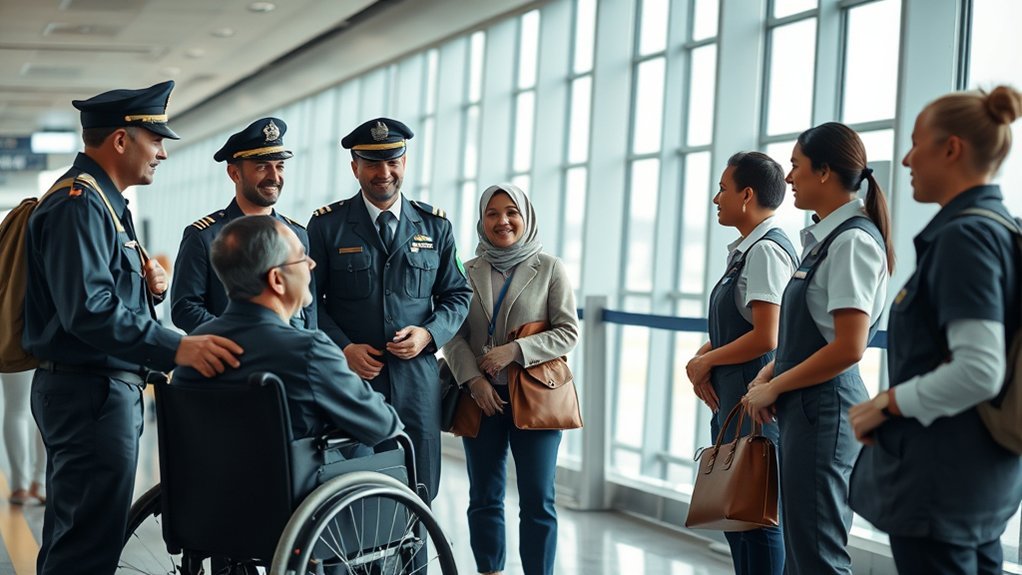
In aviation, DEI usually describes policies and practices related to who can enter the industry, how employees are treated, how careers develop, and how passengers receive service. It may apply to pilots, cabin crews, mechanics, airport workers, corporate employees, contractors, and airline leaders.
- Diversity means having people with different backgrounds, experiences, skills, and perspectives.
- Equity means reviewing whether unnecessary barriers prevent qualified people from competing, training, working, or advancing.
- Inclusion means creating a workplace where employees are treated with respect and can participate without harassment or unlawful discrimination.
These ideas can guide recruitment outreach, accessible application systems, employee-resource groups, mentorship, anti-harassment policies, passenger assistance, and service design. They should not be used to bypass job-related qualifications or safety requirements.
Note: DEI is a broad business term, not a term defined in Title VII of the U.S. Civil Rights Act. This article provides general information and is not legal advice. Employment rules and aviation policies can also differ by country.
Where DEI Stands in Airlines Today
Airline DEI policy is changing, especially in the United States. Airlines must now balance equal-employment obligations, current federal direction, operational requirements, employee expectations, and public scrutiny.
On February 13, 2026, the FAA issued Notice 8900.767 and mandatory OpSpec A134. It requires airlines operating under 14 CFR Part 121 to formally commit to merit-based pilot hiring. The requirement focuses on the experience, aptitude, qualifications, and technical ability needed for a carrier’s operating environment.
Separately, the U.S. Equal Employment Opportunity Commission states that a DEI-labelled policy may violate Title VII when an employment action is based partly or wholly on race, sex, or another protected characteristic. This applies even when the employer believes its wider goal is beneficial.
These rules do not prevent airlines from using consistent job standards, advertising jobs widely, making applications accessible, preventing harassment, offering neutral mentoring programs, or removing barriers that are unrelated to job performance.
| Area | Current Position |
|---|---|
| Pilot qualifications | FAA certificates, experience, training, testing, medical eligibility, checking, and carrier requirements continue to apply. |
| U.S. pilot hiring | Part 121 carriers are subject to the FAA’s 2026 merit-based pilot-hiring OpSpec. |
| Employment discrimination | Title VII prohibits employment decisions based on protected characteristics such as race and sex. |
| Inclusive practices | Broad outreach, accessible systems, neutral mentorship, anti-harassment rules, and consistent evaluations can remain part of workforce policy. |
| Passenger accessibility | Many disability-related services are required under the Air Carrier Access Act and DOT regulations. |
Airline announcements must also be read in context. For example, United announced in 2021 that it planned for at least half of the students trained through United Aviate Academy to be women or people of color. That is a dated corporate goal, not a general FAA requirement, and older announcements should not automatically be treated as unchanged current policy.
In 2025 U.S. Bureau of Labor Statistics data, the aircraft pilots and flight engineers occupation was 91.7% White and 7.0% women. These are separate measures and should not be combined into a single “White male” percentage.
DEI, Equal Opportunity, and Hiring Preferences
Several terms in this debate are often mixed together, even though they do not mean the same thing.
- Equal opportunity means applicants and employees should be assessed without unlawful discrimination.
- Broad outreach means sharing career information through more schools, communities, job boards, and professional organizations.
- Accessibility means removing barriers that prevent qualified people with disabilities from applying, working, or traveling.
- Structured hiring means using the same job-related questions, scoring rules, and evidence for each applicant.
- Protected-class preference means making an employment decision because of a person’s race, sex, or another protected characteristic. This can create legal risk under U.S. employment law.
An airline can expand outreach without promising jobs to people from a particular demographic group. It can also provide scholarships, mentoring, career information, and application support under eligibility rules that comply with applicable law.
Why DEI Matters for Airlines
DEI matters when it helps an airline find qualified talent, maintain a respectful workplace, understand barriers, and serve passengers consistently. Its value should be judged through specific results rather than broad slogans.
Workforce Access and Resilience
Aviation depends on trained pilots, mechanics, dispatchers, cabin crews, engineers, airport employees, and managers. Some potential workers may never consider aviation because they lack career information, nearby training, mentors, financing options, or a clear route from education to employment.
Airlines and training organizations can widen the talent pipeline by:
- Explaining aviation careers to students and career changers.
- Publishing clear qualification and advancement requirements.
- Offering accessible application and testing systems.
- Supporting lawful scholarships and training partnerships.
- Providing mentoring based on neutral and transparent eligibility rules.
- Reviewing whether selection tools measure skills that are genuinely required for the job.
These practices may increase the number of qualified applicants without changing the technical standard for employment. They can also help airlines prepare for long-term traffic growth. According to ACI World’s 2026 forecast, global airport passenger traffic is expected to reach 10.2 billion in 2026 and 18.8 billion by 2045.
Inclusive Passenger Experience
An inclusive passenger experience means designing communication and assistance around real traveler needs. Examples may include:
- Accessible websites, kiosks, boarding processes, and complaint channels.
- Safe and dignified assistance for travelers with disabilities.
- Clear communication during delays, cancellations, and missed connections.
- Language support on routes where it is practical and necessary.
- Training staff to communicate respectfully across cultures.
- Meal information that clearly identifies available dietary choices.
Not every service is available on every airline or flight. Language support and special meals may depend on the route, aircraft, advance notice, and airline policy. Disability-related rights in the United States are different because many are established under federal law.
How Inclusion Can Improve the Passenger Experience
Inclusion can improve travel when it produces clearer information, fewer unnecessary barriers, and more consistent assistance. The strongest examples are practical rather than symbolic.
- Accessible booking: A traveler can understand fare rules, request assistance, and complete a booking with assistive technology.
- Respectful assistance: Trained employees handle mobility devices and physical assistance safely and with dignity.
- Useful communication: Important information is delivered in formats passengers can understand.
- Consistent complaint handling: Employees know how to document and respond to disability, discrimination, or service concerns.
- Better feedback: Airlines collect complaints and service data to identify repeated barriers.
The Air Carrier Access Act prohibits disability discrimination in air travel covered by U.S. rules. DOT regulations require airlines to provide several forms of assistance, including help with boarding, deplaning, connections, seating accommodations, and assistive devices.
Note: Accessibility should not be described only as a DEI benefit. For covered flights, many accessibility measures are enforceable passenger rights and airline obligations.
What’s Holding Airline DEI Back?

Airline inclusion efforts can struggle when goals are vague, training pathways are expensive, career information is limited, or leaders cannot explain how a program supports lawful and job-related decisions. Political disagreement and changing regulatory direction also make broad DEI statements harder to interpret.
Hiring Pipeline Gaps
A pilot career can require years of training, certificates, flight experience, medical eligibility, and significant financial resources. Other aviation careers may require technical education, apprenticeships, licensing, security checks, or relocation.
Common pipeline barriers include:
- Limited awareness of aviation careers during school.
- High training and certification costs.
- Few local training providers or aviation employers.
- Unclear routes from entry-level work to advanced positions.
- Limited access to mentors and professional networks.
- Application systems that are difficult to use with assistive technology.
Airlines cannot solve every barrier, but they can publish clearer career paths, work with schools and training organizations, offer lawful financial support, and recruit from a wider range of locations.
Bias and Weak Decision Controls
Hiring and promotion problems are not solved by slogans or one-time training. Airlines need selection systems that are consistent, documented, related to the job, and open to review.
| Risk | Practical Response |
|---|---|
| Unclear job criteria | Define the required skills, certificates, experience, and behaviors before reviewing applicants. |
| Inconsistent interviews | Use structured questions and the same scoring framework for comparable candidates. |
| Informal promotion decisions | Publish advancement requirements and document the evidence supporting decisions. |
| Symbolic training | Connect training to specific conduct, complaint, supervision, and decision-making responsibilities. |
| Weak accountability | Audit outcomes, investigate complaints, and correct rules that are unlawful or unrelated to performance. |
How Airlines Can Build More Inclusive Teams

Airlines can widen access while keeping firm qualification standards. The most defensible approach is to focus on job-related criteria, broad access, consistent evaluation, and equal treatment.
- Define standards first. List the certificates, experience, knowledge, technical skills, medical requirements, and behaviors needed for the role.
- Advertise widely. Share openings through schools, professional associations, community groups, veterans’ organizations, disability-employment networks, and normal public job channels.
- Make applications accessible. Test websites, assessments, and interview systems for applicants who use assistive technology.
- Use structured evaluations. Ask comparable applicants the same core questions and score answers against written criteria.
- Offer neutral development support. Mentorship, career coaching, and training should use clear eligibility rules that comply with applicable law.
- Publish advancement requirements. Employees should know what experience and performance they need for promotion.
- Review outcomes carefully. Track completion, retention, complaints, promotions, training performance, and passenger-service results without assuming that representation alone proves success.
Warning: U.S. employers should not use a DEI label to hide race- or sex-based employment decisions. Airlines should review hiring, scholarship, promotion, and mentoring rules with qualified employment counsel and apply current FAA and EEOC requirements.
Does DEI Change Airline Pilot Standards?
DEI does not remove FAA pilot requirements. An airline pilot may need an appropriate pilot certificate, instrument privileges, medical eligibility, aeronautical experience, written knowledge, practical testing, type training, recurrent training, proficiency checks, and carrier-specific qualifications.
The FAA’s Airline Transport Pilot training guidance explains the ATP Certification Training Program and restricted-privileges ATP pathways. The FAA also publishes Airman Certification Standards that define the knowledge, risk-management, and flight skills tested for pilot certificates and ratings.
Airlines can set experience requirements above the FAA minimum. According to the FAA, carriers may also value particular types of flight time, turbine experience, education, and experience relevant to their operations.
The 2026 FAA merit-based hiring OpSpec adds a carrier-level requirement for Part 121 pilot hiring. It does not cancel equal-employment laws, reasonable accommodations, lawful outreach, or neutral programs that help qualified candidates understand and complete the career path.
How to Evaluate an Airline’s DEI Claims
Airline policies and public statements can change. Use the following checks before treating a claim as current or meaningful:
- Check the date. A goal announced in 2021 may not describe the airline’s 2026 policy.
- Find the original source. Prefer an airline policy page, regulatory document, annual report, or official filing over a social-media summary.
- Look for clear eligibility rules. A program should explain who can apply and what standards participants must meet.
- Separate outreach from selection. Reaching more applicants is different from selecting someone because of a protected characteristic.
- Check whether qualifications changed. Pilot certificates, experience, training, and checking should remain clear.
- Look for measurable outcomes. Useful measures include application completion, training results, retention, promotion clarity, accessibility complaints, and passenger-assistance performance.
- Distinguish law from policy. Disability assistance may be legally required, while multilingual service or meal choices may be optional and route-dependent.
Pro Tip: When an article says an airline “still” has a DEI target, open the cited airline page and check its publication date. Older goals should be labelled historical unless the company has recently confirmed them.
What the Future of DEI in Aviation Looks Like
The future will likely use more precise language and more measurable programs. Airlines will face pressure to expand their workforces as passenger traffic grows, while also following stricter rules on pilot hiring, employment discrimination, accessibility, training, and safety.
Globally, aviation organizations continue to discuss gender representation and workforce access. IATA’s 25by2025 initiative had more than 200 signatories and aimed to improve women’s representation by 25%, or to at least 25%, by the end of 2025. IATA reported that women reached 6% of flight-deck roles among reporting signatories in 2023. That figure applies to the initiative’s reporting population and should not be presented as a complete global pilot census.
In the United States, airlines will need to show that employment decisions rely on qualifications and job-related criteria. At the same time, airlines can continue working on accessible systems, respectful workplaces, broad career outreach, transparent development paths, and passenger service.
The strongest programs will be those that can answer three questions clearly: What barrier is being addressed, what lawful action is being taken, and what measurable result shows that the action worked?
Frequently Asked Questions
What Does DEI Mean in Aviation?
DEI means diversity, equity, and inclusion. In aviation, it may cover career outreach, equal opportunity, accessible systems, workplace conduct, employee development, and service for travelers with different needs. It does not replace safety, certification, or job-performance standards.
Did DEI Lower Standards for Airline Pilots?
DEI does not remove FAA pilot requirements. Pilots must still meet certification, experience, medical, training, testing, checking, and airline-specific requirements. Since February 2026, Part 121 carriers have also been subject to an FAA OpSpec requiring merit-based pilot hiring.
Is DEI Illegal in Airline Hiring?
DEI is a broad term and is not automatically illegal. However, the EEOC states that an employment decision may violate Title VII when it is based partly or wholly on race, sex, or another protected characteristic. Broad outreach, accessible applications, and consistent job-related evaluations are different from protected-class hiring preferences.
Did American Airlines Get Rid of DEI?
American Airlines has not publicly stated that it ended every inclusion-related practice. Its current public pages still describe equal employment opportunity, diverse perspectives, intentional recruitment and advancement, and employee resource groups. Individual program names, targets, reports, and public messaging may change, so dated claims should be checked against current company materials.
Does the FAA Require Airlines to Use DEI Hiring?
The FAA does not use DEI as a substitute for pilot qualifications. Its February 2026 OpSpec A134 requires Part 121 airlines to commit to merit-based pilot hiring. Separate civil-rights and equal-employment rules still prohibit unlawful discrimination.
How Does DEI Affect Airline Passengers?
It may influence communication, staff training, complaint handling, accessible design, and service planning. However, many disability-related services on covered U.S. flights are legal rights under the Air Carrier Access Act rather than optional DEI benefits. Other services, such as special meals or language support, vary by airline and route.
Conclusion
DEI in airlines is a broad term covering workforce access, equal opportunity, workplace inclusion, and passenger service. Its meaning depends on the policy being discussed. It should not be used as proof that an airline changed pilot standards, and it should not hide an employment decision based on race, sex, or another protected characteristic.
A strong airline policy uses clear qualifications, broad and lawful outreach, accessible systems, consistent evaluations, measurable results, and honest public reporting. Passengers and job applicants should also separate voluntary airline programs from FAA safety rules, employment law, and enforceable accessibility rights.
Sources
- FAA Notice 8900.767 and OpSpec A134 — current merit-based pilot-hiring requirement for Part 121 carriers.
- U.S. Equal Employment Opportunity Commission — application of Title VII to DEI-related employment practices.
- U.S. Bureau of Labor Statistics, 2025 occupational demographics — sex and race data for aircraft pilots and flight engineers.
- FAA Airline Transport Pilot Training — ATP training and restricted-privileges ATP information.
- U.S. Department of Transportation, Air Carrier Access Act — airline obligations and rights for passengers with disabilities.
- ACI World Airport Traffic Forecasts 2025–2054 — updated global passenger-traffic projections.
