
Last Updated on August 29, 2026 by Caleb Warren
Disclosure: As an Amazon Associate, we earn from qualifying purchases. If you click a link on this page and make a purchase, we may receive a small commission at no extra cost to you.
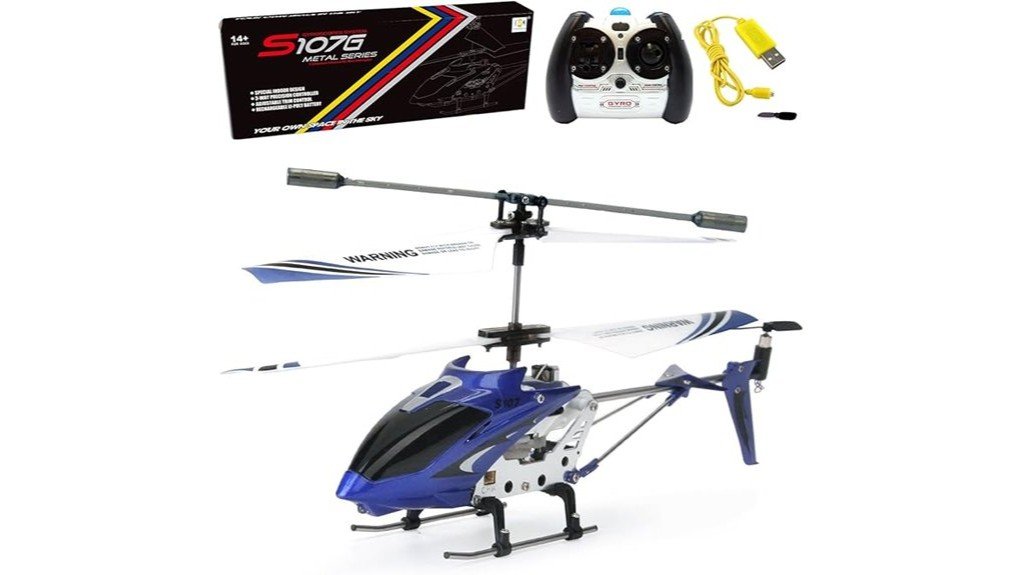
Small RC helicopters can be frustrating when they are too twitchy, difficult to trim, or nearly impossible to control in a normal room. The Cheerwing S107/S107G Phantom Mini RC Helicopter takes a simpler approach with gyro-assisted stabilization, 3-channel infrared controls, a metal frame, and a compact design intended primarily for indoor flying. It is a practical choice if you want an entry-level helicopter for short practice sessions, but its roughly 5 to 6 minute flight time and indoor-focused infrared control are important limitations. This review will help you decide if those tradeoffs make sense for the way you plan to fly.
Quick Verdict
Rating: 8/10, Recommended with caveats
Best For: Beginners age 14 and up who want a straightforward indoor RC helicopter for short practice flights.
Bottom Line: The upgraded gyro, simple 3-channel controls, and metal construction make the S107/S107G approachable for indoor practice. Its main compromises are short flight sessions and infrared controls that are better suited to rooms than outdoor flying.
| Specification | Detail |
|---|---|
| Brand | Cheerwing |
| Model | S107/S107G Phantom |
| Product Type | Mini remote-control helicopter |
| Control | 3-channel infrared remote control |
| Selectable Frequencies | 2 |
| Stabilization | Upgraded gyro system |
| Construction | Metal frame |
| Listed Dimensions | 16.8 x 2.6 x 6.1 inches |
| Listed Weight | 13.28 ounces |
| Helicopter Battery | 3.7V 150mAh Li-poly battery |
| Approx. Flight Time | About 5 to 6 minutes |
| Primary Use | Indoor flying |
| Minimum Listed Age | 14 years |
| Other Features | Colorful flashing lights, USB charging support, spare tail blade listed in the official package |
What Is the Cheerwing S107/S107G Phantom?
The Cheerwing S107/S107G Phantom is a small, battery-powered RC helicopter manufactured by Syma and sold under the Cheerwing brand. It uses a coaxial-style mini-helicopter design with an onboard gyro intended to make hovering and basic directional movement easier to manage than on a less stabilized toy helicopter.
The remote provides three basic control axes: up and down, forward and backward, and left and right rotation. That is enough for learning basic indoor helicopter control without adding the complexity found on more advanced hobby-grade collective-pitch models.
The helicopter also has colorful flashing lights and two selectable control frequencies. The frequency option can be useful when two compatible helicopters are being operated in the same area, although you should still leave enough physical space between them.
Before You Buy: This is primarily an indoor infrared-controlled helicopter. Do not buy it expecting the range, wind resistance, outdoor capability, or advanced maneuvering of a larger hobby-grade radio-control helicopter.
Who Should Buy It?
Best For
- Beginners age 14 and up learning basic RC helicopter controls.
- Indoor flyers who have a clear room or similar calm flying space.
- Casual hobbyists who prefer simple controls over aerobatic capability.
Skip If
- You mainly want to fly outdoors or in windy conditions.
- You expect long flight sessions from a single charge.
- You want advanced aerobatics or hobby-grade collective-pitch controls.
Design and Build Quality
One reason the S107/S107G has remained recognizable among small RC helicopters is its metal-frame construction. Metal does not make the helicopter crash-proof, but it gives the central airframe a more substantial feel than an all-plastic shell.
The compact helicopter format also makes it easier to use indoors than a larger RC aircraft. You still need a clear flying area because the rotating blades can strike furniture, walls, people, pets, curtains, and other objects.
Colorful flashing lights add visibility and make the helicopter easier to follow in normal indoor conditions. They are mainly a visual feature rather than a substitute for proper room lighting.
Controls, Gyro Stability, and Flight Performance
The upgraded gyro stabilization system is the most useful feature for a first-time pilot. The gyro helps correct unwanted rotation and makes the helicopter easier to keep oriented while you learn the relationship between throttle and directional inputs.
You should still expect a learning period. A stabilized mini helicopter does not hover perfectly by itself, and abrupt control inputs can send it toward a wall or ceiling quickly. Small, gradual movements generally give you more time to understand how the helicopter responds.
The 3-channel system keeps operation simple. You can raise or lower the helicopter, move it forward or backward, and rotate it left or right. That is enough for basic room-to-room practice, controlled turns, and simple landing exercises.
Because the control system is infrared, a clear path between the transmitter and helicopter is helpful. Indoor use also protects the lightweight aircraft from wind, which can overwhelm a small helicopter much more easily than a larger outdoor RC model.
Battery Life and Charging
The helicopter uses a 3.7V 150mAh Li-poly battery. Official specifications put normal flight time at roughly 5 to 6 minutes per charge. That is short compared with many modern RC drones, so this model makes more sense for brief practice sessions than extended flying.
Short flights are not necessarily a problem for a beginner. Five minutes is enough time to practice takeoff, hovering, gentle turns, and landing without turning one session into a long battery cycle.
Allow the helicopter and battery to cool after use and follow the supplied charging instructions. Do not charge a damaged, swollen, punctured, or unusually hot lithium-polymer battery.
Pro Tip: For your first flights, practice low over a clear floor instead of immediately climbing toward the ceiling. Small throttle corrections are easier to learn when you have a simple reference point and fewer obstacles around you.
How It Performs in Real Use
For First-Time Indoor Practice
The S107/S107G makes the most sense in a clear room where wind is not a factor. The gyro can help you learn basic orientation, while the three control channels keep the number of inputs manageable. Start with short takeoffs and landings before trying to cross the room.
For Hovering and Controlled Turns
Once the helicopter is trimmed and stable, you can practice holding altitude and making slow left or right turns. Small stick movements work better than aggressive corrections because a mini helicopter can change direction faster than a new pilot expects.
For Short Casual Flying Sessions
The roughly 5 to 6 minute flight time fits casual use. You can get several useful practice exercises into one charge, but the battery capacity means this is not designed for long uninterrupted sessions.
For Outdoor Flying
This is the weak point. The product is listed for indoor use, and its infrared control system and lightweight mini-helicopter format are better suited to calm rooms. If outdoor flying is your priority, you should choose an aircraft specifically designed and controlled for outdoor conditions.
Setup Tips Before First Use
- Read the supplied instructions first. Confirm the correct charging and transmitter setup before powering the helicopter.
- Clear the flying area. Move away from people, pets, ceiling fans, glass, lamps, curtains, and fragile objects.
- Start from a level surface. A flat takeoff area makes it easier to judge drift and orientation.
- Use gentle throttle inputs. Sudden throttle changes can make a lightweight helicopter rise or drop quickly.
- Practice facing one direction. Learn basic forward, backward, and turning controls before intentionally flying nose-in toward yourself.
- Land before the battery becomes very weak. A fading battery can reduce control authority and make a controlled landing harder.
Safety and Battery Notes
The current product information lists a manufacturer minimum age of 14 years and includes a small-parts warning. Follow the age guidance and the supplied instruction manual rather than treating the helicopter as an unsupervised toy for younger children.
Keep fingers, hair, loose clothing, pets, and faces away from the rotating blades. Turn the helicopter off before inspecting or handling the rotor area.
The Li-poly battery also deserves normal rechargeable-battery precautions. Use the recommended charging method, charge in an appropriate location, and stop using the battery if it becomes swollen, damaged, excessively hot, or otherwise abnormal.
Pros and Cons
Pros
- Upgraded gyro helps make basic indoor control more manageable.
- Simple 3-channel control is approachable for new pilots.
- Metal-frame construction gives the helicopter a sturdy central structure.
- Two selectable frequencies support compatible multi-helicopter use.
- Flashing lights improve visibility and add visual interest.
Cons
- About 5 to 6 minutes of flight time per charge is brief.
- Infrared controls and lightweight construction make it mainly an indoor aircraft.
- The three-channel design does not provide advanced helicopter aerobatic control.
Is It Worth the Price?
The Cheerwing S107/S107G is best viewed as a straightforward entry-level indoor helicopter rather than a replacement for a more advanced hobby aircraft. Its value comes from the combination of gyro stabilization, simple controls, a metal frame, USB charging support, and a design that does not require you to learn complex flight modes before getting started.
It is worth considering if your priority is inexpensive-feeling, low-complexity indoor practice and you are comfortable with short flight sessions. It is less compelling if battery endurance, outdoor range, wind resistance, or aerobatic capability are high on your list.
Package information can differ between retailer data and the manufacturer’s published package list, so check the current Amazon listing before ordering. In particular, verify the included controller, charging accessories, and spare parts shown for the seller you choose.
How It Compares to Alternatives
If you want another stabilized mini helicopter from the same manufacturer family, the Syma S109G is a useful comparison. It is also a 3-channel gyro-equipped mini helicopter, so it targets a similar indoor beginner use case.
If you want to move well beyond simple 3-channel flying, the Blade Nano S3 represents a more advanced class with additional flight-control technology and aerobatic capability. That also means greater complexity. The Cheerwing S107/S107G makes more sense when simple indoor hovering and basic directional control are your priorities.
Frequently Asked Questions
How long does the Cheerwing S107/S107G fly on one charge?
Official specifications list about 5 to 6 minutes of flight time. Actual use can vary with battery condition and how aggressively you fly, so plan on short practice sessions rather than long continuous flights.
Is the Cheerwing S107/S107G suitable for outdoor flying?
It is primarily an indoor helicopter. Its infrared control system and lightweight mini-helicopter design are better suited to calm indoor spaces than wind or open outdoor flying.
What battery does the helicopter use?
The helicopter uses a 3.7V 150mAh lithium-polymer battery. Follow the supplied charging instructions and stop using any Li-poly battery that becomes swollen, damaged, or abnormally hot.
Can two S107/S107G helicopters be flown at the same time?
The product provides two selectable frequencies intended to support compatible simultaneous operation. Keep adequate physical separation between aircraft and confirm the control setup before takeoff.
Is the Cheerwing S107/S107G good for beginners?
Yes, its gyro stabilization and simple 3-channel control layout make it more approachable than a complex hobby-grade helicopter. You still need practice with throttle, orientation, trimming, and controlled landings.
What age is the Cheerwing S107/S107G intended for?
The current product information lists a manufacturer minimum age of 14 years. Follow the manufacturer’s age and safety instructions, especially because the helicopter has rotating blades, rechargeable electronics, and small components.
Who should skip this mini RC helicopter?
Skip it if you want outdoor range, long battery life, strong wind resistance, or advanced aerobatics. The S107/S107G is better suited to short indoor sessions focused on basic hovering and directional control.
The Bottom Line
The Cheerwing S107/S107G Phantom is a sensible choice if you want an uncomplicated indoor RC helicopter with gyro-assisted stability, simple 3-channel controls, and a metal frame. You should skip it if you need long flights, outdoor capability, or advanced aerobatics, but for short beginner-friendly indoor practice, it earns our 8/10, Recommended with caveats verdict.
Ready to Buy?
Check the latest price, seller, and current package details before you decide.
