
Last Updated on July 27, 2026 by Daniel Globe
Visiting Istanbul’s Blue Mosque, officially the Sultan Ahmed Mosque or Sultanahmet Camii, is straightforward once you understand one important detail: this is an active place of worship, not simply a tourist attraction. Entry is free, but tourist access pauses around prayer times, modest clothing is required, and visitors remove their shoes before entering the carpeted prayer hall. A little planning will help you see the architecture without disrupting worship.
Quick Answer
The Blue Mosque is free to visit, but tourist entry pauses around prayer times and for a longer period around Friday midday prayer. Cover your shoulders and knees, women should cover their hair, and everyone removes their shoes before entering the prayer hall. Allow about 30–45 minutes inside and check the day’s prayer schedule before you go.
Key Takeaways
- Blue Mosque admission is free. Paid tours charge for guiding services, not for mosque admission.
- Tourist access pauses around prayers, and Friday midday has a longer interruption. Check the same-day Istanbul prayer schedule before leaving your hotel.
- Shoulders and knees should be covered. Women also need a head covering; scarves and wraps are available at the entrance when needed.
- Remove your shoes before stepping onto the prayer-hall carpet, keep your voice low, turn off your flash, and avoid photographing people who are praying.
- The T1 Kabataş–Bağcılar tram stops at Sultanahmet, placing you within a short walk of the mosque, Hagia Sophia, Basilica Cistern, and Topkapı Palace.
At a Glance
| Time Required | About 30–45 minutes inside; allow roughly an hour for the courtyard, shoe removal, and possible entry queues. |
| Difficulty | Easy, although prayer-time closures and crowds require some timing. |
| Tools Needed | Modest clothing, a headscarf for women if you prefer your own, easy-to-remove shoes, and a phone for checking current prayer times. |
| Cost | Free admission. Donations are voluntary; private guided tours cost extra. |
Disclosure: As an Amazon Associate I earn from qualifying purchases. Some links on this page are affiliate links, at no extra cost to you.
Understanding the Dress Code
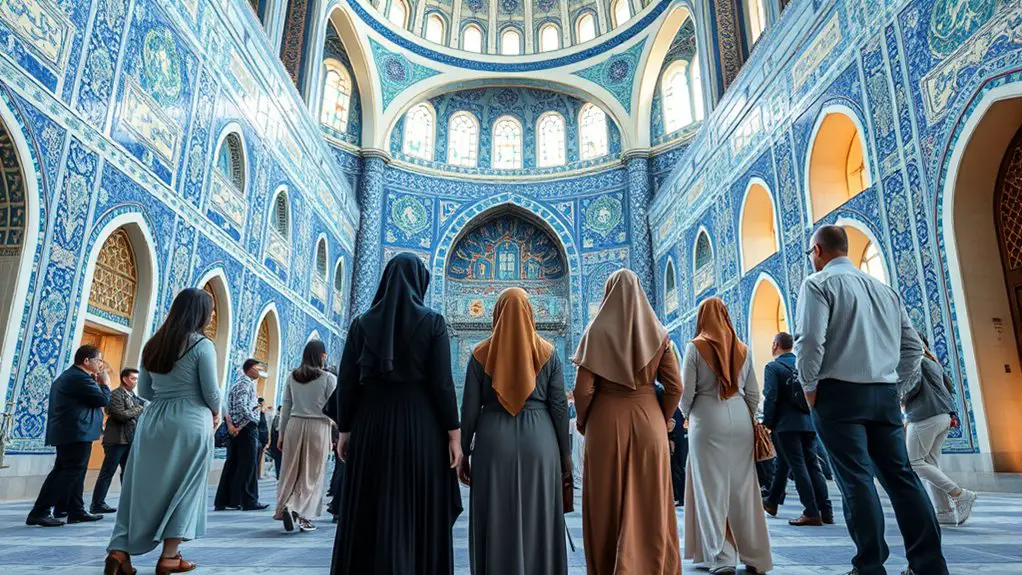
The Blue Mosque remains an active place of worship, so its dress rules are part of normal mosque etiquette rather than a tourist formality. Current visitor information for the Blue Mosque asks visitors to cover their shoulders and knees. Women are also required to cover their hair.
Long trousers or a long skirt make entry simple. A shirt that fully covers the shoulders is a safer choice than a sleeveless top. Men who arrive in short shorts may need a covering, so long trousers are the easiest option. Women can bring their own scarf, although scarves and body coverings are normally available at the entrance if needed.
All visitors remove their shoes before stepping onto the carpeted prayer-hall floor. Shoe bags are provided, allowing you to carry your footwear with you rather than leaving it unattended.
Pro Tip: Wear clean socks and shoes that slip on and off easily. It makes the entrance and exit process much quicker, especially when the mosque is busy.
Best Times to Visit
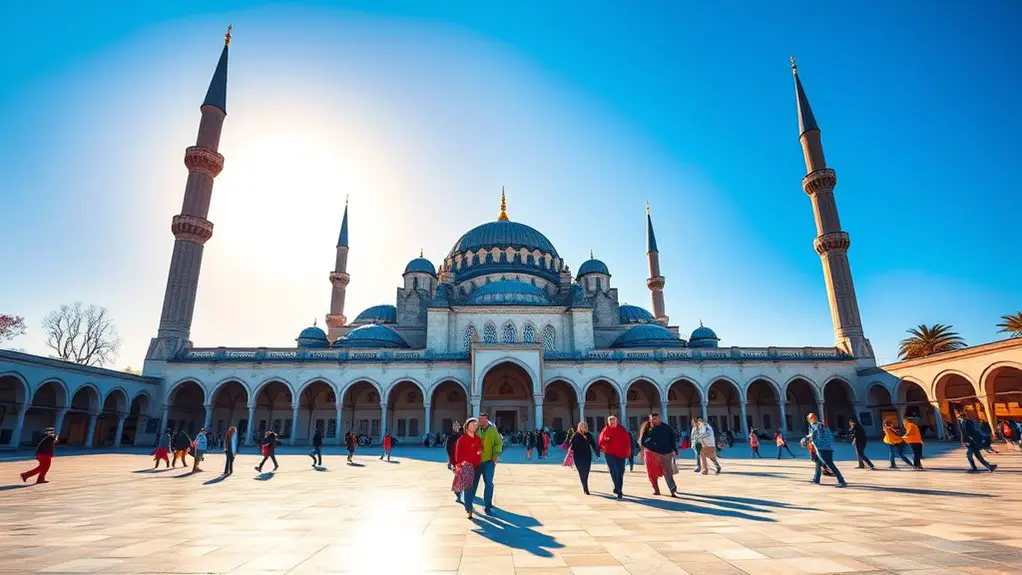
For most travelers, the easiest time to visit is near the beginning of the first tourist-access period, before the largest tour groups arrive. The mosque’s visitor information currently identifies early morning and later afternoon as calmer periods, but access always depends on worship.
Do not build your schedule around a single permanent clock time. Islamic prayer times shift throughout the year, and the mosque pauses tourist entry around prayers. Check the official Diyanet prayer times for Istanbul on the day you visit and then confirm the posted visitor schedule at the entrance.
Warning: Friday midday is the most important weekly congregational prayer and creates a longer tourist-access interruption. Avoid planning a Friday-morning sightseeing visit unless you are prepared to wait for the visitor entrance to reopen.
Early Morning Serenity
Arriving close to the first sightseeing window gives you the best chance of finding a quieter courtyard and shorter entrance line. Current visitor information generally places the first tourist period around 08:30, though the posted schedule should always take priority.
Tourists should not expect to enter as spectators during prayer. Instead, use the first visitor period after worship. Once inside, the quieter atmosphere makes it easier to study the tiles, arches, calligraphy, chandeliers, and enormous central space without rushing.
Late Afternoon Light
Late afternoon can be excellent for photography, but there is an important distinction between photographing the interior and photographing the exterior. Tourist access to the prayer hall follows the mosque’s visitor schedule, while Sultanahmet Square remains an excellent place to photograph the exterior as the light changes toward sunset and after dark.
| Timing | Best For | What to Know |
|---|---|---|
| Morning visitor window | Interior details and fewer crowds | Check prayer times first. |
| Late-afternoon visitor window | Interior and courtyard photography | Tourist access may end well before summer sunset. |
| Golden hour | Exterior domes and minarets | Use Sultanahmet Square if the prayer hall is closed. |
| After dark | Illuminated exterior | Night photography is best treated as an exterior activity. |
Off-Peak Season Advantages
Late autumn, winter, and early spring generally bring fewer leisure travelers than peak summer. That can make the mosque and surrounding Sultanahmet area easier to explore, although Istanbul winters can be cold, wet, and windy.
Even in a quieter season, prayer periods still determine visitor access. A low-crowd month does not eliminate the need to check the daily schedule.
Entry Guidelines and Hours
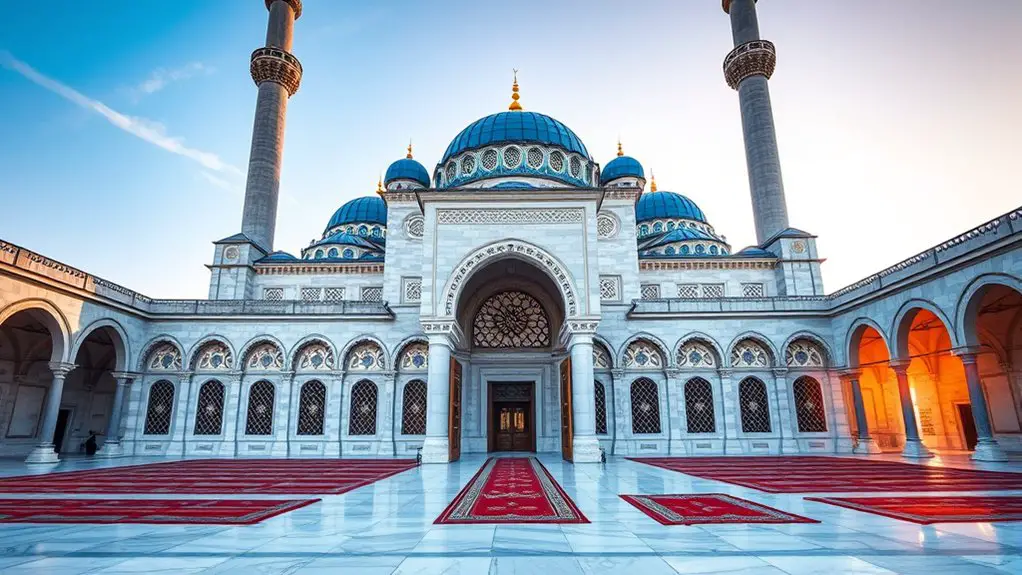
The Blue Mosque is open every day as a place of worship, but sightseeing access is divided into periods around prayers. There is no admission fee or reservation requirement for ordinary mosque entry.
The mosque’s current visitor-information page generally publishes sightseeing windows around 08:30–11:30, 13:00–14:30, and 15:30–16:45. These should be treated as planning guidance rather than a permanent guarantee because prayer schedules, Friday worship, religious holidays, and operational needs can affect access.
Note: Blue Mosque admission itself is free. A website or tour operator charging money is generally selling a guided experience or another service, not a required mosque entrance ticket.
At the entrance, follow signs for visitors rather than the worshipper entrance. Be prepared for a clothing check, remove your shoes before the carpeted area, and carry them in the supplied bag. Stay within designated visitor areas once inside.
Blue Mosque History in Brief
Sultan Ahmed I commissioned the mosque in the early 17th century. According to the Türkiye Ministry of Culture and Tourism, construction took place from 1609 to 1616 under architect Sedefkâr Mehmed Ağa.
The mosque’s six minarets, cascading domes, vast courtyard, calligraphy, and İznik tile decoration helped make it one of the defining monuments of Ottoman Istanbul. It also stands within the UNESCO-listed Historic Areas of Istanbul.
A major restoration campaign began in 2018. In a 2026 update, Türkiye’s Ministry of Culture and Tourism reported that the Sultanahmet restoration had been completed. Conservation teams documented more than 22,000 historic tile pieces and carried out extensive work on the domes, minarets, stone, marble, lead roofing, decorative surfaces, and courtyard.
During the recent restoration, conservation teams documented more than 22,000 historic tile pieces inside the Blue Mosque.
Exploring the Architecture
The Blue Mosque combines the monumental scale of Ottoman imperial mosque design with a carefully balanced series of domes, semi-domes, arches, piers, minarets, windows, calligraphy, and richly decorated surfaces.
Rather than trying to see everything at once, spend a few minutes looking at the overall structure and then focus on individual features such as the İznik tiles, mihrab, minbar, calligraphy, massive supporting piers, windows, and dome system.
Unique Design Elements
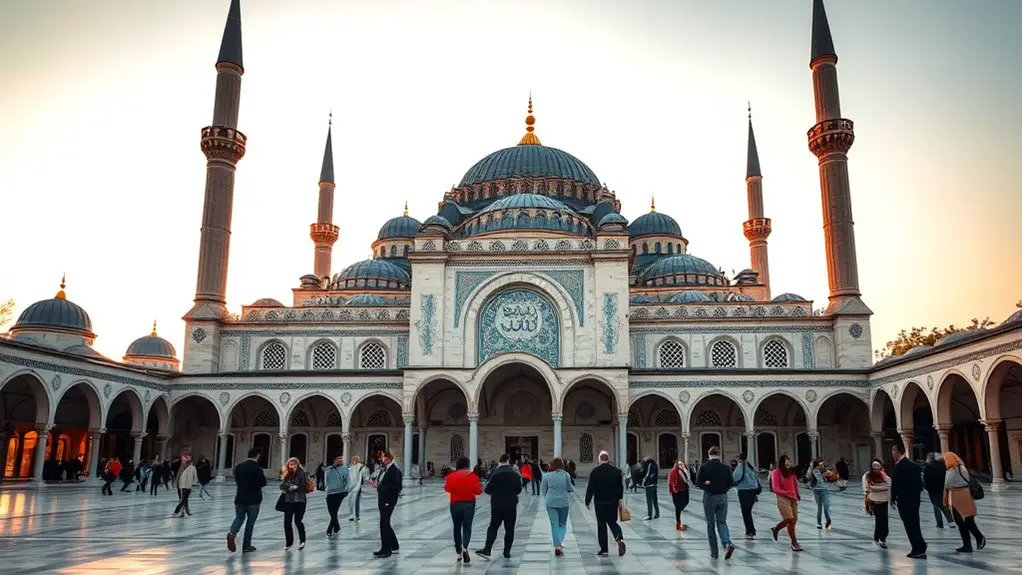
One of the mosque’s most recognizable features is its silhouette: a large central dome surrounded by a cascade of supporting domes and semi-domes, with six slender minarets rising around the complex.
Inside, blue-dominant İznik tiles, floral motifs, calligraphy, patterned surfaces, and filtered natural light soften the scale of the enormous prayer hall. The visual effect comes from craftsmanship and repetition rather than from a simple one-color decorative scheme.
For an especially strong exterior view, approach from the former Hippodrome side of Sultanahmet Square. This angle makes it easier to appreciate the relationship between the courtyard, domes, and minarets.
Stunning Dome Structure
The central dome is considerably larger than the original article stated. The Ministry of Culture and Tourism gives it as approximately 33.4 meters in diameter and 43 meters high.
- The central dome is supported visually and structurally by a system of semi-domes, arches, and massive piers.
- Smaller domes step downward toward the edges of the building, creating the mosque’s famous cascading profile.
- Four huge interior piers carry much of the dome’s weight.
- The six minarets create one of the most recognizable silhouettes on Istanbul’s Historic Peninsula.
- Numerous windows help bring natural light into the large prayer space.
Intricate Tile Work
The Blue Mosque’s nickname comes from the blue-dominant İznik ceramic decoration inside. Türkiye’s official tourism portal notes that the lower levels contain more than 20,000 tiles with more than 50 tulip designs.
Look beyond blue alone. The decoration includes white, turquoise, green, and red accents along with floral and geometric motifs. Tulips, carnations, and other plant forms show the technical and artistic strength of İznik ceramic production during the Ottoman period.
Take your time with the lower walls, then look upward to see how the smaller-scale tile patterns contrast with the enormous dome and painted upper surfaces.
Getting There and Accessibility
The simplest public-transport route for many visitors is the T1 Kabataş–Bağcılar tram. Get off at Sultanahmet; the mosque is a short walk through the historic square.
The same tram line connects Sultanahmet with Eminönü, Sirkeci, Karaköy, Kabataş, Beyazıt-Kapalıçarşı, and other useful visitor areas. Metro İstanbul states that T1 stations support low-floor tram operation and ramped access.
For visitors with reduced mobility, current Blue Mosque visitor information says a designated accessible entrance is available. Ask staff at the entrance to direct you to the appropriate ramped route rather than following the standard queue if it presents a barrier.
Pro Tip: If you use a wheelchair or have difficulty with steps, speak with mosque staff before joining the normal visitor line. The accessible route may use a different entrance.
Photography Tips
Photography is permitted for ordinary visitors, but the Blue Mosque’s role as a place of worship comes first. Current visitor guidance prohibits flash photography and asks visitors not to photograph people while they are praying.
- Turn off the flash: Use available light inside the prayer hall.
- Photograph the exterior at golden hour: Sultanahmet Square gives you room to frame the domes and minarets even when tourist entry has finished.
- Look for symmetry: The courtyard arcades and central doorway work well for balanced compositions.
- Focus on details: İznik tiles, calligraphy, arches, chandeliers, and carved stone provide strong close-up subjects.
- Respect worshippers: Do not photograph people at prayer or cross into restricted areas to improve a shot.
- Be patient: Waiting a minute or two can give you a cleaner frame without blocking other visitors.
Respectful Behavior Inside the Mosque
The easiest rule is to remember that sightseeing is secondary to worship. Speak quietly, move slowly, obey staff instructions, and give worshippers plenty of space.
| Action | What to Do | Why It Matters |
|---|---|---|
| Remove your shoes | Take them off before stepping onto the carpet and use the provided bag. | The prayer floor is kept clean for worship. |
| Keep your voice low | Avoid loud conversation, calls, or disruptive behavior. | People may be praying even during visitor periods. |
| Stay in visitor areas | Follow barriers, signs, and staff directions. | This keeps sightseeing separate from active worship areas. |
| Photograph respectfully | Turn off flash and do not photograph people who are praying. | It protects privacy and reduces disruption. |
Avoid walking directly in front of someone who is praying. Food and drinks should also remain outside the prayer hall.
Nearby Attractions to Explore
The Blue Mosque sits in one of Istanbul’s most concentrated sightseeing areas, so it is easy to combine several major landmarks in a single day.
- Hagia Sophia: Directly across Sultanahmet Square. Hagia Sophia is an active mosque rather than a museum. Türkiye introduced a separate visitor-management route for foreign cultural visitors in January 2024.
- Topkapı Palace: The former Ottoman imperial palace is a short walk away. Its official visitor page currently lists Tuesday as its weekly closed day.
- Basilica Cistern: This Roman-era underground reservoir is a few minutes from Sultanahmet Square. Its official visitor information currently lists daily opening from 09:00 to 22:00.
- Sultanahmet Square and the Hippodrome: Walk around the former Byzantine chariot-racing area to see the Egyptian Obelisk, Serpent Column, Walled Obelisk, and German Fountain.
- Grand Bazaar: Continue west toward Beyazıt for a much larger shopping district filled with jewelry, leather goods, textiles, carpets, ceramics, and souvenirs.
If you are building a one-day Sultanahmet itinerary, checking prayer times first is useful because you can visit Basilica Cistern, the Hippodrome, or another nearby attraction while the Blue Mosque is temporarily closed to tourists.
Guided Tours vs. Self-Exploration
You do not need a tour to enter the Blue Mosque. Ordinary admission is free, and you can comfortably explore the visitor area on your own.
A knowledgeable guide can still add value by explaining Ottoman architecture, İznik ceramics, the mihrab and minbar, Islamic worship practices, Sultan Ahmed I, and the relationship between the Blue Mosque and surrounding Historic Peninsula.
Current Blue Mosque visitor information says the mosque itself does not operate an official guided-tour program. Private licensed guides and commercial tours are available around Sultanahmet. A fee charged by those operators pays for the tour service, not for mosque admission.
The same visitor information describes a mosque audio guide as upcoming, so you should not currently depend on an official Blue Mosque audio tour being available when you arrive.
Useful Resources for Visitors
For a smoother visit, rely on current operational sources rather than an old screenshot or a fixed timetable saved months in advance.
- Blue Mosque visitor information: Current visitor windows, dress code, admission rules, photography guidance, and basic etiquette.
- Diyanet Istanbul prayer times: The most useful same-day reference for planning around worship.
- Türkiye Ministry of Culture and Tourism: Architectural measurements and historical background.
- Metro İstanbul T1 tram information: Stations, operating information, connections, and accessibility details.
- Sultanahmet Tourism Information Office: Official in-person tourism assistance close to the historic district.
Sources
- Türkiye Ministry of Culture and Tourism — Sultanahmet (Blue) Mosque — construction dates, architect, dome dimensions, and architectural facts.
- Blue Mosque Visitor Information — visitor windows, free admission, dress code, shoe removal, photography, and prayer-time access.
- Presidency of Religious Affairs — Istanbul Prayer Times — current daily prayer schedule.
- Türkiye Ministry of Culture and Tourism — Sultanahmet Restoration Update — completed restoration work and documentation of historic tiles.
- Metro İstanbul — T1 Kabataş–Bağcılar Tram Line — Sultanahmet station, connections, and tram accessibility.
- UNESCO World Heritage Centre — Historic Areas of Istanbul — heritage context for Sultanahmet and the Blue Mosque.
Frequently Asked Questions
Are There Any Facilities for Storing Luggage at the Mosque?
Do not plan your visit around on-site luggage storage. Current visitor information does not advertise a general baggage-storage facility. Travel with a small bag when possible, or leave large luggage at your hotel or a reputable luggage-storage service before arriving in Sultanahmet.
Is There an Entrance Fee to Visit the Blue Mosque?
No. Standard entry to the Blue Mosque is free. No admission ticket is required for an ordinary visit. Donations are voluntary. Private tour companies may charge for a guide or combined sightseeing service, but that fee is not a Blue Mosque entrance charge.
Can I Bring Food or Drinks Inside the Mosque?
Keep food and drinks outside the prayer hall. The interior is a carpeted worship space, so eating and drinking there is not appropriate. Sultanahmet has many cafés and restaurants where you can stop before or after the visit.
Are There Guided Audio Tours Available for Visitors?
Do not rely on a mosque-operated audio tour being available. Current Blue Mosque visitor information says the mosque does not run official guided tours and describes its own audio guide as upcoming. Private licensed guides and commercial walking tours are available in Sultanahmet.
What Languages Are Spoken by the Mosque Staff?
There is no published guarantee that staff members speaking a particular foreign language will always be available. Turkish is the primary local language, while visitor information and signage are commonly available in English. A translation app can be useful if you need more detailed assistance.
Can Non-Muslims Visit the Blue Mosque?
Yes. The Blue Mosque welcomes sightseeing visitors outside prayer periods. Non-Muslim visitors follow the same dress, shoe-removal, photography, and respectful-behavior rules that apply to other tourists.
How Should I Check Blue Mosque Prayer Times Before Visiting?
Check the official Diyanet Istanbul prayer schedule on the morning of your visit, then confirm the visitor-opening notice at the mosque entrance. Prayer times change throughout the year, and Friday midday requires extra planning because the congregational prayer creates a longer tourist closure.
Conclusion
A Blue Mosque visit is easiest when you treat the building first as a functioning mosque and second as a historic attraction. Check Istanbul’s prayer times before leaving, dress modestly, remove your shoes at the prayer hall, keep photography respectful, and allow enough flexibility for temporary closures.
Once inside, slow down and look beyond the famous blue color. The 33.4-meter central dome, cascading semi-domes, six minarets, thousands of İznik tiles, calligraphy, and filtered light explain why Sultanahmet Camii remains one of Istanbul’s defining Ottoman monuments. With Hagia Sophia, the Hippodrome, Basilica Cistern, and Topkapı Palace close by, it also fits naturally into a full day exploring the Historic Peninsula.

