

Last Updated on November 4, 2026 by Mason Reed
Looking for the best lightweight 2-person backpacking tent? The right choice can reduce your pack weight without leaving you short on sleeping space or weather protection. The Naturehike Cloud-Up 2 is a strong option for weight-conscious hikers, while the Star River UL offers two doors and better access for couples. If you prefer extra room or easier setup, the Kelty Grand Mesa and Naturehike Mongar are worth considering. Below, we compare five two-person tents to help you find the right balance of weight, comfort, durability, and value.
Disclosure: As an Amazon Associate I earn from qualifying purchases. Some links on this page are affiliate links, at no extra cost to you.
Quick Answer: Which Lightweight 2-Person Tent Is Best?
The Naturehike Cloud-Up 2 Person Lightweight Backpacking Tent is our top weight-focused recommendation from this shortlist. Its listed weight of approximately 3.6 pounds makes it appealing for hiking and bikepacking, while its double-layer construction provides a practical balance of protection and ventilation.
If you camp with a partner and prefer two doors and easier access, consider the Naturehike Star River UL. For a more traditional backpacking tent with straightforward setup, the Kelty Grand Mesa is another option, although it weighs more.
Important: Tent weights may refer to minimum trail weight, packaged weight, or different configurations. Compare the complete weight you will actually carry before buying.
Key Takeaways
- Best for minimizing carried weight: Naturehike Cloud-Up 2 lightweight nylon configuration.
- Best for two-person access: Naturehike Star River UL with two doors and vestibule space.
- Best alternative Cloud-Up configuration: Naturehike Cloud-Up 2 polyester version for buyers comparing materials and carrying weight.
- Best for straightforward setup: Kelty Grand Mesa with Quick Corners and a practical carry bag.
- Best for extra interior comfort: Naturehike Mongar with dual doors and vestibules, provided you accept the additional weight.
- Most important buying check: Confirm the exact two-person model, packed weight, floor dimensions, included footprint, and rainfly specifications.
Our Top Lightweight 2-Person Tent Picks
| Naturehike Cloud-Up 2 Person Lightweight Backpacking Tent |  |
Best Weight-Focused Pick | Listed Weight: Approximately 3.6 lbs | Capacity: 2 people | Packed Size: Approximately 15.7 × 5.1 × 5.1 inches | Check Price on Amazon | Read Our Analysis |
| Naturehike Star River UL 2 Person Backpacking Tent |  |
Best Dual-Door Design | Listed Weight: Approximately 4.07 lbs | Capacity: 2 people | Packed Size: Approximately 15.7 × 5.1 inches | Check Price on Amazon | Read Our Analysis |
| Naturehike Cloud-Up 2 Person Backpacking Tent, Polyester Version | 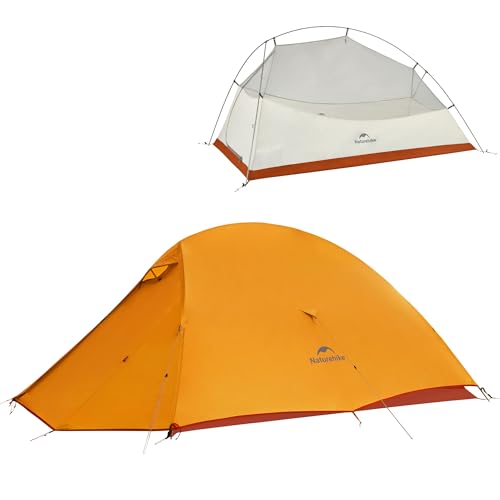 |
Best Alternative Configuration | Listed Weight: Approximately 4.25 lbs | Capacity: 2 people | Packed Size: Approximately 15.7 × 5.1 × 5.1 inches | Check Price on Amazon | Read Our Analysis |
| Kelty Grand Mesa 2 Person Backpacking Tent |  |
Best Easy-Setup Option | Weight: 4 lbs 1 oz minimum; 4 lbs 12 oz packaged | Capacity: 2 people | Packed Size: 16 × 7 × 7 inches | Check Price on Amazon | Read Our Analysis |
| Naturehike Mongar 2 Person Camping Tent |  |
Best Comfort-Focused Pick | Listed Weight: Approximately 5.3 lbs | Capacity: 2 people | Packed Size: Approximately 19.7 × 5.9 inches | Check Price on Amazon | Read Our Analysis |
Comparison note: Weights and packed dimensions are based on the original product listings and available manufacturer information. Accessories, fabric versions, and weight definitions may differ. The entries are not guaranteed to use identical weight measurements. Confirm the exact configuration and total carried weight on the product page.
More Details on Our Top Picks
-
Naturehike Cloud-Up 2 Person Lightweight Backpacking Tent
If your main goal is to reduce backpack weight while keeping a two-person shelter, the Naturehike Cloud-Up 2 Lightweight Backpacking Tent deserves a close look. The source listing gives its weight as approximately 3.6 pounds, making it one of the lighter options in this comparison.
Its double-layer design combines a coated nylon rainfly, breathable inner tent, and aluminum pole structure. A front vestibule provides space for smaller gear, helping you keep shoes and other equipment outside the sleeping area.
The front-entry design is useful for solo backpackers and couples who do not mind sharing one entrance. An added ventilation opening can help release moisture, although condensation may still form in humid or cold conditions.
Why You’ll Like It: Its biggest advantage is the balance between lower carried weight, compact packing, and an enclosed double-wall shelter.
Who Should Buy This: Backpackers, cyclists, and weight-conscious campers who want a compact two-person tent for typical three-season conditions.
Who Should Avoid This: Couples who strongly prefer separate entrances or need generous space for two wide sleeping pads and large backpacks.
Before Buying: Check the exact nylon version, included footprint, complete packaged weight, and manufacturer specifications. Cloud-Up models have several configurations with different materials and weights.
- Listed Weight: Approximately 3.6 lbs; verify the complete package
- Capacity: 2 people
- Packed Size: Approximately 15.7 × 5.1 × 5.1 inches
- Water Resistance: Coated nylon construction; verify the rating for the exact fabric layer
- Design Type: Double-layer, freestanding-style pole structure
- Ventilation: Mesh inner tent and ventilation opening
- Additional Feature: Front vestibule for gear
- Additional Feature: Aluminum pole structure
- Additional Feature: Compact backpacking design
-
Naturehike Star River UL 2 Person Backpacking Tent
The Naturehike Star River UL 2 Person Backpacking Tent is a practical choice if you want low weight without giving up separate entrances. Unlike many compact front-entry tents, its two-door layout makes it easier for both campers to enter and exit.
The source listing states a weight of approximately 4.07 pounds. Naturehike publishes different minimum and packaged weights for Star River UL configurations, so the exact number depends on the items included in your setup.
Its inner tent measures approximately 82.7 × 51.2 × 41.3 inches. The double-layer construction uses lightweight nylon fabric and mesh ventilation. Two vestibule areas help separate footwear and small equipment from the sleeping area.
The vestibule arrangement also makes this model useful for bikepacking and trips where both campers carry separate gear. However, the floor is still fairly compact for two adults, particularly if both use wide sleeping pads.
Why You’ll Like It: Two doors reduce the need to climb over your camping partner. Separate vestibule access also makes gear management more convenient.
Who Should Buy This: Hiking partners, couples, and bikepackers who value individual entrances and gear access.
Who Should Avoid This: Campers who want the simplest possible single-door layout or a tent with substantial extra floor space beyond two sleeping pads.
Before Buying: Confirm whether the stated weight includes the footprint, stakes, guylines, and storage bags.
- Listed Weight: Approximately 4.07 lbs; configuration dependent
- Capacity: 2 people
- Packed Size: Approximately 15.7 × 5.1 inches
- Water Resistance: Coated 15D nylon rainfly; verify current layer-specific ratings
- Design Type: Double-layer backpacking tent
- Ventilation: Mesh inner tent and two-door airflow options
- Additional Feature: Dual entrances
- Additional Feature: Vestibule storage
- Additional Feature: Interior storage pockets
-
Naturehike Cloud-Up 2 Person Backpacking Tent, Polyester Version
If you like the compact design of the Cloud-Up series but want to compare a different fabric configuration, this Naturehike Cloud-Up 2 Person Backpacking Tent is worth reviewing.
The linked version is described with 210T polyester fabric and a listed weight of approximately 4.25 pounds. That makes it heavier than the lighter Cloud-Up nylon configuration featured above, so it is better viewed as a lightweight backpacking alternative rather than a strict ultralight choice.
Its double-layer design uses a front-entry sleeping area, mesh ventilation, and a rainfly that creates a small vestibule. The freestanding-style pole structure helps with positioning the tent before you stake it down.
The listing also describes a waterproof coating rated around PU3000mm+. Actual rain protection depends on more than fabric ratings, including seams, fly coverage, tent tension, and campsite drainage.
Why You’ll Like It: You get a familiar, compact Cloud-Up layout while considering a different fabric and weight combination.
Who Should Buy This: Weekend backpackers and campers comparing Cloud-Up configurations who are comfortable carrying a somewhat heavier tent.
Who Should Avoid This: Long-distance hikers trying to minimize every ounce or couples who need two separate doors.
Before Buying: Verify that the selected variant uses the expected polyester fabric. Do not assume the specifications of a nylon Cloud-Up model apply to this listing.
- Listed Weight: Approximately 4.25 lbs
- Capacity: 2 people
- Packed Size: Approximately 15.7 × 5.1 × 5.1 inches
- Water Resistance: PU3000mm+ reported for the listed polyester configuration
- Design Type: Double-layer backpacking tent
- Ventilation: Mesh inner tent and ventilation opening
- Additional Feature: Front-entry design
- Additional Feature: Vestibule storage
- Additional Feature: Included accessories vary by listing
-
Kelty Grand Mesa 2 Person Backpacking Tent
The Kelty Grand Mesa 2 Person Backpacking Tent is a sensible option for couples and weekend campers who want straightforward setup and a practical sleeping area.
Kelty lists a minimum weight of 4 pounds 1 ounce and a packaged weight of 4 pounds 12 ounces. That makes it heavier than the most weight-focused tents in this comparison, but it remains relevant for backpackers who place more value on convenience and durable construction.
Its approximately 30-square-foot interior provides sleeping space for two people. The floor tapers toward one end, so checking your sleeping-pad widths is particularly important.
The Grand Mesa uses 68D polyester fabric, aluminum poles, color-coded attachments, and Kelty Quick Corners. These features help simplify pitching, especially after a long hiking day.
The single-door layout includes an EZ-Zip vestibule for footwear and smaller gear. Its Shark Mouth carry bag is designed to make packing easier.
Why You’ll Like It: Its main benefits are practical setup features, a familiar backpacking layout, and durable fabric construction.
Who Should Buy This: New backpackers, weekend hikers, and couples who prefer simple assembly over the lowest possible carried weight.
Who Should Avoid This: Strict ultralight backpackers or campers who need individual entrances.
Before Buying: Compare the packaged weight rather than the minimum weight alone. Also check current product availability and the exact version being sold.
For manufacturer specifications, visit the Kelty Grand Mesa product page.
- Minimum Weight: 4 lbs 1 oz
- Packaged Weight: 4 lbs 12 oz
- Capacity: 2 people
- Packed Size: 16 × 7 × 7 inches
- Floor Area: Approximately 30 square feet
- Water Resistance: Coated polyester fly and floor with taped construction
- Design Type: Freestanding backpacking tent
- Ventilation: Mesh inner panels
- Additional Feature: Kelty Quick Corners
- Additional Feature: EZ-Zip vestibule
- Additional Feature: Shark Mouth carry bag
-
Naturehike Mongar 2 Person Camping Tent
The Naturehike Mongar 2 Person Camping Tent is a comfort-focused option for backpacking partners who value convenient access and interior room more than minimum weight.
The original listing describes a weight of approximately 5.3 pounds, although reported weights vary between Mongar versions and bundles. This is noticeably heavier than the UL-focused alternatives in our comparison.
The tent’s interior measures approximately 82.7 × 53.2 × 41.3 inches. Its wider floor and dual-door arrangement can make sharing a tent more convenient, particularly when both campers want independent access.
The double-layer construction uses 210T polyester in the linked configuration, with a reported waterproof rating around 3000mm. Mesh sections help ventilate the sleeping area, while two vestibules provide separate spaces for footwear and small gear.
Why You’ll Like It: The two-door, two-vestibule layout makes it easier for couples to organize their belongings and move in and out of the shelter.
Who Should Buy This: Couples, weekend campers, and short-distance backpackers who prioritize access and comfort.
Who Should Avoid This: Solo ultralight hikers, long-distance backpackers, and anyone with a strict shelter-weight target.
Before Buying: Confirm the exact Mongar fabric version and full packed weight. The standard Mongar and Mongar UL versions should not be assumed to have identical specifications.
- Listed Weight: Approximately 5.3 lbs; verify configuration
- Capacity: 2 people
- Packed Size: Approximately 19.7 × 5.9 inches
- Water Resistance: 3000mm rating reported for the linked polyester configuration
- Design Type: Double-layer camping tent
- Ventilation: Mesh inner panels and dual-door access
- Additional Feature: Two entrances
- Additional Feature: Dual vestibules
- Additional Feature: Wider sleeping area
Factors to Consider When Choosing a Lightweight 2-Person Tent

Choosing the right lightweight two-person tent involves more than comparing the number on a product listing. You also need to consider packed weight, interior dimensions, weather protection, ventilation, durability, and ease of setup.
A lighter tent may save energy on long hikes, but a slightly heavier design may provide easier access or more room for your gear.
Weight and Portability
Weight is one of the most important buying factors for backpacking tents. However, manufacturers and retailers do not always measure it the same way.
Minimum trail weight generally refers to the essential shelter components, while packaged weight includes additional items such as stakes, guylines, storage bags, and sometimes a footprint.
For a realistic comparison, calculate the weight of everything you intend to carry.
| Term | What It Means |
|---|---|
| Minimum Weight | Usually the tent body, fly, and essential pole system. |
| Packaged Weight | The advertised package with included accessories, depending on the manufacturer. |
| Actual Carried Weight | Everything you personally pack, including any additional stakes, footprint, or repair supplies. |
If two people share the tent, you can distribute the components between backpacks. One person may carry the poles and stakes while the other carries the tent body and rainfly.
Also consider packed dimensions. A narrow tent package may fit more easily inside a backpack or bikepacking bag than a longer, bulkier bundle.
Weather Resistance Features
A lightweight tent should provide suitable protection against the weather you expect to encounter. Look beyond a single waterproof rating when comparing models.
Waterproof ratings are commonly expressed in millimeters of hydrostatic head. A higher rating indicates greater fabric resistance to water pressure under test conditions, but it does not guarantee that the entire tent will remain dry in every storm.
Consider the following features:
- Rainfly coverage: A properly fitted fly helps shield doors, walls, and entrances from rain.
- Seam construction: Seams need appropriate waterproof treatment to reduce leakage.
- Floor protection: A durable floor and correctly sized footprint can help protect against abrasion and ground moisture.
- Guylines and stakes: Proper anchoring helps maintain tent shape and rainfly tension.
- Ventilation: Airflow helps manage condensation during humid or cool nights.
For example, a fabric with a reported 4000mm rating is not automatically more weatherworthy than a well-designed tent using lower-rated fabric. Construction, pitching, seam treatment, and condition matter too.
Interior Space Dimensions
A two-person tent is designed to accommodate two sleepers, but that does not always mean it will feel spacious.
Many lightweight models have floors approximately 82 to 85 inches long and 49 to 57 inches wide, although some designs taper toward the foot end.
Before choosing a tent, compare its usable floor width with your sleeping pads.
For example, two standard 20-inch sleeping pads require approximately 40 inches of combined width. Two 25-inch wide pads require about 50 inches, leaving limited clearance in many compact backpacking tents.
Wall slope also matters. A tent may provide enough floor length while offering less usable headroom near the sides.
Peak height affects how comfortably you can sit upright. However, peak height alone does not describe the amount of space available across the entire interior.
If you regularly camp with another adult, consider whether separate doors and vestibules would make the experience more comfortable.
Setup and Ease
A tent that is easy to pitch can save time and frustration, particularly when you arrive at camp late or tired.
Freestanding and freestanding-style designs are generally easier to position before final staking. However, you should still anchor the tent properly to prevent movement and improve stability.
Look for helpful setup features such as:
- Color-coded pole connections and clips.
- Clear instructions for attaching the rainfly.
- Simple corner attachments.
- Accessible guylines and staking points.
- A carry bag that makes repacking manageable.
The Kelty Grand Mesa offers Quick Corners and color-coded attachments, while the Naturehike models use lightweight pole structures intended for portable camping setups.
Practice setting up a new tent at home before taking it on a remote trip. This also gives you an opportunity to inspect the poles, fabric, zippers, and accessories.
Ventilation and Airflow
Ventilation affects comfort in both warm and cool conditions. When moisture from breathing and the surrounding air collects on cooler tent surfaces, condensation can form.
Double-wall tents help separate the inner sleeping area from the outer rainfly. Mesh panels, vents, and door openings may also help moisture escape.
Good ventilation features include:
- Mesh inner walls for airflow and insect protection.
- Adjustable vents to help release moist air.
- Doors that can be opened safely in suitable weather.
- Adequate separation between the inner tent and rainfly.
Two-door tents can offer more flexible ventilation than some single-door designs, although actual airflow depends on the tent’s shape and surrounding conditions.
Keep gear from pushing the inner tent against the rainfly. Contact between the layers can transfer collected moisture into the sleeping area.
Material Durability and Quality
Lightweight tents use different materials to balance packed weight, tear resistance, weather protection, and cost.
Common materials include 15D nylon, 20D nylon, 68D polyester, and 210T polyester. The denier number describes yarn fineness, while a thread-count designation such as 210T describes a different fabric characteristic.
These numbers should not be compared as if they measured the same property.
Lightweight nylon can reduce packed weight, but thinner fabrics may need more careful handling on rough ground. Polyester is common in backpacking tents and may offer practical durability depending on its construction and coating.
Aluminum poles are widely used because they provide a useful strength-to-weight balance.
Check the quality of the stitching, zippers, pole connections, reinforcement points, and floor material rather than relying only on the fabric name.
A footprint can help protect a lighter tent floor from abrasion, but it should not extend beyond the rainfly in a way that collects rainwater underneath the tent.
Doors, Vestibules, and Gear Storage
Entrance placement is especially important when two people share a compact tent.
A single front-entry tent can save weight and maintain a compact shape, but one person may need to move around the other when entering or leaving.
A dual-door design offers more flexibility, particularly when both campers need access during the night.
Vestibules provide sheltered space for shoes and some equipment. However, vestibule size varies, and not every vestibule can accommodate a full backpack.
Think about your usual gear before choosing between a single-vestibule and dual-vestibule layout.
How to Choose the Right 2-Person Tent for Your Trip
The best tent for you depends on the distance you hike, whether you share the shelter, and how much comfort you expect at camp.
| Your Main Priority | Recommended Model | Why It Fits |
|---|---|---|
| Reducing backpack weight | Naturehike Cloud-Up 2 Lightweight | One of the lighter listed configurations in this comparison. |
| Two-person access | Naturehike Star River UL | Two doors and convenient vestibule access. |
| Comparing Cloud-Up materials | Naturehike Cloud-Up Polyester | An alternative material configuration with a higher listed weight. |
| Simple setup | Kelty Grand Mesa | Quick Corners, color-coded attachments, and practical packing features. |
| Interior comfort and access | Naturehike Mongar | Dual doors, two vestibules, and a wider sleeping area. |
Before You Buy: Lightweight Tent Checklist
Use this checklist before ordering a two-person backpacking tent:
- Confirm capacity: Make sure the selected option is actually the two-person version.
- Compare carried weight: Check whether the number includes poles, stakes, guylines, footprint, and bags.
- Measure your sleeping pads: Check both the floor width and any taper.
- Inspect entrance placement: Decide whether one door is sufficient or two would be more convenient.
- Check weather specifications: Review fly coverage, seam treatment, floor fabric, and the expected camping season.
- Verify included accessories: Footprints, repair kits, stakes, and guylines may differ between packages.
- Review the return policy: Make sure you can inspect the tent before a major trip.
- Confirm spare-part support: Check the manufacturer’s current warranty and options for replacing damaged poles or components.
For additional product details and variant specifications, check the official Naturehike website or Kelty’s website. Manufacturer information is especially useful when retailer listings combine several versions of the same tent.
Frequently Asked Questions
How Do I Properly Set Up a Lightweight 2-Person Tent?
Start by choosing a level campsite away from drainage channels, loose rocks, and other hazards. Clear sharp objects from the area without damaging vegetation.
Lay out the footprint if your setup includes one, then spread the inner tent according to its manufacturer’s instructions.
Assemble the poles, connect them to the appropriate attachment points, and secure the tent body. Fit the rainfly, stake the corners, and tension the guylines.
Finally, check that the rainfly is properly positioned and does not press unnecessarily against the inner tent. Practice this process at home before your first trip.
What Is the Weight Limit for Two People in These Tents?
Two-person tents generally specify sleeping capacity and floor dimensions rather than a universal combined body-weight limit.
There is no reliable single weight limit that applies to all the models in this comparison. The tent floor rests on the ground, so its construction is different from a suspended sleeping platform.
For most buyers, the more useful checks are the tent’s floor dimensions, sleeping-pad compatibility, usable headroom, and overall fit.
If the manufacturer provides a specific occupancy or loading restriction, follow that guidance.
Can I Use a Lightweight Backpacking Tent in Winter Conditions?
Some three-season tents may be usable during mild cold-weather trips, but they should not be treated as dedicated winter shelters.
Most lightweight three-season designs are not intended to handle substantial snow accumulation or severe alpine winds.
If you expect significant snow, strong winter storms, or exposed mountain conditions, choose a shelter specifically designed for those conditions.
Also remember that a tent does not provide the insulation needed to keep you warm. Appropriate sleeping bags, insulated sleeping pads, clothing, and campsite planning are essential.
How Do I Clean and Maintain My Lightweight 2-Person Tent?
After each trip, shake out loose dirt and remove debris from the floor and zippers.
Clean dirty areas gently with water, a soft sponge, and a cleaner approved for your tent fabric when necessary.
Avoid harsh detergents, bleach, machine washing, and excessive scrubbing unless the manufacturer specifically permits them.
Allow the tent, rainfly, footprint, and storage bag to dry completely before long-term storage.
Store the tent in a cool, dry place away from prolonged sunlight and heat. Inspect seams, coatings, poles, and zippers regularly so small problems can be repaired before your next trip.
What Accessories Are Recommended for Lightweight 2-Person Tents?
Useful accessories include a correctly sized footprint, lightweight stakes suitable for your campsite, replacement guylines, and a small tent repair kit.
For sleeping comfort, choose pads that fit within the tent’s actual floor dimensions. Two wide sleeping pads may not fit comfortably in narrower two-person models.
Small storage organizers can also help keep equipment accessible without covering ventilation openings.
Before purchasing additional accessories, check what the tent already includes so you do not carry unnecessary duplicates.
Is a 2-Person Backpacking Tent Comfortable for Two Adults?
A two-person backpacking tent can accommodate two adults, but comfort depends on their sizes, sleeping pads, and gear.
Many lightweight tents provide enough floor space for two standard sleeping pads with limited room left over.
If you want more space for clothing, backpacks, or moving around, a roomier two-person design or a lightweight three-person tent may be more comfortable.
For couples sharing a compact tent, two doors and separate vestibules can make daily use easier.
What Is the Difference Between Minimum and Packaged Tent Weight?
Minimum weight typically includes the key parts needed to form the shelter, such as the tent body, fly, and poles.
Packaged weight generally includes more of the supplied accessories. However, manufacturers may define these terms differently.
For the most accurate backpacking comparison, add up the weight of all the components you will bring on your trip.
Are Double-Wall Tents Better for Condensation?
Double-wall tents can make condensation easier to manage because the mesh inner tent is separated from the outer rainfly.
However, condensation can still develop when humidity is high, ventilation is limited, or temperatures fall.
Proper pitching, suitable ventilation, and avoiding contact between the inner tent and rainfly can help improve comfort.
Conclusion
Choosing the best lightweight 2-person backpacking tent comes down to how you balance weight, space, access, weather protection, and ease of setup.
If you want a compact shelter and lower carried weight, the Naturehike Cloud-Up 2 Lightweight Backpacking Tent is our leading weight-focused recommendation from these five options.
For couples who prefer separate entrances, the Naturehike Star River UL provides a useful balance of lightweight construction and two-person convenience.
The Kelty Grand Mesa is worth considering for straightforward setup, while the Naturehike Mongar better suits campers willing to carry more weight for additional access and comfort. The heavier Cloud-Up polyester configuration gives you another material option to compare.
Final Recommendation: Start with your complete carried-weight target, then check the floor dimensions and entry layout. These details will usually matter more than broad marketing terms such as “ultralight” or “waterproof.”
Before ordering, confirm the exact tent configuration, included accessories, and current manufacturer specifications. A carefully chosen shelter can make your backpacking trips more comfortable without adding unnecessary weight.
