
Last Updated on July 24, 2026 by Daniel Globe
Choosing where to stay in Rome with your family is less about finding one “perfect” neighborhood and more about matching your home base to your children’s ages, your must-see sights, and how much walking you want to do. Centro Storico puts famous landmarks on your doorstep, while Prati, Monti, Celio, Trastevere, Flaminio, and Rome’s quieter residential districts each offer different advantages.
Quick Answer
For most families, Prati is the easiest all-around base because it combines Vatican access, shops, public transport, and relatively straightforward streets. Choose Centro Storico for maximum sightseeing convenience, Monti or Celio for the Colosseum, Trastevere for atmosphere, or Flaminio for younger children and Explora.
Key Takeaways
- Prati offers one of the best balances of sightseeing access, everyday services, and public transport for families.
- Centro Storico minimizes transport time but comes with crowds, cobblestones, higher prices, and more difficult stroller conditions.
- Monti and Celio are strong choices when the Colosseum, Roman Forum, and ancient Rome are your priorities.
- Trastevere and Ostiense have plenty of character but require careful hotel selection if your children need quiet nights.
- Check the exact address, not just the neighborhood name. Noise, hills, metro access, elevators, and sidewalks can change within a few blocks.
Disclosure: As an Amazon Associate I earn from qualifying purchases. Some links on this page are affiliate links, at no extra cost to you.
Best Areas to Stay in Rome With Family at a Glance
| Area | Best For | Biggest Advantage | Main Trade-Off |
|---|---|---|---|
| Prati | Most families | Vatican access, shops, Metro A | Less old-Rome atmosphere |
| Centro Storico | First visits and short stays | Walk to many headline sights | Crowds, cobbles, higher prices |
| Monti | Ancient-Rome sightseeing | Near Colosseum and Forum | Hills and evening activity |
| Celio | Families wanting Colosseum proximity | Quieter feel close to ancient sites | Fewer doorstep attractions beyond ancient Rome |
| Trastevere | Older kids and atmosphere | Dining, lanes, evening energy | Noise and cobblestones |
| Flaminio | Families with younger children | Near Explora and Piazza del Popolo | Farther from the Colosseum |
| Trieste-Salario | Quiet, longer stays | Residential feel and large parks nearby | More transport time |
| San Giovanni | Value and local amenities | Metro, shops, restaurants | Less central for some sights |
| Testaccio | Food-focused local stays | Markets and neighborhood atmosphere | Not as close to headline monuments |
| Ostiense | Older kids, art and modern Rome | Street art and Centrale Montemartini | Some streets have active nightlife |
How to Choose the Right Rome Neighborhood for Your Family
Start with the attraction your family most wants to see. A hotel that lets you walk to your first activity can save more energy than one that looks slightly better on paper but requires a cross-city trip every morning.
Families with babies and toddlers should pay particular attention to pavement, elevators, room layout, grocery stores, and opportunities to return to the room for naps. Families with school-age children may value proximity to the Colosseum, Vatican Museums, parks, and interactive attractions. Teenagers may appreciate the evening atmosphere of Trastevere, Monti, or Ostiense.
Pro Tip: Open the accommodation on a map before booking and inspect the final few blocks to the nearest metro stop or major attraction. In Rome, a short map distance can still involve cobbles, steep streets, stairs, heavy traffic, or a difficult stroller route.
Hotel or Apartment?
Hotels can be easier when you want reception help, luggage storage, breakfast, housekeeping, cribs, or connecting rooms. Apartments can be especially practical for longer stays because a kitchen, washing machine, separate bedrooms, and living space can simplify family routines.
Whichever you choose, confirm the property’s legal occupancy, bed configuration, elevator access, air conditioning, and whether a crib counts toward the stated room capacity. Rome has many older buildings where elevators are small or absent.
Quiet or Central?
Centro Storico minimizes commuting but puts you in the busiest part of the city. Prati, Celio, Trieste-Salario, and parts of San Giovanni can provide a calmer base. Trastevere, Monti, Campo de’ Fiori, and parts of Ostiense can stay active well into the evening, so read recent reviews for street-noise comments before booking.
Centro Storico: The Heart of Rome for Families
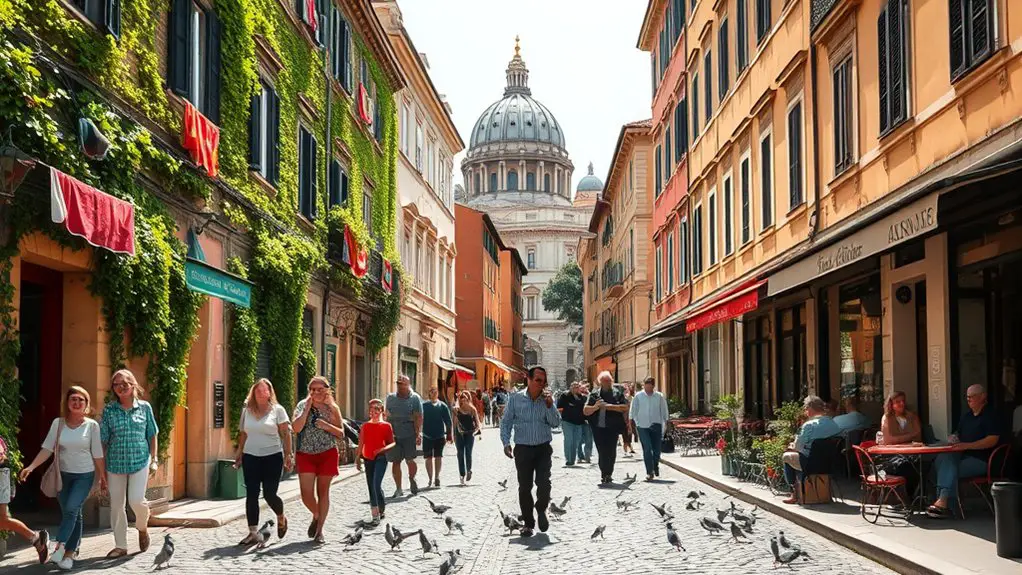
When you stay in Centro Storico, many of Rome’s most recognizable sights become part of your everyday walking route. Depending on your exact location, the Pantheon, Piazza Navona, Trevi Fountain, Campo de’ Fiori, and Spanish Steps may all be reachable without using public transport.
Centro Storico is hard to beat for sightseeing efficiency, but its old streets are better described as highly walkable than universally stroller-friendly.
The trade-off is the physical character that gives the historic center its appeal. Cobblestones, narrow sidewalks, crowds, irregular paving, and busy squares can make pushing a stroller more tiring than the map suggests.
You will have no shortage of restaurants, cafés, pizza, and gelato, but dining immediately beside the most famous sights can be more tourist-oriented and expensive than in residential districts.
Explora, the Children’s Museum of Rome, is an excellent family attraction, but it is not in the Pantheon/Piazza Navona core. It is on Via Flaminia near Piazza del Popolo, making northern Centro Storico or neighboring Flaminio the most convenient bases for it.
Centro Storico works especially well for first-time families staying only a few days and willing to pay more to reduce transit time.
Warning: Do not assume a “central” hotel will be easy with a stroller. Check the actual route, building elevator, entrance steps, and nearby pavement before booking.
Exploring the Vatican Area: Prati and Trionfale
For many families, Prati is the easiest compromise between central sightseeing and everyday convenience. The district sits a short distance from Vatican City and has shops, restaurants, pharmacies, supermarkets, and Metro A access. Rome’s official tourism site highlights Via Cola di Rienzo as one of the area’s main shopping and dining streets.
Trionfale can provide a more residential feel and may offer good accommodation choices, but it covers a larger area. Do not assume every Trionfale address is a short walk from St. Peter’s Square or the Vatican Museums; check the precise property location.
Family-Friendly Dining Options
Rather than booking this area for one specific restaurant, choose it for the density of everyday options. Prati has casual pizzerias, bakeries, gelaterias, cafés, supermarkets, and traditional restaurants, while Trionfale adds neighborhood food shops and local dining away from the busiest tourist corridors.
| Area | Useful Family Dining Choice | Why It Helps |
|---|---|---|
| Prati | Pizzerias and casual restaurants | Simple meals after Vatican sightseeing |
| Prati | Gelaterias and cafés | Quick snacks and flexible timing |
| Trionfale | Neighborhood trattorias | More residential dining atmosphere |
| Prati and Trionfale | Markets and grocery stores | Useful for breakfast supplies, fruit, milk, and snacks |
Proximity to Vatican Attractions
Prati is especially useful when St. Peter’s Basilica and the Vatican Museums are high on your list. Staying nearby can let you visit early, return to your accommodation for a break, and avoid crossing Rome with tired children.
The Vatican Museums’ official family information confirms that strollers are welcome and that families can use dedicated lifts, baby-changing facilities, a nursing room, rest areas, and high chairs in some refreshment areas.
St. Peter’s Basilica is free to enter. A reservation is not mandatory, although optional timed services are available, and security screening can create queues at busy times.
- Choose Prati for the easiest balance of Vatican access, shopping, and Metro A.
- Consider Trionfale when you prefer a more residential base and do not mind checking transport or walking distance carefully.
- Castel Sant’Angelo is another major attraction close to the Prati side of the river.
- Use the metro or another transport option for sights on the opposite side of central Rome when young legs need a break.
Trastevere: A Unique Experience With Older Kids
Trastevere offers the atmosphere many visitors picture when imagining Rome: narrow lanes, weathered buildings, busy piazzas, small restaurants, churches, and plenty of evening activity. Rome’s official tourism site highlights landmarks such as Santa Maria in Trastevere, Villa Farnesina, the Botanical Garden, and the area’s links to the Janiculum.
Aromaticus has a Trastevere location, and Da Enzo al 29 is also in Trastevere rather than Trionfale. More broadly, the neighborhood gives families an enormous choice of casual restaurants, Roman dishes, pizza, and gelato.
Older children and teenagers may enjoy Trastevere most because they can experience a lively neighborhood after the major sights close. Younger children can enjoy the squares and nearby green spaces, but parents using a stroller should expect cobbles and uneven paving.
The main drawback is nighttime activity. A peaceful side street can work beautifully for a family, while a room over a popular bar or piazza may be frustrating at bedtime. Check recent accommodation reviews for noise before you book.
Monti: A Charming Neighborhood Near the Colosseum
Monti mixes ancient Rome with restaurants, small shops, galleries, and an active neighborhood atmosphere. The Colosseum, Imperial Fora, Domus Aurea, and Roman Forum are all convenient from parts of the district, making it particularly good for families whose children are excited about gladiators and Roman history.
Monti is one of Rome’s strongest bases for ancient-history sightseeing because families can reach the Colosseum and Forum without making them cross-city excursions.
- Colle Oppio and the Baths of Trajan Park provides green space, Colosseum views, and an equipped children’s play area.
- DoubleTree by Hilton Rome Monti currently lists cribs, childcare, a kids menu, and connecting rooms among its family-relevant services.
- The Roman Forum and Colosseum are genuinely nearby from much of Monti.
- Vatican City is not a Monti neighborhood attraction; plan on a longer walk or public-transport/taxi trip.
Monti is not completely flat, and some streets can be busy at night. For families with a stroller, check the route between the accommodation and the places you expect to visit most often.
Celio: Quieter Options Close to Major Attractions
Celio sits beside some of ancient Rome’s biggest sights, yet parts of the neighborhood feel calmer than the busiest streets around the historic center. It can be a smart option when you want to prioritize the Colosseum without staying directly in a crowded sightseeing corridor.
Do not assume Celio is always “budget-friendly”: room prices change sharply with season and demand. Its real advantage is the chance to combine ancient-site proximity with a somewhat more residential atmosphere.
Family Accommodation Options
One important 2026 update is that the former Hotel Capo d’Africa is now Room Mate Collection Mia. Its current official room list includes triple and connected-room configurations, making it worth checking for families who need more than a standard double room.
Another nearby option is Mercure Rome Colosseum Centre, which Accor currently labels family friendly and which sits close to the archaeological area.
- Compare the cost of one family room or connecting rooms with a nearby apartment.
- Confirm elevator access if you have a stroller or heavy luggage.
- Check how many real beds the room provides rather than assuming a sofa bed will suit every child.
- Read the most recent noise and air-conditioning reviews before booking.
Proximity to Attractions
Celio makes the Colosseum, Roman Forum, Palatine Hill, Basilica of San Clemente, and other ancient sights straightforward to reach. Colle Oppio also gives families a nearby place to pause outdoors.
Expect old paving and occasional steps rather than uniformly smooth stroller routes. The district is walkable, but comfortable stroller use depends heavily on the exact street and destination.
Families planning the Colosseum should use the official archaeological park ticket information. In 2026, Colosseum entry requires a reserved time slot, and ticket sales open in advance. Visitors under 18 qualify for free admission under the official rules but still need the appropriate booked ticket.
Flaminio: A Smart Choice for Younger Children
Flaminio deserves consideration when you are traveling with toddlers or younger school-age children. It sits just north of Piazza del Popolo and gives families easy access to Explora without forcing every day to begin in the densest tourist streets.
Explora is at Via Flaminia 82 and currently operates timed visits rather than unrestricted all-day admission. Its hands-on exhibits are designed around learning through play, making it a useful break from churches and archaeological sites.
From this part of Rome, families can also reach Piazza del Popolo and Villa Borghese easily. The trade-off is that the Colosseum and southern ancient sites are farther away than they would be from Monti or Celio.
Trieste-Salario: Discovering Local Life With Kids
Trieste-Salario suits families who prefer residential Rome to a tourist district. You sacrifice some doorstep sightseeing, but the neighborhood provides everyday shops, bakeries, restaurants, and easier access to large green spaces.
Nearby Villa Ada is one of Rome’s major parks, while Villa Torlonia combines gardens with museums and a children’s play area. These can make the district particularly appealing on a longer stay when your family needs downtime between major sightseeing days.
- More residential atmosphere than the historic core.
- Good access to parks and neighborhood services.
- Useful for families who do not need to walk to the Pantheon every morning.
- Longer travel time to several headline attractions.
San Giovanni: Modern Comforts and Local Amenities
San Giovanni combines a local residential and shopping district with one of Rome’s major religious landmarks, the Basilica of San Giovanni in Laterano. Rome’s official tourism information also notes strong city-transport connections and the extensive shops and food options around Via Appia Nuova.
Families may find better value here than beside Piazza Navona or the Trevi Fountain, although rates still depend on dates and accommodation type.
| Feature | What You’ll Find | Family Benefit |
|---|---|---|
| Local amenities | Shops, restaurants, markets and pharmacies | Easy everyday errands |
| Cultural sights | San Giovanni in Laterano and nearby historic sites | Sightseeing without entering the busiest center |
| Public transport | Metro and bus connections | Straightforward trips into central Rome |
The main compromise is distance: you are no longer stepping outside your hotel directly into the Pantheon–Navona sightseeing zone.
Testaccio: A Local, Food-Focused Alternative
Testaccio is worth adding to the shortlist for families who want a neighborhood feel and care as much about Roman food as being beside the major monuments. It sits south of the historic center and is convenient for the Tiber, Aventine area, and parts of ancient Rome while feeling more residential than Centro Storico.
This is also where Pizzeria da Remo belongs—not in Prati. Testaccio’s food culture goes well beyond one pizzeria, with a covered market, bakeries, traditional cooking, and casual places that make flexible family meals easier.
The drawback is that the Vatican, Trevi Fountain, and Spanish Steps are no longer doorstep sights. Testaccio is better for families who are comfortable mixing walking with public transport.
Ostiense District: Art and Culture for the Family
Ostiense offers a different side of Rome. Official tourism material describes a district shaped by industrial archaeology, street art, restaurants, music venues, and nightlife.
- Visit Centrale Montemartini, where classical Roman sculpture is displayed inside a former power station alongside historic industrial machinery.
- Walk selected streets to see some of the district’s large-scale murals and industrial architecture.
- Romeow Cat Bistrot offers an unusual cat-café-style dining experience in Ostiense; check its current house rules before promising children direct interaction with the resident cats.
- Use nearby rail, metro, and bus connections for journeys toward central sights.
Ostiense is often better suited to older children and teenagers than to families seeking the quietest possible evenings. Choose your exact street carefully because some parts of the district are known for nightlife.
Tips for Navigating Rome With Children
Rome rewards walking, but a successful family trip usually combines walking with strategic transport and rest breaks. Avoid measuring a day only by distance: cobbles, heat, museum time, queues, and crowded streets can tire children faster than the same mileage at home.
Rome’s transport operator, ATAC, states that children up to age 10 travel free on ATAC services within Roma Capitale when accompanied by a fare-paying adult.
ATAC currently allows accompanied children up to age 10 to travel free on its services within Roma Capitale.
Accessibility is not identical at every station. ATAC publishes a current accessibility guide, and temporary elevator outages or station works can affect your route.
Note: Check ATAC’s live station and service information on the day you travel if your family depends on a lift, step-free route, or specific metro station. Temporary works can make static travel advice outdated quickly.
| Tip | Why It Helps |
|---|---|
| Use public transport strategically | Save children’s energy for the sights rather than long cross-city walks. |
| Book close to your top priority | A nearby hotel makes early starts, naps, and breaks easier. |
| Visit major sights early | Earlier visits can reduce time spent in peak crowds. |
| Prepare for cobbles | A sturdy, manageable stroller is easier than assuming every historic street will roll smoothly. |
| Plan child-led breaks | Parks, gelato stops, interactive museums, and unstructured time prevent sightseeing fatigue. |
Family-Friendly Dining and Activities in Rome
Rome makes casual family meals relatively easy because pizza, pasta, bread, fruit, sandwiches, and gelato are widely available. Rather than relying on restaurants advertising a special children’s menu, look for places where the regular menu already includes simple dishes your children will eat.
Kid-Friendly Restaurant Options
You will find casual dining throughout the neighborhoods in this guide. A few practical habits make meals easier:
- Use pizzerias, bakeries, markets, and cafés when children need a quick meal rather than a long restaurant service.
- Choose outdoor seating for atmosphere, but keep children close because tables may border active streets rather than protected play areas.
- Ask the restaurant whether a smaller portion is possible instead of assuming children’s or half portions are always offered.
- Use neighborhood markets for fruit, bread, cheese, and other easy picnic or apartment supplies.
Trastevere, Prati, Testaccio, Monti, and San Giovanni all give families plenty of dining choice without requiring every meal to be planned in advance.
Family Activities and Attractions
Rome’s official family itinerary includes interactive museums, parks, children’s theater, Villa Borghese, Villa Ada, Explora, and other activities designed to break up monument-heavy sightseeing.
For younger children, Explora near Piazza del Popolo can provide hands-on play. Near Monti and Celio, Colle Oppio gives families open space and close Colosseum views. Families staying in Prati can combine Vatican sightseeing with less structured time along the river or around the neighborhood.
Older kids may enjoy Ostiense’s street art and the unusual setting of Centrale Montemartini, while Trastevere adds churches, historic lanes, the Botanical Garden area, and easy access toward the Janiculum.
Local Markets and Experiences
Markets can turn an ordinary meal into an easy family activity because children can see ingredients, choose snacks, and experience everyday Roman life without committing to another formal attraction.
- Campo de’ Fiori has a long-running daytime market in the historic center.
- Testaccio is a strong choice for a food-focused neighborhood experience.
- Pizza- or pasta-making classes can work well with school-age children, but check the provider’s minimum age before booking.
- Buying breakfast and snack supplies near your accommodation can make early sightseeing mornings much easier.
Leave room in the schedule for parks, markets, and meals rather than trying to turn every hour into another museum visit.
Frequently Asked Questions
Where Is the Best Place to Stay in Rome With Kids?
Prati is one of the best all-around choices because it combines Vatican access, shops, restaurants, and Metro A. Centro Storico is better when your top goal is walking to famous sights, while Monti or Celio are especially convenient for the Colosseum and Roman Forum.
What Are the Best Areas in Rome for Families?
The strongest choices include Prati, Centro Storico, Monti, Celio, Trastevere, Flaminio, Trieste-Salario, San Giovanni, Testaccio, and Ostiense. The best one depends on whether your family values walkability, quieter nights, parks, public transport, nightlife, or proximity to a specific attraction.
What Is the Best Area of Rome to Stay in as a Tourist?
Centro Storico is one of the most convenient areas for first-time sightseeing because the Pantheon, Piazza Navona, Trevi Fountain, and other central sights are close together. Families who want easier transit and a slightly more residential base may prefer Prati.
What Is the Best Area to Stay in Rome for First Timers?
Centro Storico is excellent for a first visit when walking to major sights matters most. Prati is another strong first-timer choice for families because it offers good transport, everyday services, and easy access to Vatican City without placing you in the busiest historic lanes.
Is Prati or Centro Storico Better With a Stroller?
Prati is usually the easier choice because many streets are broader and the district has Metro A access. Centro Storico keeps more attractions within walking distance, but cobbles, crowds, narrow sidewalks, and steps can make stroller use more tiring.
Which Rome Area Is Best for a Quiet Family Stay?
Consider quieter parts of Prati, Celio, Trieste-Salario, or San Giovanni. Exact street choice matters more than the neighborhood label, so check recent reviews for traffic, bars, restaurants, construction, and late-night noise before booking.
Conclusion
The best area to stay in Rome with your family depends on what will make each day easier. Prati is the strongest all-around option for many families, while Centro Storico is ideal when sightseeing convenience matters most. Choose Monti or Celio for ancient Rome, Flaminio for younger children, Trastevere for atmosphere, or a residential district such as Trieste-Salario or San Giovanni when quieter evenings matter more than being beside the major monuments.
Whichever neighborhood you choose, inspect the exact accommodation location, room setup, elevator, nearby transport, street noise, and walking route before booking. Those practical details usually matter more to a family trip than the neighborhood name alone.
Sources
- Turismo Roma — Rome for Families — official family attractions, parks, museums, and activity guidance.
- ATAC — Child Public-Transport Fares — current rules for accompanied children using Rome’s public transport.
- ATAC — Transport Accessibility — bus, tram, metro, lift, and step-free accessibility information.
- Vatican Museums — Family-Friendly Services — stroller access, baby-changing facilities, nursing areas, and family services.
- Explora — The Children’s Museum of Rome — current location, visitor sessions, and museum information.
- Parco archeologico del Colosseo — Opening Times and Tickets — current Colosseum reservation and visitor information.
