
Last Updated on July 24, 2026 by Daniel Globe
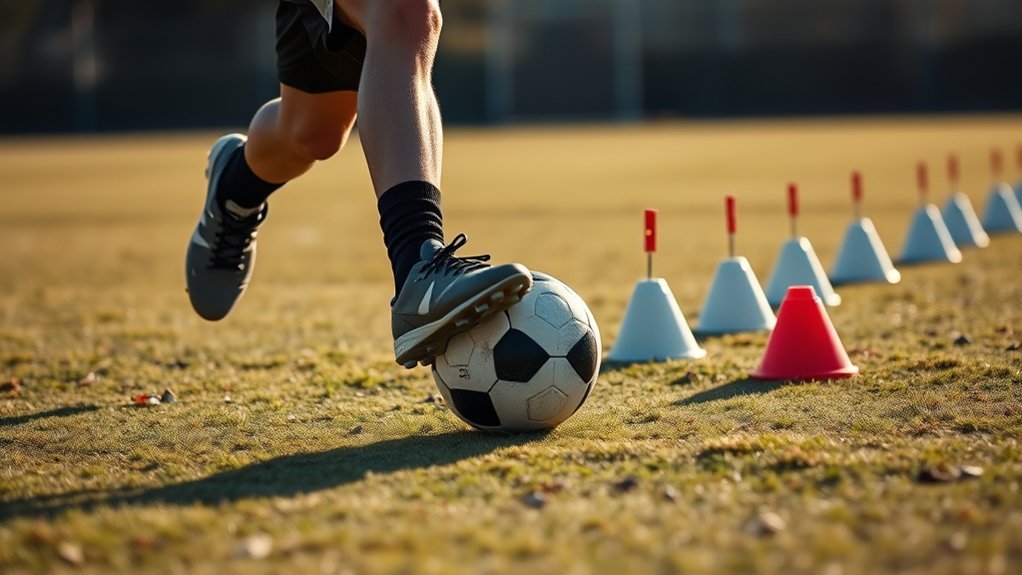
Better soccer dribbling starts with more than quick feet. You need a balanced body shape, a useful first touch, close control in traffic, larger touches in open space, and the awareness to choose whether to dribble, pass, or shoot. The drills below help players and coaches build those skills in a clear progression, from unopposed ball work to realistic pressure.
Quick Answer
To improve soccer dribbling, keep your knees soft, scan before receiving, direct your first touch into useful space, use small touches near defenders, and take longer touches when you can accelerate. Practise both feet, add changes of speed and direction, then test the skill in 1v1 and small-sided games.
Key Takeaways
- Your first touch should prepare the next action, not simply stop the ball.
- Use frequent, light touches in tight areas and longer touches when space lets you run.
- Scan before, during, and after receiving so you can see pressure and open options.
- Practise with both feet and several foot surfaces instead of relying on one favourite move.
- Progress from simple ball work to opposed games where decisions matter.
At a Glance
| Time Required | 30 to 45 minutes for a complete session |
| Difficulty | Beginner to advanced, with progressions |
| Tools Needed | One ball per player, 8 to 12 cones or markers, and small goals or end zones if available |
| Cost | No added cost if you already have a ball and safe training space |
What It Means to Move With the Ball
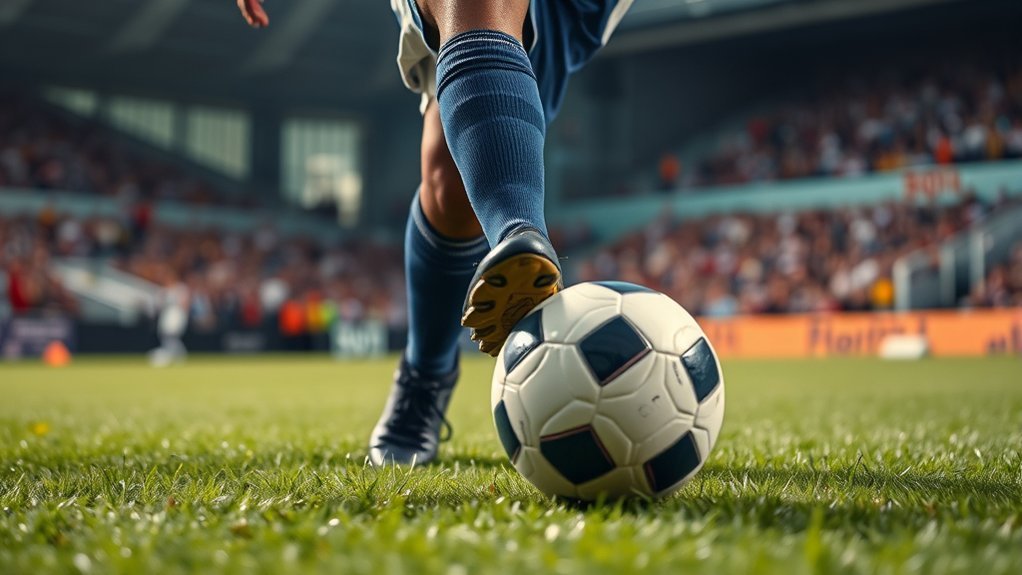
Moving with the ball in soccer means controlling the ball while also controlling your route, speed, and next option. You may dribble with short touches to protect possession, carry the ball into an open lane, or run with it at speed when no defender is close enough to challenge.
The best choice depends on the space around you. In a crowded area, keep the ball within quick playing distance. In open grass, push it farther ahead so you can accelerate. Before each action, scan for defenders, teammates, the touchline, and the goal. FIFA’s grassroots guidance also encourages players to scan before and after controlling the ball so practice reflects real match demands.
A useful way to think about the skill is:
- Close control: small touches that let you turn or protect the ball quickly.
- Running with the ball: longer touches that let you cover open ground at speed.
- Dribbling past an opponent: a change of direction, speed, or body shape that creates a route beyond a defender.
- Possession decisions: knowing when a pass or shot is better than another touch.
Start With Body Position and Balance
You do not need one fixed stance for every moment. Your position should change with the ball, pressure, and intended direction. However, soft knees, an active core, and balanced feet make it easier to stop, turn, shield, and accelerate.
Balanced Stance
Begin in an athletic position with your knees slightly bent and your weight over the middle of your feet. Stay on the balls of your feet rather than settling back on your heels. Keep your chest relaxed and your arms free for balance.
Your feet may be around shoulder width when you are waiting or receiving, but they will naturally narrow and widen as you move. The goal is not to hold a perfect pose. The goal is to stay ready to move in more than one direction.
Body Control
Good body control connects your upper body, hips, and feet. As you turn, shift your weight toward the new route and take the ball with you. When you shield, place your body between the opponent and the ball without pushing, holding, or swinging an arm into the defender.
- Lower your center of gravity as pressure gets closer.
- Use your arms for balance and awareness, not to strike or restrain an opponent.
- Plant outside the ball before a sharp cut so you can leave in the opposite direction.
- Recover your balance after every feint, turn, or acceleration.
Pro Tip: Record a short front and side view of your dribbling. If your upper body stays tall and stiff, bend your knees slightly more and let your arms move naturally for balance.
Master the First Touch in Open Space
Your first touch should prepare what happens next. A good touch may take the ball away from pressure, move it into your running path, open a passing angle, or set up a shot. FIFA’s first-touch training guidance focuses on body orientation, close control, and directing the ball into an advantageous area.
Choose the foot surface that matches your purpose:
- Inside of the foot: cushions or redirects many ground passes with control.
- Outside of the foot: changes the angle quickly and can help you move away from pressure.
- Sole: stops, drags, or protects the ball in tight areas, especially in futsal-style situations.
- Laces or instep: can cushion a dropping ball or move a rolling ball forward into space.
Scan before the pass arrives, open your body when possible, and move toward the path of the ball. The FA’s receiving guidance stresses that successful receiving starts with scanning and planning, not only the contact at your feet.
First-Touch Practice
- Stand 4 to 8 yards from a partner or wall.
- Check over one shoulder before the pass reaches you.
- Receive across your body and direct the ball one or two steps to the side.
- Play the return pass with your second touch.
- Repeat on both feet, then vary the pass speed and angle.
- Add a passive defender, then an active defender when control is consistent.
The best first touch is not always the softest one. It is the touch that gives you the clearest next action.
Use Close Dribbling in Tight Areas
When defenders or boundaries are close, reduce the distance between your foot and the ball. Frequent touches help you change direction, protect possession, and react when a lane closes.
Close Control in Traffic
Stay low, use both feet, and move the ball with the inside, outside, and sole. Keep your head moving between the ball and the field. You still need brief downward looks to judge contact, but avoid staring at the ball for several steps.
- Touch the ball lightly enough that you can reach it again quickly.
- Move across the defender’s line rather than dribbling straight into pressure.
- Use your shoulder and hip position to protect the ball.
- Exit the crowded area as soon as a safe lane opens.
Small Touches Under Pressure
| Focus | What to Do | Why It Helps |
|---|---|---|
| Touch size | Use light, frequent contacts | You can turn or pass sooner |
| Body position | Stay low and side-on when shielding | Your body protects the ball |
| Vision | Take quick looks up between touches | You see pressure and exits earlier |
| Foot use | Alternate feet and surfaces | You can escape in more directions |
Shielding in Tight Spaces
Shield by turning your hip or shoulder toward the defender while keeping the ball on the far side. Bend your knees, widen your base as needed, and keep the ball moving. A stationary ball is easier to poke away.
Use your nearest arm as a feeler and balancing tool, but keep it bent and controlled. Do not extend it into the opponent’s face, neck, or chest. If a safe pass is available, releasing the ball is often better than trying to hold off pressure for too long.
Use Bigger Touches in Open Space
Close control is not the right answer everywhere. When you have open grass and no immediate challenge, a longer touch lets you run naturally and reach higher speed. The ball should travel far enough to free your stride but not so far that a defender or goalkeeper can reach it first.
Practise this with a 15- to 25-yard lane:
- Start with three controlled touches.
- Push the ball ahead with the laces or outside of the foot.
- Sprint after it while checking the space in front of you.
- Shorten your touches as you approach a cone, defender, touchline, or goal.
- Finish with a pass, shot, or change of direction.
Note: Touch size is relative to your speed, age, surface, and nearby pressure. A useful touch for one player may be too long or too short for another.
Change Speed and Direction
Most defenders are harder to beat if you move at one pace in a straight line. A simple pause, cut, or burst can be more useful than a complicated trick because it changes the defender’s timing.
- Inside cut: plant beside the ball and take it across your body with the inside of the other foot.
- Outside cut: use the outside of the same foot to move away from the defender.
- Pullback: place the sole on top of the ball and drag it behind or across your body.
- Stop and go: slow enough to make the defender settle, then accelerate into the open side.
- Body feint: sell one direction with your eyes, shoulders, and hips before taking the ball another way.
Practise each move slowly first. Once the footwork is clean, add speed, a target gate, and then a defender. The move only works in a match when the exit touch takes you into useful space.
Teach Better Decisions While Dribbling
Decision-making begins before the ball reaches your feet. Scan for pressure, support, open space, and the position of the goal. Then decide whether another touch improves the situation.
| Situation | Likely Best Choice | Key Cue |
|---|---|---|
| Open lane ahead | Take a longer touch and accelerate | Attack the space before it closes |
| Defender within tackling distance | Shorten touches, shield, or change direction | Keep the ball on the safe side |
| Teammate free in a better position | Pass early | Do not dribble only because you can |
| Defender moving quickly toward you | Use their momentum with a cut or feint | Change direction after they commit |
| Shooting lane opens | Set the ball and shoot | The next touch should improve the finish |
Coaches can improve decisions by asking short questions after a play: What did you see? Where was the pressure? What other option was open? Avoid stopping every mistake. Players need repeated chances to solve the problem themselves.
Build Dribbling Skills With Small-Sided Games
Small-sided games place players in repeated moments of receiving, protecting, dribbling, passing, and finishing. FIFA’s U-10 core-skills session uses targeted technical work followed by 1v1, 2v1, and larger small-sided games so players can make decisions under realistic pressure.
Small-Sided Game Benefits
- Players face more frequent decisions than they do while waiting in long lines.
- Tight areas encourage close control, scanning, shielding, and quick support.
- 1v1 and 2v2 formats create clear attacking and defending problems.
- Rules and field size can be changed to make the task easier or harder.
- Players learn whether a move works against a real opponent, not only a cone.
Dribbling Drills With Pressure
1v1 gate game: Mark a 12-by-10-yard area with two small gates on each end line. The attacker scores by dribbling through either gate under control. The defender scores by winning the ball and crossing the opposite end. Play for 20 to 30 seconds, then switch roles.
2v2 end-zone game: Use a 20-by-15-yard area with a 3-yard end zone at each end. A team scores when a player dribbles into the end zone under control. This rewards forward movement while keeping passing available.
3v3 four-goal game: Place two small goals on each end line. Teams can attack either goal. The extra targets encourage scanning, changing direction, and switching away from pressure.
Make a game easier by enlarging the area, widening goals, or reducing defensive pressure. Make it harder by reducing space, adding a time limit, requiring a weak-foot action, or awarding a bonus for a successful 1v1 that leads to a shot or pass.
Coach Dribbling With Game-Like Drills
A useful session moves from simple control to realistic decisions. The plan below works for one player with a partner or for a small group. Adjust the area, work time, and pressure to match the players.
Sample 35-Minute Dribbling Session
| Time | Activity | Coaching Focus |
|---|---|---|
| 5 minutes | Dynamic warm-up with a ball | Light movement, both feet, changing directions |
| 5 minutes | Ball-mastery box | Inside, outside, sole, and controlled turns |
| 7 minutes | First touch with a partner or wall | Scan, open body, direct the touch into space |
| 6 minutes | Close-control gate dribble | Small touches, head movement, both feet |
| 8 minutes | 1v1 or 2v2 game | Protect, change pace, choose when to pass |
| 4 minutes | Free play and review | Apply the skill, then name one success and one next goal |
Coaching Cues That Help
- “Scan before it comes.”
- “Can your first touch take you somewhere?”
- “Small touches near pressure, bigger touches in space.”
- “Change speed after the move.”
- “Use the foot farthest from the defender.”
- “What did you see?”
Keep instructions brief so players spend more time moving and solving problems. Demonstrate when a visual example will help, then let the activity run long enough for players to adapt.
Adjust Dribbling Coaching by Age Group
Age bands are guides, not strict ability labels. Match the challenge to the player’s coordination, confidence, experience, and physical development. FIFA’s current grassroots resources promote age-appropriate, player-centred sessions and progressive practice.
| Stage | Main Focus | Good Practice Format |
|---|---|---|
| Ages 4 to 8 | Enjoyment, many touches, basic turns, creativity, confidence | Short games, races, tag activities, and simple 1v1 or 2v2 play |
| Ages 8 to 12 | Both feet, first touch, scanning, changes of pace, 1v1 decisions | Progressive technical work followed by small-sided games |
| Ages 12 to 15 | Faster decisions, position-specific pressure, combination play | Opposed practices with direction, targets, and transitions |
| Older or advanced players | Execution at match speed, disguise, tactical risk, end product | Position-relevant games, video review, and realistic numerical situations |
For younger players, avoid long speeches and elimination games that leave children standing. FIFA’s dribbling guidance for ages 4 to 8 recommends simple, engaging activities, freedom to explore, positive feedback, and game-like scenarios.
Fix Common Dribbling Mistakes
Most dribbling problems come from timing, awareness, or touch distance rather than a lack of fancy moves. Fix one habit at a time and test it again under light pressure.
| Mistake | Why It Hurts | Fix |
|---|---|---|
| Looking down for too long | You miss pressure, support, and space | Take brief looks up between touches and scan before receiving |
| Every touch is the same size | You cannot match changing space | Alternate tight-control zones with open running lanes |
| Using only the dominant foot | Your routes become predictable | Give the weaker foot equal repetitions at low speed first |
| Moving at one pace | Defenders can match your rhythm | Add a pause, then accelerate after the move |
| Dribbling straight into a crowd | The ball becomes easy to trap | Scan sooner and pass, switch direction, or protect the ball |
| Performing a move without an exit | The defender recovers before you escape | Make the next touch sharp and accelerate into space |
Use Feedback and Video to Track Progress
Video can reveal habits that are hard to feel while playing, such as repeated downward staring, an upright stance, or always turning toward the same foot. Record short clips from more than one angle and review one skill at a time.
| Tool | What to Check | How to Use It |
|---|---|---|
| Video | Body height, touch distance, scanning, and exit speed | Choose one correction for the next round |
| Coach or teammate feedback | What pressure or option the player missed | Ask a specific question instead of requesting general criticism |
| Practice log | Weak-foot use, successful exits, first-touch direction, and decisions | Compare the same activity across several sessions |
| Game clips | Whether the training skill appears under real pressure | Track the decision and outcome, not only successful tricks |
Useful goals are specific and observable. For example: scan before most receiving actions, use the weaker foot during both directions of a drill, or complete a first touch into space before the second action. A slalom time can measure speed, but it should not be the only measure because match dribbling also requires awareness and decisions.
Train Safely
Check the playing area before the session. Remove loose objects, mark clear boundaries, leave space between nearby grids, and use footwear suited to the surface. Increase speed and contact gradually, especially after a break from training.
- Warm up with light movement and the ball before full-speed turns or sprints.
- Keep water available and adjust work periods for heat, humidity, and player fitness.
- Stop if a player has sharp pain, dizziness, or cannot move normally.
- Use age-appropriate contact and avoid mismatches that create unnecessary risk.
Warning: If a player may have a concussion after a bump, blow, or jolt, remove the player from participation immediately. The CDC says the athlete should not return the same day and should stay out until cleared by a healthcare provider.
Frequently Asked Questions
How often should you practise soccer dribbling?
Short, regular practice is usually more useful than one long session followed by a long break. Beginners can add 10 to 15 minutes of focused ball work several times per week, while team sessions should also include realistic games. Reduce the volume if technique drops because of fatigue.
What is the most important dribbling skill for beginners?
The best starting point is learning to change touch size while staying balanced. Keep the ball close near pressure, push it farther in open space, and practise with both feet. Scanning should be introduced early so control connects to decisions.
Should you look at the ball while dribbling?
Yes, but only in brief checks. Players need visual information from the ball and the field. Look down when needed to judge contact, then lift your eyes between touches to scan defenders, teammates, space, and the goal.
How can you improve your weaker foot?
Begin slowly with inside, outside, sole, and laces touches. Use the weaker foot for both sides of a cone pattern, then receive and pass against a wall. Add passive pressure before using it in 1v1 play. Quality repetitions matter more than rushing.
What is the best drill for close control?
A small gate-dribbling area works well because it combines frequent touches, scanning, and changes of direction. Place several gates in a tight grid, dribble through as many as possible, then add other players or a defender to create traffic and pressure.
What is the difference between dribbling and running with the ball?
Dribbling usually describes controlling and manipulating the ball around pressure, often with shorter touches and changes of direction. Running with the ball uses longer touches to cover open ground at speed. Good players switch between both based on available space.
Conclusion
Strong soccer dribbling combines technique with awareness. Build a balanced base, direct your first touch, keep the ball close under pressure, lengthen your touch in open space, and change speed after a turn or feint. Practise both feet, then use 1v1 and small-sided games to test whether your decisions work against real opponents. Review one habit at a time and keep the training progressive.
Sources
- FIFA Training Centre: Coaching children to master ball control — scanning, repetition, progression, and game-like practice.
- FIFA Training Centre: Directing the ball with the first touch — body orientation, directional control, and receiving under pressure.
- FIFA Training Centre: Developing core skills with Clearwater Chargers U-10 — progressive technical work, 1v1 situations, and small-sided games.
- The FA Boot Room: Top tips for receiving the ball — scanning, body shape, first touch, and realistic practice.
- CDC HEADS UP: Responding to a sports-related concussion — removal from play and medical clearance guidance.
