
Last Updated on September 10, 2026 by Daniel Globe
Hiking poles, also called trekking poles, can make rough trails feel more controlled by giving you extra points of contact with the ground. They can be especially useful on long descents, loose rocks, muddy paths, stream crossings, and hikes with a loaded backpack. Their benefits are real, but they are not magic: research shows both advantages and tradeoffs depending on the terrain, pace, pack weight, and technique.
Quick Answer
Yes, hiking poles can help by improving stability and reducing some of the forces placed on the legs and knees, particularly during descents. They can also make loaded hiking feel more comfortable. However, poles do not guarantee injury prevention or automatically save energy, and they can increase upper-body and cardiovascular effort.
Key Takeaways
- Trekking poles add contact points with the ground and can improve stability on rough, loose, or slippery terrain.
- A small laboratory study found reductions of about 12% to 25% in several knee-related forces and moments during steep downhill walking with poles.
- Poles shift some work toward the arms and upper body, which can ease lower-body loading but may increase oxygen use and heart rate at the same walking speed.
- For general hiking, a roughly 90-degree elbow bend is a useful starting point for pole height; longer climbs and descents may benefit from small length adjustments.
- Two poles usually provide more support than one when carrying a pack, while a single hiking staff may be enough for easier terrain.
- Good technique and responsible pole placement matter for both comfort and minimizing trail damage.
Disclosure: As an Amazon Associate I earn from qualifying purchases. Some links on this page are affiliate links, at no extra cost to you.
How Hiking Poles Improve Stability and Balance
One of the clearest reasons to use hiking poles is the extra support they provide on uneven ground. Instead of relying only on two feet, you can use the poles as additional contact points while stepping over rocks, roots, mud, or loose gravel.
There is some research behind this benefit. In a small laboratory study involving 15 young adults, participants maintained static balance better when using two hiking sticks than when using none. The advantage was particularly useful when they were also wearing a loaded backpack. The study did not prove that trekking poles prevent falls on real trails, but it supports the idea that poles can improve stability under controlled conditions. The study is available through PubMed.
Poles can also help when you need to test uncertain footing. During a stream crossing, for example, a secure pole plant can give you another point of support before you move your foot. On a side slope, the uphill and downhill poles can help you stay more centered.
Warning: Trekking poles improve support but do not make unsafe terrain safe. Deep or fast-moving water, exposed scrambling, ice, and unstable rock can require different equipment, route choices, or a decision to turn around.
Hiking Poles and Joint Support
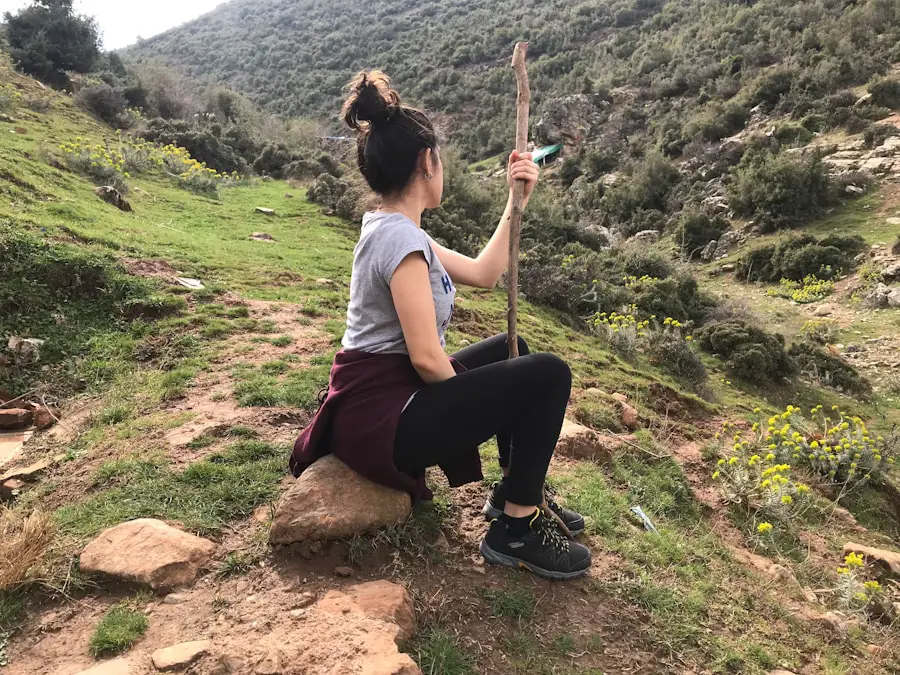
Descending is often where hikers notice the greatest benefit from poles. Your legs must repeatedly control your body as you step down, and carrying a backpack adds to that demand. Properly planted poles let your arms take part in supporting and controlling each movement.
A frequently cited 1999 biomechanics study measured eight men walking down a 25-degree ramp. With hiking poles, several measured values—including ground-reaction force, knee-joint moment, and tibiofemoral compressive and shear forces—were reduced by roughly 12% to 25%.
In one small downhill laboratory study, hiking poles reduced several measured knee-related forces and moments by approximately 12% to 25%—a useful finding, but not a universal 25% reduction for every hiker or every trail.
Other research has found benefits during loaded hiking. A study of experienced hikers walking downhill with no pack, a day pack, and a heavier expedition-style load found that pole use reduced several lower-extremity joint moments and forces across pack conditions.
There is also evidence that poles can reduce some of the after-effects of a demanding hike. In a study of 37 active adults ascending and descending Mount Snowdon, the trekking-pole group reported lower perceived exertion during the ascent and showed lower muscle soreness and some lower markers of muscle damage afterward. See the randomized mountain-walking study on PubMed.
These findings support using poles to manage load, especially on descents, but they do not prove that poles prevent arthritis, cure knee pain, or eliminate hiking injuries.
Note: If you have persistent knee, hip, ankle, shoulder, or back pain, a recent injury, or a condition that affects walking, ask a qualified healthcare professional or physical therapist what support is appropriate. Trekking poles are recreational equipment and are not a substitute for a medically prescribed cane, crutch, or walker.
Do Hiking Poles Increase Endurance?
The relationship between trekking poles and endurance is more complicated than simply saying that poles save energy. They shift some of the workload from the legs to the arms, shoulders, and upper body. For some hikers, this makes a climb or loaded hike feel more manageable even when the body’s total energy demand stays the same or increases.
| Study | Participants | Protocol | Key Finding |
|---|---|---|---|
| Schwameder et al. (1999) | 8 men | Controlled downhill walking on a 25° ramp | Several ground-reaction and knee-related forces and moments were reduced by about 12% to 25% with poles. |
| Howatson et al. (2011) | 37 active adults | Ascent and descent of Mount Snowdon | Pole users had lower perceived exertion on the ascent and less post-hike muscle soreness and muscle-damage response. |
| Saunders et al. (2008) | 14 recreational hikers | Matched hiking trials over flat, uphill, and downhill terrain | Oxygen consumption, ventilation, and heart rate were higher with poles, while perceived exertion was not significantly higher. |
The 2008 field study is particularly useful because it shows why hikers can feel as though poles are helping even when they are not necessarily conserving energy. At the same matched pace, oxygen consumption and heart rate increased with pole use, yet ratings of perceived exertion remained similar. Read the study on PubMed.
A later review of trekking-pole research reached a similar conclusion: poles can decrease some lower-extremity loading while increasing cardiovascular demand. In other words, they redistribute work rather than simply making every hike physiologically easier.
For a long climb, that redistribution can still be valuable. Pushing through the poles gives the upper body a role in forward movement and may make heavily loaded legs feel less overworked. Some experienced hikers also find that a steady pole rhythm helps them hold a consistent pace.
Hiking Poles and Weight Distribution
Trekking poles are particularly useful when you are carrying a backpack because they allow your arms to share some of the work involved in supporting and moving the body.
On an uphill section, a well-timed pole plant lets you push backward against the ground as you step forward. On a descent, planting the poles ahead of you can provide an additional point of support before your next foot lands.
Research involving downhill hiking with different backpack loads found reductions in several lower-extremity joint forces and moments when participants used poles. This does not mean that a heavy pack becomes harmless; rather, poles can change how some of that mechanical demand is distributed.
The effect depends strongly on technique. Poles that are too long, too short, planted too far away, or gripped with excessive tension may create unnecessary stress in the shoulders and arms instead of helping.
When Hiking Poles Can Be Less Helpful
Hiking poles have disadvantages, and not every trail requires them.
- Your hands are occupied. Using a phone, camera, map, snack, or water bottle can become less convenient.
- They add gear and weight. Ultralight hikers sometimes prefer to leave them behind on easy terrain.
- They can snag. Tips and baskets may catch between rocks, roots, or dense vegetation.
- Your upper body works more. Studies have measured higher oxygen use and heart rate during some pole-assisted walking conditions.
- Poor sizing can cause discomfort. Excessively long or short poles can make the shoulders, wrists, back, or neck feel strained.
- They can be awkward during hands-on scrambling. On terrain where you need your hands on rock, stowing the poles securely may be safer and more practical.
For a short, flat walk on a smooth trail, poles may provide little practical benefit. On a steep descent, loose trail, snowfield, muddy section, stream crossing, or backpacking trip, their value can be much greater.
The Environmental Impact of Hiking Poles
Trekking poles can affect the trail as well as the hiker. Their small metal tips concentrate force into a narrow area, so repeated planting can disturb soft soil and damage vegetation beside the established tread.
This issue now has more research behind it than it did when trekking poles first became common. A 2025 study in Sagarmatha National Park documented numerous small holes associated with uncapped trekking-pole tips, particularly where trail surfaces were loose after the monsoon. The researchers warned that disturbed soil could contribute to erosion and trail widening.
Another 2025 experimental study found that adding trekking poles increased the lateral spread of disturbed soil compared with walking without them.
The practical answer is not necessarily to stop using poles. It is to place them carefully. Leave No Trace guidance emphasizes concentrating travel on established trails and durable surfaces rather than trampling fragile vegetation.
Pro Tip: Keep pole plants within the established trail tread whenever possible. Rubber tip protectors can also reduce rock scarring and noise on appropriate hard surfaces, but always use the tip or basket type recommended for the terrain and your pole model.
Choosing the Right Hiking Poles for You
The best trekking poles are the ones that fit your body, intended terrain, and hiking style. Weight matters, but comfort and reliable adjustment are usually more important than saving a few ounces.
Get the Pole Length Right
For general hiking on level ground, a good starting position is a roughly 90-degree bend at the elbow when the grip is in your hand and the pole tip rests near your foot. This is also the basic fitting method recommended in REI’s current trekking-pole fitting guide.
For long climbs, adjustable poles can usually be shortened by roughly 5 to 10 cm (2 to 4 inches). For prolonged descents, lengthening them by approximately 5 to 10 cm can make it easier to reach the trail without hunching forward. On a long traverse across a slope, some hikers shorten the uphill pole and lengthen the downhill pole.
Aluminum vs. Carbon Fiber
Aluminum poles are generally durable and less expensive. They are somewhat heavier and can bend under severe loads.
Carbon-fiber or composite poles can be lighter and transmit less vibration, but they generally cost more and may be more vulnerable to cracking or breaking when loaded sharply from the side.
Choose Comfortable Grips
Cork grips are popular because they feel comfortable in warm conditions and can gradually conform to the hand. Foam is soft and can absorb moisture, while rubber can work well in cool conditions but may feel less comfortable to some hikers during hot, sweaty trips.
Check the Locking System
Adjustable poles depend on their locks. Before a hike, extend each pole and press down firmly enough to make sure the sections do not slip. Look for cracks, bent shafts, damaged locking hardware, and badly worn tips.
Match Tips and Baskets to the Terrain
Carbide or metal tips provide bite on many natural surfaces. Rubber protectors can be useful on pavement, rock, or other hard surfaces where you want less noise and scarring. Wider baskets help keep poles from sinking deeply into snow or very soft ground.
One Hiking Pole or Two?
A pair of trekking poles provides the greatest ability to share work between both sides of the body and gives you two extra contact points. A laboratory balance study found two sticks more effective than one when participants were carrying a load.
A single hiking staff can still be useful for casual walking, testing footing, or crossing easier terrain. It also leaves one hand free. For backpacking, sustained descents, or rough terrain, a pair is usually the more versatile choice.
Tips for Using Hiking Poles Effectively
Good technique helps the poles feel like part of your stride rather than two objects you have to manage.
Use a Relaxed Grip
Do not squeeze the grips continuously. Keep your hands relaxed and use the straps as intended by the pole manufacturer. A death grip wastes energy and can make the hands and forearms sore.
Develop an Alternating Rhythm
For normal walking, the easiest pattern is usually opposite arm and leg: right pole with left foot, then left pole with right foot. After a few minutes, the movement should become automatic.
Use Double Plants When You Need More Support
On a steep step, awkward obstacle, or difficult descent, you do not have to maintain a perfect alternating rhythm. Planting both poles securely before making the next move can give you a more stable base.
Adjust for Long Climbs and Descents
Shorten adjustable poles slightly on sustained climbs so you are not lifting your shoulders with each plant. Lengthen them slightly for long descents so you can reach downhill without bending excessively at the waist.
Be Careful at Stream Crossings
Plant each pole securely before transferring weight. Do not assume a submerged rock is stable simply because the pole touches it. If the current, depth, or footing makes a crossing unsafe, trekking poles are not enough to make it safe.
Stow Poles When Your Hands Are More Important
If a route turns into hands-on scrambling, secure your poles to your pack rather than trying to climb while holding them. Make sure the tips cannot strike you or another hiker.
Used well, hiking poles can improve stability, reduce certain lower-body loads, and help distribute work during difficult hiking. Their biggest advantage is not that they magically eliminate fatigue; it is that they give you another way to manage balance and force on terrain where your legs would otherwise do nearly all the work.
If you’re planning a hiking trip and considering using hiking poles, you may also want to read our guide to compact binoculars for hiking. A lightweight pair can make it easier to observe wildlife and distant scenery without leaving the trail.
Love travel? Join Our Facebook Community For More Tips.
Frequently Asked Questions
What are hiking poles?
Hiking poles, also called trekking poles, are lightweight poles designed to provide extra stability and support while walking on trails. Most trekking poles are used as a pair and are adjustable or sold in several fixed lengths.
Do hiking poles really help with hiking?
Yes. Research shows that trekking poles can improve stability in some conditions and reduce certain lower-extremity forces, particularly during downhill or loaded walking. The size of the benefit varies with the hiker, terrain, pack weight, and technique.
Do trekking poles reduce stress on your knees?
They can reduce some knee-related forces during downhill walking. One small laboratory study found reductions of roughly 12% to 25% in several measured ground-reaction forces, knee moments, and tibiofemoral forces when participants used hiking poles on a steep downhill ramp. That percentage should not be treated as a guaranteed reduction for every hiker.
Do hiking poles save energy?
Not necessarily. Poles transfer some work from the legs to the upper body. In one field study, hikers using poles had higher oxygen consumption and heart rate at the same walking speed without reporting significantly greater perceived exertion. Poles may therefore make the workload feel better distributed without reducing total energy use.
Are one or two hiking poles better?
Two trekking poles usually provide more balanced support and are particularly useful when carrying a backpack. A single hiking staff may be enough for easier terrain and leaves one hand free.
Who can benefit from using hiking poles?
Beginners, backpackers, experienced hikers, and people tackling steep or uneven terrain can all benefit. Hikers with existing joint problems should treat poles as recreational support rather than medical treatment and discuss persistent pain or mobility problems with a qualified healthcare professional.
How high should trekking poles be?
For general hiking, start with the pole adjusted so your elbow forms roughly a 90-degree angle while the tip rests near your foot. For prolonged climbs, shortening the pole by about 5 to 10 cm can help. For long descents, lengthening it by roughly the same amount may improve reach and posture.
How do I choose the right hiking poles?
Consider pole length, shaft material, weight, grip comfort, locking mechanism, packed size, tips, and baskets. Aluminum is generally durable and economical, while carbon-composite poles can be lighter but usually cost more and may be less tolerant of sharp side impacts.
Can trekking poles damage hiking trails?
They can contribute to trail disturbance, especially when narrow metal tips are repeatedly planted in soft soil or beside the established trail. Keep pole plants on durable surfaces and within the existing trail tread whenever practical, and follow local trail rules.
Sources
- Schwameder et al., Journal of Sports Sciences — biomechanical measurements of knee forces during downhill walking with hiking poles.
- Howatson et al., Medicine & Science in Sports & Exercise — trekking poles, perceived exertion, muscle soreness, and muscle-damage markers during mountain walking.
- Saunders et al., Journal of Strength and Conditioning Research — oxygen consumption, heart rate, and perceived exertion while hiking with poles.
- Are Trekking Poles Helping or Hindering Your Hiking Experience? A Review — overview of biomechanical and physiological research on trekking poles.
- Environmental Challenges, 2025 — field research on trekking-pole use and trail degradation in Sagarmatha National Park.
- Leave No Trace: Travel & Camp on Durable Surfaces — guidance for reducing impacts to trails, soils, and vegetation.
